Vancomycin
JFDA label: VANCOCIN CP Vial
Mechanism of Action
Inhibitor of Peptidoglycan — Peptidoglycan inhibitor
| Target | Action | Gene / class |
|---|---|---|
| Peptidoglycan efficacy | INHIBITOR |
Indications
Approved
- Clostridium difficile infection (oral)
- Corynebacteria (diphtheroids)
- Endocarditis (injection)
- Enterococcal
- Enterocolitis (oral)
- Staphylococcal
- Staphylococcal infections (injection)
- Streptococcal
Off-label
- Catheter-related infections
- Cerebrospinal fluid (CSF) shunt infection
- Clostridium difficile infection (adults
- Community-acquired pneumonia (children)
- Endophthalmitis, treatment
- Group B Streptococcus, maternal use (neonatal prophylaxis)
- Intra-abdominal infections
- Meningitis, bacterial
- Perioperative prophylaxis
- Peritonitis, treatment (continuous ambulatory peritoneal dialysis [CAPD] patients)
- Prosthetic joint infection
- Surgical-site infections
- rectal administration)
Antimicrobial Spectrum
Expected / intrinsic spectrum (EUCAST breakpoints & labels) — not local resistance. Source: EUCAST v16 · curated · openfda-label.
Bacteria
| Organism | Activity | MIC |
|---|---|---|
| Anaerobes | Susceptible | 2.0 mg/L |
| Bacillus spp. | Susceptible | 2.0 mg/L |
| Clostridium difficile | Susceptible | 2.0 mg/L |
| Coagulase-negative staphylococci | Susceptible | 4.0 mg/L |
| Corynebacterium spp. | Susceptible | 2.0 mg/L |
| Enterococcus faecalis | Susceptible | 4.0 mg/L |
| Enterococcus faecium | Susceptible | 4.0 mg/L |
| Enterococcus spp. | Susceptible | 4.0 mg/L |
| Listeria monocytogenes | Active | — |
| Staphylococcus aureus | Susceptible | 2.0 mg/L |
| Staphylococcus epidermidis | Active | — |
| Streptococcus A/B/C/G | Susceptible | 2.0 mg/L |
| Streptococcus agalactiae | Active | — |
| Streptococcus bovis | Active | — |
| Streptococcus gallolyticus | Active | — |
| Streptococcus pneumoniae | Susceptible | 2.0 mg/L |
| Streptococcus pneumoniae | Susceptible | 2.0 mg/L |
| Streptococcus pyogenes | Active | — |
| Viridans group streptococci | Susceptible | 2.0 mg/L |
| Enterococcus faecalis | Resistant | 4.0 mg/L |
| Enterococcus faecium | Resistant | 4.0 mg/L |
| Staphylococcus aureus | Resistant | 2.0 mg/L |
Class profile
| gramStatus | Gram+ |
|---|---|
| spectrumBreadth | Narrow |
| atypicalCoverage | No |
| isBactericidal | 1 |
| moaCategory | Cell wall synthesis inhibitor (glycopeptide, D-Ala-D-Ala binding) |
| pdIndex | Time-dependent |
| postAntibioticEffect | Short |
| mrsaCoverage | 1 |
| resistanceMechanisms | VanA/VanB gene clusters (D-Ala-D-Lac substitution),Cell wall thickening (VISA/hVISA),Biofilm formation |
Contraindications
Source: Lexicomp
- Hypersensitivity to vancomycin or any component of the formulation Absolute
Adverse Reactions
Cardiac disorders (2)
Common Local phlebitis · Peripheral edema
Vascular disorders (1)
Common Thrombophlebitis
Nervous system disorders (4)
Common Chills · drug fever · Fatigue · headache
Renal and urinary disorders (2)
Common Nephrotoxicity (elevated serum creatinine) · Urinary tract infection
Blood and lymphatic system disorders (2)
Common Eosinophilia · neutropenia (reversible)
Immune system disorders (1)
Uncommon Hypersensitivity / rash
Gastrointestinal disorders (3)
Common Diarrhea · flatulence · vomiting
Skin and subcutaneous tissue disorders (2)
Very Common Red Man Syndrome (infusion-related flushing)
Common Skin rash
Musculoskeletal and connective tissue disorders (1)
Common Back pain
Ear and labyrinth disorders (1)
Uncommon Ototoxicity (high-level or prolonged therapy)
General disorders and administration site conditions (1)
Common Fever
Other (5)
Very Common Cardiovascular: Hypotension (accompanied by flushing) · dysgeusia (with oral solution) · Gastrointestinal: Abdominal pain · nausea
Not Known Hypersensitivity: Flushing of face and neck (Red man syndrome; may be infusion related)
Dosing
Source: Lexicomp
Warnings & Precautions
Source: Lexicomp
Extravasation and thrombophlebitis
IV vancomycin is an irritant; ensure proper needle or catheter placement prior to and during infusion; avoid extravasation. Pain, tenderness, and necrosis may occur with extravasation. If thrombophlebitis occurs, slow infusion rates, dilute solution (eg, 2.5 to 5 g/L) and rotate infusion sites.
Nephrotoxicity
May cause nephrotoxicity although limited data suggest direct causal relationship; usual risk factors include preexisting renal impairment, concomitant nephrotoxic medications, advanced age, and dehydration. If multiple sequential (≥2) serum creatinine concentrations demonstrate an increase of 0.5 mg/dL or ≥50% increase from baseline (whichever is greater) in the absence of an alternative explanation, the patient should be identified as having vancomycin-induced nephrotoxicity (ASHP/IDSA/SIDP [Rybak 2009]). Discontinue treatment if signs of nephrotoxicity occur; renal damage is usually reversible. Nephrotoxicity has been reported following treatment with oral vancomycin (typically in patients >65 years of age).
Neutropenia
Prolonged therapy and use of concomitant drugs that cause neutropenia may increase the risk; monitor leukocyte counts periodically in these patients. Prompt reversal of neutropenia is expected after discontinuation of therapy.
Ototoxicity
Ototoxicity is rarely associated with monotherapy. It has been most frequently reported in patients receiving excessive doses, those who have underlying hearing loss, or those receiving concomitant ototoxic drugs (eg, aminoglycosides). Serial auditory function testing may be helpful to minimize risk. Ototoxicity may be transient or permanent; discontinue treatment if signs of ototoxicity occur.
Superinfection
Prolonged use may result in fungal or bacterial superinfection, including C. difficile infection (CDI); CDI has been observed >2 months postantibiotic treatment. Disease-related concerns:
Inflammatory bowel disease
Clinically significant serum concentrations have been reported in patients with inflammatory disorders of the intestinal mucosa who have taken oral vancomycin (multiple doses) for the treatment of C. difficile-associated diarrhea. Although use may be warranted, the risk for adverse reactions may be higher in this situation; consider monitoring serum trough concentrations, especially with renal insufficiency, severe colitis, concurrent rectal vancomycin administration, and/or concomitant IV aminoglycosides. The Society for Healthcare Epidemiology of America (SHEA) and the Infectious Diseases Society of America (IDSA) suggest that it is appropriate to obtain trough concentrations when a patient is receiving long courses of ≥2 g/day in adults (SHEA/IDSA [Cohen 2010]).
Renal impairment
Use with caution in patients with renal impairment or those receiving other nephrotoxic or ototoxic drugs; dosage modification required (especially in elderly patients). Accumulation may occur after multiple oral doses of vancomycin in patients with renal impairment; consider monitoring trough concentrations in this circumstance. Concurrent drug therapy issues:
Drug-drug interactions
Potentially significant interactions may exist, requiring dose or frequency adjustment, additional monitoring, and/or selection of alternative therapy. Consult drug interactions database for more detailed information. Other warnings/precautions:
Appropriate use
Oral vancomycin is only indicated for the treatment of CDI or enterocolitis due to S. aureus and is not effective for systemic infections; parenteral vancomycin is not effective for the treatment of enterocolitis.
Infusion reactions
Rapid IV administration (eg, over • Intraocular administration (off-label route): Hemorrhagic occlusive retinal vasculitis (HORV), including permanent visual loss, has been reported in patients receiving intracameral or intravitreal administration of vancomycin during or after cataract surgery. Safety and efficacy of intraocularly administered vancomycin has not been established; vancomycin is not indicated for prophylaxis of endophthalmitis.
Intraperitoneal administration (off-label route)
Use caution when administering intraperitoneally (IP); in some continuous ambulatory peritoneal dialysis (CAPD) patients, chemical peritonitis (cloudy dialysate, fever, severe abdominal pain) has occurred. Symptoms are self-limited and usually clear after vancomycin discontinuation.
Pregnancy & Lactation
Pregnancy
Caution
Use only for documented/suspected MRSA. AUC-guided dosing with careful renal monitoring
Lactation
Vancomycin is present in breast milk following IV administration. Vancomycin exhibits minimal oral absorption; therefore, the amount available to pass into the milk would be limited following oral administration and any amount present in breast milk is unlikely to reach the bloodstream of a breastfed infant. The relative infant dose (RID) of vancomycin is 4.8% when calculated using the highest breast milk concentration located and compared to an infant therapeutic oral dose of 40 mg/kg/day.
Monitoring
| Efficacy | AUC₀₋₂₄/MIC-guided dosing (target AUC 400–600 mg·h/L for MRSA); or trough-guided (15–20 mg/L for serious infections); renal function |
|---|---|
| Toxicity | Nephrotoxicity (rising SCr — particularly with concomitant aminoglycosides, NSAIDs, or amphotericin); ototoxicity (audiogram if prolonged or high-level therapy); Red Man Syndrome (infusion-rate related) |
| Clinical pearl | AUC-guided monitoring is now preferred over trough-only as it achieves pharmacodynamic targets while minimising nephrotoxicity. Infuse over at least 60 min (120 min for > 2 g doses). |
| Counseling | Report ringing in the ears, hearing changes, decreased urination, or flushing/rash during infusion. Stay well hydrated. |
Chemistry & Properties
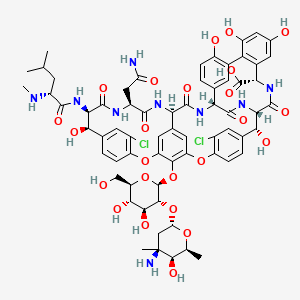
| Formula | C66H75Cl2N9O24 |
|---|---|
| Molecular weight | 1449.27 g/mol |
| IUPAC name | (1S,2R,18R,19R,22S,25R,28R,40S)-48-[(2S,3R,4S,5S,6R)-3-[(2S,4S,5S,6S)-4-amino-5-hydroxy-4,6-dimethyloxan-2-yl]oxy-4,5-dihydroxy-6-(hydroxymethyl)oxan-2-yl]oxy-22-(2-amino-2-oxoethyl)-5,15-dichloro-2,18,32,35,37-pentahydroxy-19-[[(2R)-4-methyl-2-(methylamino)pentanoyl]amino]-20,23,26,42,44-pentaoxo-7,13-dioxa-21,24,27,41,43-pentazaoctacyclo[26.14.2.23,6.214,17.18,12.129,33.010,25.034,39]pentaconta-3,5,8(48),9,11,14,16,29(45),30,32,34(39),35,37,46,49-pentadecaene-40-carboxylic acid |
| CAS | 1404-90-6 |
| PubChem CID | 14969 |
| InChIKey | MYPYJXKWCTUITO-LYRMYLQWSA-N |
SMILES
CN[C@H](CC(C)C)C(=O)N[C@H]1C(=O)N[C@@H](CC(N)=O)C(=O)N[C@H]2C(=O)N[C@H]3C(=O)N[C@H](C(=O)N[C@H](C(=O)O)c4cc(O)cc(O)c4-c4cc3ccc4O)[C@H](O)c3ccc(c(Cl)c3)Oc3cc2cc(c3O[C@@H]2O[C@H](CO)[C@@H](O)[C@H](O)[C@H]2O[C@H]2C[C@](C)(N)[C@H](O)[C@H](C)O2)Oc2ccc(cc2Cl)[C@H]1OBiology & Pharmacokinetics
Pharmacokinetics
| BBB penetrant | No |
|---|
Enzyme interactions
| Enzyme | Role | Detail |
|---|---|---|
| CYP2C19 | Substrate | — |
Transporters
BCRP (Inhibitor)BSEP (Inhibitor)MRP1 (Inhibitor)OATP1B1 (Inhibitor)OATP1B1 (Inhibitor)OATP1B3 (Inhibitor)OATP1B3 (Inhibitor)OCT1 (Inhibitor)OCTN2 (Inhibitor)P-gp (Inhibitor)P-gp (Substrate)
Drug–drug interactions (100+, DDInter)
| Interacting drug | Severity | Management |
|---|---|---|
| Cidofovir | major | |
| Deferasirox | major | |
| Diatrizoate | major | |
| Everolimus | major | |
| Human Rho(D) immune globulin | major | |
| Human botulinum neurotoxin A/B immune globulin | major | |
| Human cytomegalovirus immune globulin | major | |
| Human immunoglobulin G (intravenous and subcutaneous) | major | |
| Human immunoglobulin G (intravenous) | major | |
| Inotersen | major | |
| Iodipamide | major | |
| Iodixanol | major | |
| Iohexol | major | |
| Iopamidol | major | |
| Iopromide | major | |
| Iothalamic acid | major | |
| Ioversol | major | |
| Ioxilan | major | |
| Piperacillin | major | |
| Sirolimus | major | |
| Tacrolimus | major | |
| Temsirolimus | major | |
| Typhoid vaccine (live) | major | |
| Vibrio cholerae CVD 103-HgR strain live antigen (live) | major | |
| Amikacin | moderate | |
| Amikacin (liposome) | moderate | |
| Amphotericin B | moderate | |
| Amphotericin B (cholesteryl sulfate) | moderate | |
| Amphotericin B (lipid complex) | moderate | |
| Amphotericin B (liposomal) | moderate | |
| Atracurium | moderate | |
| Bacitracin | moderate | |
| Balsalazide | moderate | |
| Bifidobacterium longum infantis | moderate | |
| Bromfenac | moderate | |
| Capreomycin | moderate | |
| Carboplatin | moderate | |
| Celecoxib | moderate | |
| Cholestyramine | moderate | |
| Cisatracurium | moderate |
Showing 40 of 100+.
Registered Products (23)
| Brand | Form / strength | Pack | Agent | Citizen (JOD) |
|---|---|---|---|---|
| Colat 500mg Powder for solution for IV Infusion | Infusion Vancomycin Hcl 512.56 mg | 500 mg | Sukhtian Group | — |
| Polivan 500mg Lyophilised Powder for Solution for I.V Infusion and Oral use | Infusion Vancomycin Hcl 525 mg | (one VIL) | JAWEDA INT. DRUD STORE | — |
| VANCOCIN CP Vial | Vial 500 mg | 10 ml | THE ARAB DRUG STORE P.S.C | — |
| VANCOSALA 1000 mg, powder for solution for injection. | Powder for Injection 1000 mg | 10 vial | Reda Jardaneh Drug Store | — |
| VANCOSALA 500 mg, powder for solution for injection. | Powder for Injection 500 mg | 10 vial | Reda Jardaneh Drug Store | — |
| VOXIN, Powder for Solution for Infusion 1g/vial | Infusion 1 g | 1 vial | Manar Drug Store | — |
| Vanco | Vial (equivalent to vancomycin 500) mg | 1 vial | Hikma Pharmaceuticals Co.Ltd/Jordan | — |
| Vanco | Vial (equivalant to vancomycin1000) mg | 1 vial | Hikma Pharmaceuticals Co.Ltd/Jordan | — |
| Vancolab | Vial 500 mg | 10 vial | ORIENT DRUG STORE CO | — |
| Vancolab 1 gm | Vial 1000 mg | 10 vial | ORIENT DRUG STORE CO | — |
| Vancolon | Vial 1 g | 1 vial | Professional Drug Store | — |
| Vancolon | Vial 0.5 g | 1 vial pack varies | Professional Drug Store | — |
| Vancolon | Vial 0.5 g | 10 vial pack varies | Professional Drug Store | — |
| Vancomicina Azevedos | Vial 500 mg | 10 vial | Alshefra Dru Store company | — |
| Vancomicina Azevedos | Vial 1000 mg | 10 vial | Alshefra Dru Store company | — |
| Vinkamine 1g/vial powder for solution for injection | Powder for Injection Vancomycin Hcl 1025.1 mg | 1 vial | MS Pharma Jordan | — |
| Voxin | Vial 500 mg | one vial | Manar Drug Store | — |
| Zermacin | Vial equivalent to 0.5 g Vancomycin | 1 vial pack varies | Adonis Drug Store | — |
| Zermacin | Vial 1 g | 1 vial pack varies | Adonis Drug Store | — |
| Zermacin | Vial 1 g | 10 vial pack varies | Adonis Drug Store | — |
| Zermacin | Vial equivalent to 0.5 g Vancomycin | 10 vial pack varies | Adonis Drug Store | — |
| vinkamine | Vial 500 mg | 1 vial pack varies | MS PHARMA/JORDAN | — |
| vinkamine | Vial 500 mg | 10 vial pack varies | MS PHARMA/JORDAN | — |