Trabectedin
JFDA label: Yondelis
Mechanism of Action
Inhibitor of DNA — DNA inhibitor
| Target | Action | Gene / class |
|---|---|---|
| DNA efficacy | INHIBITOR |
Indications
Approved
- Soft tissue sarcoma
Off-label
- Ovarian cancer, relapsed (platinum sensitive)
Contraindications
Source: Lexicomp
- Additional contraindications (not in the US labeling): Active serious or uncontrolled infection Absolute
- Known, severe hypersensitivity (including anaphylaxis) to trabectedin or any component of the formulation Absolute
- breastfeeding Absolute
Adverse Reactions
Cardiac disorders (2)
Very Common Peripheral edema
Common Pulmonary embolism (Central nervous system: Hypoesthesia (Frequency not defined:
Nervous system disorders (3)
Very Common Fatigue · headache · insomnia
Hepatobiliary disorders (5)
Very Common hyperbilirubinemia · increased serum alkaline phosphokinase · Increased serum ALT · increased serum AST
Common Hepatic failure
Renal and urinary disorders (1)
Very Common Increased serum creatinine
Blood and lymphatic system disorders (3)
Very Common Anemia · neutropenia · thrombocytopenia
Immune system disorders (1)
Common Anaphylaxis
Metabolism and nutrition disorders (1)
Very Common Hypoalbuminemia
Gastrointestinal disorders (5)
Very Common constipation · decreased appetite · diarrhea · Nausea · vomiting
Musculoskeletal and connective tissue disorders (3)
Very Common arthralgia · Increased creatine phosphokinase · myalgia
Respiratory, thoracic and mediastinal disorders (1)
Very Common Dyspnea
Dosing
Source: Lexicomp
Warnings & Precautions
Source: Lexicomp
Bone marrow suppression
Anemia, neutropenia, and thrombocytopenia commonly occur; neutropenic fever and neutropenic sepsis (with fatalities) have been reported. The median onset for first occurrence of grade 3/4 neutropenia was 16 days (range: 8 days to ~10 months) and median time to recovery was 13 days (range: 3 days to ~2 months). Monitor blood counts prior to each dose and periodically throughout treatment cycle. Withhold treatment for neutrophil count 3. Reduce dose (permanently) for life-threatening or prolonged severe neutropenia in the preceding cycle.
Capillary leak syndrome
Capillary leak syndrome (CLS) has been reported, including serious cases resulting in death. Symptoms include hypotension, edema, and hypoalbuminemia; monitor for signs/symptoms of CLS. Discontinue if CLS develops and manage as appropriate.
Cardiovascular events
Cardiomyopathy, including HF, decreased ejection fraction, diastolic dysfunction, or right ventricular dysfunction, has been observed; some events were grades 3 and 4. The median time to development of grades 3 and 4 cardiomyopathy was ~5 months (range: 1 to 15 months). Monitor left ventricular ejection fraction (LVEF) by echocardiogram or MUGA scan prior to treatment initiation and every 2 to 3 months until trabectedin is discontinued. Withhold treatment if LVEF is below the lower limit of normal (LLN); permanently discontinue for symptomatic cardiomyopathy or persistent ventricular dysfunction that does not recover to LLN within 3 weeks. Patients with a history of New York Heart Association class II, III, or IV heart failure or abnormal LVEF were excluded from the sarcoma study.
Extravasation
Vesicant; ensure proper needle or catheter placement prior to and during infusion. Infuse through a central line. Avoid extravasation. Extravasation of trabectedin with subsequent tissue necrosis requiring debridement has been reported; evidence of necrosis may be delayed up to 1 week after extravasation. There are no specific antidotes for trabectedin extravasation.
GI events
Trabectedin is associated with a moderate emetic potential; antiemetics are recommended to prevent nausea and vomiting (Hesketh 2017; Roila 2016). Nausea and vomiting are common; corticosteroid premedication (eg, dexamethasone) is recommended; other antiemetics may also be needed. Constipation and diarrhea (generally mild) also commonly occur.
Hepatotoxicity
Hepatotoxicity (including hepatic failure) may occur with trabectedin. Grade 3 and 4 LFT elevations (AST, ALT, total bilirubin, or alkaline phosphatase) occurred in over one-third of patients. The median onset for grade 3/4 ALT or AST elevations was 29 days (range: 3 days to 11.5 months) and the median time to resolution was 13 days (range: 4 days to ~4 months); some patients experienced complete resolution. Drug-induced liver injury (ALT or AST elevation >3 times ULN, alkaline phosphatase 8 times ULN have been reported. Monitor LFTs prior to each dose (more frequently if clinically indicated); elevated LFTs may require treatment interruption, dose reduction, and/or discontinuation (based on severity and duration). Premedication with dexamethasone (4 mg twice daily the day prior to administration) has been reported to reduce the incidence of hepatotoxicity (Grosso 2006). Patients with bilirubin above the ULN or AST or ALT >2.5 times the ULN were excluded from the sarcoma clinical trial.
Hypersensitivity
Symptoms of hypersensitivity reactions have been reported.
Rhabdomyolysis
Trabectedin may cause rhabdomyolysis and musculoskeletal toxicity (some fatal). Creatine phosphokinase (CPK) elevations occurred in nearly one-third of patients receiving trabectedin; grade 3 and 4 CPK elevations, some complicated by renal failure, occurred. The median time to first occurrence of grade 3 or 4 CPK elevation was 2 months (range: 1 to 11.5 months) and the median time to complete resolution was 14 days (range: 5 to 30 days). Monitor CPK levels prior to each dose; withhold treatment for CPK levels >2.5 times ULN; discontinue permanently if rhabdomyolysis occurs.
Thromboembolic events
Pulmonary embolism has been reported. Concurrent drug therapy issues:
Drug-drug interactions
Potentially significant interactions may exist, requiring dose or frequency adjustment, additional monitoring, and/or selection of alternative therapy. Consult drug interactions database for more detailed information.
Pregnancy & Lactation
Pregnancy
Animal reproduction studies have not been conducted. Based on the mechanism of action, trabectedin may cause fetal harm if administered during pregnancy. Women of reproductive potential should use effective contraception during and for at least 2 months after treatment. Males with partners of reproductive potential should use effective contraception during and for at least 5 months following treatment. Trabectedin may cause decreased fertility in males and females.
Lactation
It is not known if trabectedin is present in breast milk. Due to the potential for serious adverse reactions in the breastfed infant, the manufacturer recommends discontinuing breastfeeding during trabectedin treatment.
Monitoring
| Clinical pearl | CBC with differential (baseline, prior to each dose, and periodically throughout treatment cycles); total bilirubin (prior to each cycle; more frequently if clinically indicated), ALT, AST, and alkaline phosphatase (prior to each cycle; more frequently if clinically indicated); renal function (baseline and during treatment); CPK (prior to each treatment cycle), evaluate LVEF via MUGA or echocardiogram (baseline and every 2 to 3 months); monitor for signs/symptoms of capillary leak syndrome; monitor infusion site for signs/symptoms of extravasation |
|---|
Chemistry & Properties
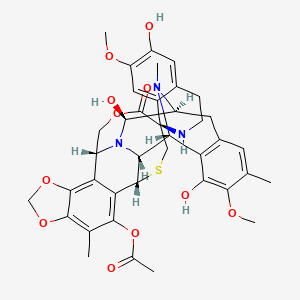
| Formula | C39H43N3O11S |
|---|---|
| Molecular weight | 761.85 g/mol |
| IUPAC name | [(1R,2R,3R,11S,12S,14R,26R)-5,6',12-trihydroxy-6,7'-dimethoxy-7,21,30-trimethyl-27-oxospiro[17,19,28-trioxa-24-thia-13,30-diazaheptacyclo[12.9.6.13,11.02,13.04,9.015,23.016,20]triaconta-4(9),5,7,15,20,22-hexaene-26,1'-3,4-dihydro-2H-isoquinoline]-22-yl] acetate |
| CAS | 114899-77-3 |
| PubChem CID | 108150 |
| InChIKey | PKVRCIRHQMSYJX-AIFWHQITSA-N |
| logP | 3.41 (XLogP 3.4) |
| Polar surface area | 168.72 Ų |
| H-bond acceptors / donors | 15 / 4 |
| Drug-likeness (QED) | 0.23 |
| Lipinski violations | 2 |
SMILES
COc1cc2c(cc1O)CCN[C@]21CS[C@@H]2c3c(OC(C)=O)c(C)c4c(c3[C@H](COC1=O)N1[C@@H]2[C@H]2c3c(cc(C)c(OC)c3O)C[C@@H]([C@@H]1O)N2C)OCO4Biology & Pharmacokinetics
Pharmacokinetics predicted
| Bioavailability | 70.0% |
|---|---|
| Half-life | 1.795 h |
| Volume of distribution | 1.306 L/kg |
| Protein binding | 92.3% |
| BBB penetrant | No |
Enzyme interactions
| Enzyme | Role | Detail |
|---|---|---|
| CYP1A2 | Inhibitor | — |
| CYP1A2 | Substrate | — |
| CYP2B6 | Inhibitor | — |
| CYP2C19 | Substrate | — |
| CYP2C9 | Substrate | — |
| CYP2D6 | Inhibitor | — |
| CYP2D6 | Substrate | — |
| CYP3A4 | Substrate | — |
Transporters
BCRP (Inhibitor)BSEP (Inhibitor)MRP1 (Inhibitor)OATP1B1 (Inhibitor)OATP1B3 (Inhibitor)P-gp (Inhibitor)P-gp (Substrate)
Drug–drug interactions (100+, DDInter)
| Interacting drug | Severity | Management |
|---|---|---|
| Adalimumab | major | |
| Amprenavir | major | |
| Apalutamide | major | |
| Atazanavir | major | |
| Bacillus calmette-guerin substrain tice live antigen | major | |
| Baricitinib | major | |
| Boceprevir | major | |
| Carbamazepine | major | |
| Ceritinib | major | |
| Certolizumab pegol | major | |
| Cladribine | major | |
| Clarithromycin | major | |
| Clozapine | major | |
| Cobicistat | major | |
| Conivaptan | major | |
| Deferiprone | major | |
| Delavirdine | major | |
| Enzalutamide | major | |
| Etanercept | major | |
| Fingolimod | major | |
| Fosamprenavir | major | |
| Fosphenytoin | major | |
| Golimumab | major | |
| Idelalisib | major | |
| Indinavir | major | |
| Infliximab | major | |
| Itraconazole | major | |
| Ketoconazole | major | |
| Leflunomide | major | |
| Lomitapide | major | |
| Lonafarnib | major | |
| Lumacaftor | major | |
| Measles virus vaccine live attenuated | major | |
| Mipomersen | major | |
| Mitotane | major | |
| Mumps virus strain B level jeryl lynn live antigen | major | |
| Natalizumab | major | |
| Nefazodone | major | |
| Nelfinavir | major | |
| Ozanimod | major |
Showing 40 of 100+.
Registered Products (1)
| Brand | Form / strength | Pack | Agent | Citizen (JOD) |
|---|---|---|---|---|
| Yondelis | Vial Trabectedin 1 mg | 1 vial | Nabulsi Drug Store | — |