Ceftazidime
🧬 Cross-allergy: Cephalosporins
JFDA label: Zidime 1g IV.IM Vial
Mechanism of Action
Inhibitor of Bacterial penicillin-binding protein — Bacterial penicillin-binding protein inhibitor
| Target | Action | Gene / class |
|---|---|---|
| Bacterial penicillin-binding protein efficacy | INHIBITOR |
Indications
Approved
- Bacterial septicemia
- Bone and joint infections
- CNS infections
- Empiric therapy in the immunocompromised patient
- Gynecologic infections
- Intra-abdominal infections
- Lower respiratory tract infections
- Skin and skin-structure infections
- Urinary tract infections (UTI)
Off-label
- Bacterial endophthalmitis
- Catheter-related bloodstream infections (children/adolescents)
- Endocarditis, treatment (children)
- Melioidosis (Burkholderia pseudomallei) infection
- Non–cystic fibrosis bronchiectasis (aerosolized ceftazidime)
Antimicrobial Spectrum
Expected / intrinsic spectrum (EUCAST breakpoints & labels) — not local resistance. Source: EUCAST v16 · curated · openfda-label.
Bacteria
| Organism | Activity | MIC |
|---|---|---|
| Aeromonas spp. | Susceptible | 1.0 mg/L |
| Citrobacter freundii | Active | — |
| Citrobacter koseri | Active | — |
| Enterobacter aerogenes | Active | — |
| Enterobacter cloacae | Susceptible | 1.0 mg/L |
| Enterobacterales | Susceptible | 1.0 mg/L |
| Escherichia coli | Susceptible | 1.0 mg/L |
| Haemophilus influenza | Active | — |
| Haemophilus influenzae | Active | — |
| Klebsiella oxytoca | Active | — |
| Klebsiella pneumoniae | Susceptible | 1.0 mg/L |
| Morganella morganii | Active | — |
| Proteus mirabilis | Active | — |
| Providencia stuartii | Active | — |
| Pseudomonas aeruginosa | Susceptible | 8.0 mg/L |
| Pseudomonas aeruginosa | Susceptible | 0.001 mg/L |
| Serratia marcescens | Active | — |
| Vibrio spp. | Susceptible | 1.0 mg/L |
| Escherichia coli | Resistant | 4.0 mg/L |
| Klebsiella pneumoniae | Resistant | 4.0 mg/L |
| Pseudomonas aeruginosa | Resistant | 8.0 mg/L |
Class profile
| gramStatus | Gram- |
|---|---|
| spectrumBreadth | Broad |
| atypicalCoverage | No |
| isBactericidal | 1 |
| moaCategory | Cell wall synthesis inhibitor (beta-lactam, 3rd generation, anti-pseudomonal) |
| pdIndex | Time-dependent |
| postAntibioticEffect | None |
| mrsaCoverage | 0 |
| resistanceMechanisms | ESBL production,AmpC induction,Efflux pumps (MexAB-OprM),OprD porin loss |
Contraindications
Source: Lexicomp
- Clinically significant hypersensitivity to ceftazidime, other cephalosporins, penicillins, other beta-lactam antibiotics, or any component of the formulation Absolute
Adverse Reactions
Nervous system disorders (1)
Common Seizure
Hepatobiliary disorders (3)
Common increased serum alkaline phosphatase · Increased serum ALT · increased serum AST
Renal and urinary disorders (2)
Common Increased blood urea nitrogen · increased serum creatinine
Blood and lymphatic system disorders (8)
Common Agranulocytosis · Eosinophilia · leukopenia · lymphocytosis · neutropenia · positive direct Coombs test · thrombocythemia · thrombocytopenia
Immune system disorders (1)
Common Hypersensitivity reactions
Gastrointestinal disorders (1)
Common Diarrhea
Skin and subcutaneous tissue disorders (1)
Common Pruritus, increased gamma-glutamyl transferase
General disorders and administration site conditions (3)
Common Fever (Frequency not defined: · Inflammation at injection site · injection site phlebitis
Dosing
Source: Lexicomp
Warnings & Precautions
Source: Lexicomp
Elevated INR
May be associated with increased INR, especially in nutritionally-deficient patients, prolonged treatment, hepatic or renal disease.
Neurotoxicity
High ceftazidime levels in patients with renal insufficiency can lead to seizures, encephalopathy, coma, asterixis, myoclonia, and neuromuscular excitability. Reduce total daily dosage.
Penicillin allergy
Use with caution in patients with a history of penicillin allergy, especially IgE-mediated reactions (eg, anaphylaxis, angioedema, urticaria).
Superinfection
Prolonged use may result in fungal or bacterial superinfection, including C. difficile-associated diarrhea (CDAD) and pseudomembranous colitis; CDAD has been observed >2 months postantibiotic treatment. Disease-related concerns:
Renal impairment
Use with caution in patients with renal impairment; dosage adjustment recommended.
Seizure disorders
Use with caution in patients with a history of seizure disorder; high levels, particularly in the presence of renal impairment, may increase risk of seizures.
Pregnancy & Lactation
Pregnancy
Adverse events have not been observed in animal reproduction studies. Ceftazidime crosses the placenta and reaches the cord serum and amniotic fluid. An increase in most types of birth defects was not found following first trimester exposure to cephalosporins. Maternal peak serum concentration is unchanged in the first trimester. After the first trimester, serum concentrations decrease by approximately 50% of those in nonpregnant patients. Renal clearance is increased during pregnancy.
Lactation
Very small amounts of ceftazidime are excreted in breast milk. The manufacturer recommends that caution be exercised when administering ceftazidime to nursing women. Ceftazidime in not absorbed when given orally; therefore, any medication that is distributed to human milk should not result in systemic concentrations in the nursing infant. Nondose-related effects could include modification of bowel flora.
Monitoring
| Efficacy | Culture and susceptibility testing; clinical resolution (temperature, WBC, CRP, procalcitonin) |
|---|---|
| Toxicity | Renal function (dose adjustment in renal impairment); hepatic function for hepatically cleared agents; signs of C. difficile infection (diarrhoea) |
| Clinical pearl | Culture results guide de-escalation to narrower-spectrum therapy. Review antibiotic appropriateness at 48–72 h (antimicrobial stewardship). |
| Counseling | Complete the full course. Report persistent diarrhoea, rash, or lack of improvement after 48–72 h. |
Chemistry & Properties
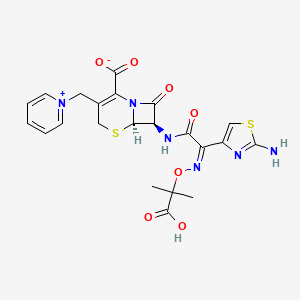
| Formula | C22H22N6O7S2 |
|---|---|
| Molecular weight | 546.59 g/mol |
| IUPAC name | (6R,7R)-7-[[(2Z)-2-(2-amino-1,3-thiazol-4-yl)-2-(2-carboxypropan-2-yloxyimino)acetyl]amino]-8-oxo-3-(pyridin-1-ium-1-ylmethyl)-5-thia-1-azabicyclo[4.2.0]oct-2-ene-2-carboxylate |
| CAS | 72558-82-8 |
| PubChem CID | 5481173 |
| InChIKey | ORFOPKXBNMVMKC-DWVKKRMSSA-N |
| logP | -1.3 (XLogP 0.4) |
| Polar surface area | 191.22 Ų |
| H-bond acceptors / donors | 11 / 3 |
| Drug-likeness (QED) | 0.15 |
| Lipinski violations | 2 |
SMILES
CC(C)(O/N=C(\C(=O)N[C@@H]1C(=O)N2C(C(=O)[O-])=C(C[n+]3ccccc3)CS[C@H]12)c1csc(N)n1)C(=O)OBiology & Pharmacokinetics
Pharmacokinetics predicted
| Bioavailability | 70.0% |
|---|---|
| Half-life | 1.667 h |
| Volume of distribution | 0.477 L/kg |
| Protein binding | 16.9% |
| BBB penetrant | No |
Transporters
BCRP (Inhibitor)BSEP (Inhibitor)MRP1 (Inhibitor)OATP1B1 (Inhibitor)OATP1B3 (Inhibitor)OCTN2 (Inhibitor)P-gp (Inhibitor)PEPT1 (Inhibitor)PEPT2 (Inhibitor)P-gp (Substrate)
Drug–drug interactions (28, DDInter)
| Interacting drug | Severity | Management |
|---|---|---|
| Acyclovir | moderate | |
| Amikacin | moderate | |
| Amikacin (liposome) | moderate | |
| Amphotericin B | moderate | |
| Amphotericin B (cholesteryl sulfate) | moderate | |
| Amphotericin B (lipid complex) | moderate | |
| Amphotericin B (liposomal) | moderate | |
| Bleomycin | moderate | |
| Chloramphenicol | moderate | |
| Cisplatin | moderate | |
| Cyclophosphamide | moderate | |
| Cyclosporine | moderate | |
| Dicoumarol | moderate | |
| Ethinylestradiol | moderate | |
| Gentamicin | moderate | |
| Ifosfamide | moderate | |
| Kanamycin | moderate | |
| Melphalan | moderate | |
| Methotrexate | moderate | |
| Mycophenolic acid | moderate | |
| Neomycin | moderate | |
| Pentamidine | moderate | |
| Picosulfuric acid | moderate | |
| Porfimer sodium | moderate | |
| Streptomycin | moderate | |
| Tacrolimus | moderate | |
| Uracil mustard | moderate | |
| Warfarin | moderate |
Registered Products (21)
| Brand | Form / strength | Pack | Agent | Citizen (JOD) |
|---|---|---|---|---|
| Forta-Z | Vial 1 g | 1 vial | The Arab Pharmaceutical Manufactruing Co. | 3.500 |
| Fetazim | Vial 0.5 g | 1 vial | Pharma International Company/ Jordan | — |
| Fetazim | Vial 1 g | 1 vial pack varies | Pharma International Company/ Jordan | — |
| Fetazim | Vial 2 g | 1 vial | Pharma International Company/ Jordan | — |
| Fetazim | Vial 1 g | 10 vial pack varies | Pharma International Company/ Jordan | — |
| Fetazim IM | Vial 1 g, 1 %/5 ml | 1 vial | pharma international | — |
| Fetazim IV | Vial 1 g | 1 vial pack varies | pharma international | — |
| Fortum Inj. IV/ IM | Powder for Injection 1 g | 1 vial | Suleiman Tannous & Sons Co. Ltd | — |
| Fortum Inj. IV/ IM | Powder for Injection 500 mg | 1 vial | Suleiman Tannous & Sons Co. Ltd | — |
| Fortum Inj. IV/ IM | Powder for Injection 2 g | 1 vial | Suleiman Tannous & Sons Co. Ltd | — |
| Lemoxol Vial | Vial 2 g | 1 vial pack varies | Al Hilal Drug Store | — |
| Lemoxol Vial | Vial 1 g | 1 vial pack varies | Al Hilal Drug Store | — |
| Lemoxol Vial | Vial 1 g | 10 vial pack varies | Al Hilal Drug Store | — |
| Lemoxol Vial | Vial 1 g | 50 vial pack varies | Al Hilal Drug Store | — |
| Lemoxol Vial | Vial 2 g | 10 vial pack varies | Al Hilal Drug Store | — |
| Lemoxol Vial | Vial 2 g | 50 vial pack varies | Al Hilal Drug Store | — |
| Septax | Vial 2 g | 1 vial | Burqan Drug Store | — |
| Septax | Vial 1 g | 1 vial | Burqan Drug Store | — |
| Zavicefta | Vial 2 g, 0.5 g | 10 vial | Khoury Drug Store | — |
| Zidav | Vial Ceftazidime 2 g, Avibactam 0.5 g | 10 vial | / Pharma International Company/Jordan / General | — |
| Zidime 1g IV.IM Vial | Vial 1 g | 1 | Sukhtian Group | — |