Mitoxantrone
JFDA label: Mitoxantron "Ebewe"
- Experienced physician:
- Bone marrow suppression:
- Cardiotoxicity:
- Secondary leukemia:
- Appropriate administration:
Mechanism of Action
Related to the anthracyclines, mitoxantrone intercalates into DNA resulting in cross-links and strand breaks; binds to nucleic acids and inhibits DNA and RNA synthesis by template disordering and steric obstruction; replication is decreased by binding to DNA topoisomerase II and seems to inhibit the incorporation of uridine into RNA and thymidine into DNA; active throughout entire cell cycle (cell-cycle nonspecific)
Indications
Approved
- Canadian labeling
Off-label
- Acute lymphocytic leukemia (ALL)
- Autologous hematopoietic stem cell transplantation (HSCT) (conditioning regimen)
- Breast cancer (metastatic)
- Hodgkin lymphoma (refractory)
- Non-Hodgkin lymphomas (NHL)
- Pediatric acute myelogenous leukemia (AML)
- Pediatric acute promyelocytic leukemia (APL)
- Relapsed acute myeloid leukemia (AML)
Contraindications
Source: Lexicomp
- Additional contraindications (not in U.S. labeling): Prior hypersensitivity to anthracyclines Absolute
- Hypersensitivity to mitoxantrone or any component of the formulation Absolute
- intrathecal administration Absolute
- presence of severe myelosuppression due to prior chemo- and/or radiotherapy Absolute
- prior substantial anthracycline exposure and abnormal cardiac function prior to initiation of mitoxantrone therapy Absolute
- severe hepatic impairment Absolute
Adverse Reactions
Cardiac disorders (8)
Very Common cardiac arrhythmia · cardiac disease · ECG changes · Edema
Common Cardiac failure · decreased left ventricular ejection fraction · hypertension · ischemia
Nervous system disorders (7)
Very Common fatigue · headache · Pain
Common anxiety · Chills · depression · seizure
Hepatobiliary disorders (3)
Very Common Increased serum alkaline phosphatase · increased serum transaminases
Common Jaundice
Renal and urinary disorders (9)
Very Common hematuria · Increased blood urea nitrogen · increased serum creatinine · Urinary tract infection · urine abnormality
Common Impotence · proteinuria · Renal failure · sterility
Blood and lymphatic system disorders (12)
Very Common anemia · bruise · decreased hemoglobin · febrile neutropenia · leukopenia · lymphocytopenia · Neutropenia · petechia · thrombocytopenia
Common acute leukemia · Granulocytopenia · hemorrhage
Metabolism and nutrition disorders (10)
Very Common amenorrhea · hyperglycemia · increased gamma-glutamyl transferase · Menstrual disease · weight gain · weight loss
Common hypermenorrhea · Hypocalcemia · hypokalemia · hyponatremia
Gastrointestinal disorders (11)
Very Common abdominal pain · anorexia · constipation · diarrhea · dyspepsia · gastrointestinal hemorrhage · mucositis · Nausea · stomatitis · vomiting
Common Aphthous stomatitis
Skin and subcutaneous tissue disorders (4)
Very Common Alopecia · nail bed changes
Common Diaphoresis · skin infection
Musculoskeletal and connective tissue disorders (4)
Very Common Weakness
Common arthralgia · Back pain · myalgia
Eye disorders (2)
Common blurred vision · Conjunctivitis
Infections and infestations (3)
Very Common fungal infection · Infection · sepsis
General disorders and administration site conditions (1)
Very Common Fever
Respiratory, thoracic and mediastinal disorders (7)
Very Common cough · dyspnea · pharyngitis · Upper respiratory tract infection
Common pneumonia · Rhinitis · sinusitis
Dosing
Source: Lexicomp
Warnings & Precautions
Source: Lexicomp
Bone marrow suppression
Treatment may lead to severe myelosuppression; unless the expected benefit outweighs the risk, use is generally not recommended in patients with pre-existing myelosuppression from prior chemotherapy. [U.S. Boxed Warning]: Usually should not be administered if baseline neutrophil count 3 (except for in the treatment of ANLL). Monitor blood counts and monitor for infection due to neutropenia.
Extravasation
Irritant with vesicant-like properties. [U.S. Boxed Warning]: For IV administration only, into a free-flowing IV; may cause severe local tissue damage if extravasation occurs. Extravasation resulting in burning, erythema, pain, swelling and skin discoloration (blue) has been reported; may result in tissue necrosis and require debridement for skin graft. Ensure proper needle or catheter placement prior to and during infusion. Avoid extravasation.
Hyperuricemia
Rapid lysis of tumor cells may lead to hyperuricemia.
Myocardial toxicity
[U.S. Boxed Warning]: May cause myocardial toxicity and potentially-fatal heart failure (HF); risk increases with cumulative dosing. Effects may occur during therapy or may be delayed (months or years after completion of therapy). Predisposing factors for mitoxantrone-induced cardiotoxicity include prior anthracycline or anthracenedione therapy, prior cardiovascular disease, concomitant use of cardiotoxic drugs, and mediastinal/pericardial irradiation, although may also occur in patients without risk factors. Prior to therapy initiation, evaluate all patients for cardiac-related signs/symptoms, including history, physical exam, and ECG; and evaluate baseline left ventricular ejection fraction (LVEF) with echocardiogram or multigated radionuclide angiography (MUGA) or MRI. Not recommended for use in MS patients when LVEF 2, and discontinued if LVEF falls below LLN or a significant decrease in LVEF is observed; decreases in LVEF and HF have been observed in patients with MS who have received cumulative doses 2. Patients with MS should undergo annual LVEF evaluation following discontinuation of therapy to monitor for delayed cardiotoxicity.
Secondary malignancy
[U.S. Boxed Warning]: Treatment with mitoxantrone increases the risk of developing secondary acute myelogenous leukemia (AML) in patients with cancer and in patients with MS; acute promyelocytic leukemia (APL) has also been observed. Symptoms of acute leukemia include excessive bruising, bleeding and recurrent infections. The risk for secondary leukemia is increased in patients who are heavily pretreated, with higher doses, and with combination chemotherapy. Disease-related concerns:
Hepatic impairment
Clearance is reduced in patients with hepatic impairment; use with caution; dosage adjustment recommended. Not for treatment of multiple sclerosis in patients with concurrent hepatic impairment. Canadian labeling contraindicates use in severe impairment.
Multiple sclerosis
Not for treatment of primary progressive multiple sclerosis. Other warnings/precautions:
Appropriate administration
[U.S. Boxed Warning]: For IV administration only, into a free-flowing IV; do not administer subcutaneously, intramuscularly, or intra-arterially. Do not administer intrathecally; may cause serious and permanent neurologic damage.
Blue-green coloration
May cause urine, saliva, tears, and sweat to turn blue-green for 24 hours postinfusion; whites of eyes may have blue-green tinge.
Experienced physician
[U.S. Boxed Warning]: Should be administered under the supervision of a physician experienced in cancer chemotherapy agents.
Pregnancy & Lactation
Pregnancy
Adverse events have been observed in animal reproduction studies. Based on the mechanism of action, mitoxantrone may cause fetal harm if administered during pregnancy. Use of effective contraception during therapy is recommended. Information related to pregnancy outcomes following maternal use of mitoxantrone in pregnancy is limited (Amato 2015; Houtchens 2013; NTP 2013). Infertility and amenorrhea have been reported in women with MS using mitoxantrone (Amato 2015; Houtchens 2013). Women with multiple sclerosis who are of reproductive potential should have a pregnancy test prior to each dose. Women who wish to become pregnant should discontinue therapy at least 2 to 3 months prior to conception (Houtchens 2013). The European Society for Medical Oncology has published guidelines for diagnosis, treatment, and follow-up of cancer during pregnancy. The guidelines recommend referral to a facility with expertise in cancer during pregnancy and encourage a multidisciplinary team (obstetri
Lactation
Mitoxantrone is excreted in human milk and significant concentrations (18 ng/mL) have been reported for 28 days after the last administration. Due to the potential for serious adverse reactions in the nursing infant, the manufacturer recommends that breast-feeding be discontinued before starting treatment.
Monitoring
| Clinical pearl | CBC with differential, serum uric acid (for leukemia treatment), liver function tests; for the treatment of multiple sclerosis, obtain pregnancy test; monitor injection site for extravasation Cardiac monitoring: Prior to initiation, evaluate all patients for cardiac-related signs/symptoms, including history, physical exam, and ECG; evaluate baseline and periodic left ventricular ejection fraction (LVEF) with echocardiogram or multigated radionuclide angiography (MUGA) or MRI. In patients with MS, evaluate for cardiac signs/symptoms (by history, physical exam, and ECG) and evaluate LVEF (using same method as baseline LVEF) prior to each dose and if signs/symptoms of HF develop. Patients with MS should undergo annual LVEF evaluation following discontinuation of therapy to monitor for delayed cardiotoxicity. |
|---|
Chemistry & Properties
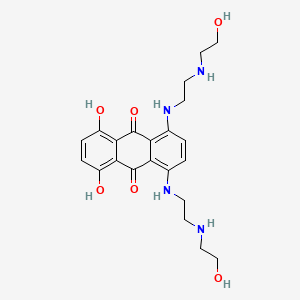
| Formula | C22H28N4O6 |
|---|---|
| Molecular weight | 444.49 g/mol |
| IUPAC name | 1,4-dihydroxy-5,8-bis[2-(2-hydroxyethylamino)ethylamino]anthracene-9,10-dione |
| CAS | 65271-80-9 |
| PubChem CID | 4212 |
| InChIKey | KKZJGLLVHKMTCM-UHFFFAOYSA-N |
| logP | -0.14 (XLogP 1.0) |
| Polar surface area | 163.18 Ų |
| H-bond acceptors / donors | 10 / 8 |
| Drug-likeness (QED) | 0.14 |
| Lipinski violations | 1 |
SMILES
O=C1c2c(O)ccc(O)c2C(=O)c2c(NCCNCCO)ccc(NCCNCCO)c21Biology & Pharmacokinetics
Pharmacokinetics
| BBB penetrant | No |
|---|
Enzyme interactions
| Enzyme | Role | Detail |
|---|---|---|
| CYP1A2 | Inhibitor | — |
| CYP1A2 | Substrate | — |
| CYP2D6 | Inhibitor | IC₅₀ 76.30000000000004 µM |
Receptor binding (top 1)
| Target | Action | Affinity |
|---|---|---|
| DNA topoisomerase II alpha (TOP2A) | Inhibitor | pIC50 5.3 |
Transporters
BCRP (Inhibitor)BCRP (Inhibitor)BSEP (Inhibitor)BSEP (Inhibitor)MATE1 (Inhibitor)MATE2 (Inhibitor)MDR1 (Inhibitor)MRP1 (Inhibitor)MRP1 (Inhibitor)OATP1B1 (Inhibitor)OATP1B1 (Inhibitor)OATP1B3 (Inhibitor)OATP1B3 (Inhibitor)OATP2B1 (Inhibitor)OCT1 (Inhibitor)OCT2 (Inhibitor)OCT3 (Inhibitor)OCTN1 (Inhibitor)P-gp (Inhibitor)BCRP (Substrate)MDR1 (Substrate)MRP1 (Substrate)MRP2 (Substrate)P-gp (Substrate)
Drug–drug interactions (100+, DDInter)
| Interacting drug | Severity | Management |
|---|---|---|
| Adalimumab | major | |
| Bacillus calmette-guerin substrain tice live antigen | major | |
| Baricitinib | major | |
| Certolizumab pegol | major | |
| Cladribine | major | |
| Clozapine | major | |
| Deferiprone | major | |
| Dolasetron | major | |
| Etanercept | major | |
| Fingolimod | major | |
| Golimumab | major | |
| Infliximab | major | |
| Leflunomide | major | |
| Measles virus vaccine live attenuated | major | |
| Mumps virus strain B level jeryl lynn live antigen | major | |
| Natalizumab | major | |
| Ozanimod | major | |
| Rotavirus vaccine | major | |
| Rubella virus vaccine | major | |
| Samarium (153Sm) lexidronam | major | |
| Siponimod | major | |
| Smallpox (Vaccinia) Vaccine, Live | major | |
| Talimogene laherparepvec | major | |
| Teriflunomide | major | |
| Thalidomide | major | |
| Tofacitinib | major | |
| Typhoid vaccine (live) | major | |
| Upadacitinib | major | |
| Varicella Zoster Vaccine (Recombinant) | major | |
| Yellow Fever Vaccine | major | |
| Abiraterone | moderate | |
| Aldesleukin | moderate | |
| Alefacept | moderate | |
| Alemtuzumab | moderate | |
| Alpelisib | moderate | |
| Amiodarone | moderate | |
| Anakinra | moderate | |
| Anthrax vaccine | moderate | |
| Apalutamide | moderate | |
| Atorvastatin | moderate |
Showing 40 of 100+.
Registered Products (2)
| Brand | Form / strength | Pack | Agent | Citizen (JOD) |
|---|---|---|---|---|
| Mitoxantron "Ebewe" | Vial 2 mg/ml | 1 vial pack varies | Sabbagh Drug Store | — |
| Mitoxantron "Ebewe" | Injection 2 mg/ml | 1 vial pack varies | Sabbagh Drug Store | — |