Pioglitazone
JFDA label: Uniglit 30 mg Tab
- Congestive heart failure:
Mechanism of Action
Thiazolidinedione antidiabetic agent that lowers blood glucose by improving target cell response to insulin, without increasing pancreatic insulin secretion. It has a mechanism of action that is dependent on the presence of insulin for activity. Pioglitazone is a potent and selective agonist for peroxisome proliferator-activated receptor-gamma (PPARgamma). Activation of nuclear PPARgamma receptors influences the production of a number of gene products involved in glucose and lipid metabolism. PPARgamma is abundant in the cells within the renal collecting tubules; fluid retention results from stimulation by thiazolidinediones which increases sodium reabsorption.
Indications
Approved
- Diabetes mellitus, type 2
Class profile
| mechanismClass | Thiazolidinedione/TZD (PPARgamma agonist) |
|---|---|
| insulinSecretagogue | 0 |
| weightEffect | Gain (fluid retention) |
| hypoglycemiaRisk | None (when used alone) |
| renalContraindicated | 0 |
| cardioProtective | 0 |
| renalProtective | 0 |
| source | ADA-EASD2023/Maruthur2016 |
Contraindications
Source: Lexicomp
- Additional contraindications (not is U.S. labeling): Any stage of heart failure (eg, NYHA Class I, II, III, IV) Absolute
- Hypersensitivity to pioglitazone or any component of the formulation Absolute
- NYHA Class III/IV heart failure (initiation of therapy) Absolute
- active bladder cancer Absolute
- history of bladder cancer Absolute
- serious hepatic impairment Absolute
- uninvestigated macroscopic hematuria Absolute
Adverse Reactions
Cardiac disorders (3)
Very Common Edema
Common Cardiac failure · Heart failure (fluid overload)
Nervous system disorders (1)
Common Headache
Blood and lymphatic system disorders (3)
Common Anaemia (haemodilution)
Not Known Decreased hematocrit · decreased hemoglobin
Metabolism and nutrition disorders (7)
Very Common Hypoglycemia · Weight gain (fluid retention and fat)
Common Elevated LDL cholesterol
Not Known Decreased serum triglycerides · increased HDL-cholesterol · weight gain · weight loss
Musculoskeletal and connective tissue disorders (2)
Common Bone fracture · myalgia
General disorders and administration site conditions (1)
Very Common Peripheral oedema
Injury, poisoning and procedural complications (1)
Common Bone fractures (female, distal limbs)
Neoplasms benign, malignant and unspecified (1)
Uncommon Bladder cancer (prolonged use, debated)
Respiratory, thoracic and mediastinal disorders (3)
Very Common Upper respiratory tract infection
Common pharyngitis · Sinusitis
Dosing
Source: Lexicomp
Warnings & Precautions
Source: Lexicomp
Bladder cancer
An FDA review concluded that although clinical trial data are inconsistent regarding the risk of bladder cancer in patients exposed to pioglitazone, there is still the potential for an increased risk and package labeling has been updated to reflect this. Avoid use of pioglitazone in patients with active bladder cancer and consider risks versus benefits prior to initiating therapy in patients with a history of bladder cancer.
Edema
Dose-related edema, including new-onset or exacerbation of existing edema, has been reported; use with caution in patients with edema. Monitor for signs/symptoms of heart failure.
Fractures
An increased incidence of bone fractures in females treated with pioglitazone has been observed; majority of fractures occurred in the lower limb and distal upper limb. Consider risk of fracture prior to initiation and during use.
Heart failure/cardiac effects
Thiazolidinediones, including pioglitazone, may cause or exacerbate heart failure; closely monitor for signs and symptoms of heart failure (eg, rapid weight gain, dyspnea, edema), particularly after initiation or dose increases; if heart failure develops, treat accordingly and consider dose reduction or discontinuation of pioglitazone. Not recommended for use in any patient with symptomatic heart failure. Initiation of therapy is contraindicated in patients with NYHA class III or IV heart failure; if used in patients with NYHA class I or II (systolic) heart failure, initiate at lowest dosage and monitor closely.
Hematologic effects
May decrease hemoglobin/hematocrit; effects may be related to increased plasma volume.
Hepatic effects
Hepatic failure, including fatalities, has been reported. Monitor for signs/symptoms of liver injury closely during therapy; discontinuation of therapy may be necessary.
Hypoglycemia
The risk of hypoglycemia is increased when pioglitazone is combined with insulin or other diabetic medications; dosage adjustment of concomitant hypoglycemic agents may be necessary.
Macular edema
Has been reported with thiazolidinedione use, including pioglitazone; some patients with macular edema presented with blurred vision or decreased visual acuity, and most had peripheral edema at time of diagnosis. Patients should be seen by an ophthalmologist if any visual symptoms arise during therapy and all diabetic patients should have regular eye exams.
Weight gain
Dose-related weight gain observed with use; mechanism unknown but likely associated with fluid retention and fat accumulation. Disease-related concerns:
Diabetes, type 1
Mechanism requires the presence of insulin; therefore, use in type 1 diabetes (insulin dependent, IDDM) or diabetic ketoacidosis is not recommended.
Hepatic impairment
Due to the possible risk of drug-induced liver injury, serum liver function tests (ALT, AST, alkaline phosphatase, and total bilirubin) should be obtained prior to initiation in all patients. In patients with abnormal hepatic tests, therapy should be initiated with caution. During therapy, if signs/symptoms of liver injury (eg, fatigue, anorexia, jaundice, dark urine, right upper abdominal discomfort) arise, interrupt pioglitazone therapy, obtain liver tests immediately and evaluate alternative etiologies. If an alternative etiology is not identified and serum ALT is >3 × ULN, do not resume therapy. Patients with serum ALT >3 × ULN and serum total bilirubin >2 × ULN are at risk for severe drug-induced liver injury. Concurrent drug therapy issues:
Drug-drug interactions
Potentially significant interactions may exist, requiring dose or frequency adjustment, additional monitoring, and/or selection of alternative therapy. Consult drug interactions database for more detailed information.
Pregnancy & Lactation
Pregnancy
Information related to the use of pioglitazone in pregnant women is limited (Glueck 2003; Ortega-Gonzalez 2005; Ota 2008). Thiazolidinediones may cause ovulation in anovulatory premenopausal women, increasing the risk of unintended pregnancy. In women with diabetes, maternal hyperglycemia can be associated with congenital malformations as well as adverse effects in the fetus, neonate, and the mother (ACOG 2005; ADA 2018c; Kitzmiller 2008; Metzger 2007). To prevent adverse outcomes, prior to conception and throughout pregnancy maternal blood glucose and HbA1c should be kept as close to target goals as possible but without causing significant hypoglycemia (ACOG 2013; ADA 2018c; Blumer 2013; Kitzmiller 2008). Agents other than pioglitazone are currently recommended to treat diabetes in pregnant women (ADA 2018c).
Lactation
It is not known if pioglitazone is excreted in breast milk. Although breastfeeding is encouraged for all women, including those with diabetes, the safety of pioglitazone during breastfeeding has not yet been established (Metzger 2007). According to the manufacturer, the decision to breastfeed during therapy should consider the risk of infant exposure, the benefits of breastfeeding to the infant, and benefits of treatment to the mother.
Monitoring
| Efficacy | HbA1c every 3 months initially, then every 6–12 months when stable; fasting and post-prandial blood glucose; patient-reported hypoglycaemia episodes |
|---|---|
| Toxicity | Hypoglycaemia symptoms; eGFR for renally-cleared agents; weight; blood pressure |
| Clinical pearl | Individualise HbA1c targets based on patient age, comorbidities, and hypoglycaemia risk. Targets of < 7% are appropriate for most patients but < 8% may be safer in frail elderly. |
| Counseling | Monitor blood glucose regularly. Know how to recognise and treat hypoglycaemia. Keep carbohydrate snacks available. |
Chemistry & Properties
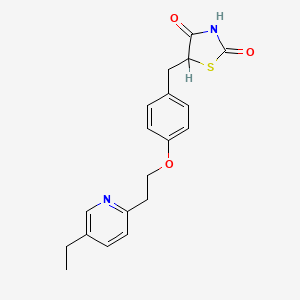
| Formula | C19H20N2O3S |
|---|---|
| Molecular weight | 356.45 g/mol |
| IUPAC name | 5-[[4-[2-(5-ethyl-2-pyridinyl)ethoxy]phenyl]methyl]-1,3-thiazolidine-2,4-dione |
| CAS | 111025-46-8 |
| PubChem CID | 4829 |
| InChIKey | HYAFETHFCAUJAY-UHFFFAOYSA-N |
| logP | 3.16 (XLogP 3.8) |
| Polar surface area | 68.29 Ų |
| H-bond acceptors / donors | 5 / 1 |
| Drug-likeness (QED) | 0.83 |
| Lipinski violations | 0 |
SMILES
CCc1ccc(CCOc2ccc(CC3SC(=O)NC3=O)cc2)nc1Biology & Pharmacokinetics
Pharmacokinetics
| BBB penetrant | No |
|---|
Enzyme interactions
| Enzyme | Role | Detail |
|---|---|---|
| CYP1A2 | Inhibitor | — |
| CYP2C8 | Inhibitor | — |
| CYP2C9 | Substrate | — |
| CYP3A4 | Substrate | — |
Receptor binding (top 1)
| Target | Action | Affinity |
|---|---|---|
| Peroxisome proliferator-activated receptor-γ (PPARG) | Agonist | pIC50 6.2 |
Transporters
ASBT (Inhibitor)BCRP (Inhibitor)BSEP (Inhibitor)BSEP (Inhibitor)ENT1 (Inhibitor)MDR1 (Inhibitor)MRP1 (Inhibitor)MRP3 (Inhibitor)MRP4 (Inhibitor)NTCP (Inhibitor)OATP1B1 (Inhibitor)OATP1B1 (Inhibitor)OATP1B3 (Inhibitor)OATP1B3 (Inhibitor)OATP2B1 (Inhibitor)OCT1 (Inhibitor)P-gp (Inhibitor)MDR1 (Substrate)P-gp (Substrate)
Drug–drug interactions (100+, DDInter)
| Interacting drug | Severity | Management |
|---|---|---|
| Clopidogrel | major | |
| Gatifloxacin | major | |
| Gemfibrozil | major | |
| Leflunomide | major | |
| Lomitapide | major | |
| Lumateperone | major | |
| Mipomersen | major | |
| Pexidartinib | major | |
| Teriflunomide | major | |
| Abametapir (topical) | moderate | |
| Abiraterone | moderate | |
| Acetazolamide | moderate | |
| Alimemazine | moderate | |
| Aloe Vera Leaf | moderate | |
| Alpelisib | moderate | |
| Amprenavir | moderate | |
| Aprepitant | moderate | |
| Aripiprazole | moderate | |
| Asenapine | moderate | |
| Asparaginase Erwinia chrysanthemi | moderate | |
| Asparaginase Escherichia coli | moderate | |
| Atazanavir | moderate | |
| Bedaquiline | moderate | |
| Bendroflumethiazide | moderate | |
| Benzphetamine | moderate | |
| Benzthiazide | moderate | |
| Betamethasone | moderate | |
| Bexarotene | moderate | |
| Bictegravir | moderate | |
| Bortezomib | moderate | |
| Bosentan | moderate | |
| Brentuximab vedotin | moderate | |
| Brexpiprazole | moderate | |
| Brigatinib | moderate | |
| Bumetanide | moderate | |
| Calaspargase pegol | moderate | |
| Cannabidiol | moderate | |
| Carbamazepine | moderate | |
| Cariprazine | moderate | |
| Ceritinib | moderate |
Showing 40 of 100+.
Registered Products (13)
| Brand | Form / strength | Pack | Agent | Citizen (JOD) |
|---|---|---|---|---|
| Actos Tablets | Tablet 15 mg | 30 tab | The Arab Pharmaceutical Manufacturing PSC/Salt | 12.330 |
| Glisenz | Tablet 15 mg | 30 tab | Dar Al Dawa Development and Investment Co Ltd/Jordan | 12.330 |
| Uniglit | Tablet 15 mg | 30 tab | UNITED PHARM.MFG.CO.LTD(UPM)/JORDAN | 12.330 |
| Actos Tablets | Tablet 30 mg | 30 tab | The Arab Pharmaceutical Manufacturing PSC/Salt | 19.380 |
| Glisenz | Tablet 30 mg | 30 tab | Dar Al Dawa Development and Investment Co Ltd/Jordan | 19.380 |
| Uniglit | Tablet 30 mg | 30 tab | UNITED PHARM.MFG.CO.LTD(UPM)/JORDAN | 19.380 |
| Incresync | Tablet 15 mg, 25 mg | 28 tab | The Arab Pharmaceutical Manufacturing PSC/Salt | 19.950 |
| Duetact 30mg/2mg Tab | Tablet (as Pioglitazone Hcl) 30 mg, 2 mg | 30 tab | The Arab Pharmaceutical Manufacturing PSC/Salt | 23.310 |
| Duetact 30mg/4mg Tab | Tablet (as Pioglitazone Hcl) 30 mg, 4 mg | 30 tab | The Arab Pharmaceutical Manufacturing PSC/Salt | 23.310 |
| Actosmet 15mg/850 mg F.C Tab | Film-Coated Tablet (as Pioglitazone Hcl) 15 mg, 850 mg | 56 tab | The Arab Pharmaceutical Manufacturing PSC/Salt | 26.210 |
| Glisenz | Tablet 45 mg | 30 tab | Dar Al Dawa Development and Investment Co Ltd/Jordan | 30.240 |
| Incresync | Tablet 30 mg, 25 mg | 28 tab | The Arab Pharmaceutical Manufacturing PSC/Salt | 32.710 |
| Actos Tablets | Tablet 45 mg | 30 tab | The Arab Pharmaceutical Manufactruing Co. | 33.600 |