Ibuprofen
🧬 Cross-allergy: NSAIDs
JFDA label: Taskine F.C Tab
- Serious cardiovascular thrombotic events (excluding NeoProfen):
- Serious gastrointestinal bleeding, ulcerations, and perforation (excluding NeoProfen):
Mechanism of Action
Inhibitor of Cyclooxygenase — Cyclooxygenase inhibitor
| Target | Action | Gene / class |
|---|---|---|
| Cyclooxygenase efficacy | INHIBITOR |
Indications
Approved
- Ibuprofen injection (Caldolor)
- Ibuprofen lysine injection (NeoProfen)
- OTC labeling
- Oral
Off-label
- Acute migraine headache
- Ankylosing spondylitis
- Cystic fibrosis
- Gout
- Juvenile idiopathic arthritis
- Migraine prophylaxis
- Pericarditis
Class profile
| cox1_IC50_uM | 4.8 |
|---|---|
| cox2_IC50_uM | 72.0 |
| cox2_selectivity | 0.06666666666666667 |
| inhibitionType | reversible |
| preferentialCOX2 | 0 |
| selectiveCOX2 | 0 |
| plateletEffect | 1 |
| source | Warner1999/Vane1996/ChEMBL |
Contraindications
Source: Curated · Lexicomp
- Active peptic ulcer disease or GI bleeding Absolute
- Additional contraindications (not in US labeling): Cerebrovascular bleeding or other bleeding disorders Absolute
- Coronary artery bypass graft (CABG) surgery — peri-operative use Absolute
- Hypersensitivity to ibuprofen (eg, anaphylactic reactions, serious skin reactions) or any component of the formulation Absolute
- Third trimester of pregnancy (premature closure of ductus arteriosus) Absolute
- active gastric/duodenal/peptic ulcer, active GI bleeding Absolute
- aspirin triad (eg, bronchial asthma, aspirin intolerance, rhinitis) Absolute
- bleeding (especially those with active intracranial hemorrhage or GI bleeding) Absolute
- coagulation defects Absolute
- congenital heart disease in whom patency of the PDA is necessary for satisfactory pulmonary or systemic blood flow (eg, pulmonary atresia, severe coarctation of the aorta, severe tetralogy of Fallot) Absolute
- history of asthma, urticaria, or allergic-type reaction to aspirin or other NSAIDs Absolute
- inflammatory bowel disease Absolute
- moderate [IV formulation only] to severe renal impairment (creatinine clearance [CrCl] OTC labeling: When used for self-medication, do not use if previous allergic reaction to any other pain reliever/fever reducer Absolute
- or significant renal function impairment Absolute
- prior to or following cardiac surgery Absolute
- proven or suspected necrotizing enterocolitis Absolute
- thrombocytopenia Absolute
- uncontrolled heart failure Absolute
- use in the setting of coronary artery bypass graft (CABG) surgery Ibuprofen lysine (NeoProfen): Preterm neonates: With proven or suspected infection that is untreated Absolute
Adverse Reactions
Cardiac disorders (8)
Common cardiac failure · Edema · hypertension · Hypotension · myocardial infarction · peripheral edema · tachycardia
Uncommon Cardiovascular thrombotic events (MI/stroke)
Vascular disorders (1)
Common Hypertension (worsening)
Nervous system disorders (7)
Common convulsions · Dizziness · eating disorder · headache · Intraventricular hemorrhage · nervousness · seizure
Hepatobiliary disorders (4)
Common Increased serum ALT · increased serum AST · Jaundice
Uncommon Elevated liver enzymes
Renal and urinary disorders (10)
Common decreased urine output · Increased blood urea nitrogen · increased serum creatinine · renal failure · renal insufficiency · renal toxicity · uremia · Urinary retention · Urinary tract infection
Rare Acute kidney injury
Blood and lymphatic system disorders (9)
Common Anemia · decreased hemoglobin · eosinophilia · hemorrhage · hypoproteinemia · neutropenia · thrombocythemia · thrombocytopenia · wound hemorrhage
Immune system disorders (2)
Common Hypersensitivity reaction
Uncommon Hypersensitivity reactions (rash, urticaria)
Metabolism and nutrition disorders (9)
Common adrenocortical insufficiency · changes in LDH · Fluid retention · hyperglycemia · hypernatremia · hypoalbuminemia · Hypocalcemia · hypoglycemia · Hypokalemia
Gastrointestinal disorders (25)
Common abdominal discomfort · abdominal distension · Abdominal pain · abdominal pain · cholestasis · constipation · decreased appetite · diarrhea · Diarrhoea · Dyspepsia · dyspepsia · Enterocolitis · Epigastric pain · flatulence · gastritis · gastroesophageal reflux disease · gastrointestinal disease · heartburn · inguinal hernia · intestinal obstruction · Nausea · nausea · vomiting
Uncommon Gastrointestinal haemorrhage · Gastrointestinal ulcer
Skin and subcutaneous tissue disorders (7)
Common Exfoliative dermatitis · pruritus · Skin irritation · skin lesion · Skin rash · Stevens-Johnson syndrome · toxic epidermal necrolysis
Ear and labyrinth disorders (1)
Common Tinnitus
Infections and infestations (2)
Common infection · Sepsis
Investigations (1)
Uncommon Elevated serum creatinine
General disorders and administration site conditions (3)
Common Injection site reaction · Peripheral oedema · Reduced intake of food/fluids
Respiratory, thoracic and mediastinal disorders (7)
Common Apnea · atelectasis · Bacterial pneumonia · cough · respiratory failure · respiratory tract infection
Uncommon Bronchospasm (in aspirin-sensitive asthma)
Other (2)
Common Ibuprofen (Caldolor): Frequency not defined · Ibuprofen lysine (NeoProfen): Frequency not always defined
Dosing
Source: Lexicomp
Warnings & Precautions
Source: Lexicomp
Anaphylactoid reactions
Even in patients without prior exposure anaphylactoid reactions may occur; patients with "aspirin triad" (bronchial asthma, aspirin intolerance, rhinitis) may be at increased risk. Contraindicated in patients who experience bronchospasm, asthma, rhinitis, or urticaria with NSAID or aspirin therapy.
Cardiovascular events
NSAIDs cause an increased risk of serious (and potentially fatal) adverse cardiovascular thrombotic events, including fatal MI and stroke. Risk may occur early during treatment and may increase with duration of use. Relative risk appears to be similar in those with and without known cardiovascular disease or risk factors for cardiovascular disease; however, absolute incidence of cardiovascular events (which may occur early during treatment) was higher in patients with known cardiovascular disease or risk factors. New-onset hypertension or exacerbation of hypertension may occur (NSAIDS may also impair response to ACE inhibitors, thiazide diuretics, or loop diuretics); may contribute to cardiovascular events; monitor blood pressure; use with caution in patients with hypertension. May cause sodium and fluid retention; use with caution in patients with edema. Avoid use in heart failure (ACCF/AHA [Yancy 2013]). Avoid use in patients with a recent MI unless benefits outweigh risk of cardiovascular thrombotic events. Use the lowest effective dose for the shortest duration of time, consistent with individual patient goals, to reduce risk of cardiovascular events; alternate therapies should be considered for patients at high risk.
CNS effects
May cause drowsiness, dizziness, blurred vision, and other neurologic effects which may impair physical or mental abilities; patients must be cautioned about performing tasks which require mental alertness (eg, operating machinery or driving).
Gastrointestinal events
NSAIDs cause an increased risk of serious gastrointestinal inflammation, ulceration, bleeding, and perforation (may be fatal); elderly patients and patients with history of peptic ulcer disease and/or GI bleeding are at greater risk for serious GI events. These events may occur at any time during therapy and without warning. Avoid use in patients with active GI bleeding. In patients with a history of acute lower GI bleeding, avoid use of non-aspirin NSAIDs, especially if due to angioectasia or diverticulosis (Strate 2016). Use caution with a history of GI ulcers, concurrent therapy known to increase the risk of GI bleeding (eg, aspirin, anticoagulants and/or corticosteroids, selective serotonin reuptake inhibitors), advanced hepatic disease, coagulopathy, smoking, use of alcohol, or in elderly or debilitated patients. Use the lowest effective dose for the shortest duration of time, consistent with individual patient goals, to reduce risk of GI adverse events; alternate therapies should be considered for patients at high risk. When used concomitantly with aspirin, a substantial increase in the risk of gastrointestinal complications (eg, ulcer) occurs; concomitant gastroprotective therapy (eg, proton pump inhibitors) is recommended (Bhatt 2008).
Hematologic effects
Platelet adhesion and aggregation may be decreased; may prolong bleeding time; patients with coagulation disorders or who are receiving anticoagulants should be monitored closely. Anemia may occur; patients on long-term NSAID therapy should be monitored for anemia. Rarely, NSAID use has been associated with potentially severe blood dyscrasias (eg, agranulocytosis, thrombocytopenia, aplastic anemia).
Hepatic effects
Transaminase elevations have been reported with use; closely monitor patients with any abnormal LFT. Rare (sometimes fatal) severe hepatic reactions (eg, fulminant hepatitis, liver necrosis, hepatic failure) have occurred with NSAID use; discontinue immediately if signs or symptoms of hepatic disease develop or if systemic manifestations occur.
Hyperkalemia
NSAID use may increase the risk of hyperkalemia, particularly in the elderly, diabetics, renal disease, and with concomitant use of other agents capable of inducing hyperkalemia (eg, ACE-inhibitors). Monitor potassium closely.
Ophthalmic events
Blurred/diminished vision, scotomata, and changes in color vision have been reported. Discontinue therapy and refer for ophthalmologic evaluation if symptoms occur. Periodically evaluate vision in all patients receiving long-term therapy.
Renal effects
NSAID use may compromise existing renal function; dose-dependent decreases in prostaglandin synthesis may result from NSAID use, reducing renal blood flow which may cause renal decompensation (usually reversible). Patients with impaired renal function, dehydration, hypovolemia, heart failure, hepatic impairment, those taking diuretics and ACE inhibitors, and the elderly are at greater risk of renal toxicity. Rehydrate patient before starting therapy; monitor renal function closely. Long-term NSAID use may result in renal papillary necrosis and other renal injury.
Skin reactions
NSAIDs may cause potentially fatal serious skin adverse events including exfoliative dermatitis, Stevens-Johnson syndrome (SJS), and toxic epidermal necrolysis (TEN); may occur without warning; discontinue use at first sign of skin rash (or any other hypersensitivity). Disease-related concerns:
Aseptic meningitis
May increase the risk of aseptic meningitis, especially in patients with systemic lupus erythematosus (SLE) and mixed connective tissue disorders.
Asthma
Contraindicated in patients with aspirin-sensitive asthma; severe and potentially fatal bronchospasm may occur. Use caution in patients with other forms of asthma.
Coronary artery bypass graft surgery
Use is contraindicated in the setting of coronary artery bypass graft (CABG) surgery. Risk of MI and stroke may be increased with use following CABG surgery.
Hepatic impairment
Use with caution in patients with hepatic impairment; patients with advanced hepatic disease are at an increased risk of GI bleeding with NSAIDs.
Renal impairment
Avoid use in patients with advanced renal disease; discontinue use with persistent or worsening abnormal renal function tests. Use of ibuprofen lysine (NeoProfen) is contraindicated in preterm infants with significant renal impairment. Special populations:
Elderly
Elderly patients are at greater risk for serious GI events; use with caution. Concurrent drug therapy issues:
Drug-drug interactions
Potentially significant interactions may exist, requiring dose or frequency adjustment, additional monitoring, and/or selection of alternative therapy. Consult drug interactions database for more detailed information. Dosage form specific issues:
Benzyl alcohol and derivatives
Some dosage forms may contain sodium benzoate/benzoic acid; benzoic acid (benzoate) is a metabolite of benzyl alcohol; large amounts of benzyl alcohol (≥99 mg/kg/day) have been associated with a potentially fatal toxicity (“gasping syndrome”) in neonates; the “gasping syndrome” consists of metabolic acidosis, respiratory distress, gasping respirations, CNS dysfunction (including convulsions, intracranial hemorrhage), hypotension, and cardiovascular collapse (AAP ["Inactive" 1997]; CDC 1982); some data suggests that benzoate displaces bilirubin from protein binding sites (Ahlfors 2001); avoid or use dosage forms containing benzyl alcohol derivative with caution in neonates. See manufacturer’s labeling.
Ibuprofen injection (Caldolor)
Must be diluted prior to administration; hemolysis can occur if not diluted.
Ibuprofen lysine injection (NeoProfen)
Hold second or third doses if urinary output is • Phenylalanine: Some products may contain phenylalanine.
Polysorbate 80
Some dosage forms may contain polysorbate 80 (also known as Tweens). Hypersensitivity reactions, usually a delayed reaction, have been reported following exposure to pharmaceutical products containing polysorbate 80 in certain individuals (Isaksson 2002; Lucente 2000; Shelley 1995). Thrombocytopenia, ascites, pulmonary deterioration, and renal and hepatic failure have been reported in premature neonates after receiving parenteral products containing polysorbate 80 (Alade 1986; CDC 1984). See manufacturer’s labeling.
Propylene glycol
Some dosage forms may contain propylene glycol; large amounts are potentially toxic and have been associated hyperosmolality, lactic acidosis, seizures and respiratory depression; use caution (AAP ["Inactive" 1997]; Zar 2007). Other warnings/precautions:
Self medication (OTC use)
Prior to self-medication, patients should contact health care provider if they have had recurring stomach pain or upset, ulcers, bleeding problems, high blood pressure, heart or kidney disease, other serious medical problems, are currently taking a diuretic, aspirin, anticoagulant, or are ≥60 years of age. If patients are using for migraines, they should also contact health care provider if they have not had a migraine diagnosis by health care provider, a headache that is different from usual migraine, worst headache of life, fever and neck stiffness, headache from head injury or coughing, first headache at ≥50 years of age, daily headache, or migraine requiring bed rest. Recommended dosages should not be exceeded, due to an increased risk of GI bleeding. Stop use and consult a health care provider if symptoms do not improve within first 24 hours of use (children) get worse, or newly appear, fever lasts for >3 days or pain lasts >3 days (children) and >10 days (adults). Do not give for >10 days unless instructed by healthcare provider. Consuming ≥3 alcoholic beverages/day or taking longer than recommended may increase the risk of GI bleeding.
Surgical/dental procedures
Withhold for at least 4 to 6 half-lives prior to surgical or dental procedures.
Pregnancy & Lactation
Pregnancy
Caution
Avoid from 30 weeks onward. Short courses in T1/T2 may be acceptable but paracetamol preferred. Avoid near-term or during labour. Can be used as tocolytic (short-term < 32 weeks) by specialist
Lactation
Ibuprofen is present in breast milk. The relative infant dose (RID) of ibuprofen is 0.6% to 0.9% when calculated using the highest breast milk concentration located and compared to an infant therapeutic dose of 10 to 15 mg/kg/day. In general, breastfeeding is considered acceptable when the RID is 25%, breastfeeding should generally be avoided (Anderson 2016; Ito 2000). Using the highest milk concentration (0.59 mcg/mL), the estimated daily infant dose via breast milk is 0.089 mg/kg/day. This m
Monitoring
| Efficacy | Pain and inflammation control (VAS/NRS scores, joint mobility, functional status); minimum effective dose |
|---|---|
| Toxicity | Blood pressure (raises BP, antagonises antihypertensives); renal function (SCr, eGFR — especially in elderly, heart failure, CKD, dehydrated); Hb/faecal occult blood (GI bleeding); LFTs; oedema |
| Clinical pearl | Use the lowest effective dose for the shortest duration. Consider co-prescribing a proton pump inhibitor if GI risk factors present. COX-2 selective agents reduce GI but not CV risk. |
| Counseling | Take with food or milk to reduce GI upset. Report black stools, blood in urine, or significant ankle swelling. Monitor blood pressure regularly if hypertensive. |
Chemistry & Properties
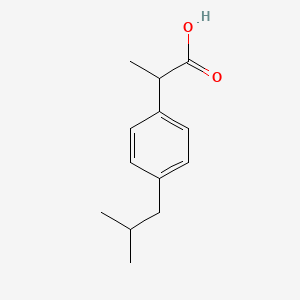
| Formula | C13H18O2 |
|---|---|
| Molecular weight | 206.28 g/mol |
| IUPAC name | 2-[4-(2-methylpropyl)phenyl]propanoic acid |
| CAS | 58560-75-1 |
| PubChem CID | 3672 |
| InChIKey | HEFNNWSXXWATRW-UHFFFAOYSA-N |
| logP | 3.07 (XLogP 3.5) |
| Polar surface area | 37.3 Ų |
| H-bond acceptors / donors | 1 / 1 |
| Drug-likeness (QED) | 0.82 |
| Lipinski violations | 0 |
SMILES
CC(C)Cc1ccc(C(C)C(=O)O)cc1Biology & Pharmacokinetics
Pharmacokinetics
| BBB penetrant | Yes (logBB -0.2) |
|---|
Enzyme interactions
| Enzyme | Role | Detail |
|---|---|---|
| CYP2C19 | Substrate | — |
| CYP2C9 | Inhibitor | Ki 49.99999999999999 µM |
| CYP2C9 | Substrate | — |
| CYP3A4 | Substrate | — |
Receptor binding (top 2)
| Target | Action | Affinity |
|---|---|---|
| COX-2 (PTGS2) | Inhibitor | pIC50 5.9 |
| COX-1 (PTGS1) | Inhibitor | pIC50 5.5 |
Transporters
BCRP (Inhibitor)BCRP (Inhibitor)BSEP (Inhibitor)BSEP (Inhibitor)MCT1 (Inhibitor)MDR1 (Inhibitor)MRP1 (Inhibitor)MRP1 (Inhibitor)MRP2 (Inhibitor)MRP3 (Inhibitor)MRP4 (Inhibitor)OAT1 (Inhibitor)OAT2 (Inhibitor)OAT3 (Inhibitor)OAT4 (Inhibitor)OATP1B1 (Inhibitor)OATP1B1 (Inhibitor)OATP1B3 (Inhibitor)OATP1B3 (Inhibitor)OATP2B1 (Inhibitor)OCT1 (Inhibitor)OCT2 (Inhibitor)P-gp (Inhibitor)MDR1 (Substrate)MRP1 (Substrate)OAT1 (Substrate)OAT3 (Substrate)OATP2B1 (Substrate)P-gp (Substrate)
Drug–drug interactions (100+, DDInter)
| Interacting drug | Severity | Management |
|---|---|---|
| Acalabrutinib | major | |
| Acetylsalicylic acid | major | |
| Aminolevulinic acid | major | |
| Anisindione | major | |
| Apixaban | major | |
| Ardeparin | major | |
| Avapritinib | major | |
| Betrixaban | major | |
| Cabozantinib | major | |
| Cidofovir | major | |
| Dalteparin | major | |
| Danaparoid | major | |
| Dasatinib | major | |
| Deferasirox | major | |
| Desirudin | major | |
| Diatrizoate | major | |
| Dicoumarol | major | |
| Drotrecogin alfa | major | |
| Edoxaban | major | |
| Enoxaparin | major | |
| Everolimus | major | |
| Fondaparinux | major | |
| Human Rho(D) immune globulin | major | |
| Human botulinum neurotoxin A/B immune globulin | major | |
| Human cytomegalovirus immune globulin | major | |
| Human immunoglobulin G (intravenous and subcutaneous) | major | |
| Human immunoglobulin G (intravenous) | major | |
| Ibritumomab tiuxetan | major | |
| Ibrutinib | major | |
| Inotersen | major | |
| Iodipamide | major | |
| Iodixanol | major | |
| Iohexol | major | |
| Iopamidol | major | |
| Iopromide | major | |
| Iothalamic acid | major | |
| Ioversol | major | |
| Ioxilan | major | |
| Ketorolac | major | |
| Leflunomide | major |
Showing 40 of 100+.
Registered Products (79)
| Brand | Form / strength | Pack | Agent | Citizen (JOD) |
|---|---|---|---|---|
| Balkaprofen Suspension | Suspension 100 mg/5 ml | 60 ml pack varies | The Arab Pharmaceutical Manufacturing PSC/Salt | 0.610 |
| Remofen Suspension | Suspension 100 mg/5 ml | 120 ml | Hikma Pharmaceuticals Co.Ltd/Jordan | 0.680 |
| Jofen Ibuprofen Suspension | Suspension 2 % | 60 ml pack varies | JERASH PHARMACEUTICALS LTD.CO/JORDAN | 0.710 |
| Profast Suspension | Suspension 100 mg/5 ml | 60 ml pack varies | Jordan Sweden Medical & Sterilization Co. | 0.710 |
| IBUGESIC 200 TAB. | Tablet 200 mg | 20 tab pack varies | Dar Al Dawa Development and Investment Co Ltd/Jordan | 0.720 |
| Iburam-200mg tablets | Tablet 200 mg | 30 tab | AL-RAM PHARMA.INDUS.CO.LTD/JORDAN | 0.720 |
| PEROFEN | Tablet 200 mg | 30 tab | JAWEDA INT. DRUD STORE | 0.730 |
| RUPAN TAB | Tablet 200 mg | 30 tab | Khoury Drug Store | 0.790 |
| PEROFEN | Tablet 400 mg | 20 tab pack varies | JAWEDA INT. DRUD STORE | 0.930 |
| Jofen Oral Drops | Oral Drops 4 % | 25 ml pack varies | JERASH PHARMACEUTICALS LTD.CO/JORDAN | 1.000 |
| profast drops | Oral Drops 50 mg/1.25 ml | 25 ml | JORDAN SWEDEN MEDICAL&STERILE.CO(JOSWE)/JORDAN | 1.000 |
| Balkaprofen Suspension | Suspension 100 mg/5 ml | 100 ml pack varies | The Arab Pharmaceutical Manufacturing PSC/Salt | 1.010 |
| IBUGESIC 100 SUSP. | Suspension 100 mg/5 ml | 100 ml | Dar Al Dawa Development and Investment Co Ltd/Jordan | 1.100 |
| Midofen F.C Tab. | Film-Coated Tablet 400 mg | 20 tab pack varies | MIDDLE EAST PHARMA&CHEMICAL IND/JORDAN | 1.100 |
| Balkaprofen F.C Tablets | Film-Coated Tablet 400 mg | 2x10s | The Arab Pharmaceutical Manufactruing Co. | 1.150 |
| Iburam-400mg tablets | Tablet 400 mg | 20 tab pack varies | AL-RAM PHARMA.INDUS.CO.LTD/JORDAN | 1.150 |
| Ibuphil Gel | Gel 5 % | 30 g tube | PHILADELPHIA PHAEMACEUTICALS.COMP/JORDAN | 1.170 |
| Doloraz Susp. | Suspension 100 mg/5 ml | 100 ml | THE JORDANIAN PHARMACEUTICAL MANUFACTURING COMPANY/JORDAN | 1.190 |
| Ibuphil Paediatric Syrup | Syrup 2 % | 100 ml | PHILADELPHIA PHAEMACEUTICALS.COMP/JORDAN | 1.190 |
| Jofen Ibuprofen Suspension | Suspension 2 % | 100 ml pack varies | JERASH PHARMACEUTICALS LTD.CO/JORDAN | 1.190 |
| Profast Suspension | Suspension 100 mg/5 ml | 100 ml pack varies | Jordan Sweden Medical & Sterilization Co. | 1.190 |
| Taskine F.C Tab | Film-Coated Tablet 400 mg | 30 tab | UNITED PHARM.MFG.CO.LTD(UPM)/JORDAN | 1.200 |
| Taskine Children | Suspension 100 mg/5 ml | 100 ml | UNITED PHARM.MFG.CO.LTD(UPM)/JORDAN | 1.250 |
| taskine pain | Tablet 200 mg, 500 mg | 30 tab | UNITED PHARM.MFG.CO.LTD(UPM)/JORDAN | 1.250 |
| Ibusoft | Capsule 400 mg | 30 cap pack varies | The Jordan Drugstore Co | 1.270 |
| Ibusoft | Capsule 400 mg | 10 cap pack varies | The Jordan Drugstore Co | 1.270 |
| RUPAN F.C. TAB | Film-Coated Tablet 400 mg | 30 tab pack varies | Khoury Drug Store | 1.360 |
| Ibugesic 400 TAB. | Tablet 400 mg | 24 tab pack varies | Dar Al Dawa Development and Investment Co Ltd/Jordan | 1.370 |
| Iburam-600mg tablets | Tablet 600 mg | 20 tab pack varies | AL-RAM PHARMA.INDUS.CO.LTD/JORDAN | 1.390 |
| Jofen Ibuprofen Suspension | Suspension 2 % | 120 ml pack varies | JERASH PHARMACEUTICALS LTD.CO/JORDAN | 1.420 |
| Profast Suspension | Suspension 100 mg/5 ml | 120 ml pack varies | Jordan Sweden Medical & Sterilization Co. | 1.430 |
| Sapofen Junior Sus | Suspension 100 mg/5 ml | 145 ml | Shawi & Rushedat Drug Store | 1.510 |
| Ibugesic Cold & Sinus | Tablet 200 mg, 30 mg | 20 tab | Dar Al Dawa Development and Investment Co Ltd/Jordan | 1.590 |
| IBUMOL-400 | Tablet 325 mg, 400 mg | 30 tab pack varies | Sahar Drug Store | 1.730 |
| Iburam-400mg tablets | Tablet 400 mg | 30 tab pack varies | AL-RAM PHARMA.INDUS.CO.LTD/JORDAN | 1.730 |
| Joswe Profast 200mg Eff.Tab | Effervescent Tablet 200 mg | 10 tab | Jordan Sweden Medical & Sterilization Co. | 1.790 |
| Taskine Muscles Tablets | Tablet 200.0 mg, 500 mg | 20 tab | / UNITED PHARM.MFG.CO.LTD(UPM)/JORDAN / General | 1.800 |
| Bigesic | Tablet 325.0 mg, 400.0 mg | 30 tab pack varies | / JORDAN SWEDEN MEDICAL&STERILE.CO(JOSWE)/JORDAN / General | 1.850 |
| Jofen Oral Drops | Oral Drops 4 % | 50 ml pack varies | JERASH PHARMACEUTICALS LTD.CO/JORDAN | 1.900 |
| Profast forte suspension 200 mg /5 ml | Suspension 200 mg/5 ml | 100 ml | JORDAN SWEDEN MEDICAL&STERILE.CO(JOSWE)/JORDAN | 2.020 |
| Taskine 200mg S.G Caps | Capsule 200 mg | 30 cap | UNITED PHARM.MFG.CO.LTD(UPM)/JORDAN | 2.030 |
| Algifast 400 mg / Powder for oral suspension | Suspension 683.34 mg | 12 sachet | Hussam Al Nmer Drug Store | 2.060 |
| Taskine Tab | Tablet 600 mg | 30 tab | UNITED PHARM.MFG.CO.LTD(UPM)/JORDAN | 2.080 |
| Algidrin 600 mg / Powder for oral suspension | Suspension 1025 mg | 20 sachet | Hussam Al Nmer Drug Store | 2.090 |
| Algidrin Infantil 200 mg / Powder for oral suspension | Suspension 341.67 mg | 20 BAG/1 BOX | Hussam Al Nmer Drug Store | 2.090 |
| Iburam-600mg tablets | Tablet 600 mg | 30 tab pack varies | AL-RAM PHARMA.INDUS.CO.LTD/JORDAN | 2.090 |
| Remofen Max | Capsule 400 mg | 1 cap | Hikma Pharmaceuticals Co.Ltd/Jordan | 2.150 |
| BRUFEN Suspension | Suspension 100 mg/5 ml | 100 ml | Sukhtian Group | 2.170 |
| Sapofen Tab | Tablet 600 mg | 30 tab | Shawi & Rushedat Drug Store | 2.180 |
| ADVIL COLD & SINUS CAPLET | Tablet 200 mg, 30 mg | 20 Caplet | Sukhtian Group | 2.370 |
| Ibusoft | Capsule 400 mg | 20 cap pack varies | The Jordan Drugstore Co | 2.410 |
| FENBID SPAN Cap | Capsule 300 mg | 30 cap | Sukhtian Group | 2.480 |
| BRUFEN | Tablet 400 mg | 30 tab pack varies | Sukhtian Group | 2.490 |
| Nashat | Tablet 400 mg | 20 tab | AL-TAQADDOM PHARMACEUTICAL INDUSTRIES/JORDAN | 2.690 |
| Taskine 400mg S.G Cap | Capsule 400 mg | 20 cap pack varies | UNITED PHARM.MFG.CO.LTD(UPM)/JORDAN | 2.710 |
| BRUFEN | Tablet 600 mg | 30 tab | Sukhtian Group | 2.790 |
| Brufen Retard 800 TAB | Tablet 800 mg | 20 tab | Sukhtian Group | 2.840 |
| Doloraz | Tablet 400 mg | 20 tab pack varies | THE JORDANIAN PHARMACEUTICAL MANUFACTURING COMPANY/JORDAN | 3.000 |
| Ibu- Quick | Capsule 400 mg | 20 cap pack varies | Al-motakadema pharmaceutical Ltd/Jordan | 3.000 |
| Deep Relief 5% + 3% W/W Gel | Gel 5 %, 3 % | 100 g tube | Khoury Drug Store | 3.930 |
| Advil 200 Liqui-Gel Cap | Capsule 200 mg | 32 cap | Sukhtian Group | 4.170 |
| Jofen 400 mg Soft Gelatin Capsule | Capsule 400 mg | 10 cap | شركة جرش للصناعات الدوائية / Jerash Pharmaceuticals Company / General | 4.230 |
| IBUMOL-400 | Tablet 325 mg, 400 mg | 100 tab pack varies | Sahar Drug Store | 4.300 |
| IBUGESIC 200 TAB. | Tablet 200 mg | 500 tab pack varies | Dar Al Dawa Development and Investment Co Ltd/Jordan | 10.330 |
| Bigesic | Tablet 325.0 mg, 400.0 mg | 200 tab pack varies | / JORDAN SWEDEN MEDICAL&STERILE.CO(JOSWE)/JORDAN / General | 11.350 |
| Ibusoft | Capsule 400 mg | 100 cap pack varies | The Jordan Drugstore Co | 11.430 |
| RUPAN F.C. TAB | Film-Coated Tablet 400 mg | 500 tab pack varies | Khoury Drug Store | 15.910 |
| BRUFEN | Tablet 400 mg | 250 tab pack varies | Sukhtian Group | 18.730 |
| Midofen F.C Tab. | Film-Coated Tablet 400 mg | 500 tab pack varies | MIDDLE EAST PHARMA&CHEMICAL IND/JORDAN | 19.080 |
| PEROFEN 400 TABS | Tablet 400 mg | 500 tab pack varies | JAWEDA INT. DRUD STORE | 19.090 |
| Ibugesic 400 TAB. | Tablet 400 mg | 504 tab pack varies | Dar Al Dawa Development and Investment Co Ltd/Jordan | 24.450 |
| RUPAN F.C. TAB | Film-Coated Tablet 400 mg | 1000 tab pack varies | Khoury Drug Store | 38.470 |
| Balkaprofen Suspension | Suspension 100 mg/5 ml | 100 ml pack varies | The Arab Pharmaceutical Manufacturing PSC/Salt | 40.000 |
| Iburam-400mg tablets | Tablet 400 mg | 1000 tab pack varies | AL-RAM PHARMA.INDUS.CO.LTD/JORDAN | 43.700 |
| Iburam-600mg tablets | Tablet 600 mg | 1000 tab pack varies | AL-RAM PHARMA.INDUS.CO.LTD/JORDAN | 59.080 |
| Ibu- Quick | Capsule 400 mg | 500 cap pack varies | Al-motakadema pharmaceutical Ltd/Jordan | 63.730 |
| Doloraz | Tablet 400 mg | 500 tab pack varies | THE JORDANIAN PHARMACEUTICAL MANUFACTURING COMPANY/JORDAN | 63.750 |
| Taskine 400mg S.G Cap | Capsule 400 mg | 600 cap pack varies | UNITED PHARM.MFG.CO.LTD(UPM)/JORDAN | 69.110 |
| Prof 400mg Solution for IV Injection | Injection 100 mg/1 ml | 5 vial | Sukhtian Group | — |