Abiraterone
JFDA label: Zytiga 250 Tab
Mechanism of Action
Inhibitor of Steroid 17-alpha-hydroxylase/17,20 lyase — Cytochrome P450 17A1 inhibitor; Antagonist of Androgen receptor — Androgen Receptor antagonist; Inhibitor of Steroid 5-alpha-reductase — Steroid 5-alpha-reductase inhibitor
| Target | Action | Gene / class |
|---|---|---|
| Androgen receptor efficacy | ANTAGONIST | AR |
| Steroid 17-alpha-hydroxylase/17,20 lyase efficacy | INHIBITOR | CYP17A1 |
| Steroid 5-alpha-reductase efficacy | INHIBITOR |
Indications
Approved
- Prostate cancer
Contraindications
Source: Lexicomp
- Additional contraindication (not in the US labeling): Hypersensitivity to abiraterone acetate or any component of the formulation or container Absolute
- Women who are or may become pregnant Absolute
Adverse Reactions
Cardiac disorders (5)
Very Common edema · Hypertension
Common Cardiac arrhythmia · cardiac failure · chest pain
Nervous system disorders (4)
Very Common Fatigue · insomnia
Common falling · Headache
Hepatobiliary disorders (3)
Very Common Increased serum ALT · increased serum AST · increased serum bilirubin
Renal and urinary disorders (5)
Very Common Urinary tract infection
Common groin pain · Hematuria · nocturia · urinary frequency
Blood and lymphatic system disorders (2)
Very Common bruise · Lymphocytopenia
Metabolism and nutrition disorders (6)
Very Common hot flash · hyperglycemia · hypernatremia · Hypertriglyceridemia · hypokalemia · hypophosphatemia
Gastrointestinal disorders (3)
Very Common Constipation · diarrhea · dyspepsia
Skin and subcutaneous tissue disorders (1)
Common Skin rash
Musculoskeletal and connective tissue disorders (3)
Very Common Joint swelling · myalgia
Common Bone fracture
General disorders and administration site conditions (1)
Common Fever
Respiratory, thoracic and mediastinal disorders (4)
Very Common Cough · dyspnea · nasopharyngitis · upper respiratory infection
Dosing
Source: Lexicomp
Warnings & Precautions
Source: Lexicomp
Adrenocortical insufficiency
Concurrent infection, stress, or interruption of daily corticosteroids is associated with reports of adrenocortical insufficiency. Monitor closely for signs and symptoms of adrenocorticoid insufficiency, which could be masked by adverse events associated with mineralocorticoid excess. Diagnostic testing for adrenal insufficiency may be clinically indicated. Increased corticosteroid doses may be required before, during, and after stress.
Hepatotoxicity
Severe hepatotoxicity (eg, fulminant hepatitis, acute liver failure, and death) has been reported. Significant increases in liver enzymes (including grade 3 and 4 events) have also been observed (higher likelihood in patients with baseline elevations), generally occurring in the first 3 months of treatment. May require dosage reduction, treatment interruption, and/or discontinuation. ALT, AST, and bilirubin should be monitored prior to treatment, every 2 weeks for 3 months and monthly thereafter; patients with hepatic impairment, elevations in liver function tests, or experiencing hepatotoxicity require more frequent monitoring (see dosage adjustment for hepatic impairment and monitoring parameters). Evaluate liver function promptly with signs or symptoms of hepatotoxicity. The safety of retreatment after significant elevations (ALT or AST ≥20 times the upper limit of normal [ULN] and/or total bilirubin ≥10 times ULN) has not been evaluated.
Mineralocorticoid excess
Increased mineralocorticoids due to CYP17 inhibition may result in hypertension, hypokalemia, and fluid retention (including grade 3 and 4 events). Monitor at least monthly for hypertension, hypokalemia, and fluid retention. Concomitant administration with corticosteroids reduces the incidence and severity of these adverse events. Disease-related concerns:
Cardiovascular disease
May cause hypertension, hypokalemia, and fluid retention. Control hypertension and correct hypokalemia prior to and during treatment. Use with caution in patients with cardiovascular disease, particularly with heart failure, recent MI, or ventricular arrhythmia. Patients with left ventricular ejection fraction (LVEF) • Hepatic impairment: Do not use in patients with preexisting severe hepatic impairment (Child-Pugh class C); dosage reduction is recommended in patients with baseline moderate impairment. Concurrent drug therapy issues:
Drug-drug interactions
Potentially significant interactions may exist, requiring dose or frequency adjustment, additional monitoring, and/or selection of alternative therapy. Consult drug interactions database for more detailed information. Other warnings/precautions:
Food
Abiraterone must be administered on an empty stomach (administer at least 1 hour before and 2 hours after any food); abiraterone AUC (exposure) may be increased up to 10-fold if administered with a meal.
Pregnancy & Lactation
Pregnancy
Based on the mechanism of action and adverse effects observed in animal reproduction studies, abiraterone may cause fetal harm or fetal loss if administered during pregnancy. Abiraterone is not indicated for use in women and is specifically contraindicated in women who are or may become pregnant. Abiraterone is available in uncoated and film-coated tablets; the manufacturer recommends females who are or may become pregnant wear gloves if handling uncoated tablets or tablets that are broken, crushed or damaged. NIOSH recommends single gloving for administration of hazardous intact oral tablets (NIOSH 2016). Male patients with female partners of reproductive potential should use effective contraception during treatment and for 3 weeks after the last abiraterone dose. Abiraterone may impair reproductive function and fertility in males of reproductive potential.
Lactation
It is not known if abiraterone is present in breast milk. Abiraterone is not indicated for use in women.
Monitoring
| Clinical pearl | ALT, AST, and bilirubin prior to treatment, every 2 weeks for 3 months and monthly thereafter; if baseline moderate hepatic impairment (Child-Pugh class B), monitor ALT, AST, and bilirubin prior to treatment, weekly for the first month, every 2 weeks for 2 months then monthly thereafter. If hepatotoxicity develops during treatment (and only after therapy is interrupted and liver function tests have returned to safe levels), monitor ALT, AST, and bilirubin every 2 weeks for 3 months and monthly thereafter. Monitoring of testosterone levels is not necessary. Serum potassium (prior to treatment and at least monthly). Monitor for signs and symptoms of adrenocorticoid insufficiency; if clinically indicated, consider appropriate diagnostics to confirm adrenal insufficiency. Monitor blood pressure and for fluid retention (prior to treatment and at least monthly). Monitor adherence. |
|---|
Chemistry & Properties
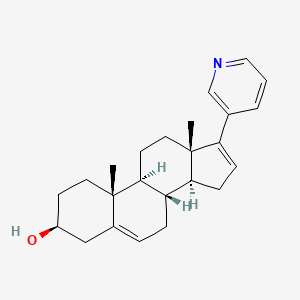
| Formula | C24H31NO |
|---|---|
| Molecular weight | 349.52 g/mol |
| IUPAC name | (3S,8R,9S,10R,13S,14S)-10,13-dimethyl-17-pyridin-3-yl-2,3,4,7,8,9,11,12,14,15-decahydro-1H-cyclopenta[a]phenanthren-3-ol |
| CAS | 154229-19-3 |
| PubChem CID | 132971 |
| InChIKey | GZOSMCIZMLWJML-VJLLXTKPSA-N |
| logP | 5.4 (XLogP 4.6) |
| Polar surface area | 33.12 Ų |
| H-bond acceptors / donors | 2 / 1 |
| Drug-likeness (QED) | 0.69 |
| Lipinski violations | 1 |
SMILES
C[C@]12CC[C@H](O)CC1=CC[C@@H]1[C@@H]2CC[C@]2(C)C(c3cccnc3)=CC[C@@H]12Biology & Pharmacokinetics
Pharmacokinetics predicted
| Bioavailability | 70.0% |
|---|---|
| Half-life | 0.119 h |
| Volume of distribution | 0.854 L/kg |
| Protein binding | 77.2% |
| BBB penetrant | Yes |
Enzyme interactions
| Enzyme | Role | Detail |
|---|---|---|
| CYP2B6 | Inhibitor | — |
| CYP2C8 | Inhibitor | — |
| CYP3A4 | Inhibitor | IC₅₀ 1.7918655387458984 µM |
| CYP3A4 | Substrate | — |
Transporters
BCRP (Inhibitor)BSEP (Inhibitor)BSEP (Inhibitor)MDR1 (Inhibitor)MRP1 (Inhibitor)MRP1 (Inhibitor)MRP2 (Inhibitor)MRP3 (Inhibitor)MRP4 (Inhibitor)OAT1 (Inhibitor)OAT3 (Inhibitor)OATP1B1 (Inhibitor)OATP1B3 (Inhibitor)P-gp (Inhibitor)MDR1 (Substrate)P-gp (Substrate)
Drug–drug interactions (100+, DDInter)
| Interacting drug | Severity | Management |
|---|---|---|
| Amiodarone | major | |
| Amisulpride | major | |
| Anagrelide | major | |
| Apalutamide | major | |
| Arsenic trioxide | major | |
| Bedaquiline | major | |
| Benzhydrocodone | major | |
| Bepridil | major | |
| Brexpiprazole | major | |
| Cabozantinib | major | |
| Carbamazepine | major | |
| Ceritinib | major | |
| Cisapride | major | |
| Citalopram | major | |
| Clozapine | major | |
| Crizotinib | major | |
| Disopyramide | major | |
| Dofetilide | major | |
| Dolasetron | major | |
| Dronedarone | major | |
| Droperidol | major | |
| Edoxaban | major | |
| Eliglustat | major | |
| Enzalutamide | major | |
| Escitalopram | major | |
| Fingolimod | major | |
| Fosphenytoin | major | |
| Gatifloxacin | major | |
| Grazoprevir | major | |
| Grepafloxacin | major | |
| Halofantrine | major | |
| Haloperidol | major | |
| Hydrocodone | major | |
| Ibutilide | major | |
| Iloperidone | major | |
| Ivabradine | major | |
| Ivosidenib | major | |
| Lefamulin | major | |
| Leflunomide | major | |
| Levacetylmethadol | major |
Showing 40 of 100+.
Registered Products (9)
| Brand | Form / strength | Pack | Agent | Citizen (JOD) |
|---|---|---|---|---|
| ABIRANAT (Abiraterone Acetate Tablets USP 250 mg) | Tablet 250 mg | 120 tab | Al-Motakadema Pharmaceutical LTD. | — |
| ABIRATERONE ACETATE NEAPOLIS | Tablet Abiraterone Acetate 250 mg | 120 tab | Professional Drug Store | — |
| Abremia | Tablet 250 mg | 120 tab | Hikma Pharmaceuticals Co.Ltd/Jordan | — |
| Birato | Tablet 250 mg | 120 tab | Manar Drug Store | — |
| PROCULA | Tablet 250 mg | 120 tab | Dar Al Dawa Development and Investment Co Ltd/Jordan | — |
| Stamagen | Tablet 500 mg | 56 tab | / Pharma International Company/Jordan / General | — |
| Zytiga | Tablet 500 mg | 60 tab | Adatco Drug Store | — |
| Zytiga 250 Tab | Tablet 250 mg | 120 tab | Adatco Drug Store | — |
| abdizyt | Tablet Abiraterone Acetate 250 mg | 120 tab | Sun Set Drug Store | — |