Alendronic Acid
JFDA label: Alendomax Caplet
Mechanism of Action
A bisphosphonate which inhibits bone resorption via actions on osteoclasts or on osteoclast precursors; decreases the rate of bone resorption, leading to an indirect increase in bone mineral density. In Paget's disease, characterized by disordered resorption and formation of bone, inhibition of resorption leads to an indirect decrease in bone formation; but the newly-formed bone has a more normal architecture.
Indications
Approved
- Osteoporosis
Off-label
- Glucocorticoid-induced osteoporosis (prevention)
- Osteogenesis imperfecta (adults)
- Osteogenesis imperfecta (children/adolescents)
Contraindications
Source: Lexicomp
- Additional contraindications (not in US labeling): Renal insufficiency with creatinine clearance Absolute
- Hypersensitivity to alendronate, other bisphosphonates, or any component of the formulation Absolute
- abnormalities of the esophagus (eg, stricture, achalasia) which delay esophageal emptying Absolute
- hypocalcemia Absolute
- inability to stand or sit upright for at least 30 minutes Absolute
- increased risk of aspiration (effervescent tablets Absolute
- oral solution) Absolute
Adverse Reactions
Nervous system disorders (1)
Common Headache
Metabolism and nutrition disorders (1)
Common Decreased serum phosphate
Gastrointestinal disorders (14)
Common abdominal distension · Abdominal pain · acid regurgitation · constipation · diarrhea · dyspepsia · dysphagia · esophageal ulcer · flatulence · gastric ulcer · gastritis · gastroesophageal reflux disease · melena · nausea
Musculoskeletal and connective tissue disorders (2)
Common muscle cramps · Musculoskeletal pain
Other (2)
Very Common Endocrine & metabolic: Decreased serum calcium
Not Known Incidence of adverse effects (mostly GI) increases significantly in patients treated for Paget's disease at 40 mg/day
Dosing
Source: Lexicomp
Warnings & Precautions
Source: Lexicomp
Bone fractures
Atypical femur fractures (AFF) have been reported in patients receiving bisphosphonates. The fractures include subtrochanteric femur (bone just below the hip joint) and diaphyseal femur (long segment of the thigh bone). Some patients experience prodromal pain weeks or months before the fracture occurs. It is unclear if bisphosphonate therapy is the cause for these fractures; atypical femur fractures have also been reported in patients not taking bisphosphonates, and in patients receiving glucocorticoids. Patients receiving long-term (>3 to 5 years) bisphosphonate therapy may be at an increased risk (Adler 2016; NOF [Cosman 2014]); however, benefits of therapy (when used for osteoporosis) generally outweigh absolute risk of AFF within the first 5 years of treatment (Adler 2016). Patients presenting with thigh or groin pain with a history of receiving bisphosphonates should be evaluated for femur fracture. Consider interrupting bisphosphonate therapy in patients who develop a femoral shaft fracture; assess for fracture in the contralateral limb.
Bone/joint/muscle pain
Severe (and occasionally debilitating) bone, joint, and/or muscle pain have been reported during bisphosphonate treatment. The onset of pain ranged from a single day to several months. Consider discontinuing therapy in patients who experience severe symptoms; symptoms usually resolve upon discontinuation. Some patients experienced recurrence when rechallenged with same drug or another bisphosphonate; avoid use in patients with a history of these symptoms in association with bisphosphonate therapy.
Gastrointestinal mucosa irritation
May cause irritation to upper gastrointestinal mucosa. Esophagitis, dysphagia, esophageal ulcers, esophageal erosions, and esophageal stricture (rare) have been reported with oral bisphosphonates; risk increases in patients unable to comply with dosing instructions. Use with caution in patients with dysphagia, esophageal disease, gastritis, duodenitis, or ulcers (may worsen underlying condition). Discontinue use if new or worsening symptoms develop.
Hypocalcemia
Hypocalcemia has been reported with the use of bisphosphonates. Prior to therapy initiation, hypocalcemia must be corrected; ensure adequate calcium and vitamin D intake.
Ocular effects
Conjunctivitis, uveitis, episcleritis, and scleritis have been reported with alendronate; patients presenting with signs of ocular inflammation may require further ophthalmologic evaluation.
Osteonecrosis of the jaw
Osteonecrosis of the jaw (ONJ), also referred to as medication-related osteonecrosis of the jaw (MRONJ), has been reported in patients receiving bisphosphonates. Known risk factors for MRONJ include invasive dental procedures (eg, tooth extraction, dental implants, boney surgery), cancer diagnosis, concomitant therapy (eg, chemotherapy, corticosteroids, angiogenesis inhibitors), poor oral hygiene, ill-fitting dentures, and comorbid disorders (anemia, coagulopathy, infection, preexisting dental or periodontal disease). Risk may increase with increased duration of bisphosphonate use. According to a position paper by the American Association of Maxillofacial Surgeons (AAOMS), MRONJ has been associated with bisphosphonate and other antiresorptive agents (denosumab), and antiangiogenic agents (eg, bevacizumab, sunitinib) used for the treatment of osteoporosis or malignancy; risk of MRONJ is significantly higher in cancer patients receiving antiresorptive therapy compared to patients receiving osteoporosis treatment (regardless of medication used or dosing schedule). MRONJ risk is also increased with intravenous antiresorptive use compared to the minimal risk associated with oral bisphosphonate use, although risk appears to increase with oral bisphosphonates when duration of therapy exceeds 4 years (AAOMS [Ruggiero 2014]). The manufacturer's labeling states that in patients requiring invasive dental procedures, discontinuing bisphosphonates may reduce the risk of ONJ and clinical j
Renal impairment
Use with caution in patients with renal impairment (not recommended for use in patients with CrCl Concurrent drug therapy issues:
Drug-drug interactions
Potentially significant interactions may exist, requiring dose or frequency adjustment, additional monitoring, and/or selection of alternative therapy. Consult drug interactions database for more detailed information. Dosage form specific issues:
Effervescent tablet
Each effervescent tablet contains 650 mg of sodium (NaCl 1650 mg). Use with caution in patients following a sodium-restricted diet.
Pregnancy & Lactation
Pregnancy
Adverse events were observed in animal reproduction studies. It is not known if bisphosphonates cross the placenta, but fetal exposure is expected (Djokanovic 2008; Stathopoulos 2011). Bisphosphonates are incorporated into the bone matrix and gradually released over time. The amount available in the systemic circulation varies by dose and duration of therapy. Theoretically, there may be a risk of fetal harm when pregnancy follows the completion of therapy; however, available data have not shown that exposure to bisphosphonates during pregnancy significantly increases the risk of adverse fetal events (Djokanovic 2008; Levy 2009; Stathopoulos 2011). Until additional data is available, most sources recommend discontinuing bisphosphonate therapy in women of reproductive potential as early as possible prior to a planned pregnancy; use in premenopausal women should be reserved for special circumstances when rapid bone loss is occurring (Bhalla 2010; Pereira 2012; Stathopoulos 2011). Because
Lactation
It is not known if alendronate is excreted into breast milk. The manufacturer recommends that caution be exercised when administering alendronate to nursing women.
Monitoring
| Clinical pearl | Osteoporosis: Bone mineral density (BMD) should be evaluated 1 to 2 years after initiating therapy and every 1 to 2 years (or less frequently if stable) thereafter (AACE/ACE [Camacho 2016]; NOF [Cosman 2014]); in patients with combined alendronate and glucocorticoid treatment, evaluate BMD at initiation of glucocorticoid therapy and after 6 to 12 months, then every 2 to 3 years if patient continues to have significant osteoporosis risk factors (ACR [Buckley 2017]); annual measurements of height and weight, assessment of chronic back pain; serum calcium and 25(OH)D; may consider monitoring biochemical markers of bone turnover Paget disease: Alkaline phosphatase at 6 to 12 weeks for initial response to treatment (when bone turnover will have shown a substantial decline) and potentially at 6 months (maximal suppression of high bone turnover); following treatment completion, monitor at ~6- to 12-month intervals (Singer 2014); monitoring more specific biochemical markers of bone turnover (eg, serum P1NP, NTX, serum beta-CTx) is generally only warranted in patients with Paget disease who have abnormal liver or biliary tract function or when early assessment of response to treatment is needed (eg, spinal compression, very active disease) (Singer 2014); pain; serum calcium and 25(OH)D |
|---|
Chemistry & Properties
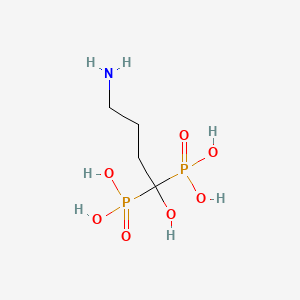
| Formula | C4H13NO7P2 |
|---|---|
| Molecular weight | 249.1 g/mol |
| IUPAC name | (4-amino-1-hydroxy-1-phosphonobutyl)phosphonic acid |
| CAS | 66376-36-1 |
| PubChem CID | 2088 |
| InChIKey | OGSPWJRAVKPPFI-UHFFFAOYSA-N |
| logP | -1.27 (XLogP -6.5) |
| Polar surface area | 161.31 Ų |
| H-bond acceptors / donors | 4 / 6 |
| Drug-likeness (QED) | 0.33 |
| Lipinski violations | 1 |
SMILES
NCCCC(O)(P(=O)(O)O)P(=O)(O)OBiology & Pharmacokinetics
Pharmacokinetics
| BBB penetrant | No |
|---|
Enzyme interactions
| Enzyme | Role | Detail |
|---|---|---|
| CYP2C9 | Substrate | — |
Receptor binding (top 1)
| Target | Action | Affinity |
|---|---|---|
| farnesyl diphosphate synthase (FDPS) | Inhibitor | pIC50 6.3 |
Transporters
BCRP (Inhibitor)BSEP (Inhibitor)BSEP (Inhibitor)MRP1 (Inhibitor)MRP2 (Inhibitor)MRP3 (Inhibitor)MRP4 (Inhibitor)OATP1B1 (Inhibitor)OATP1B3 (Inhibitor)P-gp (Inhibitor)P-gp (Substrate)
Drug–drug interactions (51, DDInter)
| Interacting drug | Severity | Management |
|---|---|---|
| Deferasirox | major | |
| Etelcalcetide | major | |
| Acetylsalicylic acid | moderate | |
| Alpelisib | moderate | |
| Aluminum hydroxide | moderate | |
| Amikacin | moderate | |
| Amikacin (liposome) | moderate | |
| Attapulgite | moderate | |
| Bevacizumab | moderate | |
| Calcium Phosphate | moderate | |
| Calcium acetate | moderate | |
| Calcium carbonate | moderate | |
| Calcium citrate | moderate | |
| Calcium glubionate anhydrous | moderate | |
| Calcium gluconate | moderate | |
| Calcium lactate | moderate | |
| Celecoxib | moderate | |
| Diclofenac | moderate | |
| Ferrous fumarate | moderate | |
| Ferrous gluconate | moderate | |
| Flurbiprofen | moderate | |
| Gentamicin | moderate | |
| Ibuprofen | moderate | |
| Iron | moderate | |
| Iron sucrose | moderate | |
| Kanamycin | moderate | |
| Kaolin | moderate | |
| Lanthanum carbonate | moderate | |
| Magaldrate | moderate | |
| Magnesium carbonate | moderate | |
| Magnesium chloride | moderate | |
| Magnesium citrate | moderate | |
| Magnesium gluconate | moderate | |
| Magnesium hydroxide | moderate | |
| Magnesium oxide | moderate | |
| Magnesium sulfate | moderate | |
| Neomycin | moderate | |
| Parathyroid hormone | moderate | |
| Salicylic acid (sodium) | moderate | |
| Streptomycin | moderate |
Showing 40 of 51.
Registered Products (12)
| Brand | Form / strength | Pack | Agent | Citizen (JOD) |
|---|---|---|---|---|
| Dargol | Tablet 70 mg | 4 tab pack varies | AL Rahma Drug Store | 5.180 |
| Alendronate Sandoz | Tablet 70 mg | 4 tab | Nabulsi Drug Store | 6.470 |
| Osteogrow Tab | Tablet 70 mg | 4 tab | Abu Sheikha Drug Store | 6.870 |
| Alendomax Caplet | Tablet eq to Alendronic Acid 70 mg | 4 tab | Jordan Sweden Medical & Sterilization Co. | 8.830 |
| Alfa-Porosis | Tablet 70 mg | 4 tab | UNITED PHARM.MFG.CO.LTD(UPM)/JORDAN | 8.830 |
| Drolate 70 | Tablet 70 mg | 4 tab | THE JORDANIAN PHARMACEUTICAL MANUFACTURING COMPANY/JORDAN | 8.830 |
| Foznate | Tablet 70 mg | 4 tab | Savvy Pharma | 8.830 |
| Bonmax | Tablet 10 mg | 20 tab | AL-RAM PHARMA.INDUS.CO.LTD/JORDAN | 9.030 |
| Fosavance | Tablet 70 mg, 2800 IU | 4 tab | Adatco Drug Store | 11.860 |
| Binosto 70mg Eff Tab | Effervescent Tablet 70 mg | 4 tab | ORIENT DRUG STORE CO | 13.930 |
| Dargol | Tablet 70 mg | 12 tab pack varies | AL Rahma Drug Store | 14.600 |
| Drolate 10 | Tablet 10 mg | 30 tab | THE JORDANIAN PHARMACEUTICAL MANUFACTURING COMPANY/JORDAN | 16.350 |