Amphotericin B
JFDA label: Amphotrecin B Vial
- Appropriate use:
- Error prevention:
Mechanism of Action
Sequestering Agent of Ergosterol — Ergosterol sequestering agent
| Target | Action | Gene / class |
|---|---|---|
| Ergosterol efficacy | SEQUESTERING AGENT |
Indications
Approved
- Leishmaniasis
- Life-threatening fungal infections
Off-label
- Candidiasis, endophthalmitis (intravitreal)
- Candidiasis, esophageal (non-HIV-infected patients)
- Candidiasis, esophageal, in HIV-exposed/-infected patients (infants/children)
- Candidiasis, esophageal, in HIV-infected patients (adolescents and adults)
- Candidiasis, oropharyngeal (fluconazole-refractory) (oral)
- Candidiasis, urinary tract
- Ocular aspergillosis (ophthalmic)
Antimicrobial Spectrum
Expected / intrinsic spectrum (EUCAST breakpoints & labels) — not local resistance. Source: openfda-label.
Fungi
| Organism | Activity | MIC |
|---|---|---|
| Aspergillus flavus | Active | — |
| Aspergillus fumigatus | Active | — |
| Blastomyces dermatitidis | Active | — |
| Candida albicans | Active | — |
| Candida krusei | Active | — |
| Candida lusitaniae | Active | — |
| Candida parapsilosis | Active | — |
| Candida tropicalis | Active | — |
| Cryptococcus neoformans | Active | — |
| Leishmania infantum | Active | — |
Class profile
| antifungalClass | Polyene |
|---|---|
| targetMolecule | Ergosterol (membrane disruption) |
| isFungicidal | 1 |
| spectrumCandida | S (intrinsic) |
| spectrumAspergillus | S (intrinsic) |
| spectrumCryptococcus | S |
| spectrumDermatophytes | Variable |
| resistanceMechanisms | Ergosterol deficiency (ERG2/ERG3 mutations),Membrane lipid changes (tolerance) |
| source | Pappas2016/Lass-Florl2011 |
Contraindications
Source: Lexicomp
- Hypersensitivity to amphotericin or any component of the formulation Absolute
Adverse Reactions
Cardiac disorders (3)
Very Common Hypotension
Common Flushing · hypertension
Nervous system disorders (8)
Very Common Chills · headache (less frequent with I.T.) · malaise · pain (less frequent with I.T.)
Common Arachnoiditis · delirium · neuralgia (lumbar; especially with intrathecal therapy) · paresthesia (especially with intrathecal therapy)
Renal and urinary disorders (3)
Very Common Renal function abnormality (including azotemia, renal tubular acidosis, nephrocalcinosis [>0.1 mg/ml]) · renal insufficiency
Common Urinary retention
Blood and lymphatic system disorders (2)
Very Common Anemia (normochromic-normocytic)
Common Leukocytosis
Metabolism and nutrition disorders (2)
Very Common Hypokalemia · hypomagnesemia
Gastrointestinal disorders (7)
Very Common Anorexia · diarrhea · epigastric pain · heartburn · nausea (less frequent with I.T.) · stomach cramps · vomiting (less frequent with I.T.)
General disorders and administration site conditions (2)
Very Common Fever · Pain at injection site (with or without phlebitis or thrombophlebitis [incidence may increase with peripheral infusion of admixtures])
Respiratory, thoracic and mediastinal disorders (1)
Very Common Tachypnea
Dosing
Source: Lexicomp
Warnings & Precautions
Source: Lexicomp
Anaphylaxis
Has been reported with amphotericin B-containing drugs; facilities for cardiopulmonary resuscitation should be available during administration due to the possibility of anaphylactic reaction. If severe respiratory distress occurs, the infusion should be immediately discontinued; during the initial dosing, the drug should be administered under close clinical observation.
Infusion reactions
Acute reactions (eg, fever, shaking chills, hypotension, anorexia, nausea, vomiting, headache, tachypnea) may occur 1 to 3 hours after starting an intravenous infusion. These reactions are usually more common with the first few doses and generally diminish with subsequent doses. Avoid rapid infusion to prevent hypotension, hypokalemia, arrhythmias, and shock.
Leukoencephalopathy
Has been reported following administration of amphotericin. Total body irradiation has been reported to be a possible predisposition.
Nephrotoxicity
May cause nephrotoxicity; usual risk factors include underlying renal disease, concomitant nephrotoxic medications and daily and/or cumulative dosing of amphotericin. Avoid use with other nephrotoxic drugs; drug-induced renal toxicity usually improves with interrupting therapy, decreasing dosage, or increasing dosing interval. However permanent impairment may occur, especially in patients receiving large cumulative dose (eg, >5 g) and in those also receiving other nephrotoxic drugs. Hydration and sodium repletion prior to administration may reduce the risk of developing nephrotoxicity. Frequent monitoring of renal function is recommended. Disease-related concerns:
Fungal infections
Should be used primarily for treatment of progressive, potentially life-threatening fungal infections, not noninvasive forms of infection.
Heart failure
In a scientific statement from the American Heart Association, amphotericin has been determined to be an agent that may cause direct myocardial toxicity (magnitude: moderate/major) (AHA [Page 2016]).
Renal impairment
Use with caution in patients with renal impairment. Special populations:
Neutropenic patients
Pulmonary reactions may occur in neutropenic patients receiving leukocyte transfusions; separation of the infusions as much as possible is advised. Other warnings/precautions:
Error prevention
Verify the product name and dosage if dose exceeds 1.5 mg/kg.
Therapy interruption
If therapy is stopped for >7 days, restart at the lowest dose recommended and increase gradually.
Pregnancy & Lactation
Pregnancy
Adverse events were not observed in animal reproduction studies. Amphotericin crosses the placenta and enters the fetal circulation. Amphotericin B is recommended for the treatment of serious systemic fungal diseases in pregnant women. Refer to current guidelines (IDSA [Pappas 2016]; King 1998; Pilmis 2015).
Lactation
It is not known if amphotericin is excreted into breast milk. Due to its poor oral absorption, systemic exposure to the nursing infant is expected to be decreased; however, because of the potential for toxicity, breast-feeding is not recommended by the manufacturer (Mactal-Haaf 2001).
Monitoring
| Efficacy | Fungal culture and species identification; minimum inhibitory concentration (MIC) where available; clinical response (temperature, imaging for invasive fungal disease) |
|---|---|
| Toxicity | LFTs (hepatotoxicity — azoles in particular); renal function; ECG for QT prolongation (azoles); drug levels if available (itraconazole, voriconazole) |
| Clinical pearl | Voriconazole levels are highly variable due to CYP2C19 polymorphism — TDM recommended (target trough 2–5 mg/L). Check for drug interactions with CYP3A4 substrates. |
| Counseling | Report visual disturbances (voriconazole), jaundice, or rash. Take azoles with food or as directed to optimise absorption. |
Chemistry & Properties
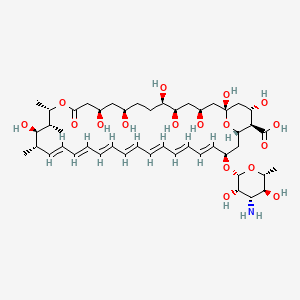
| Formula | C47H73NO17 |
|---|---|
| Molecular weight | 924.09 g/mol |
| IUPAC name | (1R,3S,5R,6R,9R,11R,15S,16R,17R,18S,19E,21E,23E,25E,27E,29E,31E,33R,35S,36R,37S)-33-[(2R,3S,4S,5S,6R)-4-amino-3,5-dihydroxy-6-methyloxan-2-yl]oxy-1,3,5,6,9,11,17,37-octahydroxy-15,16,18-trimethyl-13-oxo-14,39-dioxabicyclo[33.3.1]nonatriaconta-19,21,23,25,27,29,31-heptaene-36-carboxylic acid |
| CAS | 1397-89-3 |
| PubChem CID | 5280965 |
| InChIKey | APKFDSVGJQXUKY-INPOYWNPSA-N |
| logP | 0.71 (XLogP 0.0) |
| Polar surface area | 319.61 Ų |
| H-bond acceptors / donors | 17 / 12 |
| Drug-likeness (QED) | 0.17 |
| Lipinski violations | 3 |
SMILES
C[C@@H]1[C@H](O)[C@@H](C)/C=C/C=C/C=C/C=C/C=C/C=C/C=C/[C@H](O[C@@H]2O[C@H](C)[C@@H](O)[C@H](N)[C@@H]2O)C[C@@H]2O[C@](O)(C[C@@H](O)C[C@@H](O)[C@H](O)CC[C@@H](O)C[C@@H](O)CC(=O)O[C@H]1C)C[C@H](O)[C@H]2C(=O)OBiology & Pharmacokinetics
Pharmacokinetics
| BBB penetrant | No |
|---|
Enzyme interactions
| Enzyme | Role | Detail |
|---|---|---|
| CYP2C19 | Inhibitor | IC₅₀ 95.9999999999999 µM |
Transporters
BCRP (Inhibitor)BSEP (Inhibitor)MRP1 (Inhibitor)OATP1B1 (Inhibitor)OATP1B3 (Inhibitor)P-gp (Inhibitor)P-gp (Substrate)
Drug–drug interactions (100+, DDInter)
| Interacting drug | Severity | Management |
|---|---|---|
| Amiodarone | major | |
| Arsenic trioxide | major | |
| Cidofovir | major | |
| Deferasirox | major | |
| Diatrizoate | major | |
| Dofetilide | major | |
| Dronedarone | major | |
| Droperidol | major | |
| Everolimus | major | |
| Foscarnet | major | |
| Gallium nitrate | major | |
| Human Rho(D) immune globulin | major | |
| Human botulinum neurotoxin A/B immune globulin | major | |
| Human cytomegalovirus immune globulin | major | |
| Human immunoglobulin G (intravenous and subcutaneous) | major | |
| Human immunoglobulin G (intravenous) | major | |
| Inotersen | major | |
| Iodipamide | major | |
| Iodixanol | major | |
| Iohexol | major | |
| Iopamidol | major | |
| Iopromide | major | |
| Iothalamic acid | major | |
| Ioversol | major | |
| Ioxilan | major | |
| Levacetylmethadol | major | |
| Pimozide | major | |
| Sirolimus | major | |
| Tacrolimus | major | |
| Temsirolimus | major | |
| Ziprasidone | major | |
| Acetazolamide | moderate | |
| Amikacin | moderate | |
| Amikacin (liposome) | moderate | |
| Amisulpride | moderate | |
| Atracurium | moderate | |
| Balsalazide | moderate | |
| Beclomethasone dipropionate | moderate | |
| Bendroflumethiazide | moderate | |
| Benzthiazide | moderate |
Showing 40 of 100+.
Registered Products (4)
| Brand | Form / strength | Pack | Agent | Citizen (JOD) |
|---|---|---|---|---|
| Abelcet | Vial 100 mg/20 ml | 1 vial | Khoury Drug Store | — |
| Ambisome | Vial 50 mg | 1 vial | Beta Drug Store | — |
| Amphotrecin B Vial | Vial 50 mg | 1 | Reda Jardaneh Drug Store | — |
| Photericin B | Vial 50 mg | 1 vial | ORIENT DRUG STORE CO | — |