Clonazepam
JFDA label: Rivoram -0.5mg tablets
- Risk from concomitant use with opioids:
Mechanism of Action
Positive Allosteric Modulator of GABA-A receptor; anion channel — GABA-A receptor; anion channel positive allosteric modulator
| Target | Action | Gene / class |
|---|---|---|
| GABA-A receptor; anion channel efficacy | POSITIVE ALLOSTERIC MODULATOR |
Indications
Approved
- Panic disorder
- Seizure disorders
Off-label
- Bipolar disorder, manic or mixed episodes (adults)
- Burning mouth syndrome
- Essential tremor
- Rapid eye movement (REM) sleep behavior disorder
- Restless legs syndrome
- Tardive dyskinesia
- Tic disorders
Contraindications
Source: Lexicomp · Curated
- Additional contraindications (not in US labeling): Severe respiratory insufficiency Absolute
- Hypersensitivity to clonazepam, other benzodiazepines, or any component of the formulation Absolute
- Severe hepatic disease Absolute
- acute narrow-angle glaucoma Absolute
- myasthenia gravis Absolute
- significant liver disease Absolute
- sleep apnea syndrome Absolute
Adverse Reactions
Cardiac disorders (2)
Not Known Edema (ankle or facial) · palpitations
Nervous system disorders (24)
Common confusion · delayed ejaculation · depression · dysarthria · emotional lability · Fatigue · memory impairment · nervousness · reduced intellectual ability
Not Known Amnesia · aphonia · choreiform movements · coma · glassy-eyed appearance · hallucination · headache · hemiparesis · hypotonia · hysteria · insomnia · myasthenia · psychosis · slurred speech · vertigo
Hepatobiliary disorders (3)
Not Known Hepatomegaly · increased serum alkaline phosphatase (transient) · increased serum transaminases (transient)
Renal and urinary disorders (9)
Common Dysmenorrhea · impotence · urinary frequency · urinary tract infection · vaginitis
Not Known Dysuria · nocturia · urinary incontinence · urinary retention
Blood and lymphatic system disorders (5)
Not Known Anemia · eosinophilia · leukopenia · lymphadenopathy · thrombocytopenia
Immune system disorders (1)
Common Hypersensitivity
Metabolism and nutrition disorders (6)
Common Decreased libido
Not Known Dehydration · hirsutism · increased libido · weight gain · weight loss
Gastrointestinal disorders (12)
Common abdominal pain · Constipation · decreased appetite
Not Known Anorexia · coated tongue · diarrhea · encopresis · gastritis · gingival pain · increased appetite · nausea · xerostomia
Skin and subcutaneous tissue disorders (2)
Not Known Alopecia · skin rash
Musculoskeletal and connective tissue disorders (3)
Common Myalgia
Not Known Dysdiadochokinesia · tremor
Eye disorders (4)
Common Blurred vision
Not Known Abnormal eye movements · diplopia · nystagmus
General disorders and administration site conditions (3)
Not Known Fever · paradoxical reactions (including aggressive behavior, agitation, anxiety excitability, hostility, irritability, nervousness, nightmares, sleep disturbance, vivid dreams) · physical health deterioration
Other (4)
Very Common ataxia · behavioral problems · Central nervous system: Drowsiness · dizziness
Respiratory, thoracic and mediastinal disorders (12)
Common bronchitis · cough · influenza · pharyngitis · rhinitis · sinusitis · Upper respiratory tract infection
Not Known Chest congestion · dyspnea · respiratory depression · rhinorrhea · upper respiratory complaint (hypersecretion)
Dosing
Source: Lexicomp
Warnings & Precautions
Source: Lexicomp
Anterograde amnesia
Benzodiazepines have been associated with anterograde amnesia (Nelson 1999).
CNS depression
May cause CNS depression, which may impair physical or mental abilities; patients must be cautioned about performing tasks which require mental alertness (eg, operating machinery or driving); increased risk may occur with the use of multiple anticonvulsants.
Paradoxical reactions
Paradoxical reactions, including hyperactive or aggressive behavior, hallucinations, nightmares, anger, anxiety, irritability, agitation, and psychoses, have been reported with benzodiazepines, particularly in pediatric or elderly patients. Gradually discontinue therapy if such reactions occur (Mancuso 2004).
Sleep-related activities
An increased risk for hazardous sleep-related activities such as sleep-driving; cooking and eating food, and making phone calls while asleep have also been noted with benzodiazepines (Dolder 2008).
Suicidal ideation
Pooled analysis of trials involving various antiepileptics (regardless of indication) showed an increased risk of suicidal thoughts/behavior (incidence rate: 0.43% treated patients compared to 0.24% of patients receiving placebo); risk observed as early as 1 week after initiation and continued through duration of trials (most trials ≤24 weeks). Monitor all patients for notable changes in behavior that might indicate suicidal thoughts or depression; notify healthcare provider immediately if symptoms occur. Disease-related concerns:
Depression
Use caution in patients with depression, particularly if suicidal risk may be present.
Drug abuse
Use with caution in patients with a history of drug abuse or acute alcoholism; potential for drug dependency exists. Tolerance, psychological and physical dependence may occur with prolonged use.
Glaucoma
May be used in patients with open angle glaucoma who are receiving appropriate therapy; contraindicated in acute narrow angle glaucoma.
Hepatic impairment
Use with caution in patients with hepatic impairment; accumulation likely to occur. Contraindicated in patients with significant hepatic impairment.
Porphyria
Use with caution in patients with porphyria; may have a porphyrogenic effect.
Renal impairment
Use with caution in patients with renal impairment; clonazepam metabolites are renally eliminated.
Respiratory disease
Clonazepam may cause respiratory depression and may produce an increase in salivation; use with caution in patients with compromised respiratory function (eg, chronic obstructive pulmonary disease, sleep apnea) and in patients who have difficulty handling secretions. Concurrent drug therapy issues:
Concomitant use with opioids
Concomitant use of benzodiazepines and opioids may result in profound sedation, respiratory depression, coma, and death. Reserve concomitant prescribing of these drugs for use in patients for whom alternative treatment options are inadequate. Limit dosages to the minimum required. Follow patients for signs and symptoms of respiratory depression and sedation.
Drug-drug interactions
Potentially significant interactions may exist, requiring dose or frequency adjustment, additional monitoring, and/or selection of alternative therapy. Consult drug interactions database for more detailed information. Special populations:
Debilitated patients
Use with caution in debilitated patients.
Fall risk
Use with extreme caution in patients who are at risk of falls; benzodiazepines have been associated with falls and traumatic injury. Other warnings/precautions:
Appropriate use
Does not have analgesic, antidepressant, or antipsychotic properties. Worsening of seizures may occur when added to patients with multiple seizure types. Loss of anticonvulsant activity may occur (typically within 3 months of initiation); dose adjustment may be necessary. Periodically reevaluate the long-term usefulness of clonazepam for the individual patient.
Tolerance
Clonazepam is a long half-life benzodiazepine. Duration of action after a single dose is determined by redistribution rather than metabolism. Tolerance develops to the anticonvulsant effects. It does not develop to the anxiolytic effects (Vinkers 2012). Chronic use of this agent may increase the perioperative benzodiazepine dose needed to achieve desired effect.
Withdrawal
Rebound or withdrawal symptoms may occur following abrupt discontinuation or large decreases in dose. Use caution when reducing dose or withdrawing therapy; decrease slowly and monitor for withdrawal symptoms. Flumazenil may cause withdrawal in patients receiving long-term benzodiazepine therapy (Brogden 1988).
Pregnancy & Lactation
Pregnancy
Caution
Long half-life makes NAS prolonged; prefer shorter-acting agents for acute use
Lactation
Clonazepam is present in breast milk. The relative infant dose (RID) of clonazepam is 2.8% when calculated using the highest breast milk concentration from a case report and compared to a weight-adjusted maternal dose of 4 mg/day. In general, breastfeeding is considered acceptable when an RID of a medication is The RID of clonazepam was calculated using a milk concentration of 0.0107 mcg/mL, providing an estimated daily infant dose via breast milk of 1.6 mcg/kg/day. This milk concentration w
LactMed: monitor the infant.
Monitoring
| Clinical pearl | CBC, liver and renal function tests (periodically with long-term therapy) suicidality (eg, suicidal thoughts, depression, behavioral changes) |
|---|
Chemistry & Properties
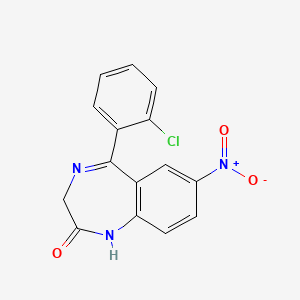
| Formula | C15H10ClN3O3 |
|---|---|
| Molecular weight | 315.72 g/mol |
| IUPAC name | 5-(2-chlorophenyl)-7-nitro-1,3-dihydro-1,4-benzodiazepin-2-one |
| CAS | 1622-61-3 |
| PubChem CID | 2802 |
| InChIKey | DGBIGWXXNGSACT-UHFFFAOYSA-N |
| logP | 3.04 (XLogP 2.4) |
| Polar surface area | 84.6 Ų |
| H-bond acceptors / donors | 4 / 1 |
| Drug-likeness (QED) | 0.68 |
| Lipinski violations | 0 |
SMILES
O=C1CN=C(c2ccccc2Cl)c2cc([N+](=O)[O-])ccc2N1Biology & Pharmacokinetics
Pharmacokinetics
| BBB penetrant | Yes |
|---|
Enzyme interactions
| Enzyme | Role | Detail |
|---|---|---|
| CYP1A2 | Inhibitor | — |
| CYP1A2 | Substrate | — |
| CYP3A4 | Substrate | — |
Receptor binding (top 6)
| Target | Action | Affinity |
|---|---|---|
| GABAA receptor α1 subunit (GABRA1) | Allosteric modulator | pKi 8.9 |
| GABA A Alpha1Beta1Gamma2 | Binding | pKi 8.9 |
| GABAA receptor α2 subunit (GABRA2) | Allosteric modulator | pKi 8.8 |
| GABA A Alpha2Beta1Gamma2 | Binding | pKi 8.8 |
| GABAA receptor α3 subunit (GABRA3) | Allosteric modulator | pKi 8.7 |
| GABA A Alpha3Beta1Gamma2 | Binding | pKi 8.7 |
Transporters
BCRP (Inhibitor)BCRP (Inhibitor)BSEP (Inhibitor)MRP1 (Inhibitor)OATP1B1 (Inhibitor)OATP1B3 (Inhibitor)P-gp (Inhibitor)BCRP (Substrate)P-gp (Substrate)
Drug–drug interactions (100+, DDInter)
| Interacting drug | Severity | Management |
|---|---|---|
| Codeine | major | |
| Hydrocodone | major | |
| Morphine | major | |
| Morphine (liposomal) | major | |
| Adalimumab | moderate | |
| Aldesleukin | moderate | |
| Alefacept | moderate | |
| Alimemazine | moderate | |
| Amyl Nitrite | moderate | |
| Anakinra | moderate | |
| Apalutamide | moderate | |
| Aprepitant | moderate | |
| Azatadine | moderate | |
| Azelastine (nasal) | moderate | |
| Bexarotene | moderate | |
| Brigatinib | moderate | |
| Brimonidine (ophthalmic) | moderate | |
| Brimonidine (topical) | moderate | |
| Brompheniramine | moderate | |
| Bupropion | moderate | |
| Canakinumab | moderate | |
| Carbinoxamine | moderate | |
| Ceritinib | moderate | |
| Certolizumab pegol | moderate | |
| Cetirizine | moderate | |
| Chlorphenesin | moderate | |
| Chlorpheniramine | moderate | |
| Cimetidine | moderate | |
| Clarithromycin | moderate | |
| Clemastine | moderate | |
| Clofedanol | moderate | |
| Cobicistat | moderate | |
| Crizotinib | moderate | |
| Cyproheptadine | moderate | |
| Dabrafenib | moderate | |
| Dasatinib | moderate | |
| Deferasirox | moderate | |
| Dexbrompheniramine | moderate | |
| Dextromethorphan | moderate | |
| Diazoxide | moderate |
Showing 40 of 100+.
Registered Products (13)
| Brand | Form / strength | Pack | Agent | Citizen (JOD) |
|---|---|---|---|---|
| Rivoram -0.5mg tablets | Tablet 0.5 mg | 30 tab pack varies | AL-RAM PHARMA.INDUS.CO.LTD/JORDAN | 1.470 |
| Clonotril | Tablet 0.5 mg | 30 tab pack varies | JAWEDA INT. DRUD STORE | 1.670 |
| Clonatril Tab | Tablet 0.5 mg | 50 tab | United Pharmaceutical Manufacturing Co. Ltd. | 1.750 |
| Clonotril | Tablet 2 mg | 30 tab pack varies | JAWEDA INT. DRUD STORE | 1.990 |
| Clonatril 2 Tablets | Tablet 2 mg | 30 tab | United Pharmaceutical Manufacturing Co. Ltd. | 2.120 |
| Rivotril Drops | Oral Drops 2.5 mg/ml | 10 ml | Shawi & Rushedat Drug Store | 2.440 |
| Rivoram -2mg tablets | Tablet 2 mg | 30 tab pack varies | AL-RAM PHARMA.INDUS.CO.LTD/JORDAN | 2.990 |
| Rivotril Tablet | Tablet 0.5 mg | 50 tab | Shawi & Rushedat Drug Store | 4.210 |
| Rivotril Tablet | Tablet 2 mg | 30 tab | Shawi & Rushedat Drug Store | 5.150 |
| Rivoram -0.5mg tablets | Tablet 0.5 mg | 1000 tab pack varies | AL-RAM PHARMA.INDUS.CO.LTD/JORDAN | 39.130 |
| Clonotril | Tablet 0.5 mg | 1000 tab pack varies | JAWEDA INT. DRUD STORE | 47.320 |
| Clonotril | Tablet 2 mg | 1000 tab pack varies | JAWEDA INT. DRUD STORE | 56.380 |
| Rivoram -2mg tablets | Tablet 2 mg | 1000 tab pack varies | AL-RAM PHARMA.INDUS.CO.LTD/JORDAN | 79.160 |