Cyanocobalamin
JFDA label: Cyanocobalamin (Vit.B12Inj.)
Mechanism of Action
— Supplement
Indications
Approved
- Vitamin B12 deficiency
Off-label
- Aphthous ulcers (recurrent)
Contraindications
Source: Lexicomp
- Hypersensitivity to cyanocobalamin (vitamin B12), cobalt, or any component of the formulation Absolute
Adverse Reactions
Cardiac disorders (3)
Not Known Cardiac failure · peripheral vascular disease · thrombosis (peripheral)
Nervous system disorders (9)
Not Known Abnormal gait · anxiety · ataxia · dizziness · headache · hypoesthesia · nervousness · pain · paresthesia
Blood and lymphatic system disorders (1)
Not Known Polycythemia vera
Immune system disorders (1)
Not Known Anaphylaxis (parenteral)
Gastrointestinal disorders (6)
Not Known Diarrhea · dyspepsia · glossitis · nausea · sore throat · vomiting
Skin and subcutaneous tissue disorders (3)
Not Known Pruritus · skin rash (transient) · urticaria
Musculoskeletal and connective tissue disorders (4)
Not Known Arthritis · back pain · myalgia · weakness
Infections and infestations (1)
Not Known Infection
Respiratory, thoracic and mediastinal disorders (3)
Not Known Dyspnea · pulmonary edema · rhinitis
Dosing
Source: Lexicomp
Warnings & Precautions
Source: Lexicomp
CNS effects
Vitamin B12 deficiency for >3 months results in irreversible degenerative CNS lesions; neurologic manifestations will not be prevented with folic acid unless vitamin B12 is also given. Spinal cord degeneration might also occur when folic acid used as a substitute for vitamin B12 in anemia prevention.
Hypokalemia
According to the manufacturer, treatment of severe vitamin B12 megaloblastic anemia may result in severe hypokalemia, sometimes fatal, due to intracellular potassium shift upon anemia resolution; however, in more recent experience, while some patients may experience hypokalemia with initial treatment, this is unlikely to be clinically significant (Carmel 2008).
Thrombocytosis
Treatment of severe vitamin B12 megaloblastic anemia may result in thrombocytosis. Disease-related concerns:
Leber disease
Patients with Leber disease who received B12 treatment have suffered from severe rapid optic atrophy.
Pernicious anemia
Appropriate use: IM/SubQ routes are used to treat pernicious anemia; oral and intranasal administration are not indicated until hematologic remission and no signs of nervous system involvement.
Polycythemia vera
Vitamin B12 deficiency masks signs of polycythemia vera; vitamin B12 administration may unmask this condition. Dosage form specific issues:
Aluminum
The parenteral product may contain aluminum; toxic aluminum concentrations may be seen with high doses, prolonged use, or renal dysfunction. Premature neonates are at higher risk due to immature renal function and aluminum intake from other parenteral sources. Parenteral aluminum exposure of >4 to 5 mcg/kg/day is associated with CNS and bone toxicity; tissue loading may occur at lower doses (Federal Register, 2002). See manufacturer's labeling.
Benzyl alcohol and derivatives
Some dosage forms may contain benzyl alcohol; large amounts of benzyl alcohol (≥99 mg/kg/day) have been associated with a potentially fatal toxicity (“gasping syndrome”) in neonates; the “gasping syndrome” consists of metabolic acidosis, respiratory distress, gasping respirations, CNS dysfunction (including convulsions, intracranial hemorrhage), hypotension and cardiovascular collapse (AAP ["Inactive" 1997]; CDC 1982); some data suggests that benzoate displaces bilirubin from protein binding sites (Ahlfors 2001); avoid or use dosage forms containing benzyl alcohol with caution in neonates. See manufacturer's labeling.
Intranasal administration
Efficacy in patients with nasal pathology or with other concomitant intranasal therapy has not been determined. Use with caution. Other warnings/precautions:
IV administration
Avoid intravenous route; anaphylactic shock has occurred.
Test dose
Intradermal test dose of vitamin B12 is recommended for any patient suspected of cyanocobalamin sensitivity prior to intranasal or injectable administration.
Pregnancy & Lactation
Pregnancy
Animal reproduction studies have not been conducted. Water soluble vitamins cross the placenta. Absorption of vitamin B12 may increase during pregnancy. Vitamin B12 requirements may be increased in pregnant women compared to nonpregnant women. Serum concentrations of vitamin B12 are higher in the neonate at birth than the mother (IOM, 1998).
Lactation
Vitamin B12 is found in breast milk. Milk concentrations are similar to maternal serum concentrations and concentrations may be decreased in women who are vegetarians. Vitamin B12 requirements may be increased in nursing women compared to non-nursing women (IOM 1998).
Monitoring
| Clinical pearl | Vitamin B12, hemoglobin, hematocrit, erythrocyte and reticulocyte count; folate and iron levels should be obtained prior to treatment; vitamin B12 and peripheral blood counts should be monitored 1 month after beginning treatment, then every 3 to 6 months thereafter. Evaluate serum methylmalonic acid and total homocysteine levels at baseline (prior to supplementation) in untreated patients to confirm vitamin B12 deficiency (and extent of deficiency); repeat to confirm adequate supplementation (Stabler 2013). Megaloblastic/pernicious anemia: In addition to normal hematological parameters, serum potassium and platelet counts should be monitored during therapy. Note: Some patients may develop hypokalemia during initial treatment; however, this is unlikely to be clinically significant (Carmel 2008). Bariatric surgery: Vitamin B12 levels at baseline and once a year postoperatively then every 3 to 6 months if supplemented; every trimester in pregnant females (Mechanick 2013). In patients on chronic administration of medications known to increase risk of B12 deficiency (eg, colchicine, metformin, neomycin, nitrous oxide, proton pump inhibitors, seizure medication), screen every 3 months for the initial postoperative year and then annually (Parrott 2017). Serum methylmalonic acid (MMA) is the recommended assay to evaluate vitamin B12 levels for patients who are asymptomatic, symptomatic, have a history of B12 deficiency, or preexisting neuropathy (Parrott 2017). Monitor for earl |
|---|
Chemistry & Properties
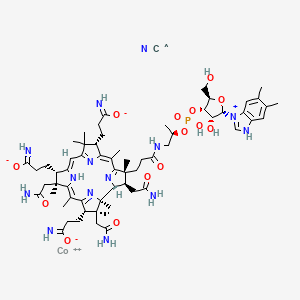
| Formula | C63H89CoN14O14P |
|---|---|
| Molecular weight | 1356.4 g/mol |
| PubChem CID | 166596686 |
Biology & Pharmacokinetics
Pharmacokinetics predicted
| Bioavailability | 10.0% |
|---|---|
| Half-life | 1.556 h |
| Volume of distribution | 0.567 L/kg |
| Protein binding | 62.8% |
| BBB penetrant | No |
Transporters
BCRP (Inhibitor)BSEP (Inhibitor)MRP1 (Inhibitor)OATP1B1 (Inhibitor)OATP1B3 (Inhibitor)P-gp (Inhibitor)P-gp (Substrate)
Drug–drug interactions (15, DDInter)
| Interacting drug | Severity | Management |
|---|---|---|
| Arsenic trioxide | moderate | |
| Chloramphenicol | moderate | |
| Aminosalicylic acid | minor | |
| Cimetidine | minor | |
| Dexlansoprazole | minor | |
| Esomeprazole | minor | |
| Famotidine | minor | |
| Lansoprazole | minor | |
| Nizatidine | minor | |
| Omeprazole | minor | |
| Pantoprazole | minor | |
| Potassium chloride | minor | |
| Rabeprazole | minor | |
| Ranitidine | minor | |
| Ranitidine (bismuth citrate) | minor |
Registered Products (14)
| Brand | Form / strength | Pack | Agent | Citizen (JOD) |
|---|---|---|---|---|
| Poly-B-Bion | Ampoule 1 mg, 100 mg, 100 mg | 3 amp pack varies | شركة مستودع ادوية جرينلاند | 1.120 |
| Neurorubine Forte | Tablet 1 mg, 50 mg, 200 mg | 20 tab | Khoury Drug Store | 2.050 |
| Nervovit tablet | Tablet 200 mcg, 200 mg, 200 mg | 20 tab | UNITED PHARM.MFG.CO.LTD(UPM)/JORDAN | 2.110 |
| Neurorubine Amp | Ampoule 1 mg/3 ml, 100.00 mg/3 ml, 100.00 mg/3 ml | 3 ml | Khoury Drug Store | 2.300 |
| vitamist Nasal Spray | Spray 0.025 % | 11 ml | Amman Pharmaceutical Industries Co | 2.560 |
| B Complete Ampoules | Ampoule 1 mg, 100 mg, 100 mg | 5 amp | Hikma Pharmaceuticals Co.Ltd/Jordan | 3.070 |
| Jectin-12 Amp | Ampoule 1000 mcg | 5 amp | Hikma Pharmaceuticals Co.Ltd/Jordan | 3.520 |
| B-YOSEF | Ampoule 100 mcg, 100 mg, 100 mg | 10 amp | moon light drugs store | 4.420 |
| Pronatal | Tablet 0.6 mg, 2.6 mcg, 18 mg, 0.03 mg, 2 mg, 85 mg, 15 mg, 0.06 mg, 150 mg, 0.03 mg, 0.2 mg, 0.05 mg, 11 mg, 1.9 mg, 27 mg, 1 mg, 53 mg, 1.4 mg, 200 IU, 1.4 mg | 30 tab | THE ARAB DRUG STORE P.S.C | 5.570 |
| Cyanocobalamin (Vit.B12Inj.) | Ampoule 1000 mcg/ml | 10 amp pack varies | AL Rahma Drug Store | 6.700 |
| Elevit Pronatal film-coated tablets | Film-Coated Tablet 0.80 mg, 4.00 mcg, 19.00 mg, 10.00 mg, 200 mcg, 100.00 mg, 1080 mcg, 12.5 mcg, 125.00 mg, 7.50 mg, 2.60 mg, 60.00 mg, 1.00 mg, 125 mg, 1.00 mg, 1.80 mg, 100.00 mg, 1.60 mg, 15.00 mg | 30 tab | The Jordan Drugstore Co | 8.330 |
| Medivitan injection | Powder for Injection 1.05 mg, 1 mg, 5 mg | 8 amp | Karmel Drug Store | 11.770 |
| Poly-B-Bion | Ampoule 1 mg, 100 mg, 100 mg | 100 amp pack varies | شركة مستودع ادوية جرينلاند | 31.730 |
| Cyanocobalamin (Vit.B12Inj.) | Ampoule 1000 mcg/ml | 100 amp pack varies | AL Rahma Drug Store | 52.960 |