Cyclophosphamide
Prodrug of Cyclophosphamide Anhydrous. Active form: 4-Hydroxycyclophosphamide.
JFDA label: ENDOXAN DRAGEES
Mechanism of Action
Inhibitor of DNA — DNA inhibitor
| Target | Action | Gene / class |
|---|---|---|
| DNA efficacy | INHIBITOR |
Indications
Approved
- Nononcology uses
- Oncology uses
Off-label
- Antibody-induced pure red cell aplasia
- Autoimmune hemolytic anemia
- Ewing sarcoma
- Gestational trophoblastic tumors, high-risk
- Granulomatosis with polyangiitis (GPA
- Hematopoietic stem cell transplant conditioning
- Immune thrombocytopenia, refractory (adults)
- Juvenile idiopathic arthritis (refractory)
- Lupus nephritis
- Myasthenia gravis
- Ovarian germ cell tumors (malignant)
- Pericarditis (recurrent)
- Pheochromocytoma (malignant)
- Rhabdomyosarcoma
- Rheumatoid disorders (severe)
- Small cell lung cancer (refractory)
- Uveitis (adults)
- Waldenström macroglobulinemia
- Wegener granulomatosis)
- Wilms tumor (relapsed)
Class profile
| mechanismClass | Alkylating agent (nitrogen mustard) |
|---|---|
| targetMolecule | DNA (cross-linking) |
| targetPathway | DNA damage response |
| generation | Classic |
| primaryTumors | Lymphoma,Breast,Ovarian,Leukemia,Sarcoma |
| resistanceMechanisms | Increased drug efflux (MRP1),Reduced bioactivation (CYP2B6),Enhanced DNA repair (ERCC1/XRCC1),GSH elevation |
| source | NCCN/OncoKB/Goodman&Gilman13ed |
Contraindications
Source: Lexicomp
- Hypersensitivity to cyclophosphamide or any component of the formulation Absolute
- Hypersensitivity to cyclophosphamide or its metabolites, urinary outflow obstructions, severe myelosuppression, severe renal or hepatic impairment, active infection (especially varicella zoster), severe immunosuppression Absolute
- urinary outflow obstruction Absolute
Adverse Reactions
Renal and urinary disorders (5)
Not Known Azoospermia · defective oogenesis · hemorrhagic cystitis · oligospermia · sterility
Blood and lymphatic system disorders (6)
Not Known Anemia · bone marrow depression · febrile neutropenia · leukopenia (dose-related; recovery: 7 to 10 days after cessation) · neutropenia · thrombocytopenia
Metabolism and nutrition disorders (2)
Not Known Altered hormone level (increased gonadotropin secretion) · amenorrhea
Gastrointestinal disorders (6)
Not Known Abdominal pain · anorexia · diarrhea · mucositis · nausea and vomiting (dose-related) · stomatitis
Skin and subcutaneous tissue disorders (1)
Not Known Alopecia (reversible; onset: 3 to 6 weeks after start of treatment)
Infections and infestations (1)
Not Known Infection
Dosing
Source: Lexicomp
Warnings & Precautions
Source: Lexicomp
Bone marrow suppression
Leukopenia, neutropenia, thrombocytopenia, and anemia may commonly occur; may be dose related. Bone marrow failure has been reported. Bone marrow failure and severe immunosuppression may lead to serious (and fatal) infections, including sepsis and septic shock, or may reactive latent infections. Antimicrobial prophylaxis may be considered in appropriate patients. Initiate antibiotics for neutropenic fever; antifungal and antiviral medications may also be necessary. Monitor blood counts during treatment. Avoid use if neutrophils are ≤1,500/mm3 and platelets are 3. Consider growth factors (primary or secondary prophylaxis) in patients at increased risk for complications due to neutropenia. Platelet and neutrophil nadirs are usually at weeks 1 and 2 of treatment and recovery is expected after ~20 days. Severe myelosuppression may be more prevalent in heavily pretreated patients or in patients receiving concomitant chemotherapy and/or radiation therapy.
Cardiotoxicity
Cardiotoxicity has been reported (some fatal), usually with high doses associated with transplant conditioning regimens, although may rarely occur with lower doses. Cardiac abnormalities do not appear to persist. Cardiotoxicities reported have included arrhythmias (supraventricular and ventricular [some with QT prolongation]), congestive heart failure, heart block, hemopericardium (secondary to hemorrhagic myocarditis and myocardial necrosis), myocarditis (including hemorrhagic), pericarditis, pericardial effusion including cardiac tamponade, and tachyarrhythmias. Cardiotoxicity is related to endothelial capillary damage; symptoms may be managed with diuretics, ACE inhibitors, beta-blockers, or inotropics (Floyd 2005). The risk for cardiotoxicity may be increased with higher doses, advanced age, prior radiation to the cardiac region, and in patients who have received prior or concurrent cardiotoxic medication. Use with caution in patients with preexisting cardiovascular disease or those at risk for cardiotoxicity. For patients with cardiac risk factors or preexisting cardiac disease, monitor during treatment. In a scientific statement from the American Heart Association, cyclophosphamide has been determined to be an agent that may either cause reversible direct myocardial toxicity or exacerbate underlying myocardial dysfunction (magnitude: moderate/major) (AHA [Page 2016]).
Fertility effects
May impair fertility; interferes with oogenesis and spermatogenesis. Effect on fertility is generally dependent on dose and duration of treatment and may be irreversible. The age at treatment initiation and cumulative dose were determined to be risk factors for ovarian failure in cyclophosphamide use for the treatment of systemic lupus erythematosus (SLE) (Mok 1998).
Gastrointestinal adverse effects
Nausea and vomiting commonly occur. Cyclophosphamide is associated with a moderate to high emetic potential (depending on dose, regimen, or administration route); antiemetics are recommended to prevent nausea and vomiting (Dupuis 2011; Hesketh 2017; Roila 2016). Stomatitis/mucositis may also occur.
Hepatotoxicity
Hepatic sinusoidal obstruction syndrome (SOS), formerly called veno-occlusive liver disease (VOD), has been reported in patients receiving chemotherapy regimens containing cyclophosphamide. A major risk factor for SOS is cytoreductive conditioning transplantation regimens with cyclophosphamide used in combination with total body irradiation or busulfan (or other agents). Other risk factors include preexisting hepatic dysfunction, prior radiation to the abdominal area, and low performance status. Children 1.4 mg/dL, unexplained weight gain, ascites, hepatomegaly, or unexplained right upper quadrant pain (Arndt 2004). SOS has also been reported in patients receiving long-term lower doses for immunosuppressive indications.
Hypersensitivity
Anaphylactic reactions have been reported. Cross-sensitivity with other alkylating agents may occur.
Hyponatremia
Hyponatremia associated with increased total body water, acute water intoxication, and a syndrome resembling SIADH (syndrome of inappropriate secretion of antidiuretic hormone) has been reported; some have been fatal.
Immunosuppression
Monitor for infections; immunosuppression and serious infections may occur. Serious infections may require dose reduction, or interruption or discontinuation of treatment.
Pulmonary toxicities
Pulmonary toxicities, including pneumonitis, pulmonary fibrosis, pulmonary veno-occlusive disease, and acute respiratory distress syndrome, have been reported. Monitor for signs/symptoms of pulmonary toxicity. Consider pulmonary function testing to assess the severity of pneumonitis (Morgan 2011). Cyclophosphamide-induced pneumonitis is rare and may present as early (within 1 to 6 months) or late onset (several months to years). Early onset may be reversible with discontinuation; late onset is associated with pleural thickening and may persist chronically (Malik 1996). In addition, late onset pneumonitis (>6 months after therapy initiation) may be associated with increased mortality.
Secondary malignancies
Secondary malignancies (bladder cancer, myelodysplasia, acute leukemias, lymphomas, thyroid cancer, and sarcomas) have been reported with both single-agent and with combination chemotherapy regimens; onset may be delayed (up to several years after treatment). Bladder cancer usually occurs in patients previously experiencing hemorrhagic cystitis; risk may be reduced by preventing hemorrhagic cystitis.
Urinary/renal toxicity
Cyclophosphamide is associated with the development of hemorrhagic cystitis, pyelitis, ureteritis, and hematuria. Hemorrhagic cystitis may rarely be severe or fatal. Bladder fibrosis may also occur, either with or without cystitis. Urotoxicity is due to excretion of cyclophosphamide metabolites in the urine and appears to be dose- and treatment duration-dependent, although may occur with short-term use. Increased hydration and frequent voiding is recommended to help prevent cystitis; some protocols utilize mesna to protect against hemorrhagic cystitis. Monitor urinalysis for hematuria or other signs of urotoxicity. Severe or prolonged hemorrhagic cystitis may require medical or surgical treatment. While hematuria generally resolves within a few days after treatment is withheld, it may persist in some cases. Discontinue cyclophosphamide with severe hemorrhagic cystitis. Exclude or correct any urinary tract obstructions prior to treatment initiation (use is contraindicated with bladder outlet obstruction). Use with caution (if at all) in patients with active urinary tract infection.
Wound healing impairment
May interfere with wound healing. Disease-related concerns:
Hepatic impairment
Use with caution in patients with hepatic impairment; dosage adjustment may be needed. The conversion between cyclophosphamide to the active metabolite may be reduced in patients with severe hepatic impairment, potentially reducing efficacy.
Renal impairment
Use with caution in patients with renal impairment; dosage adjustment may be needed. Decreased renal excretion and increased serum levels (cyclophosphamide and metabolites) may occur in patients with severe renal impairment (CrCl 10 to 24 mL/minute); monitor for signs/symptoms of toxicity. Cyclophosphamide and metabolites are dialyzable; differences in amount dialyzed may occur due to dialysis system used. If dialysis is required, maintain a consistent interval between administration and dialysis. Concurrent drug therapy issues:
Drug-drug interactions
Potentially significant interactions may exist, requiring dose or frequency adjustment, additional monitoring, and/or selection of alternative therapy. Consult drug interactions database for more detailed information. Cyclophosphamide may potentiate the cardiotoxicity of anthracyclines.
Pregnancy & Lactation
Pregnancy
Avoid
Avoid in T1 if at all possible. T2/T3 use sometimes unavoidable in cancer treatment — fetal monitoring required
Lactation
Cyclophosphamide is present in breast milk. Leukopenia and thrombocytopenia were noted in an infant exposed to cyclophosphamide while breastfeeding. The mother was treated with one course of cyclophosphamide 6 weeks prior to delivery then cyclophosphamide IV 6 mg/kg (300 mg) once daily for 3 days beginning 20 days postpartum. Complete blood counts were obtained in the breastfed infant on each day of therapy; WBC and platelets decreased by day 3 (Durodola 1979). Due to the potential for serious a
Monitoring
| Efficacy | Tumour response (RECIST criteria, tumour markers, imaging); progression-free survival; performance status (ECOG/Karnofsky) |
|---|---|
| Toxicity | CBC with differential (nadir timing depends on agent); LFTs; renal function; ECG (QT for relevant agents); echocardiogram for cardiotoxic agents (anthracyclines, trastuzumab); cumulative dose tracking for dose-limited toxicities |
| Clinical pearl | Treatment response is assessed after 2–3 cycles. Grade 3–4 toxicities typically require dose reduction or interruption per protocol-defined criteria. |
| Counseling | Attend all scheduled blood tests and imaging appointments. Report fever > 38°C (risk of neutropaenic sepsis — medical emergency), unusual bleeding, or new pain immediately. |
Chemistry & Properties
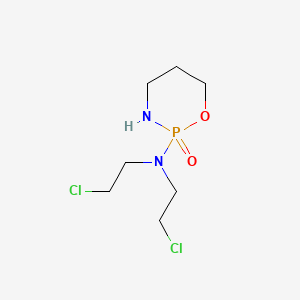
| Formula | C7H17Cl2N2O3P |
|---|---|
| Molecular weight | 279.1 g/mol |
| IUPAC name | N,N-bis(2-chloroethyl)-2-oxo-1,3,2lambda5-oxazaphosphinan-2-amine |
| CAS | 50-18-0 |
| PubChem CID | 2907 |
| InChIKey | PWOQRKCAHTVFLB-UHFFFAOYSA-N |
| logP | 1.88 (XLogP 0.6) |
| Polar surface area | 41.57 Ų |
| H-bond acceptors / donors | 2 / 1 |
| Drug-likeness (QED) | 0.61 |
| Lipinski violations | 0 |
SMILES
O.O=P1(N(CCCl)CCCl)NCCCO1Biology & Pharmacokinetics
Pharmacokinetics
| BBB penetrant | No |
|---|
Enzyme interactions
| Enzyme | Role | Detail |
|---|---|---|
| CYP1A2 | Substrate | — |
| CYP2B6 | Substrate | — |
| CYP2C19 | Substrate | — |
| CYP2C9 | Substrate | — |
| CYP2D6 | Substrate | — |
| CYP3A4 | Substrate | — |
Transporters
BCRP (Inhibitor)BSEP (Inhibitor)BSEP (Inhibitor)MATE1 (Inhibitor)MDR1 (Inhibitor)MRP1 (Inhibitor)MRP2 (Inhibitor)MRP3 (Inhibitor)MRP4 (Inhibitor)OATP1B1 (Inhibitor)OATP1B3 (Inhibitor)OCT1 (Inhibitor)OCT3 (Inhibitor)P-gp (Inhibitor)Transporter(unspecified) (Inhibitor)MDR1 (Substrate)MRP4 (Substrate)P-gp (Substrate)
Drug–drug interactions (100+, DDInter)
| Interacting drug | Severity | Management |
|---|---|---|
| Adalimumab | major | |
| Bacillus calmette-guerin substrain tice live antigen | major | |
| Baricitinib | major | |
| Certolizumab pegol | major | |
| Cidofovir | major | |
| Cladribine | major | |
| Clozapine | major | |
| Deferiprone | major | |
| Etanercept | major | |
| Fingolimod | major | |
| Golimumab | major | |
| Infliximab | major | |
| Inotersen | major | |
| Leflunomide | major | |
| Measles virus vaccine live attenuated | major | |
| Mumps virus strain B level jeryl lynn live antigen | major | |
| Nalidixic acid | major | |
| Natalizumab | major | |
| Ozanimod | major | |
| Rotavirus vaccine | major | |
| Rubella virus vaccine | major | |
| Samarium (153Sm) lexidronam | major | |
| Siponimod | major | |
| Smallpox (Vaccinia) Vaccine, Live | major | |
| Talimogene laherparepvec | major | |
| Teriflunomide | major | |
| Thalidomide | major | |
| Thiotepa | major | |
| Tofacitinib | major | |
| Typhoid vaccine (live) | major | |
| Upadacitinib | major | |
| Varicella Zoster Vaccine (Recombinant) | major | |
| Yellow Fever Vaccine | major | |
| Abametapir (topical) | moderate | |
| Acetohexamide | moderate | |
| Aldesleukin | moderate | |
| Alefacept | moderate | |
| Alemtuzumab | moderate | |
| Allopurinol | moderate | |
| Alpelisib | moderate |
Showing 40 of 100+.
Registered Products (5)
| Brand | Form / strength | Pack | Agent | Citizen (JOD) |
|---|---|---|---|---|
| ENDOXAN DRAGEES | Tablet 50 mg | 50 tab | Khoury Drug Store | 11.160 |
| ENDOXAN INJ VIAL | Powder for Injection 1000 mg | 1 vial | Khoury Drug Store | — |
| ENDOXAN INJ VIAL | Powder for Injection anhydrous 500 mg | 10 vial pack varies | Khoury Drug Store | — |
| ENDOXAN INJ VIAL | Powder for Injection 200 mg | 10 vial | Khoury Drug Store | — |
| ENDOXAN INJ VIAL | Powder for Injection anhydrous 500 mg | 1 vial pack varies | Khoury Drug Store | — |