Doxazosin
JFDA label: Prosta Tab
Mechanism of Action
Hypertension: Competitively inhibits postsynaptic alpha1-adrenergic receptors which results in vasodilation of veins and arterioles and a decrease in total peripheral resistance and blood pressure; ~50% as potent on a weight by weight basis as prazosin. BPH: Competitively inhibits postsynaptic alpha1-adrenergic receptors in prostatic stromal and bladder neck tissues. This reduces the sympathetic tone-induced urethral stricture causing BPH symptoms.
Indications
Approved
- Benign prostatic hyperplasia
- Hypertension (immediate release only)
Off-label
- Pediatric hypertension
- Ureteral calculi (distal)
Contraindications
Source: Lexicomp
- Additional contraindications (not in US labeling): Galactose intolerance, the Lapp lactase deficiency or glucose-galactose malabsorption Absolute
- Hypersensitivity to doxazosin, other quinazolines (eg, prazosin, terazosin), or any component of the formulation Absolute
Adverse Reactions
Cardiac disorders (3)
Common Edema · hypotension · orthostatic hypotension, vertigo, pain, anxiety, ataxia, hypertonia, insomnia, movement disorder, myasthenia
Renal and urinary disorders (3)
Common Polyuria · Urinary incontinence · urinary tract infection
Metabolism and nutrition disorders (1)
Common Sexual disorder
Gastrointestinal disorders (4)
Common Abdominal pain · dyspepsia · nausea · xerostomia
Musculoskeletal and connective tissue disorders (5)
Common arthralgia · arthritis · muscle cramps · myalgia · Weakness
Eye disorders (1)
Common Visual disturbance
Ear and labyrinth disorders (1)
Common Tinnitus
Other (4)
Very Common Central nervous system: Dizziness · fatigue · headache · malaise
Respiratory, thoracic and mediastinal disorders (4)
Common dyspnea · epistaxis · Respiratory tract infection · rhinitis
Dosing
Source: Lexicomp
Warnings & Precautions
Source: Lexicomp
Allergic reactions
May occur, including skin rash, urticaria, pruritus, angioedema, and respiratory symptoms.
CNS depression
May cause CNS depression, which may impair physical or mental abilities; patients must be cautioned about performing tasks that require mental alertness (eg, operating machinery or driving).
Floppy iris syndrome
Intraoperative floppy iris syndrome has been observed in cataract surgery patients who were on or were previously treated with alpha1-blockers; there appears to be no benefit in discontinuing alpha-blocker therapy prior to surgery. May require modifications to surgical technique.
Hematologic effect
Decreases in white blood cells (WBC) and neutrophil count have been reported; WBC and neutrophils returned to normal after discontinuation.
Orthostatic hypotension/syncope
May cause orthostatic hypotension and syncope within a few hours after dosing, but may occur later; anticipate a similar effect if therapy is interrupted for a few days, if dosage is increased, or if another antihypertensive drug, PDE-5 inhibitor, or nitrates are introduced. Use with caution in patients with symptomatic orthostatic hypotension.
Priapism
Priapism has been associated with use (rarely); seek immediate medical assistance for erections lasting longer than 4 hours. Disease-related concerns:
Cardiovascular disease
Use with caution in patients with heart failure, angina pectoris, or recent acute myocardial infarction (within the last 6 months). If symptoms of angina pectoris appear or worsen, discontinue use. In a scientific statement from the American Heart Association, doxazosin has been determined to be an agent that may exacerbate underlying myocardial dysfunction (magnitude: moderate) (AHA [Page 2016]).
Hepatic impairment
Use with caution in patients with mild to moderate impairment (Child-Pugh class A and B); monitor blood pressure and for symptoms of hypotension. Not recommended in severe impairment (Child-Pugh class C) (extensively metabolized).
Prostate cancer
Rule out prostatic carcinoma before beginning therapy (many symptoms of BPH and prostate cancer are similar). Concurrent drug therapy issues:
Drug-drug interactions
Potentially significant interactions may exist, requiring dose or frequency adjustment, additional monitoring, and/or selection of alternative therapy. Consult drug interactions database for more detailed information. Dosage form specific issues:
Extended release
Consists of drug within a nondeformable matrix; following drug release/absorption, the matrix/shell is expelled in the stool. The use of nondeformable products in patients with known stricture/narrowing of the GI tract has been associated with symptoms of obstruction. Use caution in patients with increased GI retention (eg, chronic constipation) as doxazosin exposure may be increased. Other warning/precautions:
Appropriate use
Extended release: Not indicated for use in women or for the treatment of hypertension.
Pregnancy & Lactation
Pregnancy
Adverse events were observed in some animal reproduction studies. Doxazosin crosses the placenta (Versmissen 2016). Untreated chronic maternal hypertension is associated with adverse events in the fetus, infant, and mother. If treatment for hypertension during pregnancy is needed, other agents are generally preferred (ACOG, 2013).
Lactation
Doxazosin is present in breast milk. Information is available from a single case report following a maternal dose of doxazosin 4 mg every 24 hours for 2 doses. Milk samples were obtained at various intervals over 24 hours, beginning ~17 hours after the first dose. Maternal serum samples were obtained at nearly the same times, beginning ~1 hour later. The highest serum and milk concentrations of doxazosin were observed ~1 hour after the dose. Using the highest milk concentration (4.15 mcg/L), the
Monitoring
| Clinical pearl | Blood pressure routinely and for at least 6 hours after initial dose and with each dose increase (standing and sitting/supine); monitor patients with mild-to-moderate impairment for symptoms of hypotension. |
|---|
Chemistry & Properties
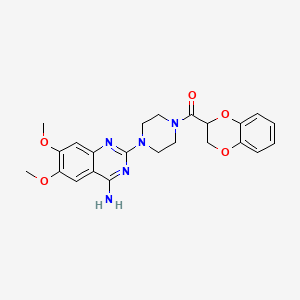
| Formula | C23H25N5O5 |
|---|---|
| Molecular weight | 451.48 g/mol |
| IUPAC name | [4-(4-amino-6,7-dimethoxyquinazolin-2-yl)piperazin-1-yl]-(2,3-dihydro-1,4-benzodioxin-3-yl)methanone |
| CAS | 74191-85-8 |
| PubChem CID | 3157 |
| InChIKey | RUZYUOTYCVRMRZ-UHFFFAOYSA-N |
| logP | 1.72 (XLogP 2.5) |
| Polar surface area | 112.27 Ų |
| H-bond acceptors / donors | 9 / 1 |
| Drug-likeness (QED) | 0.63 |
| Lipinski violations | 0 |
SMILES
COc1cc2nc(N3CCN(C(=O)C4COc5ccccc5O4)CC3)nc(N)c2cc1OCBiology & Pharmacokinetics
Pharmacokinetics
| BBB penetrant | No |
|---|
Enzyme interactions
| Enzyme | Role | Detail |
|---|---|---|
| CYP2C19 | Substrate | — |
| CYP2C9 | Inhibitor | — |
| CYP2C9 | Substrate | — |
| CYP2D6 | Substrate | — |
| CYP3A4 | Inhibitor | — |
| CYP3A4 | Substrate | — |
Transporters
BCRP (Inhibitor)BCRP (Inhibitor)BSEP (Inhibitor)BSEP (Inhibitor)MDR1 (Inhibitor)MRP1 (Inhibitor)MRP2 (Inhibitor)MRP3 (Inhibitor)MRP4 (Inhibitor)NTCP (Inhibitor)OATP1B1 (Inhibitor)OATP1B1 (Inhibitor)OATP1B3 (Inhibitor)OATP2B1 (Inhibitor)OCT1 (Inhibitor)P-gp (Inhibitor)P-gp (Substrate)
Drug–drug interactions (56, DDInter)
| Interacting drug | Severity | Management |
|---|---|---|
| Aldesleukin | moderate | |
| Alimemazine | moderate | |
| Amifostine | moderate | |
| Betamethasone | moderate | |
| Brimonidine (ophthalmic) | moderate | |
| Brimonidine (topical) | moderate | |
| Budesonide | moderate | |
| Bupropion | moderate | |
| Canagliflozin | moderate | |
| Ceritinib | moderate | |
| Clarithromycin | moderate | |
| Cobicistat | moderate | |
| Codeine | moderate | |
| Corticotropin | moderate | |
| Dapagliflozin | moderate | |
| Deflazacort | moderate | |
| Dexamethasone | moderate | |
| Diphenhydramine | moderate | |
| Doxepin | moderate | |
| Doxepin (topical) | moderate | |
| Dronabinol | moderate | |
| Empagliflozin | moderate | |
| Epoprostenol | moderate | |
| Ertugliflozin | moderate | |
| Ethanol | moderate | |
| Fludrocortisone | moderate | |
| Hydrocodone | moderate | |
| Hydrocortisone | moderate | |
| Idelalisib | moderate | |
| Iloprost | moderate | |
| Ketoconazole | moderate | |
| Larotrectinib | moderate | |
| Mepyramine | moderate | |
| Methdilazine | moderate | |
| Methylprednisolone | moderate | |
| Minoxidil (topical) | moderate | |
| Morphine | moderate | |
| Nabilone | moderate | |
| Nitrous acid | moderate | |
| Olopatadine (nasal) | moderate |
Showing 40 of 56.
Registered Products (21)
| Brand | Form / strength | Pack | Agent | Citizen (JOD) |
|---|---|---|---|---|
| Prosta Tab | Tablet 1 mg | 20 tab pack varies | Al Hilal Drug Store | 4.670 |
| Prosta Tab | Tablet 2 mg | 20 tab | Khoury Drug Store | 4.700 |
| Prosta Tab | Tablet 4 mg | 20 tab pack varies | Khoury Drug Store | 5.160 |
| Alphapress 1 | Tablet 1 mg | 20 tab | MIDDLE EAST PHARMA&CHEMICAL IND/JORDAN | 5.260 |
| Alphapress Tablets | Tablet as mesilate 4 mg | 20 tab | MIDDLE EAST PHARMA&CHEMICAL IND/JORDAN | 5.260 |
| Alphapress Tablets | Tablet (as Mesylate) 2 mg | 20 tab | MIDDLE EAST PHARMA&CHEMICAL IND/JORDAN | 5.260 |
| Cardox | Tablet 1 mg | 20 tab pack varies | Hikma Pharmaceuticals Co.Ltd/Jordan | 5.260 |
| Cardox | Tablet as Mesylate 4 mg | 20 tab pack varies | Hikma Pharmaceuticals Co.Ltd/Jordan | 5.260 |
| Curcard | Tablet 1 mg | 20 tab | UNITED PHARM.MFG.CO.LTD(UPM)/JORDAN | 5.260 |
| CARDURA TABS | Tablet 1 mg | 20 tab | Khoury Drug Store | 5.610 |
| CARDURA TABS | Tablet 4 mg | 20 tab | Khoury Drug Store | 5.610 |
| Curcard Tablets | Tablet 4 mg | 20 tab pack varies | UNITED PHARM.MFG.CO.LTD(UPM)/JORDAN | 6.550 |
| Alphapress | Tablet 8 mg | 20 tab | MIDDLE EAST PHARMA&CHEMICAL IND/JORDAN | 6.590 |
| Prosta Tab | Tablet 1 mg | 30 tab pack varies | Al Hilal Drug Store | 7.000 |
| Cardura XL | Tablet 4 mg | 28 tab | Sabbagh Drug Store | 7.260 |
| Prosta Tab | Tablet 4 mg | 30 tab pack varies | Khoury Drug Store | 7.740 |
| Cardox | Tablet as Mesylate 4 mg | 30 tab pack varies | Hikma Pharmaceuticals Co.Ltd/Jordan | 7.890 |
| Cardox | Tablet 1 mg | 30 tab pack varies | Hikma Pharmaceuticals Co.Ltd/Jordan | 7.890 |
| Cardura XL | Tablet 8 mg | 28 tab | Sabbagh Drug Store | 11.540 |
| Prosta Tab | Tablet 4 mg | 1000 tab pack varies | Khoury Drug Store | 219.290 |
| Curcard Tablets | Tablet 4 mg | 1000 tab pack varies | UNITED PHARM.MFG.CO.LTD(UPM)/JORDAN | 278.380 |