Doxycycline
🧬 Cross-allergy: Tetracyclines
JFDA label: DOXYDAR CAPS.
Mechanism of Action
Inhibitor of Matrilysin — Matrix metalloproteinase 7 inhibitor; Inhibitor of Neutrophil collagenase — Matrix metalloproteinase 8 inhibitor; Inhibitor of Collagenase 3 — Matrix metalloproteinase 13 inhibitor; Inhibitor of Interstitial collagenase — Matrix metalloproteinase-1 inhibitor; Inhibitor of Bacterial 70S ribosome — Bacterial 70S ribosome inhibitor
| Target | Action | Gene / class |
|---|---|---|
| Bacterial 70S ribosome efficacy | INHIBITOR | |
| Collagenase 3 efficacy | INHIBITOR | MMP13 |
| Interstitial collagenase efficacy | INHIBITOR | MMP1 |
| Matrilysin efficacy | INHIBITOR | MMP7 |
| Neutrophil collagenase efficacy | INHIBITOR | MMP8 |
Indications
Approved
- Acne
- Actinomycosis
- Acute intestinal amebiasis
- Anthrax, including inhalational anthrax (postexposure)
- Cholera
- Clostridium
- Gram-negative infections
- Gram-positive infections
- Listeriosis
- Malaria prophylaxis
- Mycoplasma pneumoniae
- Ophthalmic infections
- Periodontitis (20 mg tablet and capsule [Periostat (Canadian product)] only)
- Relapsing fever
- Respiratory tract infections
- Rickettsial infections
- Rosacea (Oracea, Apprilon [Canadian product] only)
- Sexually transmitted infections
- Skin and skin structure infections (Avidoxy only)
- Vincent infection
- Yaws
- Zoonotic infections
Off-label
- Anaplasmosis and ehrlichiosis
- Bartonella infections in HIV-infected patients (adolescents and adults)
- Bite-wound infection (animal and human bites)
- Cellulitis, mild to moderate
- Epididymitis, acute
- Lyme disease (Borrelia spp. infection)
- Malaria, treatment
- Pelvic inflammatory disease
- Pleurodesis, chemical (sclerosing agent for pleural effusion)
- Proctitis, acute or proctocolitis
- Prosthetic joint infection
- Rhinosinusitis, acute bacterial (ABRS)
- Surgical prophylaxis, pregnancy termination (dilation and evacuation procedure)
Antimicrobial Spectrum
Expected / intrinsic spectrum (EUCAST breakpoints & labels) — not local resistance. Source: EUCAST v16 · curated · openfda-label.
Bacteria
| Organism | Activity | MIC |
|---|---|---|
| Bacillus anthracis | Active | — |
| Bacteroides fragilis | Active | — |
| Bacteroides thetaiotaomicron | Active | — |
| Borrelia burgdorferi | Susceptible | 0.5 mg/L |
| Borrelia recurrentis | Active | — |
| Campylobacter fetus | Active | — |
| Chlamydia pneumoniae | Susceptible | 1.0 mg/L |
| Chlamydia trachomatis | Susceptible | 1.0 mg/L |
| Enterobacter aerogenes | Active | — |
| Enterococcus faecalis | Active | — |
| Escherichia coli | Active | — |
| Fusobacterium fusiforme | Active | — |
| Haemophilus ducreyi | Active | — |
| Haemophilus influenzae | Susceptible | 1.0 mg/L |
| Haemophilus influenzae | Susceptible | 11.0 mg/L |
| Klebsiella granulomatis | Active | — |
| Listeria monocytogenes | Active | — |
| Moraxella catarrhalis | Susceptible | 11.0 mg/L |
| Mycoplasma pneumoniae | Susceptible | 1.0 mg/L |
| Neisseria gonorrhoeae | Active | — |
| Pasteurella multocida | Susceptible | 1.0 mg/L |
| Plasmodium falciparum | Active | — |
| Rickettsia spp. | Susceptible | 0.5 mg/L |
| Staphylococcus aureus | Susceptible | 1.0 mg/L |
| Staphylococcus spp. | Susceptible | 11.0 mg/L |
| Streptococcus A/B/C/G | Susceptible | 11.0 mg/L |
| Streptococcus pneumoniae | Susceptible | 0.5 mg/L |
| Streptococcus pneumoniae | Susceptible | 11.0 mg/L |
| Treponema pallidum | Active | — |
| Treponema pertenue | Active | — |
| Vibrio cholerae | Susceptible | 0.25 mg/L |
| Vibrio fetus | Active | — |
| Vibrio spp. | Susceptible | 0.5 mg/L |
| Yersinia pestis | Active | — |
| Streptococcus pneumoniae | Resistant | 1.0 mg/L |
Class profile
| gramStatus | Both |
|---|---|
| spectrumBreadth | Broad |
| atypicalCoverage | Yes |
| isBactericidal | 0 |
| moaCategory | Protein synthesis inhibitor (30S ribosomal) |
| pdIndex | Time-dependent |
| postAntibioticEffect | None |
| mrsaCoverage | 0 |
| resistanceMechanisms | Active efflux (Tet pumps),Ribosomal protection proteins |
Contraindications
Source: Curated · Lexicomp
- Children under 8 years (unless benefits outweigh risks) Absolute
- Hypersensitivity to doxycycline, other tetracyclines, or any component of the formulation Periostat, Apprilon [Canadian products]: Additional contraindications: Use in infants and children Absolute
Adverse Reactions
Cardiac disorders (1)
Common Hypertension
Nervous system disorders (2)
Common Anxiety · pain
Hepatobiliary disorders (1)
Common Increased serum AST
Metabolism and nutrition disorders (2)
Common Increased lactate dehydrogenase · increased serum glucose
Gastrointestinal disorders (7)
Common abdominal distention · abdominal pain · Diarrhea · upper abdominal pain · xerostomia
Not Known Esophageal ulcer · esophagitis
Skin and subcutaneous tissue disorders (1)
Not Known Skin hyperpigmentation
Musculoskeletal and connective tissue disorders (1)
Common Back pain
Infections and infestations (2)
Common Fungal infection · influenza
Respiratory, thoracic and mediastinal disorders (4)
Common nasal congestion · Nasopharyngitis · sinus headache · sinusitis
Dosing
Source: Lexicomp
Warnings & Precautions
Source: Lexicomp
GI inflammation/ulceration
Esophagitis and ulcerations (sometimes severe) may occur; patients with dysphagia and/or retrosternal pain may require assessment for esophageal lesions.
Hepatotoxicity
Rarely occurs; if symptomatic, assess LFTs and discontinue drug.
Hypersensitivity syndromes
Severe skin reactions (eg, exfoliative dermatitis, erythema multiforme, Stevens-Johnson syndrome, toxic epidermal necrolysis, drug reaction with eosinophilia and systemic symptoms [DRESS]) have been reported. Discontinue therapy for serious hypersensitivity reactions.
Increased BUN
May be associated with increases in BUN secondary to antianabolic effects; this does not occur with use of doxycycline in patients with renal impairment.
Intracranial hypertension
Intracranial hypertension (pseudotumor cerebri) has been reported; headache, blurred vision, diplopia, vision loss, and/or papilledema may occur. Women of childbearing age who are overweight or have a history of intracranial hypertension are at greater risk. Intracranial hypertension typically resolves after discontinuation of treatment; however, permanent visual loss is possible. If visual symptoms develop during treatment, prompt ophthalmologic evaluation is warranted. Intracranial pressure can remain elevated for weeks after drug discontinuation; monitor patient until stable.
Photosensitivity
May cause photosensitivity; discontinue at first sign of skin erythema. Use skin protection and avoid prolonged exposure to sunlight and ultraviolet light.
Superinfection
Prolonged use may result in fungal or bacterial superinfection, including C. difficile-associated diarrhea (CDAD) and pseudomembranous colitis; CDAD has been observed >2 months postantibiotic treatment.
Tissue hyperpigmentation
May induce hyperpigmentation in many organs, including nails, bone, skin (diffuse pigmentation as well as over sites of scars and injury), eyes, thyroid, visceral tissue, oral cavity (adult teeth, mucosa, alveolar bone), sclerae, and heart valves independently of time or amount of drug administration. Disease-related concerns
Oral candidiasis
Safety and effectiveness have not been established for treatment of periodontitis in patients with coexistent oral candidiasis; use with caution in patients with a history or predisposition to oral candidiasis. Concurrent drug therapy issues:
Drug-drug interactions
Potentially significant interactions may exist, requiring dose or frequency adjustment, additional monitoring, and/or selection of alternative therapy. Consult drug interactions database for more detailed information. Special populations:
Pediatric
May cause tissue hyperpigmentation, tooth enamel hypoplasia, or permanent tooth discoloration (more common with long-term use, but observed with repeated, short courses) when used during tooth development (last half of pregnancy, infancy, and childhood ≤8 years of age); manufacturer states to use in children ≤8 years of age only when the potential benefits outweigh the risks in severe or life threatening conditions (eg, anthrax, Rocky Mountain spotted fever), particularly when there are no alternative therapies. Limited use between 6 to 7 years of age has minimal effect on the color of permanent incisors (CDC 2006). Recommended in treatment of anthrax exposure (CDC 2001), tickborne rickettsial diseases (CDC 2006), and Q fever (CDC 2013). Dosage form specific issues:
Oracea, Apprilon [Canadian product]
Should not be used for the treatment or prophylaxis of bacterial infections because the lower dose of drug per capsule may be subefficacious and promote resistance.
Sulfite sensitivity
Syrup may contain sodium metabisulfite, which may cause allergic reactions in certain individuals (eg, asthmatic patients). Other warnings/precautions:
Appropriate use
Acne: The American Academy of Dermatology acne guidelines recommend doxycycline as adjunctive treatment for moderate and severe acne and forms of inflammatory acne that are resistant to topical treatments. Concomitant topical therapy with benzoyl peroxide or a retinoid should be administered with systemic antibiotic therapy (eg, doxycycline) and continued for maintenance after the antibiotic course is completed (AAD [Zaenglein 2016]).
Limitations of use
Malaria prophylaxis: Doxycycline does not completely suppress asexual blood stages of Plasmodium strains; does not suppress P. falciparum's sexual blood stage gametocytes. Patients completing a regimen may still transmit the infection to mosquitoes outside endemic areas.
Pregnancy & Lactation
Pregnancy
Avoid
Avoid in T2/T3. T1: use only if no alternative. Preferred alternatives: amoxicillin, azithromycin (for atypicals)
Lactation
Doxycycline is present in breast milk. The relative infant dose (RID) of doxycycline is 6.14% when calculated using the highest average breast milk concentration located and compared to an infant therapeutic dose of 4.4 mg/kg/day. In general, breastfeeding is considered acceptable when the RID is 25% breastfeeding should generally be avoided (Anderson 2016; Ito 2000). Using the highest average milk concentration (1.8 mcg/mL), the estimated daily infant dose via breast milk is 0.27 mg/kg/da
LactMed: monitor the infant.
Monitoring
| Efficacy | Culture and susceptibility testing; clinical resolution (temperature, WBC, CRP, procalcitonin) |
|---|---|
| Toxicity | Renal function (dose adjustment in renal impairment); hepatic function for hepatically cleared agents; signs of C. difficile infection (diarrhoea) |
| Clinical pearl | Culture results guide de-escalation to narrower-spectrum therapy. Review antibiotic appropriateness at 48–72 h (antimicrobial stewardship). |
| Counseling | Complete the full course. Report persistent diarrhoea, rash, or lack of improvement after 48–72 h. |
Chemistry & Properties
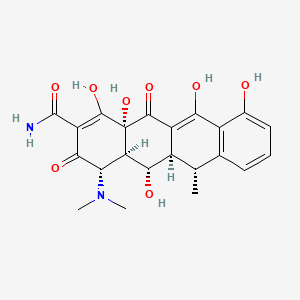
| Formula | C22H26N2O9 |
|---|---|
| Molecular weight | 462.46 g/mol |
| IUPAC name | (4S,4aR,5S,5aR,6R,12aR)-4-(dimethylamino)-1,5,10,11,12a-pentahydroxy-6-methyl-3,12-dioxo-4a,5,5a,6-tetrahydro-4H-tetracene-2-carboxamide |
| CAS | 7164-70-7 |
| PubChem CID | 54671203 |
| InChIKey | XQTWDDCIUJNLTR-CVHRZJFOSA-N |
| logP | -0.35 (XLogP -0.7) |
| Polar surface area | 181.62 Ų |
| H-bond acceptors / donors | 9 / 6 |
| Drug-likeness (QED) | 0.33 |
| Lipinski violations | 1 |
SMILES
C[C@H]1c2cccc(O)c2C(=O)C2=C(O)[C@]3(O)C(=O)C(C(N)=O)=C(O)[C@@H](N(C)C)[C@@H]3[C@@H](O)[C@@H]21.OBiology & Pharmacokinetics
Pharmacokinetics predicted
| Bioavailability | 10.0% |
|---|---|
| Half-life | 6.194 h |
| Volume of distribution | 1.485 L/kg |
| Protein binding | 79.8% |
| BBB penetrant | No |
Transporters
BCRP (Inhibitor)BSEP (Inhibitor)BSEP (Inhibitor)MRP1 (Inhibitor)MRP2 (Inhibitor)MRP3 (Inhibitor)MRP4 (Inhibitor)OAT1 (Inhibitor)OAT2 (Inhibitor)OAT3 (Inhibitor)OAT4 (Inhibitor)OATP1B1 (Inhibitor)OATP1B3 (Inhibitor)OATP1B3 (Inhibitor)OCT1 (Inhibitor)P-gp (Inhibitor)P-gp (Substrate)Transporter(unspecified) (Substrate)
Drug–drug interactions (100+, DDInter)
| Interacting drug | Severity | Management |
|---|---|---|
| Acitretin | major | |
| Aminolevulinic acid | major | |
| Isotretinoin | major | |
| Lomitapide | major | |
| Methoxyflurane | major | |
| Mipomersen | major | |
| Pexidartinib | major | |
| Tretinoin | major | |
| Typhoid vaccine (live) | major | |
| Vibrio cholerae CVD 103-HgR strain live antigen (live) | major | |
| Vitamin A | major | |
| Activated charcoal | moderate | |
| Aluminum hydroxide | moderate | |
| Aminolevulinic acid (topical) | moderate | |
| Aminophylline | moderate | |
| Amobarbital | moderate | |
| Amoxicillin | moderate | |
| Ampicillin | moderate | |
| Anisindione | moderate | |
| Asparaginase Erwinia chrysanthemi | moderate | |
| Asparaginase Escherichia coli | moderate | |
| Atracurium | moderate | |
| Attapulgite | moderate | |
| Bacampicillin | moderate | |
| Balsalazide | moderate | |
| Bedaquiline | moderate | |
| Benzylpenicillin | moderate | |
| Benzylpenicillin (potassium) | moderate | |
| Benzylpenicillin (sodium) | moderate | |
| Bifidobacterium longum infantis | moderate | |
| Bismuth subcitrate potassium | moderate | |
| Bismuth subgallate | moderate | |
| Bismuth subsalicylate | moderate | |
| Butabarbital | moderate | |
| Butalbital | moderate | |
| Calaspargase pegol | moderate | |
| Calcium Phosphate | moderate | |
| Calcium acetate | moderate | |
| Calcium carbonate | moderate | |
| Calcium chloride | moderate |
Showing 40 of 100+.
Registered Products (17)
| Brand | Form / strength | Pack | Agent | Citizen (JOD) |
|---|---|---|---|---|
| DOXYDAR CAPS. | Capsule 100 mg | 6 cap pack varies | Dar Al Dawa Development and Investment Co Ltd/Jordan | 1.480 |
| REMYCIN 100 CAPSULES | Capsule 100 mg | 10 cap pack varies | JAWEDA INT. DRUD STORE | 1.820 |
| Tabocine | Capsule 100 mg | 10 cap | Sukhtian Group | 1.820 |
| MEDOMYCIN CAP | Capsule 100 mg | 10 cap | Khoury Drug Store | 1.910 |
| Dumoxin Tabs | Tablet 100 mg | 10 tab | Reda Jardaneh Drug Store | 1.930 |
| DOXYDAR CAPS. | Capsule 100 mg | 8 cap pack varies | Dar Al Dawa Development and Investment Co Ltd/Jordan | 1.980 |
| DOXYDAR CAPS. | Capsule 100 mg | 10 cap pack varies | Dar Al Dawa Development and Investment Co Ltd/Jordan | 2.470 |
| Doxymid Capsules | Capsule 100 mg | 10 cap pack varies | MIDDLE EAST PHARMA&CHEMICAL IND/JORDAN | 2.470 |
| Unidox Capsules | Capsule 100 mg | 10 cap pack varies | UNITED PHARM.MFG.CO.LTD(UPM)/JORDAN | 2.470 |
| Unidox F.C Tablets | Film-Coated Tablet 100 mg | 10 tab pack varies | UNITED PHARM.MFG.CO.LTD(UPM)/JORDAN | 2.470 |
| Vibramycin Tab | Tablet 100 mg | 10 tab | Khoury Drug Store | 2.600 |
| DOXYDAR CAPS. | Capsule 100 mg | 20 cap pack varies | Dar Al Dawa Development and Investment Co Ltd/Jordan | 4.640 |
| REMYCIN 100 CAPSULES | Capsule 100 mg | 100 cap pack varies | JAWEDA INT. DRUD STORE | 16.380 |
| DOXYDAR CAPS. | Capsule 100 mg | 500 cap pack varies | Dar Al Dawa Development and Investment Co Ltd/Jordan | 79.800 |
| Doxymid Capsules | Capsule 100 mg | 500 cap pack varies | MIDDLE EAST PHARMA&CHEMICAL IND/JORDAN | 98.800 |
| Unidox Capsules | Capsule 100 mg | 1000 cap pack varies | UNITED PHARM.MFG.CO.LTD(UPM)/JORDAN | 197.600 |
| Unidox F.C Tablets | Film-Coated Tablet 100 mg | 1000 tab pack varies | UNITED PHARM.MFG.CO.LTD(UPM)/JORDAN | 197.600 |