Eltrombopag
JFDA label: ELTRAD 50MG
- Hepatotoxicity
Mechanism of Action
Eltrombopag is a thrombopoietin (TPO) nonpeptide agonist which increases platelet counts by binding to and activating the human TPO receptor. Activates intracellular signal transduction pathways to increase proliferation and differentiation of marrow progenitor cells.
Indications
Approved
- Aplastic anemia, severe
- Chronic hepatitis C infection-associated thrombocytopenia
- Chronic immune (idiopathic) thrombocytopenia
Contraindications
Source: Lexicomp
- Hypersensitivity to eltrombopag or any component of the formulation Absolute
- There are no contraindications listed in the manufacturer’s US labeling Absolute
- severe hepatic impairment (Child-Pugh class C) Absolute
Adverse Reactions
Cardiac disorders (3)
Common Peripheral edema · portal vein thrombosis · thrombosis
Nervous system disorders (5)
Very Common chills · Fatigue · headache · insomnia
Common Brain disease
Hepatobiliary disorders (6)
Very Common Abnormal hepatic function tests
Common ascites · Hyperbilirubinemia · increased serum alkaline phosphatase · increased serum ALT · increased serum AST
Renal and urinary disorders (1)
Common Urinary tract infection
Blood and lymphatic system disorders (1)
Very Common Anemia
Gastrointestinal disorders (7)
Very Common decreased appetite · Diarrhea · nausea
Common Abdominal pain · toothache · vomiting · xerostomia
Skin and subcutaneous tissue disorders (3)
Very Common Pruritus
Common Alopecia · skin rash
Musculoskeletal and connective tissue disorders (5)
Very Common myalgia · Weakness
Common Back pain · musculoskeletal pain · paresthesia
Eye disorders (1)
Common Cataract
Infections and infestations (1)
Common Influenza
General disorders and administration site conditions (1)
Very Common Fever
Respiratory, thoracic and mediastinal disorders (8)
Very Common cough · Flu-like symptoms · nasopharyngitis · upper respiratory tract infection
Common oropharyngeal pain · pharyngitis · Rhinitis · rhinorrhea
Dosing
Source: Lexicomp
Warnings & Precautions
Source: Lexicomp
Cataract formation
Cataract formation or worsening was observed in clinical trials. Monitor regularly for signs and symptoms of cataracts; obtain ophthalmic exam at baseline and during therapy. Use with caution in patients at risk for cataracts (eg, advanced age, long-term glucocorticoid use).
Hepatotoxicity
Eltrombopag may increase the risk of severe and potentially life-threatening hepatotoxicity. Monitor hepatic function and discontinue dosing as recommended. Liver enzyme elevations may occur; obtain ALT, AST, and bilirubin prior to treatment initiation, every 2 weeks during adjustment phase, then monthly (after stable dose established). Eltrombopag inhibits UGT1A1 and OATP1B1, which may lead to indirect hyperbilirubinemia; obtain fractionation for elevated bilirubin levels. Repeat abnormal liver function tests within 3 to 5 days; if confirmed abnormal, monitor weekly until resolves, stabilizes, or returns to baseline. Discontinue treatment for ALT levels ≥3 times the upper limit of normal (ULN) in patients with normal hepatic function, or ≥3 times baseline (or >5 times ULN; whichever is lower) in those with preexisting transaminase elevations and which are progressively increasing, or persistent (≥4 weeks), or accompanied by increased direct bilirubin, or accompanied by clinical signs of liver injury or evidence of hepatic decompensation. Hepatotoxicity may recur with re-treatment after therapy interruption; however, if the benefit of treatment outweighs the hepatotoxicity risk, initiate carefully, and monitor liver function tests weekly during the dose adjustment phase. Permanently discontinue if liver test abnormalities persist, worsen, or recur with rechallenge. In clinical trials, isolated cases of severe liver injury occurred, liver function test abnormalities usually oc
Thromboembolism
Thromboembolism (venous or arterial) may occur with excessive increases in platelet levels. Use with caution in patients with known risk factors for thromboembolism (eg, Factor V Leiden, ATIII deficiency, antiphospholipid syndrome, chronic liver disease). Thrombotic events, primarily involving the portal venous system, were more commonly seen in eltrombopag-treated chronic hepatitis C patients with thrombocytopenia (when compared to placebo). Thrombotic events (including portal venous thrombosis) were also reported in a study of non-ITP thrombocytopenic patients with chronic liver disease undergoing elective invasive procedures receiving eltrombopag 75 mg once daily. Symptoms of portal vein thrombosis include abdominal pain, nausea, vomiting, and diarrhea. The risk for portal venous thrombosis is increased in thrombocytopenic patients with chronic liver disease receiving 75 mg once daily for 2 weeks as preparation for invasive procedures. Disease-related concerns:
Chronic hepatitis C infection
May increase risk of hepatic decompensation when used in combination with interferon and ribavirin in patients with chronic hepatitis C. In clinical trials, patients with low albumin (• Hepatic impairment: Clearance may be reduced in patients with hepatic impairment; use with caution; reduced starting doses are recommended in patients with ITP (except children 1 to 5 years) and severe aplastic anemia who have hepatic impairment (no initial dose reductions are necessary in patients with chronic hepatitis C-related thrombocytopenia).
Myelodysplastic syndromes
Eltrombopag is not indicated for the treatment of myelodysplastic syndromes (MDS). A clinical trial comparing the combination of azacitidine plus eltrombopag to azacitidine alone in patients with intermediate-1, intermediate-2, or high-risk MDS was terminated due to lack of efficacy and safety concerns (including increased progression to AML). Increased relative risks of death and progression to AML in the eltrombopag arm compared to placebo were observed in the study.
Renal impairment
Use with caution with renal impairment (any degree) and monitor closely; initial dosage adjustment is not necessary. Concurrent drug therapy issues:
Drug-drug interactions
Potentially significant interactions may exist, requiring dose or frequency adjustment, additional monitoring, and/or selection of alternative therapy. Consult drug interactions database for more detailed information. Special populations:
East-Asian ethnicity (eg, Chinese, Japanese, Korean, Taiwanese)
May have greater drug exposure (compared to non-East Asians); therapy should be initiated with lower starting doses in ITP and severe aplastic anemia patients. Other warnings/precautions:
Appropriate use
Do not use to normalize platelet counts. ITP: Indicated only when the degree of thrombocytopenia and clinical conditions increase the risk for bleeding in patients with chronic immune ITP; use the lowest dose necessary to achieve and maintain platelet count ≥50,000/mm3. Discontinue if platelet count does not respond to a level to avoid clinically important bleeding after 4 weeks at the maximum recommended dose. Chronic hepatitis C-associated thrombocytopenia: Use only when thrombocytopenia prevents the initiation and maintenance of interferon-based therapy; discontinue if antiviral therapy is discontinued. Safety and efficacy have not been established when combined with direct acting antiviral medications approved for chronic hepatitis C genotype 1 infection therapy. Severe aplastic anemia: Use the lowest dose to achieve and maintain hematologic response. Discontinue if no hematologic response has occurred after 16 weeks of therapy, excessive platelet count responses or important liver test abnormalities. Consider discontinuation if new cytogenetic abnormalities are observed.
Pregnancy & Lactation
Pregnancy
Adverse effects were observed in animal reproduction studies. Information related to the use of eltrombopag for the treatment of thrombocytopenia in pregnancy is limited (Favier 2017; Purushothaman 2016; Suzuki 2017). If used in combination with ribavirin, all warnings related to the use of ribavirin and pregnancy and/or contraception should be followed. Refer to the ribavirin monograph for additional information.
Lactation
It is not known if eltrombopag is present in breast milk. Due to the potential for serious adverse effects in the breastfed infant, a decision should be made to discontinue therapy or to discontinue breastfeeding, taking into account the importance of treatment to the mother.
Monitoring
| Clinical pearl | Monitor liver function tests, including ALT, AST, and bilirubin (baseline, every 2 weeks during dosage titration, then monthly after a stable dose is achieved; evaluate abnormal liver function tests within 3 to 5 days; monitor weekly until abnormalities resolve, stabilize, or return to baseline or if re-treating [not recommended] after therapy interruption for hepatotoxicity); bilirubin fractionation (for elevated bilirubin); ophthalmic exam (baseline and during treatment). Thrombocytopenia due to CHC and chronic ITP: CBC with differential and platelet count (weekly at initiation and during dosage titration, then monthly when stable; after cessation, monitor weekly for ≥4 weeks; when switching between the oral suspension and tablet, monitor platelet counts weekly for 2 weeks, then monthly when stable). Severe aplastic anemia: CBC with differential and platelets (regularly throughout therapy) Monitor adherence. |
|---|
Chemistry & Properties
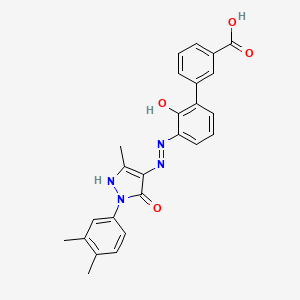
| Formula | C25H22N4O4 |
|---|---|
| Molecular weight | 442.48 g/mol |
| IUPAC name | 3-[3-[[2-(3,4-dimethylphenyl)-5-methyl-3-oxo-1H-pyrazol-4-yl]diazenyl]-2-hydroxyphenyl]benzoic acid |
| CAS | 496775-61-2 |
| PubChem CID | 135449332 |
| InChIKey | XDXWLKQMMKQXPV-QYQHSDTDSA-N |
| logP | 4.56 (XLogP 5.4) |
| Polar surface area | 114.59 Ų |
| H-bond acceptors / donors | 6 / 3 |
| Drug-likeness (QED) | 0.40 |
| Lipinski violations | 0 |
SMILES
CC1=NN(c2ccc(C)c(C)c2)C(=O)/C1=N\Nc1cccc(-c2cccc(C(=O)O)c2)c1OBiology & Pharmacokinetics
Pharmacokinetics
| BBB penetrant | No |
|---|
Enzyme interactions
| Enzyme | Role | Detail |
|---|---|---|
| CYP1A2 | Substrate | — |
| CYP2C8 | Inhibitor | — |
Receptor binding (top 1)
| Target | Action | Affinity |
|---|---|---|
| Thrombopoietin receptor (MPL) | Agonist | pEC50 7.4 |
Transporters
BCRP (Inhibitor)BSEP (Inhibitor)MRP1 (Inhibitor)OATP1B1 (Inhibitor)OATP1B1 (Inhibitor)OATP1B3 (Inhibitor)OATP1B3 (Inhibitor)OATP2B1 (Inhibitor)OCT1 (Inhibitor)P-gp (Inhibitor)MDR1 (Substrate)OATP2B1 (Substrate)P-gp (Substrate)
Drug–drug interactions (100+, DDInter)
| Interacting drug | Severity | Management |
|---|---|---|
| Berotralstat | major | |
| Carfilzomib | major | |
| Eluxadoline | major | |
| Grazoprevir | major | |
| Interferon alfa-2a, Recombinant | major | |
| Interferon alfa-2b | major | |
| Interferon alfa-n1 | major | |
| Interferon alfacon-1 | major | |
| Leflunomide | major | |
| Lomitapide | major | |
| Mipomersen | major | |
| Ozanimod | major | |
| Peginterferon alfa-2a | major | |
| Peginterferon alfa-2b | major | |
| Pexidartinib | major | |
| Teriflunomide | major | |
| Alpelisib | moderate | |
| Aluminum hydroxide | moderate | |
| Apalutamide | moderate | |
| Artesunate | moderate | |
| Asparaginase Erwinia chrysanthemi | moderate | |
| Asparaginase Escherichia coli | moderate | |
| Atorvastatin | moderate | |
| Attapulgite | moderate | |
| Bedaquiline | moderate | |
| Bictegravir | moderate | |
| Binimetinib | moderate | |
| Bosentan | moderate | |
| Brentuximab vedotin | moderate | |
| Brigatinib | moderate | |
| Calaspargase pegol | moderate | |
| Calcium Phosphate | moderate | |
| Calcium acetate | moderate | |
| Calcium carbonate | moderate | |
| Calcium citrate | moderate | |
| Calcium glubionate anhydrous | moderate | |
| Calcium gluconate | moderate | |
| Calcium glycerophosphate | moderate | |
| Calcium lactate | moderate | |
| Cannabidiol | moderate |
Showing 40 of 100+.
Registered Products (5)
| Brand | Form / strength | Pack | Agent | Citizen (JOD) |
|---|---|---|---|---|
| ELTRAD | Tablet Eltrombopag 50 mg | 30 tab pack varies | Omicron Pharma | — |
| ELTRAD | Tablet Eltrombopag 25 mg | 30 tab pack varies | Omicron Pharma | — |
| ELTRAD | Tablet Eltrombopag 50 mg | 100 tab pack varies | Omicron Pharma | — |
| ELTRAD | Tablet Eltrombopag 25 mg | 100 tab pack varies | Omicron Pharma | — |
| Revolade | Tablet 25 mg | 28 tab | The Jordan Drugstore Co | — |