Entrectinib
JFDA label: Rozlytrek 100mg hard capsule
Mechanism of Action
Inhibitor of Neurotrophic tyrosine kinase receptor — Neurotrophic tyrosine kinase receptor inhibitor; Inhibitor of Proto-oncogene tyrosine-protein kinase ROS — Proto-oncogene tyrosine-protein kinase ROS inhibitor; Inhibitor of ALK tyrosine kinase receptor — ALK tyrosine kinase receptor inhibitor
| Target | Action | Gene / class |
|---|---|---|
| ALK tyrosine kinase receptor efficacy | INHIBITOR | ALK |
| Neurotrophic tyrosine kinase receptor efficacy | INHIBITOR | |
| Proto-oncogene tyrosine-protein kinase ROS efficacy | INHIBITOR | ROS1 |
Indications
Approved
- Carcinoma, Non-Small-Cell Lung — non-small cell lung carcinoma
- Neoplasms — neoplasm
Off-label
- Carcinoma, Lobular
- Hematologic Neoplasms
- Melanoma
- Thyroid Neoplasms
Contraindications
Source: openFDA
- None. None. ( 4 ) Absolute
Adverse Reactions
Cardiac disorders (2)
Common And Qt Prolongation · Congestive Heart Failure
Vascular disorders (1)
Common Hypotension
Nervous system disorders (7)
Common Cognitive Disorder · Cognitive Disorders · Dizziness · Headache · Sarcoma · Syncope · Were Dizziness
Renal and urinary disorders (2)
Common Increased Blood Creatinine · Ted In Interruption Were Increased Blood Creatinine
Blood and lymphatic system disorders (2)
Common And Neutropenia · Anemia
Gastrointestinal disorders (4)
Very Common Of Patients Include Dysphagia
Common Diarrhea · Nausea
Uncommon Large Intestine Perforation
Musculoskeletal and connective tissue disorders (2)
Very Common Of Patients Included Skeletal Fractures
Common Fractures
Infections and infestations (8)
Common And Sepsis · And Urinary Tract Infection · Device Related Infection · Sepsis · Upper Respiratory Infection · Were Lung Infection · Were Pneumonia
Uncommon Pneumonia
Investigations (2)
Common And Increased Weight · Increased Weight
General disorders and administration site conditions (11)
Very Common Most Adults
Common And Colon · And Pyrexia · Asthenia · Fall · Fatigue · Gait Disturbance · Hydrocephalus · Pain · Pyrexia
Uncommon Completed Suicide
Respiratory, thoracic and mediastinal disorders (7)
Very Common Were Lung
Common Dyspnea · Hypoxia · Pleural Effusion · Pulmonary Embolism · Respiratory Failure
Uncommon Fatal Events Included Dyspnea
Neoplasms benign, malignant and unspecified (incl cysts and polyps) (1)
Uncommon And Tumor Lysis Syndrome
Dosing
Source: openFDA
Warnings & Precautions
Source: openFDA
Warnings & Precautions
Congestive Heart Failure (CHF) : Assess left ventricular ejection fraction (LVEF) prior to initiation of ROZLYTREK. Monitor patients for clinical signs and symptoms of CHF. For patients with myocarditis, with or without a decreased ejection fraction, MRI or cardiac biopsy may be required to make the diagnosis. For new onset or worsening CHF, withhold ROZLYTREK, reassess LVEF and institute appropriate medical management. Reduce dose or permanently discontinue ROZLYTREK based on severity of CHF or worsening LVEF. ( 2.7 , 5.1 ) Central Nervous System (CNS) Effects: CNS adverse reactions including cognitive impairment, mood disorders, dizziness, and sleep disturbances can occur with ROZLYTREK. Withhold and then resume at same or reduced dose upon improvement or permanently discontinue ROZLYTREK based on severity. ( 2.7 , 5.2 ) Skeletal Fractures: ROZLYTREK increases the risk of fractures. Promptly evaluate patients with signs or symptoms of fractures. ( 5.3 ) Hepatotoxicity : Monitor liver tests, including ALT and AST, every 2 weeks during the first month of treatment, then monthly thereafter, and as clinically indicated. Withhold or permanently discontinue ROZLYTREK based on severity. If withheld, resume ROZLYTREK at same or reduced dose based on severity. ( 2.7 , 5.4 ) Hyperuricemia : Assess serum uric acid levels prior to initiation and periodically during treatment with ROZLYTREK. Monitor patients for signs and symptoms of hyperuricemia. Initiate treatment with urate-lowering medications as clinically indicated and withhold ROZLYTREK for signs and symptoms of hyperuricemia. Resume at same or reduced dose upon improvement based on severity. ( 2.7 , 5.5 ) QT Interval Prolongation : Monitor patients who have or who are at risk for QTc interval prolongation. Assess QT interval and electrolytes at baseline and periodically during treatment. Withhold and then resume at same or reduced dose, or permanently discontinue ROZLYTREK based on severity. ( 2.7 , 5.6 ) Vision Disorders : Withhold for new visual changes or changes that interfere with activities of daily living until improvement or stabilization. Conduct an ophthalmological evaluation as appropriate. Resume at same or reduced dose upon improvement or stabilization. ( 2.7 , 5.7 ) Embryo-Fetal Toxicity : Can cause fetal harm. Advise females of reproductive potential of the potential risk to a fetus and use of effective contraception. ( 5.8 , 8.1 , 8.3 )
Congestive Heart Failure Among the 355 patients who received ROZLYTREK
Congestive Heart Failure Among the 355 patients who received ROZLYTREK across clinical trials, congestive heart failure (CHF) occurred in 3.4% of patients, including Grade 3 (2.3%) [see Adverse Reactions (6.1) ]. In clinical trials, baseline cardiac function and routine cardiac monitoring other than electrocardiograms (ECGs) were not conducted and eligibility criteria excluded patients with symptomatic CHF, myocardial infarction, unstable angina, and coronary artery bypass graft within 3 months of study entry. Among the 12 patients with CHF, the median time to onset was 2 months (range: 11 days to 12 months). ROZLYTREK was interrupted in 6 of these patients (50%) and discontinued in 2 of these patients (17%). CHF resolved in 6 patients (50%) following interruption or discontinuation of ROZLYTREK and institution of appropriate medical management. In addition, myocarditis in the absence of CHF was documented in 0.3% of patients. Assess left ventricular ejection fraction (LVEF) prior to initiation of ROZLYTREK. Monitor patients for clinical signs and symptoms of CHF, including shortness of breath and edema. For patients with myocarditis, with or without a decreased ejection fraction, MRI or cardiac biopsy may be required to make the diagnosis. For patients with new onset or worsening CHF, withhold ROZLYTREK, institute appropriate medical management, and reassess LVEF. Based on the severity of CHF or worsening LVEF, resume ROZLYTREK at a reduced dose upon recovery to baseline or permanently discontinue [see Dosage and Administration (2.7) ] .
Central Nervous System Effects A broad spectrum of central nervous sys
Central Nervous System Effects A broad spectrum of central nervous system (CNS) adverse reactions occurred in patients receiving ROZLYTREK, including cognitive impairment, mood disorders, dizziness, and sleep disturbances. Among the 355 patients who received ROZLYTREK across clinical trials, 96 (27%) experienced cognitive impairment; symptoms occurred within 3 months of starting ROZLYTREK in 74 (77%). Cognitive impairment included cognitive disorders (8%), confusional state (7%), disturbance in attention (4.8%), memory impairment (3.7%), amnesia (2.5%), aphasia (2.3%), mental status changes (2%), hallucinations (1.1%), and delirium (0.8%). Grade 3 cognitive adverse reactions occurred in 4.5% of patients. Among the 96 patients with cognitive impairment, 13% required a dose reduction, 18% required dose interruption and 1% discontinued ROZLYTREK due to cognitive adverse reactions. Among the 355 patients who received ROZLYTREK across clinical trials, 36 (10%) experienced mood disorders. The median time to onset of mood disorders was 1 month (range: 1 day to 9 months). Mood disorders occurring in ≥ 1% of patients included anxiety (4.8%), depression (2.8%) and agitation (2%). Grade 3 mood disorders occurred in 0.6% of patients. One completed suicide was reported 11 days after treatment had ended. Among the 36 patients who experienced mood disorders, 6% required a dose reduction, 6% required dose interruption and no patients discontinued ROZLYTREK due to mood disorders. Dizziness occurred in 136 (38%) of the 355 patients. Among the 136 patients who experienced dizziness, Grade 3 dizziness occurred in 2.2% of patients. Ten percent of patients required a dose reduction, 7% required dose interruption and 0.7% discontinued ROZLYTREK due to dizziness. Among the 355 patients who received ROZLYTREK across clinical trials, 51 (14%) experienced sleep disturbances. Sleep disturbances included insomnia (7%), somnolence (7%), hypersomnia (1.1%), and sleep disorder (0.3%). Grade 3 sleep disturbances occurred in 0.6% of patients. Among the 51 patients who experienced sleep disturbances, 6% required a dose reduction and no patients discontinued ROZLYTREK due to sleep disturbances. The incidence of CNS adverse reactions was similar in patients with and without CNS metastases; however, the incidence of dizziness (38% vs 31%), headache (21% vs 13%), paresthesia (20% vs 6%), balance disorder (13% vs 4%), and confusional state (11% vs 2%) appeared to be increased in patients with CN
Skeletal Fractures ROZLYTREK increases the risk of fractures
Skeletal Fractures ROZLYTREK increases the risk of fractures. In an expanded safety population that included 338 adult patients and 76 pediatric patients who received ROZLYTREK across clinical trials, 5% of adult patients and 25% of pediatric patients experienced fractures [see Use in Specific Population (8.4) ] . In adult and pediatric patients, some fractures occurred in the setting of a fall or other trauma to the affected area; in pediatric patients some fractures occurred with no trauma. In general, there was inadequate assessment for tumor involvement at the site of fracture; however, radiologic abnormalities possibly indicative of tumor involvement were reported in some adult patients. In both adult and pediatric patients, most fractures were hip or other lower extremity fractures (e.g., femoral or tibial shaft). In two pediatric patients, bilateral femoral neck fractures occurred. A total of 41 fracture events were reported in 19 pediatric patients, with 13 patients who experienced more than one occurrence of fracture. Among the 19 pediatric patients who experienced fractures, 17 patients were less than 12 years of age. Among the 41 fracture events, 27 fracture events resolved, 4 fracture events resolved with sequelae and 3 events were resolving. The median time to fracture was 3.8 months (range 0.3 to 18.5 months) in adults and 4.3 months (range: 2 months to 28.7 months) in pediatric patients. ROZLYTREK was interrupted in 41% of adults and 16% of pediatric patients who experienced fractures. Five pediatric patients discontinued treatment due to fractures. Promptly evaluate patients with signs or symptoms (e.g., pain, changes in mobility, deformity) of fractures. There are no data on the effects of ROZLYTREK on healing of known fractures and risk of future fractures.
Hepatotoxicity Among the 355 patients who received ROZLYTREK, increase
Hepatotoxicity Among the 355 patients who received ROZLYTREK, increased AST of any grade occurred in 42% of patients and increased ALT of any grade occurred in 36%. Grade 3 – 4 increased AST or ALT occurred in 2.5% and 2.8% of patients, respectively; the incidence may be underestimated as 4.5% of patients had no post-treatment liver function tests [see Adverse Reactions (6.1) ] . The median time to onset of increased AST was 2 weeks (range: 1 day to 29.5 months). The median time to onset of increased ALT was 2 weeks (range: 1 day to 9.2 months). Increased AST or ALT leading to dose interruptions or reductions occurred in 0.8% and 0.8% of patients, respectively. ROZLYTREK was discontinued due to increased AST or ALT in 0.8% patients. Monitor liver tests, including ALT and AST, every 2 weeks during the first month of treatment, then monthly thereafter, and as clinically indicated. Withhold or permanently discontinue ROZLYTREK based on the severity. If withheld, resume ROZLYTREK at the same or reduced dose [see Dosage and Administration (2.7) ] .
Hyperuricemia Among 355 patients who received ROZLYTREK across clinica
Hyperuricemia Among 355 patients who received ROZLYTREK across clinical trials, 32 patients (9%) experienced hyperuricemia reported as adverse reactions with symptoms, as well as elevated uric acid levels. Grade 4 hyperuricemia occurred in 1.7% of patients, including one patient who died due to tumor lysis syndrome. Among the 32 patients with hyperuricemic adverse reactions, 34% required urate-lowering medication to reduce uric acid levels, 6% required dose reduction and 6% required dose interruption. Hyperuricemia resolved in 73% of patients following initiation of urate-lowering medication without interruption or dose reduction of ROZLYTREK. No patients discontinued ROZLYTREK due to hyperuricemia. Assess serum uric acid levels prior to initiation of ROZLYTREK and periodically during treatment. Monitor patients for signs and symptoms of hyperuricemia. Initiate treatment with urate-lowering medications as clinically indicated and withhold ROZLYTREK for signs and symptoms of hyperuricemia. Resume ROZLYTREK at same or reduced dose upon improvement of signs or symptoms based on severity [see Dosage and Administration (2.7) ] .
QT Interval Prolongation Among the 355 patients who received ROZLYTREK
QT Interval Prolongation Among the 355 patients who received ROZLYTREK across the clinical trials, 3.1% of patients with at least one post-baseline ECG assessment experienced QTcF interval prolongation of > 60 ms after starting ROZLYTREK and 0.6% had a QTcF interval > 500 ms [see Adverse Reactions (6.1) , Clinical Pharmacology (12.2) ]. Monitor patients who already have or who are at significant risk of developing QTc interval prolongation, including patients with known long QT syndromes, clinically significant bradyarrhythmias, severe or uncontrolled heart failure and those taking other medicinal products associated with QT prolongation. Assess QT interval and electrolytes prior to initiation of ROZLYTREK and periodically during treatment, adjusting frequency based upon risk factors such as congestive heart failure, electrolyte abnormalities, or concomitant medications known to prolong the QTc interval. Based on the severity of QTc interval prolongation, withhold ROZLYTREK and then resume at same or reduced dose, or permanently discontinue [see Dosage and Administration (2.7) ] .
Vision Disorders Among the 355 patients who received ROZLYTREK across
Vision Disorders Among the 355 patients who received ROZLYTREK across clinical trials, vision changes occurred in 21% of patients, including Grade 1 (17%), Grade 2 (2.8%) and Grade 3 (0.8%) [see Adverse Reactions (6.1) ] . Vision disorders occurring in ≥ 1% included blurred vision (9%), photophobia (5%), diplopia (3.1%), visual impairment (2%), photopsia (1.1%), cataract (1.1%), and vitreous floaters (1.1%). For patients with new visual changes or changes that interfere with activities of daily living, withhold ROZLYTREK until improvement or stabilization and conduct an ophthalmological evaluation as clinically appropriate. Upon improvement or stabilization, resume ROZLYTREK at same or reduced dose [see Dosage and Administration (2.7) ] .
Embryo-Fetal Toxicity Based on literature reports in humans with conge
Embryo-Fetal Toxicity Based on literature reports in humans with congenital mutations leading to changes in TRK signaling, findings from animal studies, and its mechanism of action, ROZLYTREK can cause fetal harm when administered to a pregnant woman. Administration of entrectinib to pregnant rats resulted in malformations at exposures approximately 2.7 times the human exposure at the 600 mg dose based on area under the curve (AUC). Advise pregnant women of the potential risk to a fetus. Advise female patients of reproductive potential to use effective contraception during treatment with ROZLYTREK and for 5 weeks following the last dose. Advise males with female partners of reproductive potential to use effective contraception during treatment with ROZLYTREK and for 3 months after the last dose [see Use in Specific Populations (8.1 , 8.3) ] .
Pregnancy & Lactation
Lactation
However, because of its potential toxicity in the breastfed infant, the manufacturer recommends that breastfeeding be discontinued during entrectinib therapy and for 7 days after the last dose.
Chemistry & Properties
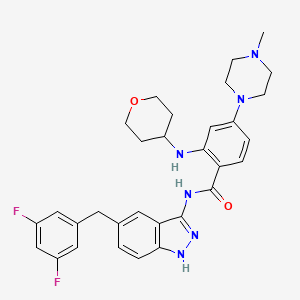
| Formula | C31H34F2N6O2 |
|---|---|
| Molecular weight | 560.65 g/mol |
| IUPAC name | N-[5-[(3,5-difluorophenyl)methyl]-1H-indazol-3-yl]-4-(4-methylpiperazin-1-yl)-2-(oxan-4-ylamino)benzamide |
| CAS | 1108743-60-7 |
| PubChem CID | 25141092 |
| InChIKey | HAYYBYPASCDWEQ-UHFFFAOYSA-N |
| logP | 5.03 (XLogP 5.7) |
| Polar surface area | 85.52 Ų |
| H-bond acceptors / donors | 6 / 3 |
| Drug-likeness (QED) | 0.29 |
| Lipinski violations | 2 |
SMILES
CN1CCN(c2ccc(C(=O)Nc3n[nH]c4ccc(Cc5cc(F)cc(F)c5)cc34)c(NC3CCOCC3)c2)CC1Biology & Pharmacokinetics
Pharmacokinetics predicted
| Bioavailability | 10.0% |
|---|---|
| Half-life | 0.725 h |
| Volume of distribution | 9.02 L/kg |
| Protein binding | 91.7% |
| BBB penetrant | No |
Enzyme interactions
| Enzyme | Role | Detail |
|---|---|---|
| CYP2C19 | Inhibitor | — |
| CYP2C8 | Inhibitor | — |
| CYP2D6 | Substrate | — |
Transporters
BCRP (Inhibitor)BSEP (Inhibitor)MDR1 (Inhibitor)MRP1 (Inhibitor)OATP1B1 (Inhibitor)OATP1B3 (Inhibitor)P-gp (Inhibitor)MDR1 (Substrate)P-gp (Substrate)Transporter(unspecified) (Substrate)
Drug–drug interactions (100+, DDInter)
| Interacting drug | Severity | Management |
|---|---|---|
| Amiodarone | major | |
| Amisulpride | major | |
| Amprenavir | major | |
| Anagrelide | major | |
| Apalutamide | major | |
| Aprepitant | major | |
| Arsenic trioxide | major | |
| Atazanavir | major | |
| Bedaquiline | major | |
| Bepridil | major | |
| Berotralstat | major | |
| Boceprevir | major | |
| Bosentan | major | |
| Cabozantinib | major | |
| Carbamazepine | major | |
| Cenobamate | major | |
| Ceritinib | major | |
| Chloramphenicol | major | |
| Chloroquine | major | |
| Ciprofloxacin | major | |
| Cisapride | major | |
| Citalopram | major | |
| Clarithromycin | major | |
| Clozapine | major | |
| Cobicistat | major | |
| Conivaptan | major | |
| Crizotinib | major | |
| Dabrafenib | major | |
| Dalfopristin | major | |
| Darunavir | major | |
| Delavirdine | major | |
| Dexamethasone | major | |
| Diltiazem | major | |
| Disopyramide | major | |
| Dofetilide | major | |
| Dolasetron | major | |
| Dronedarone | major | |
| Droperidol | major | |
| Duvelisib | major | |
| Efavirenz | major |
Showing 40 of 100+.
Registered Products (2)
| Brand | Form / strength | Pack | Agent | Citizen (JOD) |
|---|---|---|---|---|
| Rozlytrek 100mg hard capsule | Capsule 100 mg | 30 cap | Shawi & Rushedat Drug Store | — |
| Rozlytrek 200mg hard capsule | Capsule 200 mg | 90 cap | Shawi & Rushedat Drug Store | — |