Etoposide
JFDA label: ETOPOSID "Ebewe"
- Experienced physician:
- Bone marrow suppression:
Mechanism of Action
Inhibitor of DNA topoisomerase II — DNA topoisomerase II inhibitor
| Target | Action | Gene / class |
|---|---|---|
| DNA topoisomerase II efficacy | INHIBITOR |
Indications
Approved
- Small cell lung cancer (oral and IV)
- Testicular cancer (IV)
Off-label
- Acute lymphocytic leukemia (ALL)
- Acute myeloid leukemia (AML) induction (Children)
- Acute myeloid leukemia (AML), refractory
- Breast cancer, recurrent or metastatic
- Central nervous system tumors
- Ewing sarcoma
- Gestational trophoblastic disease
- Hematopoietic stem cell transplant conditioning regimen (Children)
- Hematopoietic stem cell transplant conditioning regimen, lymphoid malignancies
- Hodgkin lymphoma (Children)
- Merkel cell cancer
- Multiple myeloma, refractory
- Neuroblastoma (Children)
- Neuroendocrine tumors (adrenal gland and carcinoid tumors)
- Non-Hodgkin lymphomas
- Non-small cell lung cancer
- Osteosarcoma
- Ovarian cancer, refractory
- Prostate cancer
- Retinoblastoma
- Sarcoma, refractory (Children)
- Soft tissue sarcoma, metastatic
- Thymic malignancies (locally advanced or metastatic)
- Thymoma, locally advanced or metastatic
- Unknown primary adenocarcinoma
- Wilms tumor
Class profile
| mechanismClass | Plant alkaloid (podophyllotoxin, topoisomerase II inhibitor) |
|---|---|
| targetMolecule | Topoisomerase II (DNA double-strand break stabilization) |
| targetPathway | DNA replication/S phase |
| generation | Classic |
| primaryTumors | Testicular,SCLC,Lymphoma,AML,Kaposi sarcoma |
| resistanceMechanisms | MDR1/P-gp efflux,Topoisomerase II mutation or downregulation,Altered apoptosis (p53 mutation) |
| source | NCCN/OncoKB/Goodman&Gilman13ed |
Contraindications
Source: Lexicomp
- Additional contraindications (not in the US labeling): Severe leukopenia or thrombocytopenia Absolute
- Hypersensitivity to etoposide or any component of the formulation Absolute
- severe hepatic impairment Absolute
- severe renal impairment Absolute
Adverse Reactions
Cardiac disorders (1)
Common Hypotension
Nervous system disorders (1)
Common Peripheral neuropathy
Hepatobiliary disorders (1)
Common Hepatotoxicity
Blood and lymphatic system disorders (3)
Very Common anemia · Leukopenia · thrombocytopenia
Immune system disorders (1)
Common Anaphylactoid reaction (intravenous: 1% to 2%; oral capsules:
Gastrointestinal disorders (5)
Very Common anorexia · diarrhea · Nausea and vomiting
Common abdominal pain · Stomatitis
Skin and subcutaneous tissue disorders (1)
Very Common Alopecia
Dosing
Source: Lexicomp
Warnings & Precautions
Source: Lexicomp
Bone marrow suppression
Severe dose-limiting and dose-related myelosuppression with resulting infection or bleeding may occur. Treatment should be withheld for platelets 3 or absolute neutrophil count (ANC) 3.
Gastrointestinal toxicity
Oral etoposide is associated with a low (adults) or moderate (children) emetic potential; antiemetics may be recommended to prevent nausea and vomiting (Dupuis 2011; Roila 2016).
Hypersensitivity reaction
May cause anaphylactic-like reactions manifested by chills, fever, tachycardia, bronchospasm, dyspnea, and hypotension. In addition, facial/tongue swelling, coughing, chest tightness, cyanosis, laryngospasm, diaphoresis, hypertension, back pain, loss of consciousness, and flushing have also been reported less commonly. Incidence is primarily associated with intravenous administration (up to 2%) compared to oral administration (• Hypotension: Hypotension may occur due to rapid administration; infuse slowly over at least 30 to 60 minutes. If hypotension occurs, interrupt infusion and administer IV hydration and supportive care; decrease infusion upon reinitiation.
Secondary malignancies
Secondary acute leukemias have been reported with etoposide, either as monotherapy or in combination with other chemotherapy agents. Disease-related concerns:
Hepatic impairment
Use with caution in patients with hepatic impairment; dosage should be adjusted.
Hypoalbuminemia
Use with caution in patients with low serum albumin; may increase risk for toxicities.
Renal impairment
Use with caution in patients with renal impairment; dosage should be adjusted. Concurrent drug therapy issues:
Drug-drug interactions
Potentially significant interactions may exist, requiring dose or frequency adjustment, additional monitoring, and/or selection of alternative therapy. Consult drug interactions database for more detailed information. Special populations:
Elderly
Use with caution in elderly patients; may be more likely to develop severe myelosuppression and/or GI effects.
Pediatric
The use of concentrations higher than recommended were associated with higher rates of anaphylactic-like reactions in children. Dosage form specific issues:
Alcohol
Injectable formulation contains alcohol (~33% v/v); may contribute to adverse reactions, especially with higher etoposide doses.
Benzyl alcohol and derivatives
Some dosage forms may contain benzyl alcohol; large amounts of benzyl alcohol (≥99 mg/kg/day) have been associated with a potentially fatal toxicity (“gasping syndrome”) in neonates; the “gasping syndrome” consists of metabolic acidosis, respiratory distress, gasping respirations, CNS dysfunction (including convulsions, intracranial hemorrhage), hypotension, and cardiovascular collapse (AAP ["Inactive" 1997]; CDC 1982); some data suggests that benzoate displaces bilirubin from protein binding sites (Ahlfors 2001); avoid or use dosage forms containing benzyl alcohol with caution in neonates. See manufacturer’s labeling.
Polysorbate 80
Some dosage forms may contain polysorbate 80 (also known as Tweens). Hypersensitivity reactions, usually a delayed reaction, have been reported following exposure to pharmaceutical products containing polysorbate 80 in certain individuals (Isaksson 2002; Lucente 2000; Shelley 1995). Thrombocytopenia, ascites, pulmonary deterioration, and renal and hepatic failure have been reported in premature neonates after receiving parenteral products containing polysorbate 80 (Alade 1986; CDC 1984). See manufacturer’s labeling. Other warnings/precautions:
Administration
Must be diluted; do not give IV push, infuse over at least 30 to 60 minutes; hypotension is associated with rapid infusion. Etoposide is an irritant; tissue irritation and inflammation have occurred following extravasation. Do not administer IM or SubQ.
Experienced physician
Should be administered under the supervision of an experienced cancer chemotherapy physician.
Pregnancy & Lactation
Pregnancy
Adverse events were observed in animal reproduction studies. Fetal growth restriction and newborn myelosuppression have been observed following maternal use of regimens containing etoposide during pregnancy (NTP 2013; Peccatori 2013). The European Society for Medical Oncology has published guidelines for diagnosis, treatment, and follow-up of cancer during pregnancy. The guidelines recommend referral to a facility with expertise in cancer during pregnancy and encourage a multidisciplinary team (obstetrician, neonatologist, oncology team). In general, if chemotherapy is indicated, it should be avoided during in the first trimester, there should be a 3-week time period between the last chemotherapy dose and anticipated delivery, and chemotherapy should not be administered beyond week 33 of gestation. Guidelines for the treatment of SCLC are not provided (Peccatori 2013). In women of reproductive potential, product labeling for etoposide phosphate notes that it may cause amenorrhea, in
Lactation
Etoposide is present in breast milk. Based on data from one case report, concentrations are below the limit of detection 24 hours after the last dose (Azuno 1995). Due to the potential for serious adverse reactions in the breastfed infant, the manufacturer recommends a decision be made whether to discontinue breastfeeding or to discontinue the drug, taking into account the importance of treatment to the mother.
Monitoring
| Efficacy | Tumour response (RECIST criteria, tumour markers, imaging); progression-free survival; performance status (ECOG/Karnofsky) |
|---|---|
| Toxicity | CBC with differential (nadir timing depends on agent); LFTs; renal function; ECG (QT for relevant agents); echocardiogram for cardiotoxic agents (anthracyclines, trastuzumab); cumulative dose tracking for dose-limited toxicities |
| Clinical pearl | Treatment response is assessed after 2–3 cycles. Grade 3–4 toxicities typically require dose reduction or interruption per protocol-defined criteria. |
| Counseling | Attend all scheduled blood tests and imaging appointments. Report fever > 38°C (risk of neutropaenic sepsis — medical emergency), unusual bleeding, or new pain immediately. |
Chemistry & Properties
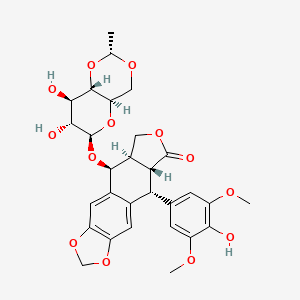
| Formula | C29H32O13 |
|---|---|
| Molecular weight | 588.56 g/mol |
| IUPAC name | (5S,5aR,8aR,9R)-5-[[(2R,4aR,6R,7R,8R,8aS)-7,8-dihydroxy-2-methyl-4,4a,6,7,8,8a-hexahydropyrano[3,2-d][1,3]dioxin-6-yl]oxy]-9-(4-hydroxy-3,5-dimethoxyphenyl)-5a,6,8a,9-tetrahydro-5H-[2]benzofuro[6,5-f][1,3]benzodioxol-8-one |
| CAS | 33419-42-0 |
| PubChem CID | 36462 |
| InChIKey | VJJPUSNTGOMMGY-MRVIYFEKSA-N |
| logP | 1.34 (XLogP 0.6) |
| Polar surface area | 160.83 Ų |
| H-bond acceptors / donors | 13 / 3 |
| Drug-likeness (QED) | 0.43 |
| Lipinski violations | 2 |
SMILES
COc1cc([C@@H]2c3cc4c(cc3[C@@H](O[C@@H]3O[C@@H]5CO[C@@H](C)O[C@H]5[C@H](O)[C@H]3O)[C@H]3COC(=O)[C@H]23)OCO4)cc(OC)c1OBiology & Pharmacokinetics
Pharmacokinetics
| BBB penetrant | No (logBB -1.5) |
|---|
Enzyme interactions
| Enzyme | Role | Detail |
|---|---|---|
| CYP2B6 | Inhibitor | — |
| CYP2C19 | Substrate | — |
| CYP3A4 | Inhibitor | — |
| CYP3A4 | Substrate | — |
Receptor binding (top 1)
| Target | Action | Affinity |
|---|---|---|
| DNA topoisomerase II alpha (TOP2A) | Inhibitor | pIC50 7.3 |
Transporters
BCRP (Inhibitor)BCRP (Inhibitor)BSEP (Inhibitor)BSEP (Inhibitor)MATE1 (Inhibitor)MDR1 (Inhibitor)MRP (Inhibitor)MRP1 (Inhibitor)MRP1 (Inhibitor)MRP2 (Inhibitor)MRP3 (Inhibitor)MRP4 (Inhibitor)MRP7 (Inhibitor)OATP1B1 (Inhibitor)OATP1B1 (Inhibitor)OATP1B3 (Inhibitor)OATP1B3 (Inhibitor)OATP2B1 (Inhibitor)OCT1 (Inhibitor)P-gp (Inhibitor)BCRP (Substrate)MDR1 (Substrate)MRP1 (Substrate)MRP2 (Substrate)OATP1B1 (Substrate)OATP1B3 (Substrate)OATP2B1 (Substrate)P-gp (Substrate)
Drug–drug interactions (100+, DDInter)
| Interacting drug | Severity | Management |
|---|---|---|
| Adalimumab | major | |
| Bacillus calmette-guerin substrain tice live antigen | major | |
| Baricitinib | major | |
| Certolizumab pegol | major | |
| Cladribine | major | |
| Clozapine | major | |
| Deferiprone | major | |
| Etanercept | major | |
| Fingolimod | major | |
| Golimumab | major | |
| Infliximab | major | |
| Leflunomide | major | |
| Measles virus vaccine live attenuated | major | |
| Mumps virus strain B level jeryl lynn live antigen | major | |
| Natalizumab | major | |
| Ozanimod | major | |
| Rotavirus vaccine | major | |
| Rubella virus vaccine | major | |
| Samarium (153Sm) lexidronam | major | |
| Siponimod | major | |
| Smallpox (Vaccinia) Vaccine, Live | major | |
| Talimogene laherparepvec | major | |
| Teriflunomide | major | |
| Thalidomide | major | |
| Tofacitinib | major | |
| Typhoid vaccine (live) | major | |
| Upadacitinib | major | |
| Varicella Zoster Vaccine (Recombinant) | major | |
| Yellow Fever Vaccine | major | |
| Abametapir (topical) | moderate | |
| Aldesleukin | moderate | |
| Alefacept | moderate | |
| Alemtuzumab | moderate | |
| Alpelisib | moderate | |
| Amiodarone | moderate | |
| Anakinra | moderate | |
| Anisindione | moderate | |
| Anthrax vaccine | moderate | |
| Apalutamide | moderate | |
| Aprepitant | moderate |
Showing 40 of 100+.
Registered Products (6)
| Brand | Form / strength | Pack | Agent | Citizen (JOD) |
|---|---|---|---|---|
| Zuvitop-50 | Capsule 50 mg | 8 cap | ٠ستÙدع أدÙÙØ© اÙÙÙÙÙÙÙ | 28.000 |
| ETOPOSID "Ebewe" | Suspension 100 mg/5 ml | 1 vial | Sabbagh Drug Store | — |
| Eotocid 100mg /5ml Sol For Inf | Solution 100 mg/5 ml | 1 vial | Hikma Pharmaceuticals Co.Ltd/Jordan | — |
| Eotocid 200mg /10ml Sol For Inf | Solution 200 mg/10 ml | 1 vial | Hikma Pharmaceuticals Co.Ltd/Jordan | — |
| Eotocid 400mg /20ml Sol For Inf | Solution 400 mg/20 ml | 1 vial | Hikma Pharmaceuticals Co.Ltd/Jordan | — |
| Fytosid | Injection 100 mg/5 ml | 1 vial | Sun Set Drug Store | — |