Glucagon
JFDA label: Glucagen 1 mg INJ
Mechanism of Action
Agonist of Glucagon receptor — Glucagon receptor agonist
| Target | Action | Gene / class |
|---|---|---|
| Glucagon receptor efficacy | AGONIST | GCGR |
Indications
Approved
- Diagnostic aid
- Hypoglycemia
Off-label
- Anaphylactic reactions
- Beta-blocker-induced myocardial depression
- Calcium channel blocker-induced myocardial depression
Contraindications
Source: Lexicomp
- Known hypersensitivity to glucagon, lactose, or any component of the formulation Absolute
- glucagonoma (excluding GlucaGen) Absolute
- insulinoma Absolute
- pheochromocytoma Absolute
Adverse Reactions
Cardiac disorders (5)
Not Known Hypertension · hypotension (up to 2 hours after GI procedures) · increased blood pressure · increased pulse · tachycardia
Gastrointestinal disorders (2)
Not Known Nausea · vomiting (high incidence with rapid administration of high doses)
General disorders and administration site conditions (2)
Not Known Anaphylaxis · hypersensitivity reaction
Dosing
Source: Lexicomp
Warnings & Precautions
Source: Lexicomp
Hypersensitivity reactions
Allergic reactions including skin rash and anaphylactic shock (with hypotension and respiratory difficulties) have been reported; reactions have generally been associated with endoscopic patients. Disease-related concerns:
Adrenal insufficiency
Use with caution in patients with adrenal insufficiency; levels of glucose stores in liver may be decreased.
Cardiac disease
Use with caution in patients with cardiac disease.
Chronic hypoglycemia
Use with caution in patients with chronic hypoglycemia; levels of glucose stores in liver may be decreased.
Diabetes
Use caution if using as diagnostic aid in patients with diabetes on insulin; may cause hyperglycemia.
Glucagonoma
Use with caution in patients with glucagonoma. The use of glucagon is contraindicated in patients with this condition (excluding GlucaGen).
Insulinoma
Exogenous glucagon may cause an initial rise in blood glucose followed by rebound hypoglycemia. The use of glucagon is contraindicated in patients with this condition.
Pheochromocytoma
Exogenous glucagon may cause the release of catecholamines, resulting in an increase in blood pressure. The use of glucagon is contraindicated in patients with this condition.
Starvation/fasting
Use caution with prolonged fasting and/or starvation; levels of glucose stores in liver may be decreased. Concurrent drug therapy issues:
Drug-drug interactions
Potentially significant interactions may exist, requiring dose or frequency adjustment, additional monitoring, and/or selection of alternative therapy. Consult drug interactions database for more detailed information. Dosage form specific issues:
Lactose
May contain lactose; avoid administration in hereditary galactose intolerance, Lapp lactase deficiency, or glucose-galactose malabsorption. Other warnings/precautions:
Appropriate use
Insulin or sulfonylurea overdose: Patients with hypoglycemia should immediately be treated with dextrose. If IV access cannot be established or if dextrose is not available, glucagon may be considered as alternative acute treatment until dextrose can be administered.
Secondary hypoglycemia
Supplemental carbohydrates should be given to patients who respond to glucagon for severe hypoglycemia to prevent secondary hypoglycemia.
Pregnancy & Lactation
Pregnancy
Adverse events have not been observed in animal reproduction studies.
Lactation
Glucagon is not absorbed from the GI tract and therefore, it is unlikely adverse effects would occur in a breast-feeding infant.
Monitoring
| Clinical pearl | Blood pressure, blood glucose, ECG, heart rate, mentation; signs or symptoms of a hypersensitivity reaction. |
|---|
Chemistry & Properties
| CAS | 9007-92-5 |
|---|---|
| PubChem CID | 16132283 |
SMILES
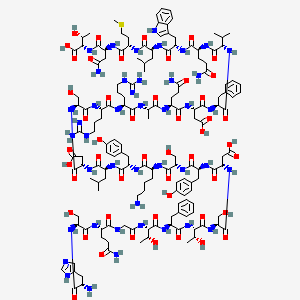
CC(C)CC(C(=O)NC(CCSC)C(=O)NC(CC(=O)N)C(=O)NC(C(C)O)C(=O)O)NC(=O)C(CC1=CNC2=CC=CC=C21)NC(=O)C(CCC(=O)N)NC(=O)C(C(C)C)NC(=O)C(CC3=CC=CC=C3)NC(=O)C(CC(=O)O)NC(=O)C(CCC(=O)N)NC(=O)C(C)NC(=O)C(CCCNC(=N)N)NC(=O)C(CCCNC(=N)N)NC(=O)C(CO)NC(=O)C(CC(=O)O)NC(=O)C(CC(C)C)NC(=O)C(CC4=CC=C(C=C4)O)NC(=O)C(CCCCN)NC(=O)C(CO)NC(=O)C(CC5=CC=C(C=C5)O)NC(=O)C(CC(=O)O)NC(=O)C(CO)NC(=O)C(C(C)O)NC(=O)C(CC6=CC=CC=C6)NC(=O)C(C(C)O)NC(=O)CNC(=O)C(CCC(=O)N)NC(=O)C(CO)NC(=O)C(CC7=CN=CN7)NBiology & Pharmacokinetics
Pharmacokinetics predicted
| Bioavailability | 70.0% |
|---|---|
| Half-life | 2.555 h |
| Volume of distribution | 0.213 L/kg |
| Protein binding | -10.9% |
| BBB penetrant | No |
Transporters
BCRP (Inhibitor)BSEP (Inhibitor)MRP1 (Inhibitor)OATP1B1 (Inhibitor)OATP1B3 (Inhibitor)P-gp (Inhibitor)P-gp (Substrate)
Drug–drug interactions (23, DDInter)
| Interacting drug | Severity | Management |
|---|---|---|
| Indomethacin | moderate | |
| Acebutolol | minor | |
| Atenolol | minor | |
| Betaxolol | minor | |
| Betaxolol (ophthalmic) | minor | |
| Bisoprolol | minor | |
| Carteolol | minor | |
| Carteolol (ophthalmic) | minor | |
| Carvedilol | minor | |
| Esmolol | minor | |
| Labetalol | minor | |
| Levobetaxolol (ophthalmic) | minor | |
| Levobunolol (ophthalmic) | minor | |
| Metipranolol (ophthalmic) | minor | |
| Metoprolol | minor | |
| Nadolol | minor | |
| Penbutolol | minor | |
| Pindolol | minor | |
| Propranolol | minor | |
| Sotalol | minor | |
| Timolol | minor | |
| Timolol (ophthalmic) | minor | |
| Warfarin | minor |
Registered Products (1)
| Brand | Form / strength | Pack | Agent | Citizen (JOD) |
|---|---|---|---|---|
| Glucagen | Powder for Injection 1 mg | 1 ml | Khoury Drug Store | 10.920 |