Glycopyrronium
JFDA label: Goprat 0.2mg/1ml solution for injection
Mechanism of Action
12.1 Mechanism of Action Glycopyrronium is a competitive inhibitor of acetylcholine receptors that are located on certain peripheral tissues, including sweat glands. In hyperhidrosis, glycopyrronium inhibits the action of acetylcholine on sweat glands, reducing sweating.
Indications
Off-label
- Asthma
- Hyperhidrosis
- Pulmonary Disease, Chronic Obstructive
- Severe Acute Respiratory Syndrome
Contraindications
Source: openFDA
- Qbrexza is contraindicated in patients with medical conditions that can be exacerbated by the anticholinergic effect of Qbrexza (e.g., glaucoma, paralytic ileus, unstable cardiovascular status in acute hemorrhage, severe ulcerative colitis, toxic megacolon complicating ulcerative colitis, myasthenia gravis, Sjogren’s syndrome). Qbrexza is contraindicated in patients with medical conditions that can be exacerbated by the anticholinergic effect of Qbrexza (e.g., glaucoma, paralytic ileus, unstable cardiovascular status in acute hemorrhage, severe ulcerative colitis, toxic megacolon complicating ulcerative colitis, myasthenia gravis, Sjogren’s syndrome) ( 4 ). Absolute
Adverse Reactions
Cardiac disorders (2)
Uncommon Atrial fibrillation · Palpitations
Vascular disorders (1)
Very Common Flushing
Nervous system disorders (1)
Very Common Headache
Renal and urinary disorders (2)
Very Common Urinary retention
Uncommon Dysuria
Metabolism and nutrition disorders (1)
Uncommon Hyperglycaemia
Gastrointestinal disorders (5)
Very Common Constipation · Dry mouth · Gastroenteritis · Vomiting
Uncommon Dyspepsia
Skin and subcutaneous tissue disorders (2)
Uncommon Dermatitis · Rash
Musculoskeletal and connective tissue disorders (1)
Uncommon Musculoskeletal chest pain
Psychiatric disorders (1)
Very Common Insomnia
Infections and infestations (6)
Very Common Nasopharyngitis · Sinusitis · Upper respiratory tract infection · Urinary tract infection
Uncommon Cystitis noninfective · Rhinitis
General disorders and administration site conditions (9)
Uncommon Asthenia · Bladder pain · Cystitis · Dental caries · Fatigue · Hypoaesthesia · Pain in extremity · Sinus congestion
Rare Ageusia
Respiratory, thoracic and mediastinal disorders (4)
Very Common Nasal congestion
Uncommon Epistaxis · Productive cough · Throat irritation
Dosing
Source: openFDA
Warnings & Precautions
Source: openFDA
Warnings & Precautions
New or worsening urinary retention: Use with caution in patients with a history of documented urinary retention ( 5.1 ). Control of body temperature: In the presence of high ambient temperature, heat illness may occur; avoid use if patients develop generalized lack of sweating when exposed to hot or very warm environmental temperatures ( 5.2 ). Operating machinery or an automobile: Transient blurred vision may occur with use of Qbrexza. If blurred vision occurs, discontinue use of Qbrexza until symptoms resolve; avoid operating a motor vehicle or other machinery until symptoms resolve ( 5.3 ).
New or Worsening Urinary Retention New or worsening signs and symptoms
New or Worsening Urinary Retention New or worsening signs and symptoms of urinary retention (e.g., difficulty passing urine, distended bladder) have occurred in patients taking Qbrexza with or without a history of documented urinary retention. Instruct patients to discontinue use immediately and consult a physician should any of these signs or symptoms develop. Qbrexza should be used with caution in patients with prostatic hypertrophy or bladder-neck obstruction.
Control of Body Temperature In the presence of high ambient temperatur
Control of Body Temperature In the presence of high ambient temperature, heat illness (hyperpyrexia and heat stroke due to decreased sweating) can occur with the use of anticholinergic drugs such as Qbrexza. Advise patients using Qbrexza to watch for generalized lack of sweating when in hot or very warm environmental temperatures and to avoid use if not sweating under these conditions.
Operating Machinery or an Automobile Transient blurred vision may occu
Operating Machinery or an Automobile Transient blurred vision may occur with use of Qbrexza. If blurred vision occurs, the patient should discontinue use until symptoms resolve. Patients should be warned not to engage in activities that require clear vision such as operating a motor vehicle or other machinery, or performing hazardous work until the symptoms have resolved.
Risk of Accidental Exposure Cases of accidental exposure resulting in
Risk of Accidental Exposure Cases of accidental exposure resulting in mydriasis, anisocoria, and blurred vision have been reported in postmarketing surveillance of Qbrexza. The exposures occurred when children accessed Qbrexza wipes discarded in trash or when patients touched the periocular area after using Qbrexza. In most cases, the mydriasis, anisocoria, and blurred vision were temporary and resolved within one week following exposure. The risk of accidental exposure was increased in these cases by not adhering to recommendations for the appropriate use of Qbrexza. Strict adherence to the recommended hand washing after use and disposal instructions is of the utmost importance to prevent accidental exposure. [see Dosage and Administration (2) ].
Pregnancy & Lactation
Pregnancy
Chemistry & Properties
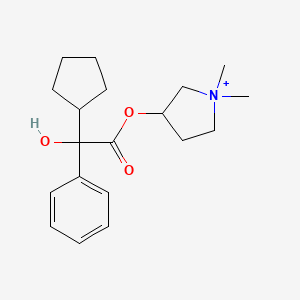
| Formula | C19H28NO3+ |
|---|---|
| Molecular weight | 318.44 g/mol |
| IUPAC name | (1,1-dimethylpyrrolidin-1-ium-3-yl) 2-cyclopentyl-2-hydroxy-2-phenylacetate |
| CAS | 740028-90-4 |
| PubChem CID | 3494 |
| InChIKey | ANGKOCUUWGHLCE-UHFFFAOYSA-N |
| logP | 2.46 (XLogP 3.1) |
| Polar surface area | 46.53 Ų |
| H-bond acceptors / donors | 3 / 1 |
| Drug-likeness (QED) | 0.69 |
| Lipinski violations | 0 |
SMILES
C[N+]1(C)CCC(OC(=O)C(O)(c2ccccc2)C2CCCC2)C1Biology & Pharmacokinetics
Pharmacokinetics
| BBB penetrant | No |
|---|
Enzyme interactions
| Enzyme | Role | Detail |
|---|---|---|
| CYP2B6 | Substrate | — |
| CYP2C19 | Substrate | — |
| CYP2D6 | Substrate | — |
| CYP3A4 | Substrate | — |
Transporters
BCRP (Inhibitor)BSEP (Inhibitor)MRP1 (Inhibitor)OATP1B1 (Inhibitor)OATP1B3 (Inhibitor)P-gp (Inhibitor)MATE1 (Substrate)OCT2 (Substrate)P-gp (Substrate)
Drug–drug interactions (100+, DDInter)
| Interacting drug | Severity | Management |
|---|---|---|
| Potassium chloride | major | |
| Potassium citrate | major | |
| Topiramate | major | |
| Zonisamide | major | |
| Acebutolol | moderate | |
| Acetylcholine | moderate | |
| Aclidinium | moderate | |
| Acrivastine | moderate | |
| Alfentanil | moderate | |
| Alimemazine | moderate | |
| Amantadine | moderate | |
| Ambenonium | moderate | |
| Amitriptyline | moderate | |
| Amoxapine | moderate | |
| Arbutamine | moderate | |
| Aripiprazole | moderate | |
| Asenapine | moderate | |
| Atenolol | moderate | |
| Atropine | moderate | |
| Azatadine | moderate | |
| Belladonna | moderate | |
| Benzatropine | moderate | |
| Benzhydrocodone | moderate | |
| Betaxolol | moderate | |
| Bethanechol | moderate | |
| Biperiden | moderate | |
| Bisoprolol | moderate | |
| Botulinum Toxin Type B | moderate | |
| Botulinum toxin type A | moderate | |
| Brexpiprazole | moderate | |
| Brompheniramine | moderate | |
| Buprenorphine | moderate | |
| Butorphanol | moderate | |
| Carbamoylcholine (ophthalmic) | moderate | |
| Carbinoxamine | moderate | |
| Cariprazine | moderate | |
| Carteolol | moderate | |
| Carvedilol | moderate | |
| Cevimeline | moderate | |
| Chlorcyclizine | moderate |
Showing 40 of 100+.
Registered Products (5)
| Brand | Form / strength | Pack | Agent | Citizen (JOD) |
|---|---|---|---|---|
| Seebri Breezhaler | Capsule 50 mcg | 1 Inhaler + 30 Hard Capsule | The Jordan Drugstore Co | 35.620 |
| Enerzair Breezhaler 150 mcg/50 mcg/160 mcg Inhalation powder | Powder 160 mcg, 150 mcg, 50 mcg | 30 Hard Capsules + 1 inhaler | The Jordan Drugstore Co | 39.740 |
| Breztri Aerosphere pressurised inhalation, suspension | Suspension 160 mcg, 5 mcg, 7.2 mcg | 120 Actuations | Shawi & Rushedat Drug Store | 51.610 |
| Ultibro Breezhaler | Capsule 110 mcg, 50 mcg | 30 Hard Capsules + 1 Inhaler | The Jordan Drugstore Co | 52.700 |
| Goprat 0.2mg/1ml solution for injection | Injection 0.2 mg/1 ml | 5 vial | MS PHARMA/JORDAN | — |