Hydroxychloroquine
JFDA label: Advaquenil tablet
Mechanism of Action
Interferes with digestive vacuole function within sensitive malarial parasites by increasing the pH and interfering with lysosomal degradation of hemoglobin; inhibits locomotion of neutrophils and chemotaxis of eosinophils; impairs complement-dependent antigen-antibody reactions
Indications
Approved
- Lupus erythematosus
- Malaria
- Rheumatoid arthritis
Off-label
- Porphyria cutanea tarda
- Primary Sjögren Syndrome - extraglandular manifestations
- Q fever (chronic)
Antimicrobial Spectrum
Expected / intrinsic spectrum (EUCAST breakpoints & labels) — not local resistance. Source: openfda-label.
Protozoa
| Organism | Activity | MIC |
|---|---|---|
| Plasmodium falciparum | Active | — |
| Plasmodium malariae | Active | — |
| Plasmodium ovale | Active | — |
| Plasmodium parasites | Active | — |
| Plasmodium vivax | Active | — |
Contraindications
Source: Lexicomp
- Additional contraindications (not in the US labeling): Preexisting retinopathy Absolute
- Known hypersensitivity to hydroxychloroquine, 4-aminoquinoline derivatives, or any component of the formulation Absolute
- use in children Absolute
Adverse Reactions
Cardiac disorders (2)
Uncommon QT prolongation
Very Rare Cardiomyopathy (rare, long-term)
Nervous system disorders (16)
Common Headache
Very Rare Myopathy / neuropathy (rare)
Not Known Ataxia · dizziness · emotional disturbance · emotional lability · headache · irritability · lassitude · nerve deafness · nervousness · nightmares · psychosis · seizure · suicidal tendencies · vertigo
Hepatobiliary disorders (2)
Not Known Acute hepatic failure (rare) · hepatic insufficiency (rare)
Blood and lymphatic system disorders (7)
Not Known Agranulocytosis · anemia · aplastic anemia · hemolysis (in patients with glucose-6-phosphate deficiency) · leukopenia · purpuric rash · thrombocytopenia
Immune system disorders (1)
Not Known Angioedema
Metabolism and nutrition disorders (2)
Not Known Exacerbation of porphyria · weight loss
Gastrointestinal disorders (6)
Common Nausea / GI upset
Not Known Anorexia · diarrhea · nausea · stomach cramps · vomiting
Skin and subcutaneous tissue disorders (18)
Uncommon Skin pigmentation changes
Not Known Acute generalized exanthematous pustulosis · alopecia · bleaching of hair · bullous rash · dyschromia (skin and mucosal; black-blue color) · erythema (annulare centrifugum) · erythema multiforme · exacerbation of psoriasis (nonlight sensitive) · exfoliative dermatitis · lichenoid eruption · maculopapular rash · morbilliform rash · pruritus · skin photosensitivity · Stevens-Johnson syndrome · toxic epidermal necrolysis · urticaria
Musculoskeletal and connective tissue disorders (1)
Not Known Myopathy (including palsy or neuromyopathy, leading to progressive weakness and atrophy of proximal muscle groups; may be associated with mild sensory changes, loss of deep tendon reflexes, and abnorm
Eye disorders (14)
Common Retinopathy (cumulative dose-dependent)
Not Known Accommodation disturbance · corneal changes (transient edema, punctate to lineal opacities, decreased sensitivity, deposits, visual disturbances, blurred vision, photophobia [reversible on discontinuation]) · decreased visual acuity · macular edema · nystagmus · optic disk disorder (pallor/atrophy) · retinal pigment changes · retinal vascular disease (attenuation of arterioles) · retinitis pigmentosa · retinopathy (early changes reversible [may progress despite discontinuation if advanced]) · scotoma · vision color changes · visual field defect
Ear and labyrinth disorders (1)
Not Known Tinnitus
Respiratory, thoracic and mediastinal disorders (1)
Not Known Bronchospasm
Dosing
Source: Lexicomp
Warnings & Precautions
Source: Lexicomp
Cardiovascular effects
Cardiomyopathy resulting in cardiac failure, sometimes fatal, has been reported (symptoms may present as atrioventricular block, pulmonary hypertension, sick sinus syndrome, or as cardiac complications), and may appear during acute or chronic therapy. Monitor for signs/symptoms of cardiac compromise; discontinue treatment promptly if signs and symptoms of cardiomyopathy occur. In a scientific statement from the American Heart Association, hydroxychloroquine has been determined to be an agent that may either cause direct myocardial toxicity or exacerbate underlying myocardial dysfunction (magnitude: major) (AHA [Page 2016]). Consider chronic toxicity if conduction disorders (eg, bundle branch block, atrioventricular heart block) as well as biventricular hypertrophy are diagnosed. May also be associated with QT interval prolongation; ventricular arrhythmia and torsades de pointes have been reported (avoid concurrent use of other medications which may prolong the QT interval).
Dermatologic effects
Skin reactions to hydroxychloroquine may occur; use with caution in patients on concomitant medications with a propensity to cause dermatitis.
Hematologic effects
Bone marrow suppression (eg, agranulocytosis, anemia, aplastic anemia, leukopenia, thrombocytopenia) have been reported; periodically monitor CBC during prolonged therapy. Discontinue treatment if signs/symptoms of severe blood disorder not attributable to the underlying disease occur.
Hypoglycemia
Severe hypoglycemia, including life-threatening loss of consciousness, has been reported in patients with and without concomitant use of antidiabetic agents. Advise patients of risk of hypoglycemia and associated signs/symptoms; discontinue use in patients who develop severe hypoglycemia.
Neuromuscular effects
Proximal myopathy or neuromyopathy, leading to progressive weakness, proximal muscle atrophy, depressed tendon reflexes, and abnormal nerve conduction may occur, especially with long-term therapy. Curvilinear bodies and muscle fiber atrophy with vacuolar changes have been noted on muscle or nerve biopsy. Muscle strength (especially proximal muscles) and reflexes should be assessed periodically during long term therapy.
Psychiatric effects
Suicidal behavior has been reported rarely.
Retinal toxicity
Retinal toxicity, potentially causing irreversible retinopathy, is predominantly associated with high daily doses and a duration of >5 years of use of chloroquine or hydroxychloroquine in the treatment of rheumatic diseases. Other major risk factors include concurrent tamoxifen use, renal impairment, lower body weight, and the presence of macular disease. Daily hydroxychloroquine (base) doses >5 mg/kg actual body weight were associated with an ~10% risk of retinal toxicity within 10 years of treatment and an almost 40% risk after 20 years of therapy. Risk is most accurately assessed on the basis of duration of use relative to daily dose/body weight (Marmor [AAO 2016]; Melles 2014). Based on these risks, the American Academy of Ophthalmology (AAO) recommends not exceeding a daily hydroxychloroquine dosage of 5 mg/kg using actual body weight. Previous recommendations to use ideal body weight are no longer advised; very thin patients in particular were at increased risk for retinal toxicity using this practice. Current AAO guidelines do not specifically address dosing in obese patients. AAO also recommends baseline screening for retinal toxicity and annual screening beginning after 5 years of use (or sooner if major risk factors are present) (Marmor [AAO 2016]). If ocular toxicity is suspected, discontinue and monitor closely; retinal changes and visual disturbances may progress after discontinuation. A baseline ocular exam is recommended within the first year of initiating hydr
G6PD deficiency
Although the manufacturer's labeling recommends hydroxychloroquine be used with caution in patients with G6PD deficiency due to a potential for hemolytic anemia, there is limited data to support this risk. Many experts consider hydroxychloroquine, when given in usual therapeutic doses to WHO Class II and III G6PD deficient patients, to probably be safe (Cappellini 2008; Glader 2017; Luzzatto 2016; Youngster 2010). Safety in Class I G6PD deficiency (ie, severe form of the deficiency associated with chronic hemolytic anemia) is generally unknown (Glader 2017). In a retrospective chart review, no incidence of hemolytic anemia was found among the 11 patients identified with G6PD deficiency receiving hydroxychloroquine therapy, despite >700 months of exposure (all patients were African-American and located in the US) (Mohammad 2017). In addition, the ACR Rheumatology guidelines do not mention the need to evaluate G6PD levels prior to initiation of therapy (Singh 2015).
Gastrointestinal disorders
Use with caution in patients with gastrointestinal disorders.
Hepatic impairment
Use with caution in patients with hepatic impairment, alcoholism, or concurrent therapy with hepatotoxic agents.
Porphyria
Use with extreme caution in patients with porphyria; may exacerbate or precipitate disease.
Psoriasis
Use with extreme caution in patients with psoriasis; may exacerbate or precipitate disease.
Renal impairment
Use with caution in patients with renal impairment; dosage reduction may be needed. Special populations:
Pediatric
Pediatric patients have an increased sensitivity to aminoquinolones. Safety and efficacy have not been established for chronic use in children for juvenile idiopathic arthritis or for systemic lupus erythematosus. Concurrent drug therapy issues:
Drug-drug interactions
Potentially significant interactions may exist, requiring dose or frequency adjustment, additional monitoring, and/or selection of alternative therapy. Consult drug interactions database for more detailed information.
Pregnancy & Lactation
Pregnancy
Safe
Should NOT be stopped in SLE patients — reduced flares and better pregnancy outcomes. Recommended to continue throughout pregnancy and breastfeeding
Lactation
Hydroxychloroquine is excreted into breast milk in low concentrations (Costedoat-Chalumeau 2002; Ostensen 1985). In a case report, hydroxychloroquine concentrations were ~100 ng/mL in the maternal serum and 3.2 ng/mL in breast milk 15 to 24 hours after an initial maternal dose of 200 mg twice daily; the highest milk concentration was 10.6 ng/mL when measured 39 to 48 hours into the dosing regimen (Ostensen 1985)
Monitoring
| Clinical pearl | CBC at baseline and periodically; liver function; renal function (in patients at risk for ocular toxicity); blood glucose (if symptoms of hypoglycemia occur); muscle strength (especially proximal, as a symptom of neuromyopathy) during long-term therapy Ophthalmologic exam at baseline (fundus examination within the first year plus visual fields and spectral-domain optical coherence tomography [SD OCT] if maculopathy is present) to screen for retinal toxicity, followed by annual screening beginning after 5 years of use (or sooner if major risk factors are present) (Marmor [AAO 2016]). Additionally, the manufacturer recommends an ocular exam include best corrected distance visual acuity and an automated threshold visual field of the central 10 degrees (24 degrees in patients of Asian ancestry as retinal toxicity may appear outside of the macula). Consider annual exams (without deferring 5 years) in patients with significant risk factors. |
|---|
Chemistry & Properties
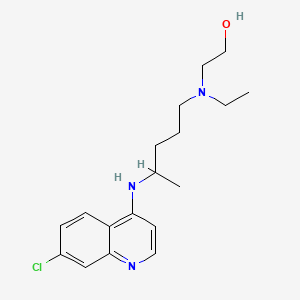
| Formula | C18H26ClN3O |
|---|---|
| Molecular weight | 335.88 g/mol |
| IUPAC name | 2-[4-[(7-chloroquinolin-4-yl)amino]pentyl-ethylamino]ethanol |
| CAS | 118-42-3 |
| PubChem CID | 3652 |
| InChIKey | XXSMGPRMXLTPCZ-UHFFFAOYSA-N |
| logP | 3.78 (XLogP 3.6) |
| Polar surface area | 48.39 Ų |
| H-bond acceptors / donors | 4 / 2 |
| Drug-likeness (QED) | 0.73 |
| Lipinski violations | 0 |
SMILES
CCN(CCO)CCCC(C)Nc1ccnc2cc(Cl)ccc12Biology & Pharmacokinetics
Pharmacokinetics
| BBB penetrant | No |
|---|
Enzyme interactions
| Enzyme | Role | Detail |
|---|---|---|
| CYP2B6 | Inhibitor | — |
| CYP2C8 | Inhibitor | — |
| CYP3A4 | Substrate | — |
Receptor binding (top 2)
| Target | Action | Affinity |
|---|---|---|
| TLR9 (TLR9) | Antagonist | pIC50 7.1 |
| TLR7 (TLR7) | Antagonist | pIC50 5.6 |
Transporters
BCRP (Inhibitor)BSEP (Inhibitor)BSEP (Inhibitor)MRP1 (Inhibitor)MRP2 (Inhibitor)MRP4 (Inhibitor)OATP1B1 (Inhibitor)OATP1B1 (Inhibitor)OATP1B3 (Inhibitor)OCT1 (Inhibitor)P-gp (Inhibitor)P-gp (Substrate)
Drug–drug interactions (100+, DDInter)
| Interacting drug | Severity | Management |
|---|---|---|
| Alfuzosin | major | |
| Alimemazine | major | |
| Amiodarone | major | |
| Amisulpride | major | |
| Amitriptyline | major | |
| Amoxapine | major | |
| Anagrelide | major | |
| Apomorphine | major | |
| Arsenic trioxide | major | |
| Asenapine | major | |
| Astemizole | major | |
| Atomoxetine | major | |
| Auranofin | major | |
| Aurothioglucose | major | |
| Azithromycin | major | |
| Bedaquiline | major | |
| Bepridil | major | |
| Bosutinib | major | |
| Buprenorphine | major | |
| Cabozantinib | major | |
| Ceritinib | major | |
| Chloroquine | major | |
| Chlorpromazine | major | |
| Cilostazol | major | |
| Ciprofloxacin | major | |
| Cisapride | major | |
| Citalopram | major | |
| Clarithromycin | major | |
| Clofazimine | major | |
| Clomipramine | major | |
| Clozapine | major | |
| Crizotinib | major | |
| Dasatinib | major | |
| Daunorubicin | major | |
| Daunorubicin (liposomal) | major | |
| Deferiprone | major | |
| Desipramine | major | |
| Deutetrabenazine | major | |
| Dextropropoxyphene | major | |
| Disopyramide | major |
Showing 40 of 100+.
Registered Products (2)
| Brand | Form / strength | Pack | Agent | Citizen (JOD) |
|---|---|---|---|---|
| Advaquenil tablet | Tablet 200 mg | 20 tab pack varies | The Arab Pharmaceutical Manufacturing PSC/Salt | 4.920 |
| Advaquenil tablet | Tablet 200 mg | 60 tab pack varies | The Arab Pharmaceutical Manufacturing PSC/Salt | 8.350 |