Lanreotide
JFDA label: Somatuline Autogel PFS
Mechanism of Action
Lanreotide is a synthetic octapeptide analogue of natural somatostatin which is a peptide inhibitor of multiple endocrine, neuroendocrine, and exocrine mechanisms. Lanreotide displays a greater affinity for somatostatin type 2 (SSTR2) and type 5 (SSTR5) receptors found in pituitary gland, pancreas, and growth hormone (GH) secreting neoplasms of pituitary gland and a lesser affinity for somatostatin receptors 1, 3, and 4. Lanreotide reduces GH secretion and also reduces the levels of insulin-like growth factor 1.
Indications
Approved
- Acromegaly
- Carcinoid syndrome
- Gastroenteropancreatic neuroendocrine tumors
Contraindications
Source: Lexicomp
- Additional contraindications (not in the US labeling): Hypersensitivity to somatostatin or related peptides Absolute
- Hypersensitivity to lanreotide or any component of the formulation Absolute
- complicated, untreated bile duct lithiasis Absolute
Adverse Reactions
Cardiac disorders (3)
Very Common Bradycardia · hypertension
Common Sinus bradycardia
Nervous system disorders (3)
Very Common Headache
Common depression · Dizziness
Hepatobiliary disorders (2)
Very Common Cholelithiasis · gallbladder sludge
Blood and lymphatic system disorders (1)
Very Common Anemia
Immune system disorders (1)
Very Common Antibody development
Metabolism and nutrition disorders (2)
Very Common Weight loss
Common Hyperglycemia
Gastrointestinal disorders (7)
Very Common abdominal pain · Diarrhea · flatulence · nausea · vomiting
Common constipation · Loose stools
Musculoskeletal and connective tissue disorders (2)
Very Common Musculoskeletal pain
Common Arthralgia
General disorders and administration site conditions (1)
Very Common Injection site reaction
Dosing
Source: Lexicomp
Warnings & Precautions
Source: Lexicomp
Cholelithiasis
May reduce gall bladder motility, leading to gall stone formation (may be dose- or duration-related); may require periodic monitoring.
Gastrointestinal effects
Diarrhea and loose stools may occur (may affect intestinal absorption of concurrently-administered medication); abdominal pain may also occur.
Hyper-/hypoglycemia
Inhibition of insulin and glucagon secretion may affect glucose regulation, leading to hyper-/hypoglycemia. Carefully monitor blood glucose levels with the initiation of therapy and with dosage alterations. Use with caution in patients with diabetes; may require dosage adjustments in antidiabetic therapy.
Hypersensitivity
Allergic reactions, including angioedema and anaphylaxis, have been reported.
Thyroid disorders
Decreases (slight) in thyroid function have been observed during treatment for acromegaly; monitor thyroid function tests if clinically indicated. The incidence of clinical hypothyroidism is rare. Disease-related concerns:
Cardiac disorders
Bradycardia, sinus bradycardia, and hypertension have been observed with therapy. Use with caution in patients with preexisting cardiac disease; monitor heart rate. Patients without preexisting cardiac disease may experience a decrease in heart rate though not to the level of bradycardia. Appropriate medical therapy should be initiated if patients develop symptomatic bradycardia.
Hepatic impairment
Use with caution in patients with acromegaly with moderate to severe hepatic impairment (systemic exposure may be increased); lower doses are recommended at therapy initiation. Lanreotide has not been studied in patients with neuroendocrine tumors with hepatic impairment.
Renal impairment
Use with caution in patients with acromegaly with moderate to severe renal impairment; lower initial doses are recommended. Concurrent drug therapy issues:
Drug-drug interactions
Potentially significant interactions may exist, requiring dose or frequency adjustment, additional monitoring, and/or selection of alternative therapy. Consult drug interactions database for more detailed information.
Pregnancy & Lactation
Pregnancy
Adverse events were observed in animal reproduction studies. Information related to the use of lanreotide in pregnancy is limited (deMenis 1999) and it is recommended to discontinue therapy during pregnancy (Chandraharan 2003; Melmed 2012).
Lactation
It is not known if lanreotide is present in breast milk. Due to the potential for serious adverse reactions in the breastfed infant (including possible effects on glucose metabolism and bradycardia), breastfeeding is not recommended by the manufacturer during treatment and for 6 months after the last lanreotide dose.
Monitoring
| Clinical pearl | Serum growth hormone (GH) and insulin-like growth factor 1 (IGF-1) at 3 months and as clinically indicated in acromegaly patients (obtain levels 6 weeks after dose adjustment when switching to extended-interval dosing), glucose levels, thyroid function (where clinically indicated); heart rate, consider periodic gall bladder monitoring |
|---|
Chemistry & Properties
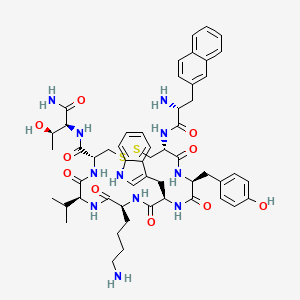
| Formula | C54H69N11O10S2 |
|---|---|
| Molecular weight | 1096.35 g/mol |
| IUPAC name | (4R,7S,10S,13R,16S,19R)-10-(4-aminobutyl)-N-[(2S,3R)-1-amino-3-hydroxy-1-oxobutan-2-yl]-19-[[(2R)-2-amino-3-naphthalen-2-ylpropanoyl]amino]-16-[(4-hydroxyphenyl)methyl]-13-(1H-indol-3-ylmethyl)-6,9,12,15,18-pentaoxo-7-propan-2-yl-1,2-dithia-5,8,11,14,17-pentazacycloicosane-4-carboxamide |
| CAS | 108736-35-2 |
| PubChem CID | 6918011 |
| InChIKey | PUDHBTGHUJUUFI-SCTWWAJVSA-N |
SMILES
CC(C)[C@@H]1NC(=O)[C@H](CCCCN)NC(=O)[C@@H](Cc2c[nH]c3ccccc23)NC(=O)[C@H](Cc2ccc(O)cc2)NC(=O)[C@@H](NC(=O)[C@H](N)Cc2ccc3ccccc3c2)CSSC[C@@H](C(=O)N[C@H](C(N)=O)[C@@H](C)O)NC1=OBiology & Pharmacokinetics
Pharmacokinetics predicted
| Bioavailability | 70.0% |
|---|---|
| Half-life | 1.656 h |
| Volume of distribution | 0.512 L/kg |
| Protein binding | 46.3% |
| BBB penetrant | No |
Enzyme interactions
| Enzyme | Role | Detail |
|---|---|---|
| CYP2C19 | Substrate | — |
| CYP2D6 | Substrate | — |
| CYP3A4 | Inhibitor | — |
Transporters
BCRP (Inhibitor)BSEP (Inhibitor)MRP1 (Inhibitor)OATP1B1 (Inhibitor)OATP1B3 (Inhibitor)P-gp (Inhibitor)P-gp (Substrate)
Drug–drug interactions (100+, DDInter)
| Interacting drug | Severity | Management |
|---|---|---|
| Copper oxodotreotide Cu-64 | major | |
| Lonafarnib | major | |
| Pexidartinib | major | |
| Acalabrutinib | moderate | |
| Acarbose | moderate | |
| Acebutolol | moderate | |
| Acetohexamide | moderate | |
| Adenosine | moderate | |
| Albiglutide | moderate | |
| Alogliptin | moderate | |
| Amiodarone | moderate | |
| Amlodipine | moderate | |
| Atenolol | moderate | |
| Avapritinib | moderate | |
| Bepridil | moderate | |
| Betaxolol | moderate | |
| Betaxolol (ophthalmic) | moderate | |
| Bisoprolol | moderate | |
| Bromocriptine | moderate | |
| Canagliflozin | moderate | |
| Carteolol | moderate | |
| Carteolol (ophthalmic) | moderate | |
| Carvedilol | moderate | |
| Chlorpropamide | moderate | |
| Cyclosporine | moderate | |
| Dapagliflozin | moderate | |
| Digitoxin | moderate | |
| Digoxin | moderate | |
| Dihydroergotamine | moderate | |
| Diltiazem | moderate | |
| Disopyramide | moderate | |
| Dofetilide | moderate | |
| Dotatate | moderate | |
| Dronedarone | moderate | |
| Dulaglutide | moderate | |
| Duvelisib | moderate | |
| Empagliflozin | moderate | |
| Entrectinib | moderate | |
| Ergometrine | moderate | |
| Ergotamine | moderate |
Showing 40 of 100+.
Registered Products (3)
| Brand | Form / strength | Pack | Agent | Citizen (JOD) |
|---|---|---|---|---|
| Somatuline Autogel PFS | Pre-filled Syringe 120 mg | 1 PFS | Petra Drug Store | — |
| Somatuline Autogel PFS | Pre-filled Syringe 60 mg | 1 PFS | Petra Drug Store | — |
| Somatuline Autogel PFS | Pre-filled Syringe 90 mg | 1 PFS | Petra Drug Store | — |