Mesalazine
JFDA label: Pentasa enema
Mechanism of Action
Inhibitor of Polyunsaturated fatty acid 5-lipoxygenase — Arachidonate 5-lipoxygenase inhibitor; Agonist of Peroxisome proliferator-activated receptor gamma — Peroxisome proliferator-activated receptor gamma agonist; Inhibitor of Cyclooxygenase — Cyclooxygenase inhibitor
| Target | Action | Gene / class |
|---|---|---|
| Cyclooxygenase efficacy | INHIBITOR | |
| Peroxisome proliferator-activated receptor gamma efficacy | AGONIST | PPARG |
| Polyunsaturated fatty acid 5-lipoxygenase efficacy | INHIBITOR | ALOX5 |
Indications
Approved
- Apriso
- Asacol 800
- Asacol HD
- Asacol, Mezavant
- Canadian labeling
- Delzicol
- Lialda, Pentasa
- Mesasal
- Oral
- Pentasa
- Rectal
- US labeling
Contraindications
Source: Lexicomp
- Additional contraindications (not in the US labeling): Severe renal impairment (GFR 2) Absolute
- Hypersensitivity to mesalamine, aminosalicylates, salicylates, or any component of the formulation Absolute
- severe hepatic impairment Additional contraindications per specific Canadian product labeling: Existing gastric or duodenal ulcer, urinary tract obstruction, use in children Absolute
Adverse Reactions
Cardiac disorders (1)
Common Hypertension
Nervous system disorders (3)
Very Common Headache
Common Dizziness · fatigue, alopecia, exacerbation of ulcerative colitis, flatulence, upper abdominal pain, dyspepsia, nausea, lower abdominal pain, infection, viral infection
Gastrointestinal disorders (3)
Very Common abdominal pain · constipation · Eructation
Musculoskeletal and connective tissue disorders (2)
Common arthralgia · Back pain
Ear and labyrinth disorders (1)
Common Tinnitus, sinusitis, fever
Respiratory, thoracic and mediastinal disorders (1)
Very Common Nasopharyngitis
Dosing
Source: Lexicomp
Warnings & Precautions
Source: Lexicomp
Cardiac hypersensitivity effects
Pericarditis and myocarditis (mesalamine-induced cardiac hypersensitivity reactions) have been reported. Use with caution in patients predisposed to these conditions.
Hypersensitivity reactions
Mesalamine-induced hypersensitivity reactions have been reported and may include internal organ involvement, such as hepatitis, hematologic abnormalities, and/or pneumonitis. Discontinue treatment for mesalamine-induced hypersensitivity reactions.
Intolerance syndrome
May cause an acute intolerance syndrome (cramping, abdominal pain, bloody diarrhea; sometimes fever, headache, malaise, pruritus, rash, conjunctivitis); may be hard to discern from an exacerbation; discontinue immediately if syndrome occurs or is suspected. Symptoms usually abate if drug is discontinued. If rechallenge is performed to validate the hypersensitivity, use a reduced dose and only if clearly needed.
Oligospermia
In males, oligospermia (rare, reversible) has been reported.
Renal effects
Renal impairment (including minimal change nephropathy, acute and chronic interstitial nephritis, nephrotic syndrome, and rarely renal failure) has been reported. A renal function evaluation is recommended prior to initiation of therapy and periodically during treatment. Mesalamine-induced nephrotoxicity should be suspected in patients developing renal impairment during treatment.
Sulfasalazine hypersensitivity
Patients with hypersensitivity to sulfasalazine may react to mesalamine. Disease-related concerns:
Hepatic impairment
Use caution in patients with hepatic impairment; hepatic failure has been reported.
Renal impairment
Use with caution in patients with renal impairment, a history of renal disease, or those on nephrotoxic medications. Concurrent drug therapy issues:
Drug-drug interactions
Potentially significant interactions may exist, requiring dose or frequency adjustment, additional monitoring, and/or selection of alternative therapy. Consult drug interactions database for more detailed information. Special populations:
Elderly
Use with caution in the elderly; uncontrolled studies and postmarketing reports suggest an increased incidence of blood dyscrasias (ie, agranulocytosis, neutropenia, pancytopenia) in patients >65 years of age. Dosage form specific issues:
Apriso
Contains phenylalanine.
Asacol HD (formulated without dibutyl phthalate [DBP]), Delzicol
Intact, partially intact, and/or tablet shells have been reported in the stool.
Canasa suppositories
Contain saturated vegetable fatty acid esters (contraindicated in patients with allergy to these components). May stain surfaces including clothing, other fabrics, flooring, painted surfaces, enamel, granite, marble and vinyl. Avoid contact with these surfaces.
Rowasa enema
Contain metabisulfite salts that may cause severe hypersensitivity reactions (ie, anaphylaxis) in patients with sulfite allergies.
Rowasa, sfRowasa
May stain direct contact surfaces including clothing, other fabrics, flooring, painted surfaces, enamel, granite, marble and vinyl. Choose a suitable location for product administration.
Tablets
Patients with pyloric stenosis or other organic or functional upper gastrointestinal obstructive disorders may have prolonged gastric retention of tablets, delaying the release of mesalamine in the colon. Other warnings/precautions:
Appropriate use
Asacol HD: Safety and effectiveness beyond 6 weeks have not been determined.
Bioequivalence
The Asacol HD 800 mg tablet has not been shown to be bioequivalent to two Delzicol 400 mg capsules. Two Delzicol 400 mg capsules have not been shown to be interchangeable or substitutable with one mesalamine 800 mg delayed-release tablet.
Pregnancy & Lactation
Pregnancy
Adverse events have not been observed in animal reproduction studies. Mesalamine is known to cross the placenta. An increased rate of congenital malformations has not been observed in human studies. Preterm birth, still birth and decreased birth weight have been observed; however, these events may also be due to maternal disease. Dibutyl phthalate (DBP) may be an inactive ingredient in the enteric coating of some products (eg Asacol, Asacol HD); adverse effects in male rats were noted at doses greater than the recommended human dose. Refer to product labeling for current formulation. When treatment for inflammatory bowel disease is needed during pregnancy, mesalamine may be used, although products with DBP should be avoided (Habal 2012; Mottet 2009).
Lactation
Low concentrations of mesalamine (undetectable to 0.11 mg/L) and higher concentrations of the active metabolite (N-acetyl-5-aminosalicylic acid; 5 to 18.1 mg/L) have been detected in human breast milk. Based on these concentrations, the estimated exposure to the breast-feeding infant would be 0 to 0.017 mg/kg/day of mesalamine and 0.75 to 2.72 mg/kg/day of the active metabolite. Adverse effects (diarrhea) in a breast-feeding infant have been reported while the mother received rectal administra
Monitoring
| Clinical pearl | Renal function (prior to and periodically during therapy); CBC (particularly in elderly patients); hepatic function; signs/symptoms of worsening acute intolerance syndrome |
|---|
Chemistry & Properties
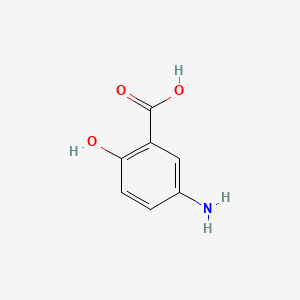
| Formula | C7H7NO3 |
|---|---|
| Molecular weight | 153.14 g/mol |
| IUPAC name | 5-amino-2-hydroxybenzoic acid |
| CAS | 89-57-6 |
| PubChem CID | 4075 |
| InChIKey | KBOPZPXVLCULAV-UHFFFAOYSA-N |
| logP | 0.67 (XLogP 1.3) |
| Polar surface area | 83.55 Ų |
| H-bond acceptors / donors | 3 / 3 |
| Drug-likeness (QED) | 0.41 |
| Lipinski violations | 0 |
SMILES
Nc1ccc(O)c(C(=O)O)c1Biology & Pharmacokinetics
Pharmacokinetics
| BBB penetrant | No |
|---|
Enzyme interactions
| Enzyme | Role | Detail |
|---|---|---|
| CYP2C19 | Inhibitor | — |
| CYP2C8 | Inhibitor | — |
Transporters
BCRP (Inhibitor)BCRP (Inhibitor)BSEP (Inhibitor)BSEP (Inhibitor)MDR1 (Inhibitor)MRP1 (Inhibitor)MRP2 (Inhibitor)OATP1A2 (Inhibitor)OATP1B1 (Inhibitor)OATP1B1 (Inhibitor)OATP1B3 (Inhibitor)OATP1B3 (Inhibitor)OATP2B1 (Inhibitor)P-gp (Inhibitor)OATP1B1 (Substrate)OATP1B3 (Substrate)OATP2B1 (Substrate)P-gp (Substrate)
Drug–drug interactions (100+, DDInter)
| Interacting drug | Severity | Management |
|---|---|---|
| Cidofovir | major | |
| Deferasirox | major | |
| Diatrizoate | major | |
| Human Rho(D) immune globulin | major | |
| Human botulinum neurotoxin A/B immune globulin | major | |
| Human cytomegalovirus immune globulin | major | |
| Human immunoglobulin G (intravenous and subcutaneous) | major | |
| Human immunoglobulin G (intravenous) | major | |
| Inotersen | major | |
| Iodipamide | major | |
| Iodixanol | major | |
| Iohexol | major | |
| Iopamidol | major | |
| Iopromide | major | |
| Iothalamic acid | major | |
| Ioversol | major | |
| Ioxilan | major | |
| Sirolimus | major | |
| Tacrolimus | major | |
| Acetohexamide | moderate | |
| Acyclovir | moderate | |
| Amikacin | moderate | |
| Amikacin (liposome) | moderate | |
| Amphotericin B | moderate | |
| Amphotericin B (cholesteryl sulfate) | moderate | |
| Amphotericin B (lipid complex) | moderate | |
| Amphotericin B (liposomal) | moderate | |
| Anisindione | moderate | |
| Azathioprine | moderate | |
| Bacitracin | moderate | |
| Bromfenac | moderate | |
| Capreomycin | moderate | |
| Celecoxib | moderate | |
| Chlorpropamide | moderate | |
| Cisplatin | moderate | |
| Clofarabine | moderate | |
| Colistimethate | moderate | |
| Cyclosporine | moderate | |
| Diclofenac | moderate | |
| Dicoumarol | moderate |
Showing 40 of 100+.
Registered Products (11)
| Brand | Form / strength | Pack | Agent | Citizen (JOD) |
|---|---|---|---|---|
| Asacol | Suppository 500 mg | 20 supp | Awtar Pharmaceutical Co | 14.930 |
| Pentasa enema | Tablet 1 g/100 ml | 7 Enema | Petra Drug Store | 18.280 |
| Pentasa Sachet | Sachet 1 g | 50 pack varies | Petra Drug Store | 33.330 |
| Asacol Tablet | Tablet 400 mg | 100 tab | Awtar Pharmaceutical Co | 33.580 |
| Pentasa Prolonged Release tab. | Tablet 500 mg | 100 tab | Petra Drug Store | 36.390 |
| Asacol | Tablet 800 mg | 60 tab | Awtar Pharmaceutical Co | 37.500 |
| Pentasa Prolonged Release tab. | Tablet 1 g | 60 tab pack varies | Petra Drug Store | 38.960 |
| Pentasa supp. | Suppository 1000 mg | 28 | Petra Drug Store | 41.120 |
| SALCROZINE | Tablet Mesalazine 1 g | 100 tab | Al-Mutawafiqa Modern Drug Store MMDS | 42.460 |
| PENTASA | Sachet 4 g | 30 sachet | Petra Drug Store | 61.370 |
| Pentasa X Tend | Sachet 2 g | 60 sachet | Petra Drug Store | 79.510 |