Mitomycin
Active form: Indolohydroquinone.
JFDA label: Misintu
- hematological toxicity — ChEMBL drug_warning (Black Box Warning) | United States
- nephrotoxicity — ChEMBL drug_warning (Black Box Warning) | United States
- Mitomycin should be administered under the supervision of a qualified physician experienced in the use of cancer chemotherapeutic agents. Appropriate management of therapy and complications is possibl
Mechanism of Action
Inhibitor of DNA — DNA inhibitor
| Target | Action | Gene / class |
|---|---|---|
| DNA efficacy | INHIBITOR |
Indications
Approved
- Adenocarcinoma — adenocarcinoma
- Glaucoma — glaucoma
- Neoplasms — neoplasm
Off-label
- Anus Neoplasms
- Appendiceal Neoplasms
- Biliary Tract Neoplasms
- Breast Neoplasms
- Carcinoma
- Carcinoma in Situ
- Carcinoma, Hepatocellular
- Carcinoma, Non-Small-Cell Lung
- Carcinoma, Squamous Cell
- Carcinoma, Transitional Cell
- Cholangiocarcinoma
- Cholangitis, Sclerosing
- Colorectal Neoplasms
- Corneal Opacity
- Esophageal Stenosis
- Glaucoma, Neovascular
- Glaucoma, Open-Angle
- Head and Neck Neoplasms
- Keratoconus
- Liver Neoplasms
- Lung Neoplasms
- Mesothelioma
- Nasopharyngeal Carcinoma
- Pancreatic Neoplasms
- Pterygium
- Sarcoma
- Stomach Neoplasms
- Urethral Stricture
- Urinary Bladder Neoplasms
- Uterine Cervical Neoplasms
Contraindications
Source: openFDA
- Mitomycin is contraindicated in patients who have demonstrated a hypersensitive or idiosyncratic reaction to it in the past. Mitomycin is contraindicated in patients with thrombocytopenia, coagulation disorder, or an increase in bleeding tendency due to other causes. Absolute
Adverse Reactions
Respiratory, thoracic and mediastinal disorders (1)
Very Common Pulmonary oedema
Dosing
Source: openFDA
Warnings & Precautions
Source: openFDA
Boxed Warning
Mitomycin should be administered under the supervision of a qualified physician experienced in the use of cancer chemotherapeutic agents. Appropriate management of therapy and complications is possible only when adequate diagnostic and treatment facilities are readily available. Bone marrow suppression, notably thrombocytopenia and leukopenia, which may contribute to overwhelming infections in an already compromised patient, is the most common and severe of the toxic effects of mitomycin (see WARNINGS and ADVERSE REACTIONS sections). Hemolytic Uremic Syndrome (HUS) a serious complication of chemotherapy, consisting primarily of microangiopathic hemolytic anemia, thrombocytopenia, and irreversible renal failure has been reported in patients receiving systemic mitomycin. The syndrome may occur at any time during systemic therapy with mitomycin as a single agent or in combination with other cytotoxic drugs, however, most cases occur at doses ≥60 mg of mitomycin. Blood product transfusion may exacerbate the symptoms associated with this syndrome. The incidence of the syndrome has not been defined.
Warnings & Precautions
Patients being treated with mitomycin must be observed carefully and frequently during and after therapy. The use of mitomycin results in a high incidence of bone marrow suppression, particularly thrombocytopenia and leukopenia. Therefore, the following studies should be obtained repeatedly during therapy and for at least eight weeks following therapy: platelet count, white blood cell count, differential, and hemoglobin. The occurrence of a platelet count below 100,000/mm 3 or a WBC below 4,000/mm 3 or a progressive decline in either is an indication to withhold further therapy until blood counts have recovered above these levels. Patients should be advised of the potential toxicity of this drug, particularly bone marrow suppression. Deaths have been reported due to septicemia as a result of leukopenia due to the drug. Patients receiving mitomycin should be observed for evidence of renal toxicity. Mitomycin should not be given to patients with a serum creatinine greater than 1.7 mg percent. Usage in Pregnancy Safe use of mitomycin in pregnant women has not been established. Teratological changes have been noted in animal studies. The effect of mitomycin on fertility is unknown.
Pregnancy & Lactation
Pregnancy
Chemistry & Properties
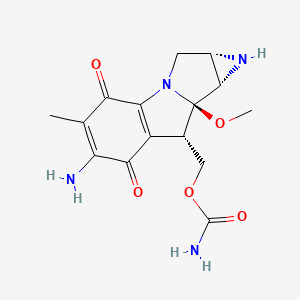
| Formula | C15H18N4O5 |
|---|---|
| Molecular weight | 334.33 g/mol |
| IUPAC name | [(4S,6S,7R,8S)-11-amino-7-methoxy-12-methyl-10,13-dioxo-2,5-diazatetracyclo[7.4.0.02,7.04,6]trideca-1(9),11-dien-8-yl]methyl carbamate |
| CAS | 50-07-7 |
| PubChem CID | 5746 |
| InChIKey | NWIBSHFKIJFRCO-WUDYKRTCSA-N |
| logP | -1.65 (XLogP -0.4) |
| Polar surface area | 146.89 Ų |
| H-bond acceptors / donors | 8 / 3 |
| Drug-likeness (QED) | 0.41 |
| Lipinski violations | 0 |
SMILES
CO[C@@]12[C@H](COC(N)=O)C3=C(C(=O)C(C)=C(N)C3=O)N1C[C@@H]1N[C@@H]12Biology & Pharmacokinetics
Pharmacokinetics
| BBB penetrant | No |
|---|
Enzyme interactions
| Enzyme | Role | Detail |
|---|---|---|
| CYP2D6 | Inhibitor | — |
| CYP3A4 | Substrate | — |
Transporters
BCRP (Inhibitor)BSEP (Inhibitor)MATE1 (Inhibitor)MDR1 (Inhibitor)MRP1 (Inhibitor)OATP1B1 (Inhibitor)OATP1B3 (Inhibitor)OATP1B3 (Inhibitor)P-gp (Inhibitor)BCRP (Substrate)MDR1 (Substrate)P-gp (Substrate)
Drug–drug interactions (100+, DDInter)
| Interacting drug | Severity | Management |
|---|---|---|
| Adalimumab | major | |
| Bacillus calmette-guerin substrain tice live antigen | major | |
| Baricitinib | major | |
| Certolizumab pegol | major | |
| Cladribine | major | |
| Clozapine | major | |
| Deferiprone | major | |
| Etanercept | major | |
| Fingolimod | major | |
| Fluorouracil | major | |
| Golimumab | major | |
| Infliximab | major | |
| Leflunomide | major | |
| Measles virus vaccine live attenuated | major | |
| Mumps virus strain B level jeryl lynn live antigen | major | |
| Natalizumab | major | |
| Ozanimod | major | |
| Rotavirus vaccine | major | |
| Rubella virus vaccine | major | |
| Samarium (153Sm) lexidronam | major | |
| Siponimod | major | |
| Smallpox (Vaccinia) Vaccine, Live | major | |
| Talimogene laherparepvec | major | |
| Teriflunomide | major | |
| Thalidomide | major | |
| Tofacitinib | major | |
| Typhoid vaccine (live) | major | |
| Upadacitinib | major | |
| Varicella Zoster Vaccine (Recombinant) | major | |
| Yellow Fever Vaccine | major | |
| Aldesleukin | moderate | |
| Alefacept | moderate | |
| Alemtuzumab | moderate | |
| Alpelisib | moderate | |
| Anakinra | moderate | |
| Anthrax vaccine | moderate | |
| Azathioprine | moderate | |
| Bendamustine | moderate | |
| Bifidobacterium longum infantis | moderate | |
| Bleomycin | moderate |
Showing 40 of 100+.
Registered Products (1)
| Brand | Form / strength | Pack | Agent | Citizen (JOD) |
|---|---|---|---|---|
| Misintu | Vial 20 mg | 1 vial | مستودع ادوية ابن رشد | — |