Niraparib
JFDA label: Akeega 50/500mg Film Coated Tablets
Mechanism of Action
Inhibitor of Poly [ADP-ribose] polymerase 2 — Poly [ADP-ribose] polymerase 2 inhibitor; Inhibitor of Poly [ADP-ribose] polymerase 1 — Poly [ADP-ribose] polymerase-1 inhibitor
| Target | Action | Gene / class |
|---|---|---|
| Poly [ADP-ribose] polymerase 1 efficacy | INHIBITOR | PARP1 |
| Poly [ADP-ribose] polymerase 2 efficacy | INHIBITOR | PARP2 |
Indications
Approved
- Ovarian, fallopian tube, or primary peritoneal cancer
Contraindications
Source: Lexicomp
- There are no contraindications listed in the manufacturer's labeling Absolute
Adverse Reactions
Cardiac disorders (4)
Very Common Hypertension
Common Palpitations · peripheral edema · tachycardia
Nervous system disorders (6)
Very Common anxiety · dizziness · Fatigue · headache · insomnia
Common Depression
Hepatobiliary disorders (3)
Very Common increased serum ALT · Increased serum AST
Common Increased serum alkaline phosphatase
Renal and urinary disorders (2)
Very Common Urinary tract infection
Common Increased serum creatinine
Blood and lymphatic system disorders (4)
Very Common anemia · leukopenia · neutropenia · Thrombocytopenia
Metabolism and nutrition disorders (3)
Common Hypokalemia · increased gamma-glutamyl transferase · weight loss
Gastrointestinal disorders (9)
Very Common constipation · decreased appetite · dyspepsia · mucositis · Nausea · stomatitis · vomiting
Common Dysgeusia · xerostomia
Skin and subcutaneous tissue disorders (1)
Very Common Skin rash
Musculoskeletal and connective tissue disorders (2)
Very Common back pain · Weakness
Eye disorders (1)
Common Conjunctivitis
Respiratory, thoracic and mediastinal disorders (5)
Very Common cough · dyspnea · Nasopharyngitis
Common Bronchitis · epistaxis
Dosing
Source: Lexicomp
Warnings & Precautions
Source: Lexicomp
Bone marrow suppression
Thrombocytopenia, anemia and neutropenia commonly occur, including grade 3 and 4 events (which rarely required discontinuation). Monitor blood counts weekly for the first month, then monthly for 11 months, then periodically thereafter. Do not initiate niraparib until hematologic toxicity due to previous chemotherapy has resolved to grade 1 or lower. Hematologic toxicity may require treatment interruption, dose reduction, or discontinuation. If hematologic toxicities do not resolve with 28 days following interruption, discontinue niraparib and obtain consult with hematology for further assessment, including marrow and cytogenetic analysis.
Cardiovascular effects
Hypertension and hypertensive crisis have been reported, including grade 3 and 4 hypertension (hypertension required discontinuation in rare cases). Monitor blood pressure and heart rate monthly during the first year and periodically thereafter. Patients with cardiac disorders (especially coronary insufficiency, arrhythmias and hypertension) should be monitored closely. If necessary, hypertension should be managed with antihypertensives and niraparib dose adjustment.
Gastrointestinal toxicity
Nausea, vomiting, constipation and mucositis/stomatitis have been reported. Consider administering niraparib at bedtime to diminish the potential for nausea and vomiting.
Secondary malignancy
Myelodysplastic syndrome/acute myeloid leukemia (MDS/AML) have been reported (rare), including fatal cases. The duration of niraparib treatment prior to the development of MDS/AML varied from Concurrent drug therapy issues:
Drug-drug interactions
Potentially significant interactions may exist, requiring dose or frequency adjustment, additional monitoring, and/or selection of alternative therapy. Consult drug interactions database for more detailed information.
Pregnancy & Lactation
Pregnancy
Animal reproduction studies have not been conducted, however based on the mechanism of action, niraparib may cause fetal harm if used during pregnancy. Pregnancy testing should be conducted prior to treatment and effective contraception should be used during therapy and for at least 6 months after the last dose in women of reproductive potential. Fertility may be impaired if administered to males.
Lactation
It is not known if niraparib is present in breast milk. Due to the potential for adverse events, breastfeeding is not recommended during therapy and for 1 month after the last dose.
Monitoring
| Clinical pearl | CBC with differential (weekly for the first month, then monthly for 11 months, then periodically); pregnancy test (prior to treatment; in females of reproductive potential). Monitor blood pressure and heart rate monthly during the first year and periodically thereafter. |
|---|
Chemistry & Properties
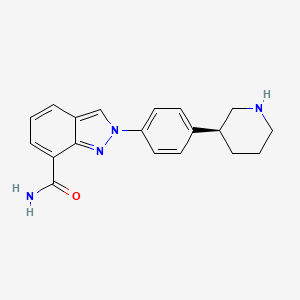
| Formula | C19H20N4O |
|---|---|
| Molecular weight | 320.4 g/mol |
| IUPAC name | 2-[4-[(3S)-piperidin-3-yl]phenyl]indazole-7-carboxamide |
| CAS | 1038915-60-4 |
| PubChem CID | 24958200 |
| InChIKey | PCHKPVIQAHNQLW-CQSZACIVSA-N |
| logP | 2.59 (XLogP 2.2) |
| Polar surface area | 72.94 Ų |
| H-bond acceptors / donors | 4 / 2 |
| Drug-likeness (QED) | 0.78 |
| Lipinski violations | 0 |
SMILES
NC(=O)c1cccc2cn(-c3ccc([C@@H]4CCCNC4)cc3)nc12Biology & Pharmacokinetics
Pharmacokinetics predicted
| Bioavailability | 10.0% |
|---|---|
| Half-life | 1.197 h |
| Volume of distribution | 3.047 L/kg |
| Protein binding | 84.7% |
| BBB penetrant | Yes |
Receptor binding (top 2)
| Target | Action | Affinity |
|---|---|---|
| poly(ADP-ribose) polymerase 2 (PARP2) | Inhibitor | pIC50 8.7 |
| poly(ADP-ribose) polymerase 1 (PARP1) | Inhibitor | pIC50 8.4 |
Transporters
BCRP (Inhibitor)BSEP (Inhibitor)MRP1 (Inhibitor)OATP1B1 (Inhibitor)OATP1B3 (Inhibitor)P-gp (Inhibitor)P-gp (Substrate)
Drug–drug interactions (100+, DDInter)
| Interacting drug | Severity | Management |
|---|---|---|
| Adalimumab | major | |
| Bacillus calmette-guerin substrain tice live antigen | major | |
| Baricitinib | major | |
| Certolizumab pegol | major | |
| Cladribine | major | |
| Clozapine | major | |
| Deferiprone | major | |
| Etanercept | major | |
| Fingolimod | major | |
| Golimumab | major | |
| Infliximab | major | |
| Leflunomide | major | |
| Measles virus vaccine live attenuated | major | |
| Mumps virus strain B level jeryl lynn live antigen | major | |
| Natalizumab | major | |
| Ozanimod | major | |
| Rotavirus vaccine | major | |
| Rubella virus vaccine | major | |
| Samarium (153Sm) lexidronam | major | |
| Siponimod | major | |
| Smallpox (Vaccinia) Vaccine, Live | major | |
| Talimogene laherparepvec | major | |
| Teriflunomide | major | |
| Tofacitinib | major | |
| Typhoid vaccine (live) | major | |
| Upadacitinib | major | |
| Varicella Zoster Vaccine (Recombinant) | major | |
| Yellow Fever Vaccine | major | |
| Abciximab | moderate | |
| Abemaciclib | moderate | |
| Acalabrutinib | moderate | |
| Acetylsalicylic acid | moderate | |
| Aflibercept | moderate | |
| Aldesleukin | moderate | |
| Alefacept | moderate | |
| Alemtuzumab | moderate | |
| Alpelisib | moderate | |
| Alteplase | moderate | |
| Altretamine | moderate | |
| Amiodarone | moderate |
Showing 40 of 100+.
Registered Products (2)
| Brand | Form / strength | Pack | Agent | Citizen (JOD) |
|---|---|---|---|---|
| Akeega 100/500mg Film Coated | Film-Coated Tablet Niraparib tosylate monohydrate 159.40 mg, Abiratrone acetate 500 mg | 56 tab | Adatco Drug Store | — |
| Akeega 50/500mg Film Coated Tablets | Film-Coated Tablet Niraparib tosylate monohydrate 79.70 mg, Abiratrone acetate 500 mg | 56 tab | Adatco Drug Store | — |