Octreotide
JFDA label: Sandostatin LAR Vial
Mechanism of Action
Mimics natural somatostatin by inhibiting serotonin release, and the secretion of gastrin, VIP, insulin, glucagon, secretin, motilin, and pancreatic polypeptide. Decreases growth hormone and IGF-1 in acromegaly. Octreotide provides more potent inhibition of growth hormone, glucagon, and insulin as compared to endogenous somatostatin. Also suppresses LH response to GnRH, secretion of thyroid-stimulating hormone and decreases splanchnic blood flow.
Indications
Approved
- Acromegaly
- Carcinoid tumors
- Injection solution
- LAR depot suspension
- Vasoactive intestinal peptide-secreting tumors
Off-label
- AIDS-associated diarrhea (including Cryptosporidiosis)
- Carcinoid crisis (prevention)
- Congenital hyperinsulinism
- Cushing's syndrome (ectopic)
- Diarrhea (refractory or persistent) associated with chemotherapy
- Diarrhea associated with graft-versus-host disease (GVHD)
- Gastroenteropancreatic neuroendocrine tumors (metastatic)
- Gastroesophageal variceal hemorrhage
- Hepatorenal syndrome
- Hypothalamic obesity
- Malignant bowel obstruction
- Postgastrectomy dumping syndrome
- Small bowel fistulas
- Sulfonylurea-induced hypoglycemia
- Thymoma/thymic malignancies (advanced)
- Zollinger-Ellison syndrome
Contraindications
Source: Lexicomp
- Hypersensitivity to octreotide or any component of the formulation Absolute
Adverse Reactions
Cardiac disorders (12)
Very Common chest pain · hypertension · palpitations · peripheral edema · Sinus bradycardia
Common angina pectoris · cardiac arrhythmia · Cardiac conduction disturbance · cardiac failure · edema · flushing · phlebitis
Nervous system disorders (22)
Very Common anxiety · confusion · dizziness · Fatigue · headache · hypoesthesia · insomnia · malaise · pain · paresthesia · rigors
Common Abnormal gait · amnesia · depression · drowsiness · hallucination · hypertonia · nervousness · neuralgia · neuropathy · vertigo · voice disorder
Renal and urinary disorders (6)
Very Common Nephrolithiasis
Common Impotence · mastalgia · pollakiuria · urinary incontinence · urinary tract infection
Blood and lymphatic system disorders (4)
Very Common Anemia
Common Bruise · hematoma · hypoproteinemia
Immune system disorders (1)
Very Common Antibody development
Metabolism and nutrition disorders (8)
Very Common Hyperglycemia · hypothyroidism
Common albuminuria · cachexia · Goiter · gout · hypoglycemia · hypokalemia
Gastrointestinal disorders (28)
Very Common abdominal cramps · abdominal pain · anorexia · biliary obstruction · cholelithiasis · constipation · Diarrhea · flatulence · gallbladder sludge · loose stools · nausea · vomiting
Common colitis · diverticulitis · dysgeusia · Dyspepsia · dysphagia · fecal discoloration · gastritis · gastroenteritis · gingivitis · glossitis · malabsorption · melena · steatorrhea · stomatitis · tenesmus · xerostomia
Skin and subcutaneous tissue disorders (6)
Very Common alopecia · diaphoresis · Pruritus · skin rash
Common Acne vulgaris · cellulitis
Musculoskeletal and connective tissue disorders (7)
Very Common arthralgia · arthropathy · Back pain · myalgia · weakness
Common Hyperkinesia · tremor
Eye disorders (2)
Common Blurred vision · visual disturbance
Ear and labyrinth disorders (2)
Very Common Otalgia
Common Tinnitus
Infections and infestations (4)
Common Abscess · bacterial infection · candidiasis · cold symptoms
General disorders and administration site conditions (3)
Very Common Fever · Pain at injection site
Common Hematoma at injection site
Respiratory, thoracic and mediastinal disorders (9)
Very Common cough · dyspnea · flu-like symptoms · pharyngitis · rhinitis · sinusitis · Upper respiratory tract infection
Common Bronchitis · epistaxis
Dosing
Source: Lexicomp
Warnings & Precautions
Source: Lexicomp
Abnormal Schillings test
Chronic treatment has been associated with abnormal Schillings test; monitor vitamin B12 levels.
Cholelithiasis
May impair gallbladder function (inhibits gallbladder contractility and decreases bile secretion); monitor patients for cholelithiasis. The incidence of gallbladder stone or biliary sludge increases with a duration of therapy of ≥12 months. Prophylactic cholecystectomy is recommended in patients with gastrointestinal or pancreatic neuroendocrine tumors undergoing abdominal surgery if octreotide treatment is planned (Oberg 2004).
Glucose regulation
Somatostatin analogs may affect glucose regulation. In type I diabetes, severe hypoglycemia may occur; in type II diabetes or patients without diabetes, hyperglycemia may occur. Insulin and other hypoglycemic medication requirements may change. Octreotide may worsen hypoglycemia in patients with insulinomas; use with caution.
Local reactions
Mild to moderate injection-site pain (usually lasting 1 hour) may occur with the depot formulation.
Hypothyroidism
Suppresses secretion of TSH; monitor for hypothyroidism.
Pancreatitis
May alter absorption of dietary fats; monitor for pancreatitis. Disease-related concerns:
Cardiovascular disease
Use with caution in patients with heart failure or concomitant medications that alter heart rate or rhythm; bradycardia, conduction abnormalities, and arrhythmia have been observed in acromegalic and carcinoid syndrome patients. Cardiovascular medication requirements may change.
Excessive fluid loss
May reduce excessive fluid loss in patients with conditions that cause such a loss; periodic monitoring for elevations in zinc levels is recommended in such patients that are maintained on total parenteral nutrition (TPN).
Hepatic impairment
Use caution in patients with hepatic impairment; dosage adjustment may be required in patients with established cirrhosis.
Renal impairment
Use with caution in patients with renal impairment; dosage adjustment may be required in patients receiving dialysis. Concurrent drug therapy issues:
Drug-drug interactions
Potentially significant interactions may exist, requiring dose or frequency adjustment, additional monitoring, and/or selection of alternative therapy. Consult drug interactions database for more detailed information.
QTc-prolonging agents
Octreotide may enhance the adverse/toxic effects of other QTc-prolonging agents. Dosage form specific issues:
Depot formulation
Do not use depot formulation for the treatment of sulfonylurea-induced hypoglycemia (Dougherty 2010).
Vehicle used in depot injection (polylactide-co-glycolide microspheres)
Has rarely been associated with retinal artery occlusion in patients with abnormal arteriovenous anastomosis (eg, patent foramen ovale). Special populations:
Elderly
Dosage adjustment may be necessary; significant increases in elimination half-life have been observed in older adults.
Females
Therapy may restore fertility; females of childbearing potential should use adequate contraception.
Pediatric
Postmarketing cases of serious and fatal events, including hypoxia and necrotizing enterocolitis, have been reported with octreotide use in children (usually with serious underlying conditions), particularly in children Other warnings/precautions:
Radiolabeled diagnostic evaluations
Therapy with immediate release octreotide (solution) should be withheld 24 hours prior to administration of radiolabeled somatostatin analogs; the IM (depot) formulation should be withheld at least 2 months before administration of radiolabeled somatostatin analogs (Oberg 2004).
Pregnancy & Lactation
Pregnancy
Adverse events have not been observed in animal reproduction studies. Octreotide crosses the placenta and can be detected in the newborn at delivery (Caron 1995; Fassnacht 2001; Maffei 2010); data concerning use in pregnancy is limited. In case reports of acromegalic women who received normal doses of octreotide during pregnancy, no congenital malformations were reported. Because normalization of IGF-1 and GH may restore fertility in women with acromegaly, women of childbearing potential should use adequate contraception during treatment. Long-acting formulations should be discontinued ~2 months prior to a planned pregnancy; use short acting octreotide as needed until conception. Octreotide therapy may be considered in pregnant women with worsening symptoms if needed. Monitoring of IGF-1 and/or GH is not recommended during pregnancy (Katznelson 2014).
Lactation
Octreotide is excreted in breast milk. In a case report, a woman was taking octreotide SubQ in doses up to 2,400 mcg/day prior to and throughout pregnancy. Octreotide was measurable in the colostrum in concentrations similar to those in the maternal serum (Maffei 2010); however, oral absorption of octreotide is considered to be poor (Battershill 1989). The manufacturer recommends that caution be exercised when administering octreotide to nursing women.
Monitoring
| Clinical pearl | Acromegaly: Growth hormone, somatomedin C (IGF-1) Carcinoid: 5-HIAA, plasma serotonin and plasma substance P VIPomas: Vasoactive intestinal peptide Chronic therapy: Thyroid function (baseline and periodic), vitamin B12 level, blood glucose, glycemic control and antidiabetic regimen (patients with diabetes mellitus), cardiac function (heart rate, ECG), zinc level (patients with excessive fluid loss maintained on TPN) |
|---|
Chemistry & Properties
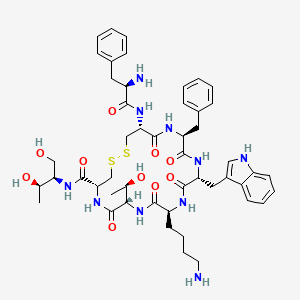
| Formula | C49H66N10O10S2 |
|---|---|
| Molecular weight | 1019.26 g/mol |
| IUPAC name | (4R,7S,10S,13R,16S,19R)-10-(4-aminobutyl)-19-[[(2R)-2-amino-3-phenylpropanoyl]amino]-16-benzyl-N-[(2R,3R)-1,3-dihydroxybutan-2-yl]-7-[(1R)-1-hydroxyethyl]-13-(1H-indol-3-ylmethyl)-6,9,12,15,18-pentaoxo-1,2-dithia-5,8,11,14,17-pentazacycloicosane-4-carboxamide |
| CAS | 83150-76-9 |
| PubChem CID | 448601 |
| InChIKey | DEQANNDTNATYII-OULOTJBUSA-N |
SMILES
C[C@@H](O)[C@@H]1NC(=O)[C@H](CCCCN)NC(=O)[C@@H](Cc2c[nH]c3ccccc23)NC(=O)[C@H](Cc2ccccc2)NC(=O)[C@@H](NC(=O)[C@H](N)Cc2ccccc2)CSSC[C@@H](C(=O)N[C@H](CO)[C@@H](C)O)NC1=OBiology & Pharmacokinetics
Pharmacokinetics predicted
| Bioavailability | 70.0% |
|---|---|
| Half-life | 2.011 h |
| Volume of distribution | 0.432 L/kg |
| Protein binding | 19.6% |
| BBB penetrant | No |
Enzyme interactions
| Enzyme | Role | Detail |
|---|---|---|
| CYP2D6 | Substrate | — |
Receptor binding (top 6)
| Target | Action | Affinity |
|---|---|---|
| SOMATOSTATIN SST2 (SSTR2) | Binding | pKi 9.2 |
| SOMATOSTATIN SST5 (SSTR5) | Binding | pKi 8.1 |
| SOMATOSTATIN SST3 (SSTR3) | Binding | pKi 8.0 |
| OPIATE Mu (OPRM1) | Binding | pKi 7.9 |
| SOMATOSTATIN SST4 (SSTR4) | Binding | pKi 6.3 |
| SOMATOSTATIN SST1 (SSTR1) | Binding | pKi 6.3 |
Transporters
BCRP (Inhibitor)BSEP (Inhibitor)BSEP (Inhibitor)MRP1 (Inhibitor)MRP2 (Inhibitor)MRP3 (Inhibitor)MRP4 (Inhibitor)OATP1B1 (Inhibitor)OATP1B1 (Inhibitor)OATP1B3 (Inhibitor)P-gp (Inhibitor)MDR1 (Substrate)MRP2 (Substrate)P-gp (Substrate)
Drug–drug interactions (100+, DDInter)
| Interacting drug | Severity | Management |
|---|---|---|
| Bexarotene | major | |
| Copper oxodotreotide Cu-64 | major | |
| Lonafarnib | major | |
| Pexidartinib | major | |
| Telotristat ethyl | major | |
| Acalabrutinib | moderate | |
| Acarbose | moderate | |
| Acebutolol | moderate | |
| Acetohexamide | moderate | |
| Adenosine | moderate | |
| Albiglutide | moderate | |
| Alogliptin | moderate | |
| Amiodarone | moderate | |
| Amlodipine | moderate | |
| Atenolol | moderate | |
| Avapritinib | moderate | |
| Bepridil | moderate | |
| Betaxolol | moderate | |
| Betaxolol (ophthalmic) | moderate | |
| Bisoprolol | moderate | |
| Bromocriptine | moderate | |
| Canagliflozin | moderate | |
| Carteolol | moderate | |
| Carteolol (ophthalmic) | moderate | |
| Carvedilol | moderate | |
| Chlorpropamide | moderate | |
| Cyclosporine | moderate | |
| Dapagliflozin | moderate | |
| Digitoxin | moderate | |
| Digoxin | moderate | |
| Dihydroergotamine | moderate | |
| Diltiazem | moderate | |
| Disopyramide | moderate | |
| Dofetilide | moderate | |
| Dotatate | moderate | |
| Dronedarone | moderate | |
| Dulaglutide | moderate | |
| Duvelisib | moderate | |
| Empagliflozin | moderate | |
| Entrectinib | moderate |
Showing 40 of 100+.
Registered Products (7)
| Brand | Form / strength | Pack | Agent | Citizen (JOD) |
|---|---|---|---|---|
| Octride | Ampoule 100 mcg/ml | 1 ampoule | Reda Jardaneh Drug Store | 2.540 |
| Sandostatin 100 mcg/ml Solution for Injection | Injection 100 mcg/ml | 5 amp | The Jordan Drugstore Co | 23.940 |
| Jintrotide | Vial 0.1 mg | 10 vial | Reda Jardaneh Drug Store | 28.770 |
| Syngro | Pre-filled Syringe 10 mg | 1 vial | Hikma Pharmaceuticals Co.Ltd/Jordan | 132.680 |
| Sandostatin LAR Vial | Vial 20 mg | 1 PFS | The Jordan Drugstore Co | — |
| Syngro | Pre-filled Syringe (as acetate) 30 mg | 1 vial | Hikma Pharmaceuticals Co.Ltd/Jordan | — |
| Syngro | Pre-filled Syringe (as actetate) 20 mg | 1 vial | / HIKMA PHARMACEUTICALS.IND/JORDAN / General / / HIKMA PHARMACEUTICALS.IND/JORDAN / General / Genera | — |