Saxagliptin
JFDA label: Onglyza 5mg Tab
Mechanism of Action
Saxagliptin inhibits dipeptidyl peptidase IV (DPP-IV) enzyme resulting in prolonged active incretin levels. Incretin hormones (eg, glucagon-like peptide-1 [GLP-1] and glucose-dependent insulinotropic polypeptide [GIP]) regulate glucose homeostasis by increasing insulin synthesis and release from pancreatic beta cells and decreasing glucagon secretion from pancreatic alpha cells. Decreased glucagon secretion results in decreased hepatic glucose production. Under normal physiologic circumstances, incretin hormones are released by the intestine throughout the day and levels are increased in response to a meal; incretin hormones are rapidly inactivated by the DPP-IV enzyme.
Indications
Approved
- Diabetes mellitus, type 2
Class profile
| mechanismClass | DPP-4 inhibitor |
|---|---|
| insulinSecretagogue | 0 |
| weightEffect | Neutral |
| hypoglycemiaRisk | None |
| renalContraindicated | 0 |
| cardioProtective | 0 |
| renalProtective | 0 |
| source | ADA-EASD2023/Maruthur2016 |
Contraindications
Source: Lexicomp
- Additional contraindications (not in US labeling): Hypersensitivity to another DPP-4 inhibitor Absolute
- Hypersensitivity (eg, anaphylaxis, angioedema, exfoliative skin conditions) to saxagliptin or any component of the formulation Absolute
- diabetic ketoacidosis, diabetic coma/precoma, type 1 diabetes mellitus Absolute
Adverse Reactions
Cardiac disorders (1)
Common Peripheral edema
Nervous system disorders (1)
Common Headache
Renal and urinary disorders (1)
Common Urinary tract infection
Blood and lymphatic system disorders (1)
Common Lymphocytopenia
Immune system disorders (1)
Common Hypersensitivity reaction
Metabolism and nutrition disorders (1)
Common Hypoglycemia
Dosing
Source: Lexicomp
Warnings & Precautions
Source: Lexicomp
Arthralgia
Severe and disabling arthralgia has been reported with DPP-IV inhibitor use; onset may occur within one day to years after treatment initiation and may resolve with discontinuation of therapy. Some patients may experience a recurrence of symptoms if DPP-IV inhibitor therapy resumed.
Bullous pemphigoid
DPP-4 inhibitor use has been associated with development of bullous pemphigoid; cases have typically resolved with topical or systemic immunosuppressive therapy and discontinuation of DPP-4 inhibitor therapy. Advise patients to report development of blisters or erosions. Discontinue therapy if bullous pemphigoid is suspected and consider referral to a dermatologist.
Hematologic
Dose-related decrease in lymphocyte count has been observed; clinical significance is not known. Monitoring of lymphocyte counts may be warranted in patients with unusual or persistent infection.
Hypersensitivity reactions
Hypersensitivity reactions, including anaphylaxis, angioedema, and exfoliative dermatologic reactions have been reported; discontinue if signs/symptoms of severe hypersensitivity reaction occur. Events have generally occurred within the first 3 months of therapy, and may occur after the initial dose. Use with caution if patient has experienced angioedema with other DPP-IV inhibitor use.
Pancreatitis
Cases of acute pancreatitis have been reported with use. Monitor for signs/symptoms of pancreatitis; discontinue use immediately if pancreatitis is suspected and initiate appropriate management. Use with caution in patients with a history of pancreatitis as it is not known if this population is at greater risk. Disease-related concerns:
Heart failure
Heart failure that may require hospitalization has been reported in a multi-center, randomized, double-blind, placebo-controlled trial in patients with type 2 diabetes with a history of, or at risk for, cardiovascular events; risk was increased in patients with preexisting heart failure or renal impairment and during the first 12 months of therapy (Scirica 2013; Scirica 2014). However, a population-based retrospective study in an ambulatory setting with relatively lower baseline cardiovascular risk factors failed to demonstrate increased risk in patients on saxagliptin compared to other agents (eg, sitagliptin, pioglitazone, sulfonylureas, insulin) (Toh 2016). Monitor for signs and symptoms of heart failure during therapy and consider discontinuation if condition develops. In a scientific statement from the American Heart Association, saxagliptin has been determined to be an agent that may exacerbate underlying myocardial dysfunction (magnitude: major) (AHA [Page 2016]).
Renal impairment
Use with caution in patients with moderate to severe renal dysfunction (eGFR 2) including end-stage renal disease (ESRD) requiring hemodialysis; dosing adjustment required. Concurrent drug therapy issues:
Drug-drug interactions
Potentially significant interactions may exist, requiring dose or frequency adjustment, additional monitoring, and/or selection of alternative therapy. Consult drug interactions database for more detailed information. Other warnings/precautions:
Appropriate use
Not indicated for use in patients with type 1 diabetes mellitus (insulin dependent, IDDM) or with diabetic ketoacidosis (DKA).
Patient education
Diabetes self-management education (DSME) is essential to maximize the effectiveness of therapy.
Pregnancy & Lactation
Pregnancy
In women with diabetes, maternal hyperglycemia can be associated with congenital malformations as well as adverse effects in the fetus, neonate, and the mother (ACOG 2005; ADA 2018c; Kitzmiller 2008; Metzger 2007). To prevent adverse outcomes prior to conception and throughout pregnancy maternal blood glucose and HbA1c should be kept as close to target goals as possible but without causing significant hypoglycemia (ACOG 2013; ADA 2018c; Blumer 2013; Kitzmiller 2008). Agents other than saxagliptin are currently recommended to treat diabetes in pregnant women (ADA 2018c).
Lactation
It is not known if saxagliptin is present in breast milk. According to the manufacturer, the decision to breastfeed during therapy should consider the risk of infant exposure, the benefits of breastfeeding to the infant, and benefits of treatment to the mother.
Monitoring
| Efficacy | HbA1c every 3 months initially, then every 6–12 months when stable; fasting and post-prandial blood glucose; patient-reported hypoglycaemia episodes |
|---|---|
| Toxicity | Hypoglycaemia symptoms; eGFR for renally-cleared agents; weight; blood pressure |
| Clinical pearl | Individualise HbA1c targets based on patient age, comorbidities, and hypoglycaemia risk. Targets of < 7% are appropriate for most patients but < 8% may be safer in frail elderly. |
| Counseling | Monitor blood glucose regularly. Know how to recognise and treat hypoglycaemia. Keep carbohydrate snacks available. |
Chemistry & Properties
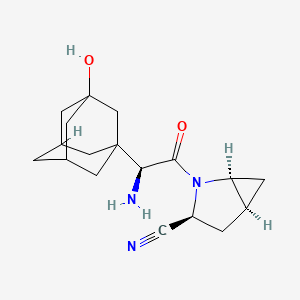
| Formula | C18H27N3O3 |
|---|---|
| Molecular weight | 333.43 g/mol |
| IUPAC name | (1S,3S,5S)-2-[(2S)-2-amino-2-(3-hydroxy-1-adamantyl)acetyl]-2-azabicyclo[3.1.0]hexane-3-carbonitrile |
| CAS | 361442-04-8 |
| PubChem CID | 11243969 |
| InChIKey | AFNTWHMDBNQQPX-NHKADLRUSA-N |
| logP | 1.16 (XLogP 0.7) |
| Polar surface area | 90.35 Ų |
| H-bond acceptors / donors | 4 / 2 |
| Drug-likeness (QED) | 0.80 |
| Lipinski violations | 0 |
SMILES
N#C[C@@H]1C[C@@H]2C[C@@H]2N1C(=O)[C@@H](N)C12CC3CC(CC(O)(C3)C1)C2.OBiology & Pharmacokinetics
Pharmacokinetics predicted
| Bioavailability | 10.0% |
|---|---|
| Half-life | 1.73 h |
| Volume of distribution | 1.6 L/kg |
| Protein binding | 27.1% |
| BBB penetrant | No |
Enzyme interactions
| Enzyme | Role | Detail |
|---|---|---|
| CYP2C19 | Substrate | — |
| CYP3A4 | Substrate | — |
Receptor binding (top 1)
| Target | Action | Affinity |
|---|---|---|
| dipeptidyl peptidase 4 (DPP4) | Inhibitor | pKi 9.2 |
Transporters
BCRP (Inhibitor)BSEP (Inhibitor)BSEP (Inhibitor)MDR1 (Inhibitor)MRP1 (Inhibitor)MRP2 (Inhibitor)MRP3 (Inhibitor)MRP4 (Inhibitor)OATP1B1 (Inhibitor)OATP1B3 (Inhibitor)OCT1 (Inhibitor)OCT2 (Inhibitor)P-gp (Inhibitor)MDR1 (Substrate)MRP2 (Substrate)OAT1 (Substrate)OAT3 (Substrate)OATP1 (Substrate)OATP1B1 (Substrate)OATP1B3 (Substrate)OCT(unspecified) (Substrate)OCT1 (Substrate)OCT2 (Substrate)OCT3 (Substrate)P-gp (Substrate)PEPT1 (Substrate)PEPT2 (Substrate)
Drug–drug interactions (100+, DDInter)
| Interacting drug | Severity | Management |
|---|---|---|
| Bexarotene | major | |
| Gatifloxacin | major | |
| Abametapir (topical) | moderate | |
| Acetazolamide | moderate | |
| Acetohexamide | moderate | |
| Alimemazine | moderate | |
| Aloe Vera Leaf | moderate | |
| Alpelisib | moderate | |
| Aminoglutethimide | moderate | |
| Amiodarone | moderate | |
| Amobarbital | moderate | |
| Amprenavir | moderate | |
| Apalutamide | moderate | |
| Aprepitant | moderate | |
| Aripiprazole | moderate | |
| Asenapine | moderate | |
| Asparaginase Erwinia chrysanthemi | moderate | |
| Asparaginase Escherichia coli | moderate | |
| Atazanavir | moderate | |
| Benazepril | moderate | |
| Bendroflumethiazide | moderate | |
| Benzphetamine | moderate | |
| Benzthiazide | moderate | |
| Berotralstat | moderate | |
| Betamethasone | moderate | |
| Bicalutamide | moderate | |
| Boceprevir | moderate | |
| Bortezomib | moderate | |
| Bosentan | moderate | |
| Brentuximab vedotin | moderate | |
| Brexpiprazole | moderate | |
| Brigatinib | moderate | |
| Bumetanide | moderate | |
| Butabarbital | moderate | |
| Butalbital | moderate | |
| Cabozantinib | moderate | |
| Calaspargase pegol | moderate | |
| Captopril | moderate | |
| Carbamazepine | moderate | |
| Cariprazine | moderate |
Showing 40 of 100+.
Registered Products (7)
| Brand | Form / strength | Pack | Agent | Citizen (JOD) |
|---|---|---|---|---|
| Captus | Tablet 2.5 mg | 30 tab | Hikma Pharmaceuticals Co.Ltd/Jordan | 16.340 |
| Onglyza | Tablet 2.5 mg | 30 tab | Shawi & Rushedat Drug Store | 16.340 |
| Captus | Tablet 5 mg | 30 tab | Hikma Pharmaceuticals Co.Ltd/Jordan | 24.120 |
| Kombiglyze XR 5mg/1000mg Extended Release Tab | Tablet 1000 mg, 5 mg | 28 tab | Shawi & Rushedat Drug Store | 26.800 |
| Onglyza | Tablet 5 mg | 30 tab | Shawi & Rushedat Drug Store | 26.800 |
| Kombiglyze XR 2.5mg/1000 mg Extended Release Tab | Tablet 1000 mg, 2.5 mg | 56 tab | Shawi & Rushedat Drug Store | 31.130 |
| Enforza | Tablet 5 mg, 10 mg | 30 tab | Hikma Pharmaceuticals Co.Ltd/Jordan | 52.070 |