Sulfasalazine
🧬 Cross-allergy: Sulfonamides
JFDA label: SALAZOPYRIN EN TABS
Mechanism of Action
Inhibitor of Polyunsaturated fatty acid 5-lipoxygenase — Arachidonate 5-lipoxygenase inhibitor; Inhibitor of Cyclooxygenase — Cyclooxygenase inhibitor
| Target | Action | Gene / class |
|---|---|---|
| Cyclooxygenase efficacy | INHIBITOR | |
| Polyunsaturated fatty acid 5-lipoxygenase efficacy | INHIBITOR | ALOX5 |
Indications
Approved
- Juvenile rheumatoid arthritis
- Rheumatoid arthritis
- Ulcerative colitis
Off-label
- Ankylosing spondylitis
- Crohn disease
- Psoriasis
- Psoriatic arthritis
Contraindications
Source: Lexicomp
- Additional contraindications (not in US labeling): Severe renal impairment (GFR 2) Absolute
- Hypersensitivity to sulfasalazine, its metabolites, sulfonamides, salicylates, or any component of the formulation Absolute
- intestinal or urinary obstruction Absolute
- porphyria Note: Although the FDA-approved product labeling states this medication is contraindicated with other sulfonamide-containing drug classes, the scientific basis of this statement has been challenged. See "Warnings/Precautions" for more detail Absolute
- severe hepatic impairment Absolute
- use in pediatric patients Absolute
Adverse Reactions
Nervous system disorders (2)
Very Common Headache
Common Dizziness
Hepatobiliary disorders (1)
Common Abnormal hepatic function tests
Renal and urinary disorders (1)
Very Common Oligospermia (reversible)
Blood and lymphatic system disorders (4)
Common Heinz body anemia · hemolytic anemia · Leukopenia · thrombocytopenia
Gastrointestinal disorders (7)
Very Common anorexia · dyspepsia · gastric distress · Nausea · vomiting
Common Abdominal pain · stomatitis
Skin and subcutaneous tissue disorders (3)
Very Common Skin rash
Common Pruritus · urticaria
General disorders and administration site conditions (1)
Common Fever
Respiratory, thoracic and mediastinal disorders (1)
Common Cyanosis
Dosing
Source: Lexicomp
Warnings & Precautions
Source: Lexicomp
Blood dyscrasias
Fatalities associated with severe reactions, including agranulocytosis, aplastic anemia, and other blood dyscrasias, have occurred; discontinue use at first sign of rash or signs of serious adverse reactions. The presence of clinical signs such as sore throat, fever, pallor, or purpura may be indicative of a serious blood disorder. Use with extreme caution in patients with blood dyscrasias; monitor CBC frequently.
CNS effects
Deaths from irreversible neuromuscular and CNS changes have been reported.
Dermatologic reactions
Severe skin reactions (some fatal), including Stevens-Johnson syndrome (SJS), exfoliative dermatitis, and toxic epidermal necrolysis (TEN), have occurred with sulfonamides (including sulfasalazine), most commonly during the first month of treatment; discontinue use at first sign of skin rash, mucosal lesions, or any other sign of dermatologic toxicity.
Fibrosing alveolitis
Deaths from fibrosing alveolitis have been reported.
Folate deficiency
May decrease folic acid absorption.
GI effects
Nausea, vomiting, and abdominal discomfort commonly occur; titration of dose and/or using the enteric coated formulation may decrease GI adverse effects.
Hepatic necrosis
Fatalities associated with hepatic damage have occurred; discontinue use at first sign of jaundice or hepatotoxicity.
Hypersensitivity reactions
Severe and life-threatening reactions, including drug rash with eosinophilia and systemic symptoms (DRESS) syndrome, have been reported. Fever or lymphadenopathy may be present prior to rash development. Other severe hypersensitivity reactions may include internal organ involvement, such as hepatitis, nephritis, myocarditis, mononucleosis-like syndrome, hematologic abnormalities (including hematophagic histiocytosis), and/or pneumonitis including eosinophilic infiltration. Discontinue treatment for severe reactions and evaluate promptly.
Infections
Serious infections (some fatal), including sepsis and pneumonia, have been reported. Infections may be associated with agranulocytosis, neutropenia, or myelosuppression. Monitor for signs/symptoms of infection during and after sulfasalazine therapy and promptly evaluate if infection occurs; discontinue therapy for serious infections. Use cautiously in patients with a history of recurring or chronic infections or with underlying conditions or concomitant therapy which may predispose them to infectious complications.
Oligospermia
In males, oligospermia (rare) and infertility have been reported; usually reverses upon discontinuation.
Sulfonamide ("sulfa") allergy
Traditionally, concerns for cross-reactivity have extended to all compounds containing the sulfonamide structure (SO2NH2). An expanded understanding of allergic mechanisms indicates cross-reactivity between antibiotic sulfonamides and nonantibiotic sulfonamides may not occur, or at the very least this potential is extremely low (Brackett 2004; Johnson 2005; Slatore 2004; Tornero 2004). In particular, mechanisms of cross-reaction due to antibody production (anaphylaxis) are unlikely to occur with nonantibiotic sulfonamides and antibiotic sulfonamides. A nonantibiotic sulfonamide compound which contains the arylamine structure and therefore may cross-react with antibiotic sulfonamides is sulfasalazine (Zawodniak 2010). T-cell-mediated (type IV) reactions (eg, maculopapular rash) are less understood and it is not possible to completely exclude this potential based on current insights. In cases where prior reactions were severe (Stevens-Johnson syndrome/TEN), some clinicians choose to avoid exposure to these classes. Disease-related concerns:
Allergies/asthma
Use with caution in patients with severe allergies or bronchial asthma.
G6PD deficiency
Use with caution in patients with G6PD deficiency; hemolytic anemia may occur (dose related).
Hepatic impairment
Use with extreme caution in patients with impaired hepatic function.
Renal impairment
Use with extreme caution in patients with renal impairment. Maintain adequate hydration to prevent crystalluria and stone formation. Special populations:
Slow acetylators
Patients classified as slow acetylators may be at increased risk for adverse reactions due to a prolonged half-life of sulfapyrazine (metabolite of sulfasalazine). Dosage form specific issues:
Appropriate use
Delayed release: Use in patients with ulcerative colitis who cannot take uncoated sulfasalazine tablets because of GI intolerance, and in whom there is evidence that this intolerance is not primarily the result of high blood levels of sulfapyridine and its metabolites (eg, patients experiencing nausea and vomiting with the first few doses of the drug, patients in whom a reduction in dosage does not alleviate the adverse GI effects).
Enteric-coated tablets
Discontinue if tablets are noted to pass without disintegrating. Other warnings/precautions:
Skin/urine discoloration
May cause skin and urine discoloration (orange/yellow).
Pregnancy & Lactation
Pregnancy
Sulfasalazine and sulfapyridine cross the placenta; a potential for kernicterus in the newborn exists. Agranulocytosis was noted in an infant following maternal use of sulfasalazine during pregnancy. Additionally, cases of neural tube defects have been reported (causation undetermined); sulfasalazine is known to inhibit the absorption and metabolism of folic acid and may diminish the effects of folic acid supplementation. Based on available data, an increase in fetal malformations has not been observed following maternal use of sulfasalazine for the treatment of inflammatory bowel disease or ulcerative colitis. When treatment for inflammatory bowel disease is needed during pregnancy, sulfasalazine may be used, although supplementation with folic acid is recommended (Habal 2012; Mahadevan 2009; Mottet 2007).
Lactation
Sulfasalazine is present in breast milk; sulfapyridine concentrations are ~30% to 60% of the maternal serum. Bloody stools or diarrhea have been reported in breastfeeding infants. Although sulfapyridine has poor bilirubin-displacing ability, exposure may cause kernicterus in the newborn. The manufacturer recommends that caution be exercised when administering sulfasalazine to breastfeeding women. Other sources consider use of sulfasalazine to be safe while breastfeeding; monitoring of the infant
Monitoring
| Clinical pearl | Manufacturer's labeling: CBC with differential and liver function tests (prior to therapy, then every other week for first 3 months of therapy, followed by every month for the second 3 months, then once every 3 months thereafter or as clinically indicated); periodic urinalysis and renal/liver function tests; stool frequency; signs of infection, dermatologic toxicity, or hypersensitivity reactions. Alternate recommendations: Rheumatoid arthritis: Complete blood count, serum creatinine, and LFTs: Baseline and every 2 to 4 weeks for 3 months after initiation or following dose increases, then every 8 to 12 weeks during 3 to 6 months of treatment, followed by every 12 weeks beyond 6 months of treatment; monitor more frequently if clinically indicated (Singh [ACR 2016]). |
|---|
Chemistry & Properties
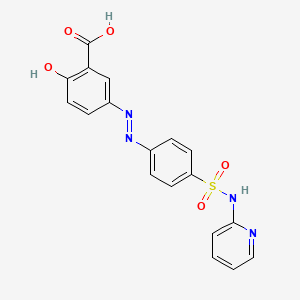
| Formula | C18H14N4O5S |
|---|---|
| Molecular weight | 398.4 g/mol |
| IUPAC name | 2-hydroxy-5-[[4-(pyridin-2-ylsulfamoyl)phenyl]diazenyl]benzoic acid |
| CAS | 599-79-1 |
| PubChem CID | 5339 |
| InChIKey | NCEXYHBECQHGNR-QZQOTICOSA-N |
| logP | 3.7 (XLogP -0.7) |
| Polar surface area | 141.31 Ų |
| H-bond acceptors / donors | 7 / 3 |
| Drug-likeness (QED) | 0.54 |
| Lipinski violations | 0 |
SMILES
O=C(O)c1cc(/N=N/c2ccc(S(=O)(=O)Nc3ccccn3)cc2)ccc1OBiology & Pharmacokinetics
Pharmacokinetics
| BBB penetrant | No (logBB -2.69) |
|---|
Enzyme interactions
| Enzyme | Role | Detail |
|---|---|---|
| CYP2C8 | Inhibitor | — |
Transporters
BCRP (Inhibitor)BCRP (Inhibitor)BSEP (Inhibitor)BSEP (Inhibitor)MDR1 (Inhibitor)MRP1 (Inhibitor)MRP2 (Inhibitor)MRP3 (Inhibitor)NTCP (Inhibitor)OAT1 (Inhibitor)OAT3 (Inhibitor)OATP (Inhibitor)OATP1B1 (Inhibitor)OATP1B1 (Inhibitor)OATP1B3 (Inhibitor)OATP1B3 (Inhibitor)OATP2B1 (Inhibitor)OCT1 (Inhibitor)P-gp (Inhibitor)BCRP (Substrate)MDR1 (Substrate)MRP2 (Substrate)OATP2B1 (Substrate)P-gp (Substrate)
Drug–drug interactions (100+, DDInter)
| Interacting drug | Severity | Management |
|---|---|---|
| Aminobenzoic acid | major | |
| Aminolevulinic acid | major | |
| Anisindione | major | |
| Cidofovir | major | |
| Cyclosporine | major | |
| Deferasirox | major | |
| Diatrizoate | major | |
| Dicoumarol | major | |
| Human Rho(D) immune globulin | major | |
| Human botulinum neurotoxin A/B immune globulin | major | |
| Human cytomegalovirus immune globulin | major | |
| Human immunoglobulin G (intravenous and subcutaneous) | major | |
| Human immunoglobulin G (intravenous) | major | |
| Inotersen | major | |
| Iodipamide | major | |
| Iodixanol | major | |
| Iohexol | major | |
| Iopamidol | major | |
| Iopromide | major | |
| Iothalamic acid | major | |
| Ioversol | major | |
| Ioxilan | major | |
| Leflunomide | major | |
| Lomitapide | major | |
| Methenamine | major | |
| Mipomersen | major | |
| Nitrous acid | major | |
| Ozanimod | major | |
| Pexidartinib | major | |
| Prilocaine | major | |
| Prilocaine (topiclal) | major | |
| Sirolimus | major | |
| Tacrolimus | major | |
| Teriflunomide | major | |
| Warfarin | major | |
| Acetohexamide | moderate | |
| Acyclovir | moderate | |
| Alpelisib | moderate | |
| Amikacin | moderate | |
| Amikacin (liposome) | moderate |
Showing 40 of 100+.
Registered Products (1)
| Brand | Form / strength | Pack | Agent | Citizen (JOD) |
|---|---|---|---|---|
| SALAZOPYRIN EN TABS | Tablet 500 mg | 100 tab | Khoury Drug Store | 11.190 |