Tetracycline
🧬 Cross-allergy: Tetracyclines
JFDA label: Opticyclin eye ointment
Mechanism of Action
Inhibitor of Bacterial 70S ribosome — Bacterial 70S ribosome inhibitor
| Target | Action | Gene / class |
|---|---|---|
| Bacterial 70S ribosome efficacy | INHIBITOR |
Indications
Approved
- Acne
- Actinomycosis
- Acute intestinal amebiasis
- Anthrax
- Campylobacter
- Cholera
- Clostridium
- Gram-negative infections
- Listeriosis
- Ophthalmic infections
- Relapsing fever
- Respiratory tract infection
- Rickettsial infections
- Sexually transmitted diseases
- Skin and skin structure infections
- Urinary tract infections
- Vincent infection
- Yaws
- Zoonotic infections
Off-label
- Helicobacter pylori eradication
- Malaria
- Periodontitis associated with presence of Actinobacillus actinomycetemcomitans
Antimicrobial Spectrum
Expected / intrinsic spectrum (EUCAST breakpoints & labels) — not local resistance. Source: EUCAST v16 · curated.
Bacteria
| Organism | Activity | MIC |
|---|---|---|
| Campylobacter jejuni/coli | Susceptible | 21.0 mg/L |
| Corynebacterium spp. | Susceptible | 2.0 mg/L |
| Haemophilus influenzae | Susceptible | 2.0 mg/L |
| Haemophilus influenzae | Susceptible | 21.0 mg/L |
| Helicobacter pylori | Susceptible | 1.0 mg/L |
| Moraxella catarrhalis | Susceptible | 21.0 mg/L |
| Neisseria gonorrhoeae | Susceptible | 0.5 mg/L |
| Neisseria meningitidis | Susceptible | 21.0 mg/L |
| Staphylococcus aureus | Susceptible | 1.0 mg/L |
| Staphylococcus spp. | Susceptible | 11.0 mg/L |
| Streptococcus A/B/C/G | Susceptible | 11.0 mg/L |
| Streptococcus pneumoniae | Susceptible | 1.0 mg/L |
| Streptococcus pneumoniae | Susceptible | 11.0 mg/L |
| Staphylococcus aureus | Resistant | 2.0 mg/L |
| Streptococcus pneumoniae | Resistant | 2.0 mg/L |
Class profile
| gramStatus | Both |
|---|---|
| spectrumBreadth | Broad |
| atypicalCoverage | Yes |
| isBactericidal | 0 |
| moaCategory | Protein synthesis inhibitor (30S ribosomal) |
| pdIndex | Time-dependent |
| postAntibioticEffect | None |
| mrsaCoverage | 0 |
| resistanceMechanisms | Active efflux (Tet pumps),Ribosomal protection proteins |
Contraindications
Source: Curated · Lexicomp
- Children under 8 years (permanent tooth discolouration and enamel hypoplasia) Absolute
- Hypersensitivity to any of the tetracyclines or any component of the formulation Absolute
- Pregnancy (causes discolouration and inhibition of bone growth in foetus) Absolute
Adverse Reactions
Cardiac disorders (2)
Not Known Pericarditis · thrombophlebitis
Nervous system disorders (4)
Not Known Bulging fontanel (infants) · increased intracranial pressure · paresthesia · pseudotumor cerebri
Hepatobiliary disorders (1)
Not Known Hepatotoxicity
Renal and urinary disorders (3)
Not Known Acute renal failure · Azotemia · renal insufficiency
Immune system disorders (2)
Not Known Anaphylaxis · hypersensitivity reaction
Gastrointestinal disorders (11)
Not Known Abdominal cramps · anorexia · dental discoloration (young children) · diarrhea · enamel hypoplasia (young children) · esophagitis · nausea · pancreatitis · pseudomembranous colitis (antibiotic-associated) · staphylococcal enterocolitis · vomiting
Skin and subcutaneous tissue disorders (4)
Not Known Exfoliative dermatitis · nail discoloration · pruritus · skin photosensitivity
Infections and infestations (2)
Not Known Fungal superinfection (candida) · superinfection
Dosing
Source: Lexicomp
Warnings & Precautions
Source: Lexicomp
Increased BUN
May be associated with increases in serum urea nitrogen (BUN) secondary to antianabolic effects; use caution in patients with renal impairment.
Intracranial hypertension (eg, pseudotumor cerebri)
Intracranial hypertension (headache, blurred vision, diplopia, vision loss, and/or papilledema) has been associated with use. Women of childbearing age who are overweight or have a history of intracranial hypertension are at greater risk. Concomitant use of isotretinoin (known to cause pseudotumor cerebri [PTC]) and tetracycline should be avoided. Intracranial hypertension typically resolves after discontinuation of treatment; however, permanent visual loss is possible. If visual symptoms develop during treatment, prompt ophthalmologic evaluation is warranted. Intracranial pressure can remain elevated for weeks after drug discontinuation; monitor patients until they stabilize.
Photosensitivity
May cause photosensitivity; discontinue if skin erythema occurs. Use skin protection and avoid prolonged exposure to sunlight; do not use tanning equipment.
Superinfection
Prolonged use may result in fungal or bacterial superinfection, including Clostridium difficile-associated diarrhea (CDAD) and pseudomembranous colitis; CDAD has been observed >2 months postantibiotic treatment. Disease-related concerns:
Hepatic impairment
Hepatotoxicity has been reported rarely; risk may be increased in patients with preexisting hepatic or renal impairment.
Renal impairment
Use with caution in patients with renal impairment; dosage adjustment recommended. Special populations:
Pediatric
May cause tissue hyperpigmentation, enamel hypoplasia, or permanent tooth discoloration; use of tetracyclines should be avoided during tooth development (children • Pregnancy: Do not use during pregnancy. In addition to affecting tooth development, tetracycline use has been associated with retardation of skeletal development and reduced bone growth. Other warnings/precautions:
Appropriate use
Acne: The American Academy of Dermatology acne guidelines recommend tetracycline as adjunctive treatment for moderate and severe acne and forms of inflammatory acne that are resistant to topical treatments. Concomitant topical therapy with benzoyl peroxide or a retinoid should be administered with systemic antibiotic therapy (eg, tetracycline) and continued for maintenance after antibiotic course is completed (AAD [Zaenglein 2016]).
Pregnancy & Lactation
Pregnancy
Avoid
Contraindicated from 2nd trimester onward. T1 probably safe for short courses but amoxicillin preferred
Lactation
Tetracycline is excreted into breast milk (Knowles 1965; Matsuda 1984). According to the manufacturer, the decision to continue or discontinue breast-feeding during therapy should take into account the risk of exposure to the infant and the benefits of treatment to the mother. The calcium in the maternal milk is expected to decrease the amount of tetracycline absorbed by the breast-feeding infant (Chung 2002). As a class, tetracyclines have generally been avoided in nursing women due to theo
LactMed: monitor the infant.
Monitoring
| Efficacy | Culture and susceptibility testing; clinical resolution (temperature, WBC, CRP, procalcitonin) |
|---|---|
| Toxicity | Renal function (dose adjustment in renal impairment); hepatic function for hepatically cleared agents; signs of C. difficile infection (diarrhoea) |
| Clinical pearl | Culture results guide de-escalation to narrower-spectrum therapy. Review antibiotic appropriateness at 48–72 h (antimicrobial stewardship). |
| Counseling | Complete the full course. Report persistent diarrhoea, rash, or lack of improvement after 48–72 h. |
Chemistry & Properties
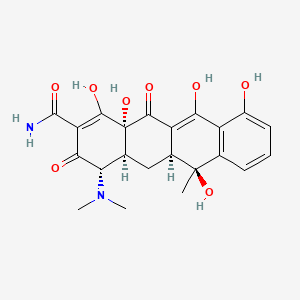
| Formula | C22H24N2O8 |
|---|---|
| Molecular weight | 444.44 g/mol |
| IUPAC name | (4S,4aS,5aS,6S,12aR)-4-(dimethylamino)-1,6,10,11,12a-pentahydroxy-6-methyl-3,12-dioxo-4,4a,5,5a-tetrahydrotetracene-2-carboxamide |
| CAS | 60-54-8 |
| PubChem CID | 54675776 |
| InChIKey | OFVLGDICTFRJMM-WESIUVDSSA-N |
| logP | -0.21 (XLogP -2.0) |
| Polar surface area | 181.62 Ų |
| H-bond acceptors / donors | 9 / 6 |
| Drug-likeness (QED) | 0.34 |
| Lipinski violations | 1 |
SMILES
CN(C)[C@@H]1C(O)=C(C(N)=O)C(=O)[C@@]2(O)C(O)=C3C(=O)c4c(O)cccc4[C@@](C)(O)[C@H]3C[C@@H]12Biology & Pharmacokinetics
Pharmacokinetics
| BBB penetrant | No |
|---|
Enzyme interactions
| Enzyme | Role | Detail |
|---|---|---|
| CYP1A2 | Substrate | — |
Transporters
BCRP (Inhibitor)BCRP (Inhibitor)BSEP (Inhibitor)BSEP (Inhibitor)MATE1 (Inhibitor)MRP1 (Inhibitor)MRP2 (Inhibitor)MRP3 (Inhibitor)MRP4 (Inhibitor)OAT1 (Inhibitor)OAT2 (Inhibitor)OAT3 (Inhibitor)OAT4 (Inhibitor)OATP1B1 (Inhibitor)OATP1B1 (Inhibitor)OATP1B3 (Inhibitor)OATP1B3 (Inhibitor)OATP2B1 (Inhibitor)OCT1 (Inhibitor)P-gp (Inhibitor)MDR1 (Substrate)MRP2 (Substrate)OAT2 (Substrate)OAT3 (Substrate)OAT4 (Substrate)P-gp (Substrate)
Drug–drug interactions (100+, DDInter)
| Interacting drug | Severity | Management |
|---|---|---|
| Acitretin | major | |
| Aminolevulinic acid | major | |
| Isotretinoin | major | |
| Lomitapide | major | |
| Methoxyflurane | major | |
| Mipomersen | major | |
| Pexidartinib | major | |
| Tretinoin | major | |
| Typhoid vaccine (live) | major | |
| Vibrio cholerae CVD 103-HgR strain live antigen (live) | major | |
| Vitamin A | major | |
| Activated charcoal | moderate | |
| Aluminum hydroxide | moderate | |
| Aminolevulinic acid (topical) | moderate | |
| Aminophylline | moderate | |
| Amoxicillin | moderate | |
| Ampicillin | moderate | |
| Anisindione | moderate | |
| Asparaginase Erwinia chrysanthemi | moderate | |
| Asparaginase Escherichia coli | moderate | |
| Atovaquone | moderate | |
| Atracurium | moderate | |
| Attapulgite | moderate | |
| Bacampicillin | moderate | |
| Balsalazide | moderate | |
| Bedaquiline | moderate | |
| Benzylpenicillin | moderate | |
| Benzylpenicillin (potassium) | moderate | |
| Benzylpenicillin (sodium) | moderate | |
| Bifidobacterium longum infantis | moderate | |
| Bismuth subcitrate potassium | moderate | |
| Bismuth subgallate | moderate | |
| Bismuth subsalicylate | moderate | |
| Calaspargase pegol | moderate | |
| Calcium Phosphate | moderate | |
| Calcium acetate | moderate | |
| Calcium carbonate | moderate | |
| Calcium chloride | moderate | |
| Calcium citrate | moderate | |
| Calcium glubionate anhydrous | moderate |
Showing 40 of 100+.
Registered Products (4)
| Brand | Form / strength | Pack | Agent | Citizen (JOD) |
|---|---|---|---|---|
| Opticyclin eye ointment | Ointment 10 mg/g | 5 g tube | Amman Pharmaceutical Indusries | 0.780 |
| TETRADAR | Capsule 250 mg | 16 cap pack varies | Dar Al Dawa Development and Investment Co Ltd/Jordan | 1.000 |
| TETRADAR | Capsule 250 mg | 20 cap pack varies | Dar Al Dawa Development and Investment Co Ltd/Jordan | 1.250 |
| TETRADAR | Capsule 250 mg | 500 cap pack varies | Dar Al Dawa Development and Investment Co Ltd/Jordan | 25.000 |