Ticagrelor
JFDA label: Brilinta 90mg Tab
- Bleeding risk:
- Aspirin dose and ticagrelor effectiveness:
Mechanism of Action
Negative Allosteric Modulator of P2Y purinoceptor 12 — Purinergic receptor P2Y12 negative allosteric modulator
| Target | Action | Gene / class |
|---|---|---|
| P2Y purinoceptor 12 efficacy | NEGATIVE ALLOSTERIC MODULATOR | P2RY12 |
Indications
Approved
- Acute coronary syndrome
Off-label
- Non-ST-elevation acute coronary syndrome, aspirin intolerant patients
Contraindications
Source: Lexicomp
- Additional contraindications (not in US labeling): Moderate to severe hepatic impairment Absolute
- Hypersensitivity (eg, angioedema) to ticagrelor or any component of the formulation Absolute
- active pathological bleeding (eg, peptic ulcer, intracranial hemorrhage) Absolute
- concomitant use of strong CYP3A4 inhibitors (eg, ketoconazole, clarithromycin, ritonavir, atazanavir, nefazodone) Absolute
- history of intracranial hemorrhage Absolute
Adverse Reactions
Cardiac disorders (3)
Common ECG abnormality · presyncope · syncope
Nervous system disorders (2)
Common Dizziness · loss of consciousness
Renal and urinary disorders (1)
Common Increased serum creatinine
Blood and lymphatic system disorders (2)
Common Major hemorrhage · minor hemorrhage
Gastrointestinal disorders (1)
Common Nausea
Other (2)
Very Common Respiratory: Dyspnea
Not Known Endocrine & metabolic: Increased uric acid
Dosing
Source: Lexicomp
Warnings & Precautions
Source: Lexicomp
Bleeding
Ticagrelor increases the risk of bleeding including significant and sometimes fatal bleeding. Use is contraindicated in patients with active pathological bleeding (eg, peptic ulcer bleeding, intracranial hemorrhage) or history of intracranial hemorrhage. Additional risk factors for bleeding include propensity to bleed (eg, recent trauma or surgery, recent or recurrent GI bleeding, active PUD, moderate-severe hepatic impairment), CABG or other surgical procedure, concomitant use of medications that increase risk of bleeding (eg, warfarin, NSAIDs), and advanced age. Bleeding should be suspected if patient becomes hypotensive after undergoing recent coronary angiography, PCI, CABG, or other surgical procedure even if overt signs of bleeding do not exist. Where possible, manage bleeding without discontinuing ticagrelor as the risk of cardiovascular events is increased upon discontinuation. If discontinuation of ticagrelor is necessary, resume as soon as possible after the bleeding source is identified and controlled. Hemostatic benefits of platelet transfusions are not known; may inhibit transfused platelets.
Bradyarrhythmias
Ventricular pauses and bradyarrhythmias, including AV block, have been reported. Use with caution in patients with second- or third-degree AV block, sick sinus syndrome, bradycardia-related syncope not protected by a pacemaker, or patients taking other bradycardic-inducing agents (eg, beta blockers, nondihydropyridine calcium channel blockers). Ventricular pauses ≥3 seconds were noted more frequently with ticagrelor than with clopidogrel during the first week after hospitalization for ACS in a substudy of the PLATO trial; however, most ventricular pauses were asymptomatic and transient (Scirica 2011).
Hyperuricemia
Use with caution in patients with a history of hyperuricemia or gouty arthritis. Renal uptake and transport of uric acid are inhibited by ticagrelor and its active metabolite and the risk of hyperuricemia may be increased (Butler 2012; Zhang 2015). However, reports of gout did not differ between treatment groups in Platelet Inhibition and Patient Outcomes (PLATO) trial.
Respiratory
Dyspnea (often mild to moderate and transient) was observed more frequently in patients receiving ticagrelor compared to clopidogrel or aspirin alone during clinical trials (14% to 19% vs 6% to 8%) (Bonaca, 2015; Wallentin, 2009). Resolution of dyspnea was observed within 1 week in most patients (Wallentin 2009). Patients with new, prolonged, or worsening dyspnea should be evaluated to rule out underlying disease. Ticagrelor-related dyspnea does not require specific treatment nor does it warrant therapy interruption; however, therapy should be discontinued in patients unable to tolerate ticagrelor-related dyspnea. Disease-related concerns:
Bleeding disorders
Use with caution in patients with platelet disorders, bleeding disorders, and/or at increased risk for bleeding (eg, PUD, trauma, or surgery).
Hepatic impairment
Use with caution in patients with moderate hepatic impairment (limited experience); avoid use in severe hepatic impairment (has not been studied).
Renal impairment
Creatinine levels may rise during therapy (mechanism undetermined); monitor renal function. Concurrent drug therapy issues:
Aspirin/other NSAIDs
Maintenance doses of aspirin greater than 100 mg/day reduce the efficacy of ticagrelor and should be avoided. Use of higher maintenance doses of aspirin (ie, >100 mg/day) was associated with relatively unfavorable outcomes for ticagrelor versus clopidogrel in the PLATO trial (Gaglia, 2011; Wallentin, 2009).
Drug-drug interactions
Potentially significant interactions may exist, requiring dose or frequency adjustment, additional monitoring, and/or selection of alternative therapy. Consult drug interactions database for more detailed information. Special populations:
Lower GI bleed patients
An individualized and multidisciplinary approach should be utilized to determine therapy discontinuation and management in patients with acute lower GI bleed (LGIB) who are on antiplatelet medications; risk of ongoing bleeding should be weighed with risk of thromboembolic events. In patients receiving dual antiplatelet therapy (aspirin plus P2Y12 receptor blocker [eg, clopidogrel, prasugrel, ticagrelor, ticlopidine]) or thienopyridine monotherapy, the thienopyridine should generally be resumed as soon as possible and at least within 7 days, taking into account control of bleeding and cardiovascular risk (aspirin should not be discontinued); however, dual antiplatelet therapy should not be discontinued in the 90 days post-acute coronary syndrome or 30 days post-coronary stenting (Strate 2016).
Surgical patients
Avoid initiation of ticagrelor when urgent CABG surgery is planned; when possible, discontinue use at least 5 days before any surgery. Discontinue therapy 5 days before elective surgery (except in patients with cardiac stents who have not completed their full course of dual antiplatelet therapy; patient-specific situations need to be discussed with cardiologist) (ACCF/AHA [Hillis 2011]). The ACCF/AHA STEMI guidelines recommend discontinuation for at least 24 hours prior to on-pump CABG if possible; off-pump CABG may be performed within 24 hours of ticagrelor administration if the benefits of prompt revascularization outweigh the risks of bleeding (ACCF/AHA [O’Gara 2013]). Elective noncardiac surgery should not be performed in patients in whom dual antiplatelet therapy (DAPT) will need to be discontinued perioperatively within 30 days following bare metal stent (BMS) placement or within 12 months after drug-eluting stent (DES) placement. In patients undergoing urgent non-cardiac surgery during the first 4 to 6 weeks after BMS or DES placement, continue DAPT. In patients with stents undergoing surgery that requires discontinuation of the P2Y12 inhibitor (eg, ticagrelor), continue aspirin and re-start the P2Y12 inhibitor as soon as possible after surgery (ACC/AHA [Fleisher 2014]). Other warnings/precautions:
Discontinuation of therapy
Premature discontinuation of therapy will increase the risk of MI, stroke, and death. If ticagrelor must be discontinued (eg, treatment of bleeding or for significant surgery), restart ticagrelor as soon as possible. Duration of therapy, in general, is determined by the type of stent placed (bare metal or drug eluting) and whether an ACS event was ongoing at the time of placement.
Pregnancy & Lactation
Pregnancy
Adverse events have been observed in animal reproduction studies.
Lactation
It is not known if ticagrelor is excreted in breast milk. Due to the potential for serious adverse reactions in the nursing infant, the manufacturer recommends a decision be made whether to discontinue nursing or to discontinue the drug, taking into account the importance of treatment to the mother.
LactMed: monitor the infant.
Monitoring
| Clinical pearl | Signs of bleeding; hemoglobin and hematocrit periodically; renal function; uric acid levels (patients with gout or at risk of hyperuricemia); signs/symptoms of dyspnea |
|---|
Chemistry & Properties
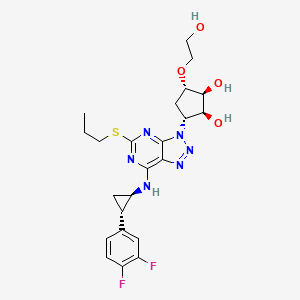
| Formula | C23H28F2N6O4S |
|---|---|
| Molecular weight | 522.58 g/mol |
| IUPAC name | (1S,2S,3R,5S)-3-[7-[[(1R,2S)-2-(3,4-difluorophenyl)cyclopropyl]amino]-5-propylsulfanyltriazolo[4,5-d]pyrimidin-3-yl]-5-(2-hydroxyethoxy)cyclopentane-1,2-diol |
| CAS | 274693-27-5 |
| PubChem CID | 9871419 |
| InChIKey | OEKWJQXRCDYSHL-FNOIDJSQSA-N |
| logP | 2.01 (XLogP 2.0) |
| Polar surface area | 138.44 Ų |
| H-bond acceptors / donors | 11 / 4 |
| Drug-likeness (QED) | 0.23 |
| Lipinski violations | 2 |
SMILES
CCCSc1nc(N[C@@H]2C[C@H]2c2ccc(F)c(F)c2)c2nnn([C@@H]3C[C@H](OCCO)[C@@H](O)[C@H]3O)c2n1Biology & Pharmacokinetics
Pharmacokinetics predicted
| Bioavailability | 70.0% |
|---|---|
| Half-life | 1.598 h |
| Volume of distribution | 1.147 L/kg |
| Protein binding | 98.7% |
| BBB penetrant | Yes |
Enzyme interactions
| Enzyme | Role | Detail |
|---|---|---|
| CYP2C8 | Inhibitor | — |
| CYP3A4 | Substrate | — |
Receptor binding (top 3)
| Target | Action | Affinity |
|---|---|---|
| P2Y12 receptor (P2RY12) | Antagonist | pKi 8.7 |
| P2Y12 receptor (P2RY12) | Antagonist | pKB 8.6 |
| Equilibrative nucleoside transporter 1 (SLC29A1) | Inhibitor | pKi 7.3 |
Transporters
BCRP (Inhibitor)BSEP (Inhibitor)MDR1 (Inhibitor)MRP1 (Inhibitor)OATP1B1 (Inhibitor)OATP1B3 (Inhibitor)OATP2B1 (Inhibitor)P-gp (Inhibitor)Transporter(unspecified) (Inhibitor)MDR1 (Substrate)P-gp (Substrate)
Drug–drug interactions (100+, DDInter)
| Interacting drug | Severity | Management |
|---|---|---|
| Acalabrutinib | major | |
| Apalutamide | major | |
| Apixaban | major | |
| Ardeparin | major | |
| Atazanavir | major | |
| Avapritinib | major | |
| Betrixaban | major | |
| Boceprevir | major | |
| Cabozantinib | major | |
| Caplacizumab | major | |
| Carbamazepine | major | |
| Ceritinib | major | |
| Clarithromycin | major | |
| Cobicistat | major | |
| Conivaptan | major | |
| Dalteparin | major | |
| Danaparoid | major | |
| Dasatinib | major | |
| Deferasirox | major | |
| Defibrotide | major | |
| Delavirdine | major | |
| Drotrecogin alfa | major | |
| Edoxaban | major | |
| Enoxaparin | major | |
| Enzalutamide | major | |
| Fondaparinux | major | |
| Fosphenytoin | major | |
| Ibrutinib | major | |
| Idelalisib | major | |
| Indinavir | major | |
| Inotersen | major | |
| Itraconazole | major | |
| Ketoconazole | major | |
| Lonafarnib | major | |
| Lumacaftor | major | |
| Mifepristone | major | |
| Mitotane | major | |
| Nefazodone | major | |
| Nelfinavir | major | |
| Omacetaxine mepesuccinate | major |
Showing 40 of 100+.
Registered Products (9)
| Brand | Form / strength | Pack | Agent | Citizen (JOD) |
|---|---|---|---|---|
| SUPAGREL 90 | Tablet 90 mg | 30 tab | Manar Drug Store | 13.420 |
| Ticablow | Tablet 60 mg | 60 tab | The Jordanian Pharmaceutical Manufacturing Company | 29.280 |
| Ticablow | Tablet Ticagrelor 90 mg | 60 tab | The Jordanian Pharmaceutical Manufacturing Company | 33.000 |
| Thincor | Tablet 90 mg | 56 tab pack varies | Pharma International Company/ Jordan | 41.000 |
| Tigomory | Tablet 90 mg | 60 tab | AL-RAM PHARMA.INDUS.CO.LTD/JORDAN | 43.000 |
| Brelexa | Tablet 90 mg | 60 tab | SAVVY PHARMA/JORDAN | 43.920 |
| Tagbro 90mg F.C.Tablets | Film-Coated Tablet 90.0 mg | 60 tab | / UNITED PHARM.MFG.CO.LTD(UPM)/JORDAN / General | 43.930 |
| Brilinta | Tablet 90 mg | 56 tab | Shawi & Rushedat Drug Store | 45.550 |
| Thincor | Tablet 90 mg | 350 tab pack varies | Pharma International Company/ Jordan | 235.720 |