Topiramate
JFDA label: Topamax 50 Tab
Mechanism of Action
Inhibitor of Carbonic anhydrase 2 — Carbonic anhydrase II inhibitor; Inhibitor of Carbonic anhydrase 4 — Carbonic anhydrase IV inhibitor; Antagonist of Glutamate receptor ionotropic AMPA — Glutamate receptor ionotropic AMPA antagonist; Antagonist of Glutamate receptor ionotropic kainate — Glutamate receptor ionotropic kainate antagonist; Positive Modulator of GABA-A receptor; anion channel — GABA-A receptor; anion channel positive modulator; Blocker of Sodium channel alpha subunit — Sodium channel alpha subunit blocker
| Target | Action | Gene / class |
|---|---|---|
| Carbonic anhydrase 2 efficacy | INHIBITOR | CA2 |
| Carbonic anhydrase 4 efficacy | INHIBITOR | CA4 |
| GABA-A receptor; anion channel efficacy | POSITIVE MODULATOR | |
| Glutamate receptor ionotropic AMPA efficacy | ANTAGONIST | |
| Glutamate receptor ionotropic kainate efficacy | ANTAGONIST | |
| Sodium channel alpha subunit efficacy | BLOCKER |
Indications
Approved
- Adjunctive therapy
- Epilepsy
- Migraine
- Monotherapy
Off-label
- Alcohol dependence
- Antipsychotic-induced weight gain
- Binge eating disorder
- Borderline personality disorder
- Bulimia nervosa
- Cluster headache (prophylaxis)
- Essential tremor
- Infantile spasms
- Status epilepticus, refractory (adults)
Contraindications
Source: Lexicomp
- Extended release: Recent alcohol use (ie, within 6 hours prior to and 6 hours after administration) (Trokendi XR only) Absolute
- Hypersensitivity to topiramate or any component of the formulation or container Absolute
- patients with metabolic acidosis who are taking concomitant metformin (Qudexy XR only). Immediate release: There are no contraindications listed in the manufacturer's labeling Absolute
- pregnancy and women in childbearing years not using effective contraception (migraine prophylaxis only) Absolute
Adverse Reactions
Cardiac disorders (5)
Common chest pain · Flushing
Not Known Hypotension · orthostatic hypotension · syncope
Nervous system disorders (31)
Very Common Cognitive impairment / slowed thinking · dizziness · drowsiness · fatigue · memory impairment · Paraesthesia · Paresthesia · Somnolence
Common agitation · anxiety · ataxia · behavioral problems · cognitive dysfunction · confusion · depression · Disturbance in attention · Dizziness · exacerbation of depression · headache · hypertonia · hypoesthesia · insomnia · lack of concentration · mood disorder · nervousness · psychomotor retardation · speech disturbance · vertigo
Not Known Attempted suicide · suicidal ideation · suicidal tendencies
Hepatobiliary disorders (1)
Not Known Increased serum alkaline phosphatase (children & adolescents)
Renal and urinary disorders (12)
Common cystitis · decreased libido · dysuria · Nephrolithiasis · premature ejaculation · urinary frequency · urinary incontinence · Urinary tract infection · vaginal hemorrhage
Uncommon Nephrolithiasis (kidney stones)
Not Known Increased blood urea nitrogen (children & adolescents) · increased serum creatinine (children & adolescents)
Blood and lymphatic system disorders (8)
Common anemia · Hemorrhage · neoplasm
Not Known Abnormal phosphorus levels (decreased; children & adolescents) · change in platelet count (increased; children & adolescents) · decreased neutrophils (children & adolescents) · decreased white blood cell count (children & adolescents) · eosinophilia
Immune system disorders (1)
Common Hypersensitivity reaction
Metabolism and nutrition disorders (10)
Very Common Decreased serum bicarbonate, anorexia, dysgeusia, nausea, diarrhea
Common increased gamma-glutamyl transferase · increased thirst · intermenstrual bleeding · Menstrual disease · Weight loss / anorexia
Uncommon Metabolic acidosis
Not Known Hyperchloremia (children & adolescents) · increased serum total protein (children & adolescents) · increased uric acid (children & adolescents)
Gastrointestinal disorders (9)
Common ageusia · constipation · Dyspepsia · gastritis · gastroenteritis · gastroesophageal reflux disease · xerostomia
Not Known Gingival hemorrhage · hematuria
Skin and subcutaneous tissue disorders (4)
Common acne vulgaris · Alopecia · pruritus · skin rash
Musculoskeletal and connective tissue disorders (5)
Common Arthralgia · leg pain · muscle spasm · weakness
Not Known Myalgia
Eye disorders (7)
Common blurred vision · Conjunctivitis · visual disturbance
Rare Acute angle-closure glaucoma
Not Known Myopia · scotoma · visual field defect
Ear and labyrinth disorders (1)
Common Otitis media
Infections and infestations (2)
Common infection · Viral infection
General disorders and administration site conditions (4)
Very Common Fever
Common Accidental injury · language problems
Rare Oligohydrosis / hyperthermia (children)
Respiratory, thoracic and mediastinal disorders (8)
Very Common Upper respiratory tract infection
Common bronchitis · cough · dyspnea · epistaxis · pharyngitis · rhinitis · Sinusitis
Dosing
Source: Lexicomp
Warnings & Precautions
Source: Lexicomp
CNS effects
Cognitive dysfunction (confusion, psychomotor slowing, difficulty with concentration/attention, difficulty with memory, speech or language problems), psychiatric disturbances (depression or mood disorders), and sedation (somnolence or fatigue) may occur with use; incidence may be related to rapid titration and higher doses; patients must be cautioned about performing tasks which require mental alertness (eg, operating machinery or driving). May also cause paresthesia, dizziness, and ataxia.
Hyperammonemia/encephalopathy
Hyperammonemia with or without encephalopathy may occur with monotherapy or in combination with valproic acid and has been documented in patients who have tolerated each drug alone; incidence may be dose-related. Risk may be increased in patients with inborn errors of metabolism or decreased hepatic mitochondrial activity. May be asymptomatic; monitor for lethargy, vomiting, or unexplained changes in mental status.
Metabolic acidosis
May be associated with hyperchloremic nonanion gap metabolic acidosis due to inhibition of carbonic anhydrase and increased renal bicarbonate loss. Decreases in serum bicarbonate are relatively common (up to 67% of epilepsy patients and 77% of migraine patients) but usually mild-to-moderate (average decrease of 4 mEq/L at dose of 400 mg/day in adults and 6 mg/kg/day in children). However, risk may be increased in patients with a predisposing condition (renal, respiratory and/or hepatic impairment), diarrhea, ketogenic diet, status epilepticus, or concurrent treatment with other drugs which may cause acidosis. Metabolic acidosis may occur at dosages as low as 50 mg/day. Serum bicarbonate should be monitored, as well as potential complications of chronic acidosis (nephrolithiasis, nephrocalcinosis, osteomalacia/osteoporosis, and reduced growth rates and/or reduced weight in children). Dose reduction or discontinuation (by tapering dose) should be considered in patients with persistent or severe metabolic acidosis. If treatment is continued, alkali supplementation should be considered.
Oligohidrosis/hyperthermia
May be associated with oligohidrosis and hyperthermia, most frequently in children; use caution and monitor closely during strenuous exercise, during exposure to high environmental temperature, or in patients receiving other carbonic anhydrase inhibitors and drugs with anticholinergic activity.
Ophthalmic effects
Has been associated with acute myopia and secondary angle-closure glaucoma in adults and children, typically within 1 month of initiation; discontinue in patients with acute onset of decreased visual acuity and/or ocular pain.
Renal calculus
Topiramate exhibits weak carbonic anhydrase inhibitory properties and may increase the risk of kidney stones about 2 to 4 times that of the untreated population. Kidney stones have been reported in children and adults (incidence higher in males). Consider avoiding use in patients on a ketogenic diet. The risk of kidney stones may be reduced by increasing fluid intake.
Suicidal ideation
Pooled analysis of trials involving various antiepileptics (regardless of indication) showed an increased risk of suicidal thoughts/behavior (incidence rate: 0.43% treated patients compared to 0.24% of patients receiving placebo); risk observed as early as 1 week after initiation and continued through duration of trials (most trials ≤24 weeks). Monitor all patients for notable changes in behavior that might indicate suicidal thoughts or depression; notify healthcare provider immediately if symptoms occur.
Visual field defects
Has been reported independent of increased intraocular pressure; generally reversible upon discontinuation. Consider discontinuation if visual problems occur at any time during treatment. Disease-related concerns:
Depression
Use with caution in patients with depression or suicidal tendencies.
Eating disorders
The exacerbation and development of eating disorders, including anorexia nervosa and bulimia, has been reported in case reports of adolescents receiving topiramate for migraines or chronic headaches and an adult receiving topiramate for epilepsy. Prior to initiation of topiramate screen for a history of eating disorder symptoms, eating disorder risk factors (eg, history of dieting behavior), cognitive symptoms of eating disorders (eg, weight or shape concerns, fear of gaining weight, drive for thinness), and any recent changes in social functioning including increased withdrawal or isolation. Inquire whether the patient has unrealistic or unhealthy weight goals. Evaluate exercise habits (eg, look for over-exercising or compulsive exercising above that of similarly athletic peers) and dietary intake; assess rigid patterns or avoidance of specific categories of foods and preoccupation with maintaining a “healthy diet” or experimentation with fad diets. In adolescents assess developmental weight history with growth curves. Monitor eating behaviors and weight closely in patients receiving topiramate who have eating disorder symptoms or risk factors (Lebow 2015; Rosenow 2002).
Hepatic impairment
Use caution with hepatic impairment; clearance may be reduced. Dosage adjustment may be required.
Renal impairment
Use caution with renal impairment; clearance may be reduced. Dosage adjustment may be required. Concurrent drug therapy issues:
Drug-drug interactions
Potentially significant interactions may exist, requiring dose or frequency adjustment, additional monitoring, and/or selection of alternative therapy. Consult drug interactions database for more detailed information. Special populations:
Elderly
Use with caution; dosage adjustment may be necessary. Weight loss, cognitive impairment, sedation, and gait/balance disturbances may be more pronounced in the older adult cohort (Sommer 2010). Other warnings/precautions:
Withdrawal
Do not discontinue abruptly because of the possibility of increasing seizure frequency; therapy should be withdrawn gradually to minimize the potential of increased seizure frequency, unless safety concerns require a more rapid withdrawal. Doses were also gradually withdrawn in migraine prophylaxis studies (decreased in weekly intervals by 25-50 mg/day).
Pregnancy & Lactation
Pregnancy
Adverse events have been observed in animal reproduction studies. Based on limited data (n=5), topiramate was found to cross the placenta and could be detected in neonatal serum (Ohman 2002). Topiramate may cause fetal harm if administered to a pregnant woman. An increased risk of oral clefts (cleft lip and/or palate) and for being small for gestational age (SGA) has been observed following in utero exposure. Data from the North American Antiepileptic Drug (NAAED) Pregnancy Registry reported that the prevalence of oral clefts was 1.1% for infants exposed to topiramate during the first trimester of pregnancy, versus 0.36% for infants exposed to a reference antiepileptic drug, and 0.12% for infants with no exposure born to mothers without epilepsy; the relative risk of oral clefts in infants exposed to topiramate was calculated to be 9.6 (95% CI: 4 to 23). Data from the NAAED Pregnancy Registry reported that the prevalence of small for gestational age newborns was 19.7% for newborns ex
Lactation
Topiramate is present in breast milk. The relative infant dose (RID) of topiramate is ~3% to 23% when calculated using a range of breast milk concentrations obtained from three lactating women and compared to a weight-adjusted maternal dose of 150 to 200 mg/day (Ohman 2002). In general, breastfeeding is considered acceptable when the RID of a medication is 25% breastfeeding should generally be avoided (Anderson 2016; Ito 2000). The RID of topiramate was calculated using a range of milk con
LactMed: monitor the infant.
Monitoring
| Clinical pearl | Seizure frequency, hydration status; electrolytes (recommended monitoring includes serum bicarbonate at baseline and periodically during treatment), serum creatinine; monitor for symptoms of acute acidosis and complications of long-term acidosis (nephrolithiasis, nephrocalcinosis, osteomalacia/osteoporosis, and reduced growth rates and/or weight in children); ammonia level in patients with unexplained lethargy, vomiting, or mental status changes; intraocular pressure, symptoms of secondary angle closure glaucoma; suicidality (eg, suicidal thoughts, depression, behavioral changes); weight and eating behaviors in patients with eating disorder symptoms or risk factors; sedation |
|---|
Chemistry & Properties
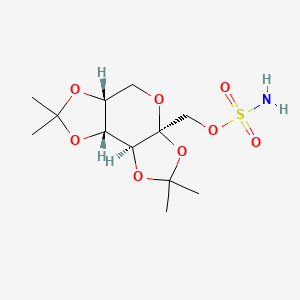
| Formula | C12H21NO8S |
|---|---|
| Molecular weight | 339.37 g/mol |
| IUPAC name | [(1R,2S,6S,9R)-4,4,11,11-tetramethyl-3,5,7,10,12-pentaoxatricyclo[7.3.0.02,6]dodecan-6-yl]methyl sulfamate |
| CAS | 97240-79-4 |
| PubChem CID | 5284627 |
| InChIKey | KJADKKWYZYXHBB-XBWDGYHZSA-N |
| logP | -0.4 (XLogP -0.8) |
| Polar surface area | 115.54 Ų |
| H-bond acceptors / donors | 8 / 1 |
| Drug-likeness (QED) | 0.74 |
| Lipinski violations | 0 |
SMILES
CC1(C)O[C@@H]2[C@@H](CO[C@@]3(COS(N)(=O)=O)OC(C)(C)O[C@@H]23)O1Biology & Pharmacokinetics
Pharmacokinetics
| BBB penetrant | Yes (logBB -0.07) |
|---|
Receptor binding (top 4)
| Target | Action | Affinity |
|---|---|---|
| carbonic anhydrase 7 (CA7) | Inhibitor | pKi 9.1 |
| carbonic anhydrase 12 (CA12) | Inhibitor | pKi 8.4 |
| carbonic anhydrase 4 (CA4) | Inhibitor | pKi 7.4 |
| carbonic anhydrase 1 (CA1) | Inhibitor | pKi 6.6 |
Transporters
BCRP (Inhibitor)BSEP (Inhibitor)BSEP (Inhibitor)MDR1 (Inhibitor)MRP1 (Inhibitor)MRP2 (Inhibitor)MRP3 (Inhibitor)MRP4 (Inhibitor)OATP1B1 (Inhibitor)OATP1B3 (Inhibitor)OCTN2 (Inhibitor)P-gp (Inhibitor)MDR1 (Substrate)P-gp (Substrate)
Drug–drug interactions (67, DDInter)
| Interacting drug | Severity | Management |
|---|---|---|
| Acrivastine | major | |
| Alimemazine | major | |
| Atropine | major | |
| Azatadine | major | |
| Brompheniramine | major | |
| Carbinoxamine | major | |
| Chlorcyclizine | major | |
| Chlorpheniramine | major | |
| Clemastine | major | |
| Clidinium | major | |
| Cyclizine | major | |
| Cyproheptadine | major | |
| Dexbrompheniramine | major | |
| Dicyclomine | major | |
| Diphenhydramine | major | |
| Doxepin | major | |
| Doxepin (topical) | major | |
| Doxylamine | major | |
| Glycopyrronium | major | |
| Hyoscyamine | major | |
| Meclizine | major | |
| Mepenzolate | major | |
| Mepyramine | major | |
| Metformin | major | |
| Methdilazine | major | |
| Methscopolamine | major | |
| Phenindamine | major | |
| Promethazine | major | |
| Propantheline | major | |
| Scopolamine | major | |
| Thiethylperazine | major | |
| Tripelennamine | major | |
| Triprolidine | major | |
| Trospium | major | |
| Apalutamide | moderate | |
| Brimonidine (ophthalmic) | moderate | |
| Brimonidine (topical) | moderate | |
| Cetirizine | moderate | |
| Chloroquine | moderate | |
| Chlorphenesin | moderate |
Showing 40 of 67.
Registered Products (23)
| Brand | Form / strength | Pack | Agent | Citizen (JOD) |
|---|---|---|---|---|
| topra | Tablet 25 mg | 60 tab | Al Hilal Drug Store | 4.050 |
| EPIGRAIN | Film-Coated Tablet 25 mg | 60 Film | Al-Taqqadom Pharmaceutical Industries | 5.390 |
| Ipramax | Tablet 25 mg | 60 tab | Sukhtian Group | 5.390 |
| Torate | Tablet 25 mg | 60 tab | AL Rahma Drug Store | 5.390 |
| pms-Topiramate | Tablet 25 mg | 60 tab | Reda Jardaneh Drug Store | 5.390 |
| Convumax | Tablet 25 mg | 60 tab | JERASH PHARMACEUTICALS LTD.CO/JORDAN | 6.000 |
| topra | Tablet 50 mg | 60 tab | Al Hilal Drug Store | 6.640 |
| Topamax 25 Tab | Tablet 25 mg | 60 tab | Shawi & Rushedat Drug Store | 7.070 |
| topra | Tablet 100 mg | 60 tab | Al Hilal Drug Store | 11.340 |
| EPIGRAIN | Film-Coated Tablet 50 mg | 60 Film | Al-Taqqadom Pharmaceutical Industries | 14.280 |
| Topamax 50 Tab | Tablet 50 mg | 60 tab | Shawi & Rushedat Drug Store | 14.430 |
| Ipramax | Tablet 100 mg | 60 tab | Sukhtian Group | 15.090 |
| Torate | Tablet 50 mg | 60 tab | AL Rahma Drug Store | 15.180 |
| pms-Topirmate | Tablet 50 mg | 60 tab | Reda Jardaneh Drug Store | 15.180 |
| Convumax | Tablet 50 mg | 60 tab | JERASH PHARMACEUTICALS LTD.CO/JORDAN | 16.350 |
| EPIGRAIN | Film-Coated Tablet 100 mg | 60 Film | Al-Taqqadom Pharmaceutical Industries | 21.770 |
| Convumax | Tablet 100 mg | 60 tab | JERASH PHARMACEUTICALS LTD.CO/JORDAN | 24.650 |
| Torate | Tablet 100 mg | 60 tab | AL Rahma Drug Store | 26.140 |
| pms-Topirmate | Tablet 100 mg | 60 tab | Reda Jardaneh Drug Store | 26.140 |
| Topamax 100 Tablet | Tablet 100 mg | 60 tab | Shawi & Rushedat Drug Store | 27.320 |
| EPIGRAIN | Film-Coated Tablet 200 mg | 60 Film | Al-Taqqadom Pharmaceutical Industries | 39.350 |
| Convumax | Tablet 200 mg | 60 tab | JERASH PHARMACEUTICALS LTD.CO/JORDAN | 42.750 |
| Topamax 200 Tablet | Tablet 200 mg | 60 tab | Shawi & Rushedat Drug Store | 51.590 |