Trametinib
JFDA label: Mekinist film coated tablets
Mechanism of Action
Inhibitor of Dual specificity mitogen-activated protein kinase kinase; MEK1/2 — Dual specificity mitogen-activated protein kinase kinase; MEK1/2 inhibitor
| Target | Action | Gene / class |
|---|---|---|
| Dual specificity mitogen-activated protein kinase kinase; MEK1/2 efficacy | INHIBITOR |
Indications
Approved
- Melanoma (metastatic or unresectable)
- Non-small cell lung cancer (metastatic)
Class profile
| mechanismClass | MEK kinase inhibitor (TKI) |
|---|---|
| targetMolecule | MEK1 (MAP2K1) + MEK2 |
| targetPathway | MAPK/ERK signaling |
| generation | 1st generation MEK inhibitor |
| primaryTumors | Melanoma (with BRAF inhibitor),NSCLC,Low-grade glioma (with dabrafenib) |
| resistanceMechanisms | KRAS mutation,NRAS mutation,RAF amplification,MEK mutation (upstream bypass) |
| source | NCCN/OncoKB/Goodman&Gilman13ed |
Contraindications
Source: Lexicomp
- Hypersensitivity to trametinib or any component of the formulation Absolute
- There are no contraindications listed in the manufacturer's US labeling Absolute
Adverse Reactions
Cardiac disorders (6)
Very Common cardiomyopathy · Hypertension · peripheral edema · prolonged Q-T Interval on ECG
Common bradycardia · Decreased left ventricular ejection fraction
Nervous system disorders (4)
Very Common chills · Fatigue · headache
Common Dizziness
Renal and urinary disorders (1)
Very Common Increased serum creatinine
Blood and lymphatic system disorders (10)
Very Common Anemia · Basal cell carcinoma · hemorrhage · hemorrhage, increased serum ALT, increased serum alkaline phosphatase · leukopenia · lymphedema · lymphocytopenia · Neutropenia · squamous cell carcinoma of skin · thrombocytopenia, increased serum AST, increased serum ALT
Metabolism and nutrition disorders (1)
Very Common Hypoalbuminemia
Gastrointestinal disorders (11)
Very Common abdominal pain · constipation · decreased appetite · Diarrhea · Gastrointestinal hemorrhage · Nausea · pancreatitis · stomatitis · vomiting
Common Dysgeusia · xerostomia
Skin and subcutaneous tissue disorders (10)
Very Common acneiform eruption · skin rash · Skin toxicity · Skin toxicity, hyponatremia, hypoalbuminemia, hypophosphatemia, exacerbation of diabetes mellitus · xeroderma
Common cellulitis · folliculitis · Paronychia · pruritus · pustular rash
Musculoskeletal and connective tissue disorders (3)
Very Common Arthralgia · myalgia
Common Rhabdomyolysis
Eye disorders (2)
Common Blurred vision · dry eye syndrome
General disorders and administration site conditions (2)
Very Common febrile reaction (complicated with dehydration: 2%, complicated with severe chills/rigors: 1% to 10%: · Fever
Respiratory, thoracic and mediastinal disorders (4)
Very Common Cough · dyspnea
Common Interstitial pulmonary disease · pneumonitis
Dosing
Source: Lexicomp
Warnings & Precautions
Source: Lexicomp
Bone marrow suppression
Neutropenia (including grade 3 and 4 events) has been observed when used in combination with dabrafenib. Monitor complete blood counts at baseline and as clinically needed during therapy.
Cardiac events
Cardiac events such as heart failure, left ventricular dysfunction, or decreased left ventricular ejection fraction (LVEF) were observed in clinical trials (for single-agent trametinib and when used in combination with dabrafenib). The median time to onset of cardiomyopathy in melanoma patients for single-agent trametinib was ~2 months (range: 16 to 156 days) and ~8 months (range: ~1 to 25 months) when used in combination with dabrafenib. The median time of onset of cardiomyopathy in patients with NSCLC was 6.7 months (range: 1.4 to 14.1 months). In some patients, cardiomyopathy developed within the first month of treatment. Assess LVEF (by echocardiogram or MUGA scan) prior to therapy initiation, at one month, and then at 2- to 3-month intervals while on therapy. Cardiac dysfunction may require treatment interruption, dosage reduction, or discontinuation; such measures resulted in resolution of cardiomyopathy in some patients.
Dermatologic toxicity
Dermatologic toxicity (eg, rash, dermatitis, acneiform rash, palmar-plantar erythrodysesthesia syndrome, and erythema) was commonly observed in trametinib-treated patients (either as a single-agent or when used in combination with dabrafenib); some patients required hospitalization for severe toxicity or for secondary skin infections. In melanoma studies, the median time to onset and resolution of skin toxicity for single-agent trametinib was 15 days (range: 1 to 221 days) and 48 days (range: 1 to 282 days), respectively. The median time to onset and resolution of skin toxicity for combination therapy was 2 months (range: 1 day to 22 months) and 1.2 months (range: 1 day to ~24 months), respectively in melanoma studies. Monitor for dermatologic toxicity and signs/symptoms of secondary infections. Treatment interruption, dose reduction, and/or therapy discontinuation may be necessary.
Febrile reactions
Serious febrile reactions and fever (any severity) accompanied by hypotension, rigors/chills, dehydration, or renal failure may occur when trametinib is used in combination with dabrafenib. The incidence and severity were higher with combination therapy than with single-agent dabrafenib; the median time to onset of fever was 1.2 months (range: 1 to 23 days) and duration was 3 days (range: 1 day to 1.7 months) for patients receiving combination therapy for the treatment of melanoma. Withhold trametinib for fever >104°F (if using in combination, withhold dabrafenib for fever ≥101.3°F) or for any fever with rigors/chills, hypotension, dehydration, or renal failure (evaluate for infection); may require prophylactic antipyretics as secondary prophylaxis upon therapy resumption. Administer corticosteroids (eg, prednisone 10 mg daily or equivalent) for at least 5 days for second or subsequent episodes of pyrexia if temperature does not return to baseline within 3 days of fever onset, or for pyrexia associated with complications (eg, dehydration, hypotension, severe chills/rigors with no evidence of active infection).
Gastrointestinal events
Colitis and GI perforation, including fatal cases, have been reported with monotherapy and when administered concomitantly with dabrafenib; monitor closely for development of colitis and GI perforations.
Hemorrhage
Hemorrhage, including symptomatic bleeding in a critical area/organ, may occur with trametinib, either as a single agent or in combination with dabrafenib. Major bleeding events (some fatal) included intracranial or gastrointestinal hemorrhage. May require treatment interruption and dosage reduction; permanently discontinue trametinib (and dabrafenib) for all grade 4 hemorrhagic events and any grade 3 event that does not improve with therapy interruption.
Hepatotoxicity
Elevated liver function tests have been reported with trametinib, including grade 3 and 4 events. Monitor hepatic function as clinically necessary.
Hyperglycemia
While not reported with single-agent trametinib, hyperglycemia may occur while on combination therapy with dabrafenib; may require initiation of insulin or oral hypoglycemic agent therapy (or an increased dose if already taking). Monitor serum glucose at baseline and as clinically necessary in patients with preexisting diabetes or hyperglycemia. Instruct patients to report symptoms of severe hyperglycemia (eg, polydipsia, polyuria).
Hypertension
May cause hypertension; monitor blood pressure.
Malignancy
New primary cutaneous malignancies (which are associated with dabrafenib as single-agent therapy) may occur when trametinib is given in combination with dabrafenib. The incidence of basal cell carcinoma (BCC) in melanoma patients is ~3% for combination therapy versus 6% for single-agent dabrafenib. The median time to BCC diagnosis ranged from ~3 to 24 months for patients receiving combination therapy for the treatment of melanoma. Cutaneous squamous cell carcinomas (cuSCC), including keratoacanthoma, occurred at a lower rate for combination therapy in melanoma patients compared to single-agent dabrafenib (3% vs 10%, respectively), with a median time to diagnosis ranging from ~2 to 17 months for combination therapy. Cases of cuSCC also occurred in patients with NSCLC, with a first occurrence onset ranging from 25 days to ~12 months. New primary melanoma occurred rarely in patients receiving trametinib. Dermatologic exams should be performed prior to initiation of combination therapy, every 2 months while receiving combination treatment, and for up to 6 months following discontinuation. There are case reports of noncutaneous malignancies, including pancreatic cancer (KRAS mutation-positive), colorectal cancer (recurrent NRAS mutation-positive), hand and neck cancer, and glioblastoma, with combination therapy; monitor for signs/symptoms of noncutaneous malignancies. No trametinib dosage modification is necessary for new primary cutaneous and noncutaneous malignancies; dabrafenib
Ocular toxicity
Retinal pigment epithelial detachments (RPED) and retinal vein occlusion were seen in clinical trials (rare). Detachments were typically bilateral and multifocal and occurred in the central macular area of the retina. Retinal vein occlusion may lead to macular edema, decreased visual function, neovascularization, and glaucoma. Promptly (within 24 hours) refer patients for ophthalmological evaluations if loss of vision or other visual disturbances occur. Ophthalmic exams (including retinal evaluation) should be performed periodically during treatment and with visual disturbances. Interrupt trametinib therapy for RPED; may resume if resolves within 3 weeks; reduce the dose or discontinue if not resolved within 3 weeks. Permanently discontinue if retinal vein occlusion develops. Uveitis and iritis have been reported when trametinib is used in combination with dabrafenib and are managed symptomatically with ophthalmic steroid and mydriatic drops (does not require alteration in trametinib therapy).
Pulmonary toxicity
Interstitial lung disease (ILD) and pneumonitis were observed in clinical trials. The median time to initial presentation in melanoma patients was ~5 months (range: 2 to ~6 months). Monitor for new or progressive pulmonary symptoms (eg, cough, dyspnea, hypoxia, pleural effusion, infiltrates); withhold treatment if symptoms occur; permanently discontinue with diagnosis of ILD or pneumonitis.
Venous thromboembolism
Venous thromboembolic events (some fatal) may occur (was observed when used in combination with dabrafenib). DVT and PE occurred at an increased incidence with combination therapy. Patients should seek immediate medical attention with symptoms of DVT or PE (shortness of breath, chest pain, arm/leg swelling). Withhold trametinib for uncomplicated DVT or PE; may resume at a lower dose if improves within 3 weeks; permanently discontinue trametinib for life-threatening PE. Concurrent drug therapy issues:
Combination therapy with dabrafenib
Serious adverse reactions (tumor promotion, hemolytic anemia), which occur with single-agent dabrafenib, may also occur when trametinib is administered in combination with dabrafenib.
Drug-drug interactions
Potentially significant interactions may exist, requiring dose or frequency adjustment, additional monitoring, and/or selection of alternative therapy. Consult drug interactions database for more detailed information. Other warnings/precautions:
Appropriate use
Trametinib is not indicated for treatment of patients with melanoma who have progressed on prior BRAF-inhibitor therapy. Prior to initiating therapy, confirm BRAF mutation status with an approved test; approved for use in melanoma patients with BRAF V600K and BRAF V600E mutations and NSCLC patients with BRAF V600E mutation. Data regarding use in melanoma patients with BRAF V600K mutation is limited; compared to BRAF V600E mutation, lower response rates have been observed with BRAF V600K mutation. Data regarding other less common BRAF V600 mutations in melanoma is lacking.
Pregnancy & Lactation
Pregnancy
Adverse effects were observed in animal reproduction studies. Based on its mechanism of action, trametinib would be expected to cause fetal harm if administered to a pregnant woman. Females of reproductive potential should use a highly effective contraceptive during therapy and for 4 months after treatment is complete. When trametinib is used in combination with dabrafenib, a highly effective nonhormonal contraceptive method should be used (dabrafenib may diminish efficacy of hormonal contraceptives). Fertility may also be impaired in females. Due to a risk for impaired spermatogenesis, males who may want to father a child should seek fertility/family planning counseling prior to initiating combination therapy with dabrafenib.
Lactation
It is not known if trametinib is present in breast milk. Due to the potential for serious adverse reactions in the breastfed infant, breastfeeding is not recommended by the manufacturer during treatment and for 4 months after the last dose.
Monitoring
| Efficacy | Tumour response (RECIST criteria, tumour markers, imaging); progression-free survival; performance status (ECOG/Karnofsky) |
|---|---|
| Toxicity | CBC with differential (nadir timing depends on agent); LFTs; renal function; ECG (QT for relevant agents); echocardiogram for cardiotoxic agents (anthracyclines, trastuzumab); cumulative dose tracking for dose-limited toxicities |
| Clinical pearl | Treatment response is assessed after 2–3 cycles. Grade 3–4 toxicities typically require dose reduction or interruption per protocol-defined criteria. |
| Counseling | Attend all scheduled blood tests and imaging appointments. Report fever > 38°C (risk of neutropaenic sepsis — medical emergency), unusual bleeding, or new pain immediately. |
Chemistry & Properties
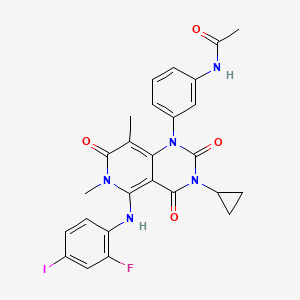
| Formula | C26H23FIN5O4 |
|---|---|
| Molecular weight | 615.4 g/mol |
| IUPAC name | N-[3-[3-cyclopropyl-5-(2-fluoro-4-iodoanilino)-6,8-dimethyl-2,4,7-trioxopyrido[4,3-d]pyrimidin-1-yl]phenyl]acetamide |
| CAS | 871700-17-3 |
| PubChem CID | 11707110 |
| InChIKey | LIRYPHYGHXZJBZ-UHFFFAOYSA-N |
| logP | 3.94 (XLogP 3.4) |
| Polar surface area | 107.13 Ų |
| H-bond acceptors / donors | 8 / 2 |
| Drug-likeness (QED) | 0.33 |
| Lipinski violations | 1 |
SMILES
CC(=O)Nc1cccc(-n2c(=O)n(C3CC3)c(=O)c3c(Nc4ccc(I)cc4F)n(C)c(=O)c(C)c32)c1Biology & Pharmacokinetics
Pharmacokinetics
| BBB penetrant | No |
|---|
Enzyme interactions
| Enzyme | Role | Detail |
|---|---|---|
| CYP1A2 | Inhibitor | — |
| CYP1A2 | Substrate | — |
| CYP2B6 | Inhibitor | — |
| CYP2C19 | Substrate | — |
| CYP2C8 | Inhibitor | — |
| CYP2C9 | Inhibitor | — |
| CYP3A4 | Substrate | — |
Receptor binding (top 1)
| Target | Action | Affinity |
|---|---|---|
| mitogen-activated protein kinase kinase 2 (MAP2K2) | Inhibitor | pIC50 8.7 |
Transporters
BCRP (Inhibitor)BSEP (Inhibitor)MDR1 (Inhibitor)MRP1 (Inhibitor)OATP1B1 (Inhibitor)OATP1B3 (Inhibitor)OATP1B3 (Inhibitor)P-gp (Inhibitor)P-gp (Substrate)
Drug–drug interactions (15, DDInter)
| Interacting drug | Severity | Management |
|---|---|---|
| Apalutamide | moderate | |
| Brigatinib | moderate | |
| Dabrafenib | moderate | |
| Elagolix | moderate | |
| Encorafenib | moderate | |
| Enzalutamide | moderate | |
| Erdafitinib | moderate | |
| Fostamatinib | moderate | |
| Gilteritinib | moderate | |
| Idelalisib | moderate | |
| Isavuconazonium | moderate | |
| Lasmiditan | moderate | |
| Midostaurin | moderate | |
| Sarecycline | moderate | |
| Tucatinib | moderate |
Registered Products (2)
| Brand | Form / strength | Pack | Agent | Citizen (JOD) |
|---|---|---|---|---|
| Mekinist film coated tablets | Film-Coated Tablet 2.254 mg | 30 tab | The Jordan Drugstore Co | — |
| Mekinist film coated tablets | Film-Coated Tablet 0.5635 mg | 30 tab | The Jordan Drugstore Co | — |