Lasmiditan
JFDA label: Acumig
Mechanism of Action
Agonist of 5-hydroxytryptamine receptor 1F — Serotonin 1f (5-HT1f) receptor agonist
| Target | Action | Gene / class |
|---|---|---|
| 5-hydroxytryptamine receptor 1F efficacy | AGONIST | HTR1F |
Indications
Approved
- Migraine Disorders — migraine disorder
Contraindications
Source: openFDA
- None. None. ( 4 ) Absolute
Dosing
Source: openFDA
Warnings & Precautions
Source: openFDA
Warnings & Precautions
Driving Impairment: Advise patients not to drive or operate machinery until at least 8 hours after taking each dose of REYVOW. Patients who cannot follow this advice should not take REYVOW. Patients may not be able to assess their own driving competence and the degree of impairment caused by REYVOW. ( 5.1 ) Central Nervous System (CNS) Depression: REYVOW may cause CNS depression and should be used with caution if used in combination with alcohol or other CNS depressants. ( 5.2 , 7.1 ) Serotonin Syndrome: Reactions consistent with serotonin syndrome were reported in patients treated with REYVOW. Discontinue REYVOW if symptoms of serotonin syndrome occur. ( 5.3 ) Medication Overuse Headache: Detoxification may be necessary. ( 5.4 )
Driving Impairment REYVOW may cause significant driving impairment
Driving Impairment REYVOW may cause significant driving impairment. In a driving study, administration of single 50 mg, 100 mg, or 200 mg doses of REYVOW significantly impaired subjects' ability to drive [see Clinical Studies ( 14.2 )] . Additionally, more sleepiness was reported at 8 hours following a single dose of REYVOW compared to placebo. Advise patients not to engage in potentially hazardous activities requiring complete mental alertness, such as driving a motor vehicle or operating machinery, for at least 8 hours after each dose of REYVOW. Patients who cannot follow this advice should not take REYVOW. Prescribers and patients should be aware that patients may not be able to assess their own driving competence and the degree of impairment caused by REYVOW.
Central Nervous System Depression REYVOW may cause central nervous sys
Central Nervous System Depression REYVOW may cause central nervous system (CNS) depression, including dizziness and sedation [see Adverse Reactions ( 6.1 )] . Because of the potential for REYVOW to cause sedation, other cognitive and/or neuropsychiatric adverse reactions, and driving impairment, REYVOW should be used with caution if used in combination with alcohol or other CNS depressants [see Drug Interactions ( 7.1 )] . Patients should be warned against driving and other activities requiring complete mental alertness for at least 8 hours after REYVOW is taken [see Warnings and Precautions ( 5.1 )] .
Serotonin Syndrome In clinical trials, reactions consistent with serot
Serotonin Syndrome In clinical trials, reactions consistent with serotonin syndrome were reported in patients treated with REYVOW who were not taking any other drugs associated with serotonin syndrome. Serotonin syndrome may also occur with REYVOW during coadministration with serotonergic drugs [e.g., selective serotonin reuptake inhibitors (SSRIs), serotonin norepinephrine reuptake inhibitors (SNRIs), tricyclic antidepressants (TCAs), and monoamine oxidase (MAO) inhibitors]. Serotonin syndrome symptoms may include mental status changes (e.g., agitation, hallucinations, coma), autonomic instability (e.g., tachycardia, labile blood pressure, hyperthermia), neuromuscular signs (e.g., hyperreflexia, incoordination), and/or gastrointestinal signs and symptoms (e.g., nausea, vomiting, diarrhea). The onset of symptoms usually occurs within minutes to hours of receiving a new or a greater dose of a serotonergic medication. Discontinue REYVOW if serotonin syndrome is suspected.
Medication Overuse Headache Overuse of acute migraine drugs (e.g., erg
Medication Overuse Headache Overuse of acute migraine drugs (e.g., ergotamines, triptans, opioids, or a combination of these drugs for 10 or more days per month) may lead to exacerbation of headache (i.e., medication overuse headache). Medication overuse headache may present as migraine-like daily headaches or as a marked increase in frequency of migraine attacks. Detoxification of patients including withdrawal of the overused drugs and treatment of withdrawal symptoms (which often includes a transient worsening of headache) may be necessary.
Pregnancy & Lactation
Lactation
If lasmiditan is required by the mother of an older infant, it is not a reason to discontinue breastfeeding, but until more data become available, an alternate drug may be preferred, especially while nursing a newborn or preterm infant.
Chemistry & Properties
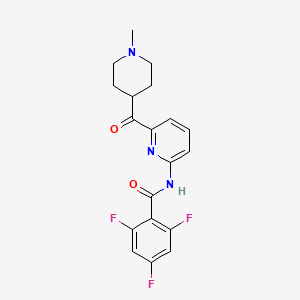
| Formula | C19H18F3N3O2 |
|---|---|
| Molecular weight | 377.37 g/mol |
| IUPAC name | 2,4,6-trifluoro-N-[6-(1-methylpiperidine-4-carbonyl)-2-pyridinyl]benzamide |
| CAS | 439239-90-4 |
| PubChem CID | 11610526 |
| InChIKey | XEDHVZKDSYZQBF-UHFFFAOYSA-N |
| logP | 3.28 (XLogP 2.8) |
| Polar surface area | 62.3 Ų |
| H-bond acceptors / donors | 4 / 1 |
| Drug-likeness (QED) | 0.83 |
| Lipinski violations | 0 |
SMILES
CN1CCC(C(=O)c2cccc(NC(=O)c3c(F)cc(F)cc3F)n2)CC1Biology & Pharmacokinetics
Pharmacokinetics predicted
| Bioavailability | 10.0% |
|---|---|
| Half-life | 2.194 h |
| Volume of distribution | 2.77 L/kg |
| Protein binding | 72.8% |
| BBB penetrant | Yes |
Enzyme interactions
| Enzyme | Role | Detail |
|---|---|---|
| CYP3A4 | Substrate | — |
Receptor binding (top 1)
| Target | Action | Affinity |
|---|---|---|
| 5-HT1F receptor (HTR1F) | Agonist | pKi 8.7 |
Transporters
BCRP (Inhibitor)BSEP (Inhibitor)MATE1 (Inhibitor)MRP1 (Inhibitor)OATP1B1 (Inhibitor)OATP1B3 (Inhibitor)OCT1 (Inhibitor)P-gp (Inhibitor)P-gp (Substrate)
Drug–drug interactions (100+, DDInter)
| Interacting drug | Severity | Management |
|---|---|---|
| Dexfenfluramine | major | |
| Dextromethorphan | major | |
| Dolasetron | major | |
| Doxepin | major | |
| Doxepin (topical) | major | |
| Edoxaban | major | |
| Fenfluramine | major | |
| Granisetron | major | |
| Lorcaserin | major | |
| Methylene blue | major | |
| Ondansetron | major | |
| Ozanimod | major | |
| Palonosetron | major | |
| Procarbazine | major | |
| Sibutramine | major | |
| Siponimod | major | |
| Acrivastine | moderate | |
| Afatinib | moderate | |
| Aldesleukin | moderate | |
| Alectinib | moderate | |
| Alimemazine | moderate | |
| Alpelisib | moderate | |
| Apixaban | moderate | |
| Apremilast | moderate | |
| Artesunate | moderate | |
| Atropine | moderate | |
| Azatadine | moderate | |
| Azelastine (nasal) | moderate | |
| Belinostat | moderate | |
| Betrixaban | moderate | |
| Bosutinib | moderate | |
| Brentuximab vedotin | moderate | |
| Brompheniramine | moderate | |
| Bupropion | moderate | |
| Cabazitaxel | moderate | |
| Carbinoxamine | moderate | |
| Ceritinib | moderate | |
| Cetirizine | moderate | |
| Chlorcyclizine | moderate | |
| Chlorphenesin | moderate |
Showing 40 of 100+.
Registered Products (4)
| Brand | Form / strength | Pack | Agent | Citizen (JOD) |
|---|---|---|---|---|
| Acumig | Tablet 50 mg | 4 tab pack varies | Hikma Pharmaceuticals Co.Ltd/Jordan | 10.810 |
| Acumig | Tablet 100 mg | 4 tab pack varies | Hikma Pharmaceuticals Co.Ltd/Jordan | 18.630 |
| Acumig | Tablet 50 mg | 8 tab pack varies | Hikma Pharmaceuticals Co.Ltd/Jordan | 21.640 |
| Acumig | Tablet 100 mg | 8 tab pack varies | Hikma Pharmaceuticals Co.Ltd/Jordan | 35.490 |