Vardenafil
JFDA label: Levitra F.C Tab
Mechanism of Action
Does not directly cause penile erections, but affects the response to sexual stimulation. The physiologic mechanism of erection of the penis involves release of nitric oxide (NO) in the corpus cavernosum during sexual stimulation. NO then activates the enzyme guanylate cyclase, which results in increased levels of cyclic guanosine monophosphate (cGMP), producing smooth muscle relaxation and inflow of blood to the corpus cavernosum. Vardenafil enhances the effect of NO by inhibiting phosphodiesterase type 5 (PDE-5), which is responsible for degradation of cGMP in the corpus cavernosum; when sexual stimulation causes local release of NO, inhibition of PDE-5 by vardenafil causes increased levels of cGMP in the corpus cavernosum, resulting in smooth muscle relaxation and inflow of blood to the
Indications
Approved
- Erectile dysfunction
Off-label
- Raynaud Phenomenon
Contraindications
Source: Lexicomp
- Additional contraindications (not in US labeling): Hypersensitivity to vardenafil or any component of the formulation Absolute
- Coadministration with nitrates (either regularly and/or intermittently), nitric oxide donors, or guanylate cyclase stimulators (eg, riociguat) Absolute
- concomitant use with indinavir, ritonavir, ketoconazole or itraconazole (Levitra, Staxyn) and erythromycin or clarithromycin (Staxyn) Absolute
- prior episode of non-arteritic anterior ischemic optic neuropathy (NAION) Absolute
Adverse Reactions
Cardiac disorders (1)
Very Common Flushing
Nervous system disorders (2)
Very Common Headache
Common Dizziness
Gastrointestinal disorders (2)
Common Dyspepsia · nausea
Musculoskeletal and connective tissue disorders (2)
Common Back pain · increased creatine phosphokinase
Respiratory, thoracic and mediastinal disorders (4)
Common flu-like symptoms · nasal congestion · Rhinitis · sinusitis
Dosing
Source: Lexicomp
Warnings & Precautions
Source: Lexicomp
Color discrimination
May cause dose-related impairment of color discrimination. Use caution in patients with retinitis pigmentosa; a minority have genetic disorders of retinal phosphodiesterases (no safety information available).
Hearing loss
Sudden decrease or loss of hearing has been reported rarely; hearing changes may be accompanied by tinnitus and dizziness. A direct relationship between therapy and hearing loss has not been determined.
Hypotension
Decreases in blood pressure may occur due to vasodilator effects; use with caution in patients with left ventricular outflow obstruction (aortic stenosis or hypertrophic cardiomyopathy [HCM] with outflow tract obstruction); may be more sensitive to hypotensive actions. Concurrent use with alpha-adrenergic antagonist therapy may cause symptomatic hypotension; patients should be hemodynamically stable prior to initiating therapy at the lowest possible dose. Avoid or limit concurrent substantial ethanol consumption as this may increase the risk of symptomatic hypotension.
Priapism
Painful erection >6 hours in duration has been reported (rarely). Instruct patients to seek immediate medical attention if erection persists >4 hours. Use with caution in patients who have conditions which may predispose them to priapism (sickle cell anemia, multiple myeloma, leukemia).
Vision loss
Vision loss may occur rarely and be a sign of NAION. Instruct patients to seek medical assistance for sudden loss of vision in one or both eyes. Patients who have already experienced NAION are at an increased risk of recurrence. Other risk factors for NAION include low cup-to-disc ratio (“crowded disc”), coronary artery disease, diabetes, hypertension, hyperlipidemia, smoking, and >50 years of age. Use with caution in these patients only when the benefits outweigh the risks. Safety and efficacy were not studied in patients with known degenerative retinal disorders (eg, retinitis pigmentosa); use is not recommended. Disease-related concerns:
Anatomical penis deformation
Use with caution in patients with anatomical deformation of the penis (angulation, cavernosal fibrosis, or Peyronie disease).
Bleeding disorders
Use with caution in patients with bleeding disorders; safety and efficacy have not been established.
Cardiovascular disease
Use is not recommended in patients with hypotension (170/100 mm Hg); unstable angina or angina during intercourse; life-threatening arrhythmias, stroke, or MI within the last 6 months; cardiac failure or coronary artery disease causing unstable angina. Safety and efficacy have not been studied in these patients. Use caution in patients with left ventricular outflow obstruction (eg, aortic stenosis, hypertrophic cardiomyopathy with outflow tract obstruction). There is a degree of cardiac risk associated with sexual activity; therefore, physicians may wish to consider the cardiovascular status of their patients prior to initiating any treatment for erectile dysfunction.
Congenital QT prolongation
Not recommended for use in patients with congenital QT prolongation.
Hepatic impairment
Use with caution in patients with moderate hepatic impairment (Child-Pugh class B); dosage adjustment is needed. Safety and efficacy have not been studied in patients with severe hepatic impairment (Child-Pugh class C); therefore, use in these patients is not recommended. Per the manufacturer, the oral disintegrating tablet should not be used in patients with moderate-to-severe hepatic impairment.
Peptic ulcer disease
Use with caution in patients with active peptic ulcer disease; safety and efficacy have not been established.
Renal impairment
Safety and efficacy have not been studied in patients with end-stage renal disease requiring dialysis, therefore, use in these patients is not recommended. Concurrent drug therapy issues:
Drug-drug interactions
Potentially significant interactions may exist, requiring dose or frequency adjustment, additional monitoring, and/or selection of alternative therapy. Consult drug interactions database for more detailed information.
Nitrates
Concomitant use with all forms of nitrates is contraindicated. If nitrate administration is medically necessary, it is not known when nitrates can be safely administered following the use of vardenafil; however, when a 20 mg (film-coated tablet) was administered 24 hours prior to a 0.4 mg sublingual dose of nitroglycerin, no changes in blood pressure or heart rate were detected. Special populations:
Elderly
Use with caution in the elderly; dosage reduction may be necessary. Dosage form specific issues:
Phenylalanine
Some products may contain phenylalanine.
Sorbitol
Some products may contain sorbitol; do not use in patients with fructose intolerance. Other warnings/precautions:
Appropriate use
Potential underlying causes of erectile dysfunction should be evaluated prior to treatment.
Pregnancy & Lactation
Pregnancy
Adverse events were not observed in animal studies; however, vardenafil is not indicated for use in women. No effects on sperm motility or morphology were observed in healthy males.
Lactation
It is not known if vardenafil is present in breast milk. Vardenafil is not indicated for use in women.
Monitoring
| Clinical pearl | Monitor for response, adverse reactions, blood pressure, and heart rate. |
|---|
Chemistry & Properties
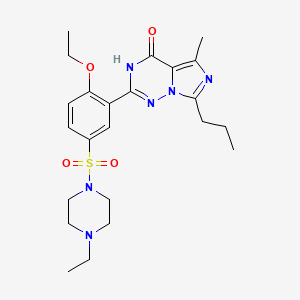
| Formula | C23H32N6O4S |
|---|---|
| Molecular weight | 488.61 g/mol |
| IUPAC name | 2-[2-ethoxy-5-(4-ethylpiperazin-1-yl)sulfonylphenyl]-5-methyl-7-propyl-3H-imidazo[5,1-f][1,2,4]triazin-4-one |
| CAS | 224785-90-4 |
| PubChem CID | 135400189 |
| InChIKey | SECKRCOLJRRGGV-UHFFFAOYSA-N |
| logP | 2.07 (XLogP 2.5) |
| Polar surface area | 112.9 Ų |
| H-bond acceptors / donors | 8 / 1 |
| Drug-likeness (QED) | 0.52 |
| Lipinski violations | 0 |
SMILES
CCCc1nc(C)c2c(=O)nc(-c3cc(S(=O)(=O)N4CCN(CC)CC4)ccc3OCC)[nH]n12Biology & Pharmacokinetics
Pharmacokinetics
| BBB penetrant | No (logBB -1.4) |
|---|
Enzyme interactions
| Enzyme | Role | Detail |
|---|---|---|
| CYP1A2 | Substrate | — |
| CYP2B6 | Inhibitor | — |
| CYP2C19 | Substrate | — |
| CYP2C9 | Substrate | — |
| CYP3A4 | Inhibitor | — |
| CYP3A4 | Substrate | — |
Receptor binding (top 1)
| Target | Action | Affinity |
|---|---|---|
| phosphodiesterase 5A (PDE5A) | Inhibitor | pIC50 9.7 |
Transporters
BCRP (Inhibitor)BSEP (Inhibitor)MRP1 (Inhibitor)OATP1B1 (Inhibitor)OATP1B3 (Inhibitor)P-gp (Inhibitor)P-gp (Substrate)
Drug–drug interactions (100+, DDInter)
| Interacting drug | Severity | Management |
|---|---|---|
| Amyl Nitrite | major | |
| Anagrelide | major | |
| Arsenic trioxide | major | |
| Cabozantinib | major | |
| Ceritinib | major | |
| Chloroquine | major | |
| Cisapride | major | |
| Clarithromycin | major | |
| Cobicistat | major | |
| Crizotinib | major | |
| Dolasetron | major | |
| Erythromycin | major | |
| Fingolimod | major | |
| Halofantrine | major | |
| Hydroxychloroquine | major | |
| Ivosidenib | major | |
| Ketoconazole | major | |
| Lumefantrine | major | |
| Macimorelin | major | |
| Nilotinib | major | |
| Osimertinib | major | |
| Ozanimod | major | |
| Panobinostat | major | |
| Pasireotide | major | |
| Ribociclib | major | |
| Siponimod | major | |
| Toremifene | major | |
| Vandetanib | major | |
| Vemurafenib | major | |
| Abarelix | moderate | |
| Abiraterone | moderate | |
| Alimemazine | moderate | |
| Alpelisib | moderate | |
| Amifostine | moderate | |
| Apalutamide | moderate | |
| Aprepitant | moderate | |
| Astemizole | moderate | |
| Bicalutamide | moderate | |
| Bisacodyl | moderate | |
| Bosutinib | moderate |
Showing 40 of 100+.
Registered Products (5)
| Brand | Form / strength | Pack | Agent | Citizen (JOD) |
|---|---|---|---|---|
| Levitra F.C Tab | Film-Coated Tablet 5 mg | 4 tab | Khoury Drug Store | 10.310 |
| Sarilen | Tablet 10 mg | 4 tab | Ibn Rushd Drug Store | 11.150 |
| Sarilen | Tablet 20 mg | 4 tab | Ibn Rushd Drug Store | 16.310 |
| Levitra ODT | Tablet 10 mg | 4 tab | Khoury Drug Store | 17.170 |
| Levitra | Tablet 20 mg | 4 tab | Khoury Drug Store | 21.890 |