Vincristine
JFDA label: VINCRISTINE INJ 1 MG
- Experienced physician:
- Extravasation:
- Not for intrathecal use:
Mechanism of Action
Vincristine binds to tubulin and inhibits microtubule formation, therefore, arresting the cell at metaphase by disrupting the formation of the mitotic spindle; it is specific for the M and S phases. Vincristine may also interfere with nucleic acid and protein synthesis by blocking glutamic acid utilization.
Indications
Approved
- Acute lymphocytic leukemia
- Hodgkin lymphoma
- Neuroblastoma
- Non-Hodgkin lymphomas
- Rhabdomyosarcoma
- Wilms tumor
Off-label
- Central nervous system tumors (low grade gliomas, medulloblastoma)
- Chronic lymphocytic leukemia/small lymphocytic lymphoma (CLL/SLL)
- Ewing sarcoma
- Gestational trophoblastic tumors (high-risk)
- Multiple myeloma
- Ovarian germ cell tumors
- Primary CNS lymphoma
- Retinoblastoma (Children)
- Small cell lung cancer
- Thymoma, advanced
Class profile
| mechanismClass | Plant alkaloid (vinca alkaloid) |
|---|---|
| targetMolecule | Beta-tubulin (prevents polymerization) |
| targetPathway | Mitotic spindle assembly |
| generation | 1st generation vinca |
| primaryTumors | ALL,Lymphoma,Neuroblastoma,Wilms tumor,Rhabdomyosarcoma |
| resistanceMechanisms | MDR1/P-gp efflux,Altered beta-tubulin (TUBB mutations),Beta-III tubulin overexpression |
| source | NCCN/OncoKB/Goodman&Gilman13ed |
Contraindications
Source: Lexicomp
- Patients with the demyelinating form of Charcot-Marie-Tooth syndrome Documentation of allergenic cross-reactivity for drugs in this class is limited. However, because of similarities in chemical structure and/or pharmacologic actions, the possibility of cross-sensitivity cannot be ruled out with certainty Absolute
Adverse Reactions
Cardiac disorders (6)
Not Known Edema · hypertension · hypotension · ischemic heart disease · myocardial infarction · phlebitis
Nervous system disorders (17)
Not Known Abnormal gait · ataxia · coma · cranial nerve dysfunction (auditory impairment, extraocular muscle impairment, laryngeal muscle impairment, motor dysfunction, paralysis, paresis, vestibular damage, vocal cord paralysis) · decreased deep tendon reflex · dizziness · headache · neuralgia (common) · neurotoxicity (dose-related) · paralysis · paresthesia · parotid pain · peripheral neuropathy (common) · seizure · sensorimotor neuropathy · sensory disturbance · vertigo
Hepatobiliary disorders (1)
Not Known Hepatic sinusoidal obstruction syndrome (formerly known as hepatic veno-occlusive disease)
Renal and urinary disorders (4)
Not Known Bladder dysfunction (atony) · dysuria · Polyuria · urinary retention
Blood and lymphatic system disorders (5)
Not Known Anemia (mild) · hemolytic uremic syndrome · leukopenia (mild) · thrombocytopenia (mild) · thrombotic thrombocytopenic purpura
Metabolism and nutrition disorders (3)
Not Known Hyperuricemia · uric acid nephropathy (acute) · weight loss
Gastrointestinal disorders (12)
Not Known Abdominal cramps · abdominal pain · anorexia · constipation (common) · diarrhea · intestinal necrosis · intestinal perforation · nausea · oral mucosa ulcer · paralytic ileus · sore throat · vomiting
Skin and subcutaneous tissue disorders (2)
Not Known Alopecia (common) · skin rash
Musculoskeletal and connective tissue disorders (7)
Not Known Amyotrophy · back pain · foot-drop · jaw pain · limb pain · myalgia · ostealgia
Eye disorders (3)
Not Known Cortical blindness (transient) · nystagmus · optic atrophy with blindness
Ear and labyrinth disorders (1)
Not Known Deafness
General disorders and administration site conditions (3)
Not Known Fever · Local irritation (if infiltrated) · tissue necrosis (if infiltrated)
Respiratory, thoracic and mediastinal disorders (2)
Not Known Bronchospasm · dyspnea
Dosing
Source: Lexicomp
Warnings & Precautions
Source: Lexicomp
Extravasation
Vincristine is a vesicant; ensure proper needle or catheter placement prior to and during infusion. Avoid extravasation. Individuals administering should be experienced in vincristine administration. Extravasation may cause significant irritation. If extravasation occurs, discontinue immediately and initiate appropriate extravasation management, including local injection of hyaluronidase and moderate heat application to the affected area. Use a separate vein to complete administration.
Gastrointestinal effects
Constipation, paralytic ileus, intestinal necrosis and/or perforation may occur; constipation may present as upper colon impaction with an empty rectum (may require flat film of abdomen for diagnosis); generally responds to high enemas and laxatives. All patients should be on a prophylactic bowel management regimen.
Neurotoxicity
Alterations in mental status such as depression, confusion, or insomnia may occur; neurologic effects are dose-limiting (may require dosage reduction) and may be additive with those of other neurotoxic agents and spinal cord irradiation. Use with caution in patients with pre-existing neuromuscular disease and/or with concomitant neurotoxic agents.
Respiratory effects
Acute shortness of breath and severe bronchospasm have been reported with vinca alkaloids, usually when used in combination with mitomycin. Onset may be several minutes to hours after vincristine administration and up to 2 weeks after mitomycin. Progressive dyspnea may occur. Permanently discontinue vincristine if pulmonary dysfunction occurs.
Uric acid nephropathy
Acute uric acid nephropathy has been reported with vincristine. Disease-related concerns:
Hepatic impairment
Use with caution in patients with hepatic impairment; dosage modification required. May be associated with hepatic sinusoidal obstruction syndrome (SOS; formerly called veno-occlusive disease [VOD]), increased risk in children 1.4 mg/dL, unexplained weight gain, ascites, hepatomegaly, or unexplained right upper quadrant pain (Arndt 2004). Concurrent drug therapy issues:
Drug-drug interactions
Potentially significant interactions may exist, requiring dose or frequency adjustment, additional monitoring, and/or selection of alternative therapy. Consult drug interactions database for more detailed information. Special handling:
Hazardous agent
Avoid eye contamination. Other warnings/precautions:
Not for intrathecal administration
For IV administration only; inadvertent intrathecal administration usually results in death. To prevent administration errors, the Institute for Safe Medication Practices (ISMP) Targeted Medication Safety Best Practices for Hospitals initiative and the World Health Organization strongly recommend dispensing vincristine diluted in a minibag (ISMP 2014, WHO 2007), if not dispensed in a minibag, affix an auxiliary label stating “For intravenous use only - fatal if given by other routes” and also place in an overwrap labeled “Do not remove covering until moment of injection.” Vincristine should NOT be prepared during the preparation of any intrathecal medications. After preparation, keep vincristine in a location away from the separate storage location recommended for intrathecal medications. Vincristine should NOT be delivered to the patient at the same time with any medications intended for central nervous system administration.
Pregnancy & Lactation
Pregnancy
Animal reproduction studies have demonstrated teratogenicity and fetal loss. May cause fetal harm if administered during pregnancy. Women of childbearing potential should avoid becoming pregnant during treatment.
Lactation
It is not known if vincristine is present in breast milk. Due to the potential for serious adverse reactions in the breastfed infant, the decision to discontinue vincristine or to discontinue breastfeeding should take into account the benefits of treatment to the mother.
Monitoring
| Efficacy | Tumour response (RECIST criteria, tumour markers, imaging); progression-free survival; performance status (ECOG/Karnofsky) |
|---|---|
| Toxicity | CBC with differential (nadir timing depends on agent); LFTs; renal function; ECG (QT for relevant agents); echocardiogram for cardiotoxic agents (anthracyclines, trastuzumab); cumulative dose tracking for dose-limited toxicities |
| Clinical pearl | Treatment response is assessed after 2–3 cycles. Grade 3–4 toxicities typically require dose reduction or interruption per protocol-defined criteria. |
| Counseling | Attend all scheduled blood tests and imaging appointments. Report fever > 38°C (risk of neutropaenic sepsis — medical emergency), unusual bleeding, or new pain immediately. |
Chemistry & Properties
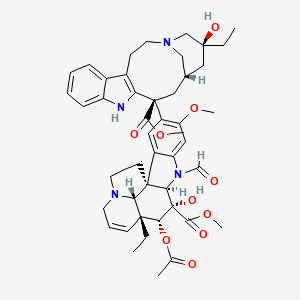
| Formula | C46H56N4O10 |
|---|---|
| Molecular weight | 824.97 g/mol |
| IUPAC name | methyl (1R,9R,10S,11R,12R,19R)-11-acetyloxy-12-ethyl-4-[(13S,15S,17S)-17-ethyl-17-hydroxy-13-methoxycarbonyl-1,11-diazatetracyclo[13.3.1.04,12.05,10]nonadeca-4(12),5,7,9-tetraen-13-yl]-8-formyl-10-hydroxy-5-methoxy-8,16-diazapentacyclo[10.6.1.01,9.02,7.016,19]nonadeca-2,4,6,13-tetraene-10-carboxylate |
| CAS | 57-22-7 |
| PubChem CID | 5978 |
| InChIKey | OGWKCGZFUXNPDA-XQKSVPLYSA-N |
| logP | 3.52 (XLogP 2.8) |
| Polar surface area | 171.17 Ų |
| H-bond acceptors / donors | 12 / 3 |
| Drug-likeness (QED) | 0.13 |
| Lipinski violations | 2 |
SMILES
CC[C@]1(O)C[C@H]2CN(CCc3c([nH]c4ccccc34)[C@@](C(=O)OC)(c3cc4c(cc3OC)N(C=O)[C@H]3[C@@](O)(C(=O)OC)[C@H](OC(C)=O)[C@]5(CC)C=CCN6CC[C@]43[C@@H]65)C2)C1Biology & Pharmacokinetics
Pharmacokinetics
| BBB penetrant | No (logBB -1.03) |
|---|
Enzyme interactions
| Enzyme | Role | Detail |
|---|---|---|
| CYP1A2 | Substrate | — |
| CYP2B6 | Inhibitor | — |
| CYP2C19 | Substrate | — |
| CYP2C8 | Inhibitor | — |
| CYP3A4 | Inhibitor | — |
| CYP3A4 | Substrate | — |
Transporters
BCRP (Inhibitor)BCRP (Inhibitor)BSEP (Inhibitor)BSEP (Inhibitor)MATE1 (Inhibitor)MDR1 (Inhibitor)MRP (Inhibitor)MRP1 (Inhibitor)MRP1 (Inhibitor)MRP2 (Inhibitor)MRP3 (Inhibitor)MRP4 (Inhibitor)MRP7 (Inhibitor)OATP1B1 (Inhibitor)OATP1B1 (Inhibitor)OATP1B3 (Inhibitor)OATP1B3 (Inhibitor)OATP2B1 (Inhibitor)OCT3 (Inhibitor)OCTN2 (Inhibitor)P-gp (Inhibitor)BCRP (Substrate)MDR1 (Substrate)MRP (Substrate)MRP1 (Substrate)MRP2 (Substrate)P-gp (Substrate)
Drug–drug interactions (100+, DDInter)
| Interacting drug | Severity | Management |
|---|---|---|
| Adalimumab | major | |
| Amprenavir | major | |
| Atazanavir | major | |
| Bacillus calmette-guerin substrain tice live antigen | major | |
| Baricitinib | major | |
| Boceprevir | major | |
| Ceritinib | major | |
| Certolizumab pegol | major | |
| Cladribine | major | |
| Clarithromycin | major | |
| Clozapine | major | |
| Cobicistat | major | |
| Conivaptan | major | |
| Deferiprone | major | |
| Delavirdine | major | |
| Erythromycin | major | |
| Etanercept | major | |
| Fingolimod | major | |
| Fosamprenavir | major | |
| Golimumab | major | |
| Idelalisib | major | |
| Indinavir | major | |
| Infliximab | major | |
| Itraconazole | major | |
| Ketoconazole | major | |
| Leflunomide | major | |
| Lomitapide | major | |
| Lonafarnib | major | |
| Measles virus vaccine live attenuated | major | |
| Mipomersen | major | |
| Mumps virus strain B level jeryl lynn live antigen | major | |
| Natalizumab | major | |
| Nefazodone | major | |
| Nelfinavir | major | |
| Ozanimod | major | |
| Pexidartinib | major | |
| Posaconazole | major | |
| Ritonavir | major | |
| Rotavirus vaccine | major | |
| Rubella virus vaccine | major |
Showing 40 of 100+.
Registered Products (6)
| Brand | Form / strength | Pack | Agent | Citizen (JOD) |
|---|---|---|---|---|
| Cytocine-C | Vial 1 mg/ml | 1 vial | Greenland Drug Store | — |
| Pharmacristine | Injection 1 mg/ml | 1 ml | Khuson Drug Store | — |
| VINCRISTINE INJ | Injection 1 mg/1 ml | 5 vial pack varies | Khoury Drug Store | — |
| VINCRISTINE INJ | Injection 1 mg/1 ml | 2 ml pack varies | Khoury Drug Store | — |
| Vincristine Sulphate | Vial 1 mg/1 ml | 5 vial | Petra Drug Store | — |
| Vincristine Sulphate | Vial 2 mg/2 ml | 5 vial | Petra Drug Store | — |