Vinorelbine
JFDA label: Vinelbine USP
- Experienced physician:
- Not for intrathecal use:
- Bone marrow suppression:
- Extravasation:
Mechanism of Action
Vinorelbine is a semisynthetic vinca alkaloid which binds to tubulin and inhibits microtubule formation, therefore, arresting the cell at metaphase by disrupting the formation of the mitotic spindle; it is specific for the M and S phases. Vinorelbine may also interfere with nucleic acid and protein synthesis by blocking glutamic acid utilization.
Indications
Approved
- Non-small cell lung cancer
Off-label
- Breast cancer, metastatic
- Cervical cancer, persistent or recurrent
- Hodgkin lymphoma, relapsed or refractory (GVD regimen)
- Hodgkin lymphoma, relapsed or refractory (IGEV regimen)
- Malignant pleural mesothelioma
- Ovarian cancer, relapsed
- Salivary gland cancer, recurrent
- Small cell lung cancer, refractory
- Soft tissue sarcoma, advanced
Class profile
| mechanismClass | Plant alkaloid (semi-synthetic vinca alkaloid) |
|---|---|
| targetMolecule | Beta-tubulin |
| targetPathway | Mitotic spindle assembly |
| generation | 3rd generation vinca |
| primaryTumors | NSCLC,Breast |
| resistanceMechanisms | MDR1/P-gp efflux,Tubulin mutations |
| source | NCCN/OncoKB/Goodman&Gilman13ed |
Contraindications
Source: Lexicomp
- Pretreatment granulocyte counts 3 Absolute
Adverse Reactions
Cardiac disorders (2)
Common chest pain · Localized phlebitis
Nervous system disorders (3)
Very Common Fatigue · peripheral neuropathy
Common Decreased deep tendon reflex
Hepatobiliary disorders (2)
Very Common Increased serum AST · increased serum bilirubin
Renal and urinary disorders (1)
Very Common Increased serum creatinine
Blood and lymphatic system disorders (6)
Very Common anemia · granulocytopenia · Leukopenia · neutropenia
Common Febrile neutropenia · thrombocytopenia
Gastrointestinal disorders (4)
Very Common constipation · diarrhea · Nausea · vomiting
Musculoskeletal and connective tissue disorders (2)
Very Common Weakness
Common Arthralgia
Infections and infestations (1)
Common Sepsis
General disorders and administration site conditions (2)
Very Common Injection site reaction · pain at injection site
Respiratory, thoracic and mediastinal disorders (1)
Common Dyspnea
Dosing
Source: Lexicomp
Warnings & Precautions
Source: Lexicomp
Bone marrow suppression
Severe granulocytopenia may occur with treatment (may lead to infection); granulocyte counts should be ≥1000 cells/mm3 prior to treatment initiation; dosage adjustment may be required based on blood counts (monitor blood counts prior to each dose). Granulocytopenia is a dose-limiting toxicity; nadir is generally 7 to 10 days after administration and recovery occurs within the following 7 to 14 days. Monitor closely for infections and/or fever in patients with severe granulocytopenia. Use with extreme caution in patients with compromised marrow reserve due to prior chemotherapy or radiation therapy.
Extravasation
Vesicant; ensure proper catheter or needle position prior to (and during) infusion. Avoid extravasation. Extravasation may cause local tissue necrosis and/or thrombophlebitis.
Gastrointestinal toxicity
May cause severe constipation (grade 3-4), paralytic ileus, intestinal obstruction, necrosis, and/or perforation; some events were fatal. Oral vinorelbine (not available in the US) is associated with a moderate antiemetic potential; antiemetics are recommended to prevent nausea/vomiting (Dupuis 2011; Hesketh 2017; Roila 2016); IV vinorelbine has a minimal emetic potential (Dupuis 2011; Hesketh 2017; Roila 2016).
Neuropathy
May cause new-onset or worsening of pre-existing neuropathy; use with caution in patients with neuropathy. Monitor for new or worsening sign/symptoms of neuropathy. Dosage adjustment required.
Pulmonary toxicity
Fatal cases of interstitial pulmonary changes and ARDS have been reported with single-agent therapy (mean onset of symptoms: 1 week). Promptly evaluate changes in baseline pulmonary symptoms or any new-onset pulmonary symptoms (eg, dyspnea, cough, hypoxia). Acute shortness of breath and severe bronchospasm have been reported with vinca alkaloids, usually when used in combination with mitomycin. Disease-related concerns:
Hepatic impairment
Vinorelbine elimination is predominantly hepatic. While there is no evidence that toxicity is enhanced in patients with elevated transaminases, use with caution in patients with severe hepatic injury or impairment; dosage modification required for elevated total bilirubin.
Radiation therapy
May have radiosensitizing effects with prior or concurrent radiation therapy; radiation recall reactions may occur in patients who have received prior radiation therapy. Concurrent drug therapy issues:
Drug-drug interactions
Potentially significant interactions may exist, requiring dose or frequency adjustment, additional monitoring, and/or selection of alternative therapy. Consult drug interactions database for more detailed information. Special handling:
Hazardous agent
Avoid eye contamination (exposure may cause severe irritation). Other warnings/precautions:
Experienced physician
Should be administered under the supervision of an experienced cancer chemotherapy physician.
NOT for intrathecal use
For IV use only; intrathecal administration of other vinca alkaloids has resulted in death. If dispensed in a syringe, should be labeled “for intravenous use only - fatal if given intrathecally". Vinorelbine should NOT be prepared during the preparation of any intrathecal medications. After preparation, keep vinorelbine in a location away from the separate storage location recommended for intrathecal medications.
Pregnancy & Lactation
Pregnancy
Animal reproduction studies have demonstrated embryotoxicity, fetotoxicity, decreased fetal weight, and delayed ossification. May cause fetal harm if administered during pregnancy. Women of childbearing potential should avoid becoming pregnant during vinorelbine treatment.
Lactation
It is not known if vinorelbine is present in breast milk. Due to the potential for serious adverse reactions in the breastfed infant, breastfeeding should be discontinued during treatment.
Monitoring
| Efficacy | Tumour response (RECIST criteria, tumour markers, imaging); progression-free survival; performance status (ECOG/Karnofsky) |
|---|---|
| Toxicity | CBC with differential (nadir timing depends on agent); LFTs; renal function; ECG (QT for relevant agents); echocardiogram for cardiotoxic agents (anthracyclines, trastuzumab); cumulative dose tracking for dose-limited toxicities |
| Clinical pearl | Treatment response is assessed after 2–3 cycles. Grade 3–4 toxicities typically require dose reduction or interruption per protocol-defined criteria. |
| Counseling | Attend all scheduled blood tests and imaging appointments. Report fever > 38°C (risk of neutropaenic sepsis — medical emergency), unusual bleeding, or new pain immediately. |
Chemistry & Properties
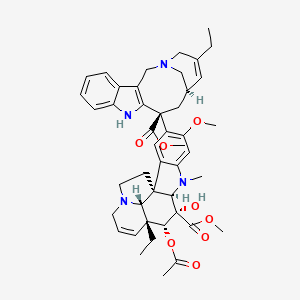
| Formula | C45H54N4O8 |
|---|---|
| Molecular weight | 778.95 g/mol |
| IUPAC name | methyl (1R,9R,10S,11R,12R,19R)-11-acetyloxy-12-ethyl-4-[(12S,14R)-16-ethyl-12-methoxycarbonyl-1,10-diazatetracyclo[12.3.1.03,11.04,9]octadeca-3(11),4,6,8,15-pentaen-12-yl]-10-hydroxy-5-methoxy-8-methyl-8,16-diazapentacyclo[10.6.1.01,9.02,7.016,19]nonadeca-2,4,6,13-tetraene-10-carboxylate |
| CAS | 71486-22-1 |
| PubChem CID | 5311497 |
| InChIKey | GBABOYUKABKIAF-IELIFDKJSA-N |
| logP | 4.75 (XLogP 3.6) |
| Polar surface area | 133.87 Ų |
| H-bond acceptors / donors | 11 / 2 |
| Drug-likeness (QED) | 0.20 |
| Lipinski violations | 2 |
SMILES
CCC1=C[C@@H]2CN(C1)Cc1c([nH]c3ccccc13)[C@@](C(=O)OC)(c1cc3c(cc1OC)N(C)[C@H]1[C@@](O)(C(=O)OC)[C@H](OC(C)=O)[C@]4(CC)C=CCN5CC[C@]31[C@@H]54)C2Biology & Pharmacokinetics
Pharmacokinetics
| BBB penetrant | No |
|---|
Enzyme interactions
| Enzyme | Role | Detail |
|---|---|---|
| CYP1A2 | Substrate | — |
| CYP2B6 | Inhibitor | — |
| CYP2B6 | Substrate | — |
| CYP2C19 | Substrate | — |
| CYP2C8 | Inhibitor | — |
| CYP2C9 | Substrate | — |
| CYP2D6 | Substrate | — |
| CYP3A4 | Inhibitor | IC₅₀ 1.0 µM |
| CYP3A4 | Substrate | — |
Transporters
BCRP (Inhibitor)BSEP (Inhibitor)MDR1 (Inhibitor)MRP1 (Inhibitor)OATP1B1 (Inhibitor)OATP1B3 (Inhibitor)OCTN2 (Inhibitor)P-gp (Inhibitor)MDR1 (Substrate)P-gp (Substrate)
Drug–drug interactions (100+, DDInter)
| Interacting drug | Severity | Management |
|---|---|---|
| Adalimumab | major | |
| Amprenavir | major | |
| Atazanavir | major | |
| Bacillus calmette-guerin substrain tice live antigen | major | |
| Baricitinib | major | |
| Boceprevir | major | |
| Ceritinib | major | |
| Certolizumab pegol | major | |
| Cladribine | major | |
| Clarithromycin | major | |
| Clozapine | major | |
| Cobicistat | major | |
| Conivaptan | major | |
| Deferiprone | major | |
| Delavirdine | major | |
| Erythromycin | major | |
| Etanercept | major | |
| Fingolimod | major | |
| Fosamprenavir | major | |
| Golimumab | major | |
| Idelalisib | major | |
| Indinavir | major | |
| Infliximab | major | |
| Itraconazole | major | |
| Ketoconazole | major | |
| Leflunomide | major | |
| Lonafarnib | major | |
| Measles virus vaccine live attenuated | major | |
| Mumps virus strain B level jeryl lynn live antigen | major | |
| Natalizumab | major | |
| Nefazodone | major | |
| Nelfinavir | major | |
| Ozanimod | major | |
| Posaconazole | major | |
| Ritonavir | major | |
| Rotavirus vaccine | major | |
| Rubella virus vaccine | major | |
| Samarium (153Sm) lexidronam | major | |
| Saquinavir | major | |
| Siponimod | major |
Showing 40 of 100+.
Registered Products (5)
| Brand | Form / strength | Pack | Agent | Citizen (JOD) |
|---|---|---|---|---|
| Vinelbine USP | Vial 10 mg/ml | 1 vial pack varies | Sun Set Drug Store | — |
| Vinelbine USP | Vial 10 mg/ml | 1 vial pack varies | Sun Set Drug Store | — |
| Vinorelbin "Ebewe"50mg/5ml Concetrate for solution for injection or infusion | Infusion 50 mg/5 ml | 1 vial | Sabbagh Drug Store | — |
| Vinorelbine | Vial 10 mg/ml | 1 vial | Sabbagh Drug Store | — |
| Vinorelbine Actavis | Vial 50 mg/5 ml | 1 vial | Beta Drug Store | — |