Acitretin
JFDA label: Neotigason 25mg Cap
- Pregnancy:
- Important information for women of childbearing potential:
- Important information for males taking acitretin:
- Medication guide (for all patients):
- Hepatotoxicity:
Mechanism of Action
Agonist of Retinoid receptor — Retinoid receptor agonist
| Target | Action | Gene / class |
|---|---|---|
| Retinoid receptor efficacy | AGONIST |
Indications
Approved
- Canadian labeling
- Psoriasis
Off-label
- Disorders of keratinization
Contraindications
Source: Lexicomp
- Additional contraindications (not in U.S. labeling): Breastfeeding Absolute
- Hypersensitivity (eg, angioedema, urticaria) to acitretin, other retinoids, or any component of the formulation Absolute
- chronic abnormally elevated blood lipid levels Absolute
- concomitant use with Vitamin A or other retinoids Absolute
- concomitant use with methotrexate or tetracyclines Acitretin is contraindicated in females of childbearing potential unless all of the following conditions apply. 1) Patient has severe psoriasis unresponsive to other therapy or if clinical condition contraindicates other treatments. 2) Patient must have two negative urine or serum pregnancy tests prior to therapy. 3) Patient must have pregnancy test repeated monthly during therapy. After discontinuation of therapy, a pregnancy test mus Absolute
- patients who are pregnant or intend on becoming pregnant during therapy or within 3 years after treatment discontinuation Absolute
- severe hepatic or renal dysfunction Absolute
Adverse Reactions
Cardiac disorders (2)
Common Edema · flushing
Nervous system disorders (11)
Very Common Hyperesthesia · paresthesia · rigors
Common Bell's palsy · depression · drowsiness · fatigue · headache · hypertonia · insomnia · pain
Hepatobiliary disorders (4)
Very Common increased direct serum bilirubin · Increased liver enzymes · increased serum alkaline phosphatase
Common Increased serum bilirubin
Renal and urinary disorders (5)
Very Common Erythrocyturia · hematuria
Common Increased blood urea nitrogen · increased serum creatinine · Proteinuria
Blood and lymphatic system disorders (13)
Very Common change in WBC count · decreased hematocrit · decreased hemoglobin · increased haptoglobin · increased neutrophils · Leukocyturia · reticulocytosis
Common Change in RBC count · decreased neutrophils · increased hematocrit · increased hemoglobin · purpura · reticulocytopenia
Metabolism and nutrition disorders (28)
Very Common acetonuria · decreased HDL cholesterol · decreased serum glucose · decreased serum magnesium · hypercholesterolemia · hypermagnesemia · hyperphospheremia · Hypertriglyceridemia · increased gamma-glutamyl transferase · increased serum glucose · increased serum potassium · increased serum sodium · increased uric acid
Common Decreased haptoglobins · decreased serum albumin · decreased serum calcium · decreased serum iron · decreased serum potassium · decreased serum sodium · glycosuria · hot flash · hyperchloremia · hypochloremia · hypophosphatemia · increased serum albumin · increased serum calcium · increased serum iron · increased thirst
Gastrointestinal disorders (13)
Very Common Xerostomia
Common Abdominal pain · anorexia · aphthous stomatitis · diarrhea · dysgeusia · gingival hemorrhage · gingivitis · increased appetite · nausea · sialorrhea · stomatitis · tongue disease
Skin and subcutaneous tissue disorders (23)
Very Common acquired cutaneous adherence · alopecia · Cheilitis · erythematous rash · exfoliation of skin · nail disease · paronychia · pruritus · skin atrophy · xeroderma
Common Abnormal hair texture · abnormal skin odor · Bullous skin disease · cold and clammy skin · dermatitis · diaphoresis (increased) · madarosis · psoriasiform eruption · pyogenic granuloma · seborrhea · skin fissure · skin rash · sunburn
Musculoskeletal and connective tissue disorders (9)
Very Common arthralgia · Increased creatine phosphokinase · spinal hyperostosis
Common Arthritis · back pain · myalgia · ostealgia · osteoarthritis · peripheral joint hyperostosis
Eye disorders (10)
Very Common Xerophthalmia
Common Blepharitis · blurred vision · cataract · conjunctivitis · diplopia · epithelial keratopathy · eye pain · nocturnal amblyopia · photophobia
Ear and labyrinth disorders (2)
Common Otalgia · tinnitus
General disorders and administration site conditions (1)
Common Ulcer
Respiratory, thoracic and mediastinal disorders (3)
Very Common epistaxis · Rhinitis
Common Sinusitis
Dosing
Source: Lexicomp
Warnings & Precautions
Source: Lexicomp
Capillary leak syndrome
Capillary leak syndrome, a potential manifestation of retinoic acid syndrome (differentiation syndrome) has been reported with acitretin use. Capillary leak syndrome features may include localized or generalized edema with secondary weight gain, fever, and hypotension; rhabdomyolysis and myalgias have also been reported. Laboratory tests may show neutrophilia, hypoalbuminemia, and an elevated hematocrit. Discontinue use if capillary leak syndrome develops during therapy.
Depression
Depression, including aggressive behavior and thoughts of self-harm have been reported; use with caution in patients with a history of mental illness.
Exfoliative dermatitis
Exfoliative dermatitis has been reported with acitretin use; discontinue use if exfoliative dermatitis occurs during therapy.
Hepatotoxicity
[US Boxed Warnings]: Hepatitis has been reported (including fatalities); some patients received etretinate for ≤1 month before presenting with hepatic signs or symptoms. Changes in transaminases have occurred in up to 1/3 of patients, which generally returned to normal after discontinuation of treatment. Monitor for hepatotoxicity; discontinue if hepatotoxicity is suspected.
Lipid effects
Lipid changes, including increased triglycerides, increased cholesterol, and decreased HDL, are common (up to 66%), which were reversible upon discontinuation of treatment; increased triglycerides may lead to pancreatitis. Fatal fulminant pancreatitis has been reported. Use with caution in patients at risk of hypertriglyceridemia (eg, patients with lipid metabolism disturbances, diabetes mellitus, obesity, increased alcohol intake, or a familial history of these conditions). Consider discontinuation if hypertriglyceridemia and decreased HDL persist. Use is contraindicated in patients with chronic abnormally elevated blood lipid values.
Otic effects
Tinnitus and impaired hearing have been reported with use; consider therapy discontinuation and further evaluation if clinically indicated.
Photosensitivity
May be photosensitizing; minimize sun or other UV exposure to treated areas. The risk of burning is increased with phototherapy; decreased doses are required.
Pseudotumor cerebri
Retinoids, including acitretin, have been associated with pseudotumor cerebri (benign intracranial hypertension). Concurrent use of other drugs associated with this effect (eg, tetracyclines) may increase risk. Early signs and symptoms include papilledema, headache, nausea, vomiting, and visual disturbances. Discontinue use in patients experiencing papilledema.
Skeletal abnormalities
Patients receiving long-term treatment should be periodically examined for bony abnormalities; risk vs benefit of therapy should be considered if abnormalities occur.
Visual disturbances
May cause adverse effects to the eyes and vision, including a decrease in night vision or decreased tolerance to contact lenses. Use caution when operating vehicles at night; discontinue if visual changes occur. Disease-related concerns:
Diabetes
Impaired glucose control has been reported with retinoid use. Use with caution in patients with diabetes mellitus; new cases of diabetes have been diagnosed. Concurrent drug therapy issues:
Drug-drug interactions
Potentially significant interactions may exist, requiring dose or frequency adjustment, additional monitoring, and/or selection of alternative therapy. Consult drug interactions database for more detailed information.
Ethanol use
Female patients should abstain from ethanol or ethanol-containing products during therapy and for 2 months after discontinuation. Special populations:
Females
Females of childbearing potential must be able to fulfill all conditions for use prior to initiating therapy, including a Patient Agreement/Informed Consent (consult manufacturer's labeling for further detail). Prescriptions should be written for a monthly supply. The Do Your P.A.R.T. (Pregnancy Prevention Actively Required During and After Treatment) program explains teratogenic risks and requirements expected of females of childbearing potential to prevent pregnancies from occurring during use and 3 years following discontinuation; this should be used to educate patients and healthcare providers. Information for the Do Your P.A.R.T. program is available at www.soriatane.com/doyour-part-Program.html or by calling 1-888-784-3335.
Pediatric
Growth potential may be affected. Long-term use of high-dose oral retinoids within this population has been associated with decreased bone mineral density, skeletal hyperostosis, and ossification of interosseous tendons and ligaments of the extremities (Menter, 2009).
Pregnancy
Acitretin is a known teratogen and contraindicated in females who are or may become pregnant. Birth defects (including facial, ear, central nervous system, cardiovascular, limb, bone, and joint) have been noted following acitretin exposure during pregnancy. Use only in women with severe psoriasis that is unresponsive to other therapies or with contraindications to the use of alternative treatments. Pregnancy must be avoided for at least 3 years after treatment discontinuation. Two reliable forms of contraception must be used simultaneously for 1 month prior to initiating therapy, during therapy, and for 3 years after discontinuation. Two negative pregnancy tests (sensitivity at least 25 milliunits/mL) are required prior to initiating therapy; pregnancy tests must be repeated every month during treatment. In addition, because ethanol forms a teratogenic metabolite and would increase the duration of teratogenic potential, ethanol should not be consumed during treatment or for 2 months after discontinuation. Any pregnancy which occurs during treatment, or within 3 years after treatment is discontinued, should be reported to the manufacturer at 1-888-784-3335 or to the FDA at 1-800-FDA-1088. Other warnings/precautions:
Blood donation
All patients should be advised not to donate blood during therapy or for 3 years following completion of therapy.
Experienced physician
Only physicians experienced with the diagnosis and treatment of severe psoriasis, including the use of retinoid treatment, and physicians who understand the risk of teratogenicity should prescribe acitretin.
Medication guide
All patients must be provided with a medication guide each time acitretin is dispensed. Female patients must also sign an informed consent prior to therapy.
Subsequent use
Most patients experience relapse of psoriasis after discontinuing therapy. Subsequent courses, when clinically indicated, have produced results similar to the initial course of therapy.
Worsening of disease
Transient worsening of psoriasis may initially occur; patients should be advised that it may take 2-3 months to achieve the full benefits of treatment.
Pregnancy & Lactation
Pregnancy
[US Boxed Warning]: Acitretin is a known teratogen and use is contraindicated in females who are or may become pregnant. Birth defects (including facial, ear, central nervous system, cardiovascular, limb, bone, and joint) have been noted following acitretin exposure during pregnancy. Use only in women with severe psoriasis that is unresponsive to other therapies or with contraindications to the use of alternative treatments. Pregnancy must be avoided for at least 3 years after treatment discontinuation. Two reliable forms of contraception must be used simultaneously for 1 month prior to initiating therapy, during therapy, and for 3 years after discontinuation. Two negative pregnancy tests (sensitivity at least 25 milliunits/mL) are required prior to initiating therapy; pregnancy tests must be repeated every month during treatment. In addition, because ethanol forms a teratogenic metabolite and would increase the duration of teratogenic potential, ethanol should not be consumed during t
Lactation
Acitretin is excreted in breast milk. Due to the potential for serious adverse reactions in the breastfeeding infant, the manufacturer does not recommend acitretin prior to or during breastfeeding. Information is available from a woman who started acitretin 40 mg per day, 8 months postpartum. The woman discontinued breastfeeding prior to the study. Milk samples were collected prior to the first dose and twice daily for 9 days; maternal serum samples were also collected. Acitretin and its metab
Monitoring
| Clinical pearl | Lipid profile (baseline and at 1- to 2-week intervals for 4 to 8 weeks, then as clinically indicated); liver function tests (baseline, and at 1- to 2-week intervals until stable, then as clinically indicated); blood glucose in patients with diabetes; evaluate for bone abnormalities (with long-term use); pregnancy tests (2 negative tests prior to therapy initiation, monthly during treatment, and every 3 months for ≥3 years after discontinuation of therapy) The American Academy of Dermatology recommends: CBC and renal function tests (baseline and then every 12 weeks); liver function tests (every 2 weeks for the first 8 weeks, then every 6 to 12 weeks thereafter) (Menter, 2009) |
|---|
Chemistry & Properties
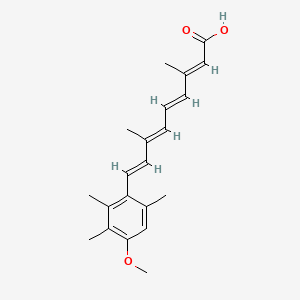
| Formula | C21H26O3 |
|---|---|
| Molecular weight | 326.44 g/mol |
| IUPAC name | (2E,4E,6E,8E)-9-(4-methoxy-2,3,6-trimethylphenyl)-3,7-dimethylnona-2,4,6,8-tetraenoic acid |
| CAS | 55079-83-9 |
| PubChem CID | 5284513 |
| InChIKey | IHUNBGSDBOWDMA-AQFIFDHZSA-N |
| logP | 5.17 (XLogP 6.1) |
| Polar surface area | 46.53 Ų |
| H-bond acceptors / donors | 2 / 1 |
| Drug-likeness (QED) | 0.58 |
| Lipinski violations | 1 |
SMILES
COc1cc(C)c(/C=C/C(C)=C/C=C/C(C)=C/C(=O)O)c(C)c1CBiology & Pharmacokinetics
Pharmacokinetics
| BBB penetrant | No |
|---|
Enzyme interactions
| Enzyme | Role | Detail |
|---|---|---|
| CYP1A2 | Inhibitor | — |
| CYP1A2 | Substrate | — |
| CYP2B6 | Inhibitor | — |
| CYP2C19 | Substrate | — |
| CYP2C8 | Inhibitor | — |
| CYP3A4 | Substrate | — |
Transporters
BCRP (Inhibitor)BSEP (Inhibitor)BSEP (Inhibitor)MDR1 (Inhibitor)MRP1 (Inhibitor)MRP2 (Inhibitor)MRP3 (Inhibitor)MRP4 (Inhibitor)OATP1B1 (Inhibitor)OATP1B3 (Inhibitor)P-gp (Inhibitor)P-gp (Substrate)
Drug–drug interactions (55, DDInter)
| Interacting drug | Severity | Management |
|---|---|---|
| Aminolevulinic acid | major | |
| Bexarotene | major | |
| Demeclocycline | major | |
| Doxycycline | major | |
| Eravacycline | major | |
| Ethanol | major | |
| Etonogestrel | major | |
| Isotretinoin | major | |
| Leflunomide | major | |
| Levonorgestrel | major | |
| Lomitapide | major | |
| Medroxyprogesterone acetate | major | |
| Methotrexate | major | |
| Minocycline | major | |
| Mipomersen | major | |
| Norethisterone | major | |
| Norgestrel | major | |
| Omadacycline | major | |
| Oxytetracycline | major | |
| Pexidartinib | major | |
| Sarecycline | major | |
| Teriflunomide | major | |
| Tetracycline | major | |
| Tretinoin | major | |
| Vitamin A | major | |
| Acetohexamide | moderate | |
| Aminolevulinic acid (topical) | moderate | |
| Asparaginase Erwinia chrysanthemi | moderate | |
| Asparaginase Escherichia coli | moderate | |
| Bedaquiline | moderate | |
| Brentuximab vedotin | moderate | |
| Calaspargase pegol | moderate | |
| Cannabidiol | moderate | |
| Chlorpropamide | moderate | |
| Clofarabine | moderate | |
| Efavirenz | moderate | |
| Epirubicin | moderate | |
| Glimepiride | moderate | |
| Glipizide | moderate | |
| Glyburide | moderate |
Showing 40 of 55.
Registered Products (4)
| Brand | Form / strength | Pack | Agent | Citizen (JOD) |
|---|---|---|---|---|
| Acotin | Capsule 10 mg | 30 cap | ٠ستÙدع أدÙÙØ© اÙÙÙÙÙÙÙ | — |
| Acotin | Capsule 25 mg | 30 cap | ٠ستÙدع أدÙÙØ© اÙÙÙÙÙÙÙ | — |
| Neotigason | Capsule 25 mg | 30 cap | Beta Drug Store | — |
| Neotigason | Capsule 10 mg | 30 cap | Beta Drug Store | — |