Amantadine
JFDA label: PK-Merz Tab
Mechanism of Action
Antiviral: The mechanism of amantadine’s antiviral activity has not been fully elucidated. It appears to primarily prevent the release of infectious viral nucleic acid into the host cell by interfering with the transmembrane domain of the viral M2 protein. Amantadine is also known to prevent viral assembly during replication. Amantadine inhibits the replication of influenza A virus isolates from each of the subtypes (ie, H1N1, H2N2 and H3N2), but has very little or no activity against influenza B virus isolates. Parkinson disease: The exact mechanism of amantadine in the treatment of Parkinson disease and drug-induced extrapyramidal symptoms is not known. Data from early animal studies suggest that amantadine may have direct and indirect effects on dopamine neurons; however, recent s
Indications
Approved
- Drug-induced extrapyramidal symptoms (immediate release only)
- Extended release
- Immediate release
- Influenza A prophylaxis (immediate release only)
- Influenza A treatment (immediate release only)
- Parkinson disease
Off-label
- Chorea of Huntington disease
- Multiple sclerosis–related fatigue
- Restless legs syndrome
- Traumatic brain injury
Contraindications
Source: Lexicomp
- Hypersensitivity to amantadine or any component of the formulation Absolute
- end-stage renal disease (CrCl 2) (extended release only) Absolute
Adverse Reactions
Cardiac disorders (5)
Very Common Orthostatic hypotension · peripheral edema · presyncope · syncope
Common Livedo reticularis
Nervous system disorders (22)
Very Common delusions · Dizziness · falling · hallucination · illusion · paranoia
Common abnormal dreams · agitation · anxiety · apathy · ataxia · confusion · depression · drowsiness · dyschromia · dystonia · fatigue · headache · Insomnia · irritability · nervousness · suicidal ideation
Renal and urinary disorders (2)
Common benign prostatic hypertrophy · Urinary tract infection
Blood and lymphatic system disorders (1)
Common Bruise
Gastrointestinal disorders (7)
Very Common constipation · Xerostomia
Common anorexia · decreased appetite · diarrhea · Nausea · vomiting
Musculoskeletal and connective tissue disorders (2)
Common Joint swelling · muscle spasm
Eye disorders (3)
Common Blurred vision · cataract · xerophthalmia
Respiratory, thoracic and mediastinal disorders (2)
Common cough · Dry nose
Dosing
Source: Lexicomp
Warnings & Precautions
Source: Lexicomp
CNS depression
May cause CNS depression, which may impair physical or mental abilities; patients must be cautioned about performing tasks that require mental alertness (eg, operating machinery or driving). Patients taking amantadine for Parkinson disease have reported falling asleep while engaged in activities of daily living, sometimes without warning. Patients with a concomitant sleep disorder may be at a greater risk. There is insufficient information that dose reduction will eliminate episodes of falling asleep or daytime somnolence.
Impulse control disorders
Dopamine agonists used for Parkinson disease or restless legs syndrome have been associated with compulsive behaviors and/or loss of impulse control, which has manifested as pathological gambling, libido increases (hypersexuality), urges to spend money, and/or binge eating. Causality has not been established, and controversy exists as to whether this phenomenon is related to the underlying disease, prior behaviors/addictions, and/or drug therapy. Dose reduction or discontinuation of therapy has been reported to reverse these behaviors in some, but not all cases.
Melanoma
Risk for melanoma development is increased in Parkinson disease patients; drug causation or factors contributing to risk have not been established. Patients should be monitored closely and periodic skin examinations should be performed.
Neuroleptic malignant syndrome
Has been associated with neuroleptic malignant syndrome (associated with dose reduction or abrupt discontinuation).
Psychosis
Visual and auditory hallucinations, delusions, illusions, and paranoia were reported in clinical trials; monitor for the occurrence of these symptoms especially at initiation and after dose increases. Use with caution in patients with uncontrolled psychosis or severe psychoneurosis.
Suicidal ideation/depression
There have been reports of suicidal ideation/attempt and depression in patients with and without a history of psychiatric illness. May exacerbate mental problems in patients with a history of mental illness. Disease-related concerns:
Cardiovascular disease
Use with caution in patients with heart failure, peripheral edema, or orthostatic hypotension; dizziness, syncope, orthostatic hypotension, presyncope, postural dizziness, and hypotension have been reported in clinical trials. Dosage reduction may be required.
Eczema
Use with caution in patients with a history of recurrent and eczematoid dermatitis.
Glaucoma
Avoid in untreated angle closure glaucoma.
Hepatic impairment
Use with caution in patients with hepatic impairment; rarely, reversible elevations in transaminases have been reported.
Influenza A
Appropriate use: Consult current guidelines. Due to increased resistance, the ACIP has recommended that rimantadine and amantadine no longer be used for the treatment or prophylaxis of influenza A in the United States until susceptibility has been re-established (CDC 2011).
Renal impairment
Use with caution in patients with renal impairment; dosage reduction recommended. Use of the extended-release capsule is contraindicated in end-stage renal disease (CrCl 2).
Seizure disorder
Use with caution in patients with a history of seizure disorder. Concurrent drug therapy issues:
Drug-drug interactions
Potentially significant interactions may exist, requiring dose or frequency adjustment, additional monitoring, and/or selection of alternative therapy. Consult drug interactions database for more detailed information. Special populations:
Elderly
Use with caution in the elderly; may be more susceptible to CNS effects (using 2 divided daily doses of immediate-release products may minimize this effect). These patients may require dosage reductions. Dosage form specific issues:
Propylene glycol
Some dosage forms may contain propylene glycol; large amounts are potentially toxic and have been associated hyperosmolality, lactic acidosis, seizures and respiratory depression; use caution (AAP 1997; Zar 2007). Other warnings/precautions:
Tolerance
Tolerance has also been reported with long-term use (Zubenko1984).
Withdrawal syndrome
May cause agitation, anxiety, delirium, delusions, depression, hallucinations, paranoia, parkinsonian crisis, slurred speech, or stupor. Upon discontinuation of amantadine therapy, gradually taper dose.
Pregnancy & Lactation
Pregnancy
Adverse events have been observed in animal reproduction studies and teratogenic events have been observed in humans (case reports) (Seier 2017). When treatment for Parkinson disease is needed, agents other than amantadine are recommended in pregnant women (Seier 2017). Untreated influenza infection is associated with an increased risk of adverse events to the fetus and an increased risk of complications or death to the mother. Other agents are currently recommended for the treatment or prophylaxis influenza in pregnant women and women up to 2 weeks postpartum. Appropriate antiviral agents are currently recommended as an adjunct to vaccination and should not be used as a substitute for vaccination in pregnant women (CDC 2011; CDC 2014).
Lactation
Amantadine is present in breast milk. Amantadine may alter breast milk production or excretion. According to the manufacturer, the decision to breastfeed during therapy should consider the risk of infant exposure, the benefits of breastfeeding to the infant, and benefits of treatment to the mother.
Monitoring
| Clinical pearl | Renal function (baseline and as clinically indicated), mental status including psychosis, depression and suicidality, blood pressure (as clinically indicated) |
|---|
Chemistry & Properties
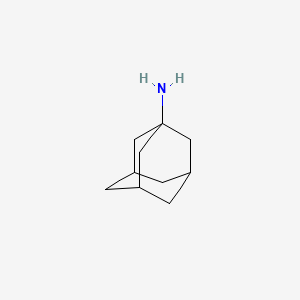
| Formula | C10H17N |
|---|---|
| Molecular weight | 151.25 g/mol |
| IUPAC name | adamantan-1-amine |
| CAS | 768-94-5 |
| PubChem CID | 2130 |
| InChIKey | DKNWSYNQZKUICI-UHFFFAOYSA-N |
| logP | 1.91 (XLogP 2.4) |
| Polar surface area | 26.02 Ų |
| H-bond acceptors / donors | 1 / 1 |
| Drug-likeness (QED) | 0.56 |
| Lipinski violations | 0 |
SMILES
NC12CC3CC(CC(C3)C1)C2Biology & Pharmacokinetics
Pharmacokinetics
| BBB penetrant | Yes |
|---|
Enzyme interactions
| Enzyme | Role | Detail |
|---|---|---|
| CYP2C19 | Substrate | — |
Transporters
BCRP (Inhibitor)BCRP (Inhibitor)BSEP (Inhibitor)MATE1 (Inhibitor)MATE2 (Inhibitor)MDR1 (Inhibitor)MRP1 (Inhibitor)MRP2 (Inhibitor)OATP1B1 (Inhibitor)OATP1B1 (Inhibitor)OATP1B3 (Inhibitor)OATP1B3 (Inhibitor)OATP2B1 (Inhibitor)OCT1 (Inhibitor)OCT2 (Inhibitor)P-gp (Inhibitor)Proton-coupled organic cation antiporter (Inhibitor)MDR1 (Substrate)MRP2 (Substrate)OATP1A2 (Substrate)OCT(unspecified) (Substrate)OCT2 (Substrate)P-gp (Substrate)
Drug–drug interactions (46, DDInter)
| Interacting drug | Severity | Management |
|---|---|---|
| Bupropion | major | |
| Iohexol | major | |
| Iopamidol | major | |
| Acrivastine | moderate | |
| Alimemazine | moderate | |
| Atropine | moderate | |
| Azatadine | moderate | |
| Brimonidine (ophthalmic) | moderate | |
| Brimonidine (topical) | moderate | |
| Brompheniramine | moderate | |
| Carbinoxamine | moderate | |
| Chlorcyclizine | moderate | |
| Chlorpheniramine | moderate | |
| Clemastine | moderate | |
| Clidinium | moderate | |
| Cyclizine | moderate | |
| Cyproheptadine | moderate | |
| Dexbrompheniramine | moderate | |
| Dicyclomine | moderate | |
| Diphenhydramine | moderate | |
| Doxepin | moderate | |
| Doxepin (topical) | moderate | |
| Doxylamine | moderate | |
| Glycopyrronium | moderate | |
| Hyoscyamine | moderate | |
| Ifosfamide | moderate | |
| Ioflupane I-123 | moderate | |
| Lindane | moderate | |
| Meclizine | moderate | |
| Mepenzolate | moderate | |
| Mepyramine | moderate | |
| Methdilazine | moderate | |
| Methscopolamine | moderate | |
| Metoclopramide | moderate | |
| Phenindamine | moderate | |
| Picosulfuric acid | moderate | |
| Polyethylene glycol (3350 with electrolytes) | moderate | |
| Promethazine | moderate | |
| Propantheline | moderate | |
| Quinine | moderate |
Showing 40 of 46.
Registered Products (2)
| Brand | Form / strength | Pack | Agent | Citizen (JOD) |
|---|---|---|---|---|
| PK-Merz Tab | Tablet 100 mg | 100 tab | Jarash Drug Store | 10.040 |
| PK-Merz Infusion | Infusion 0.4 mg/1 ml | 500 ml | Jarash Drug Store | — |