Aminolevulinic Acid
Active form: Protoporphyrin.
JFDA label: Gliolan powder for oral solution
Mechanism of Action
12.1 Mechanism of Action ALA occurs endogenously as a metabolite that is formed in the mitochondria from succinyl-CoA and glycine. Exogenous administration of ALA leads to accumulation of the ALA metabolite PpIX in tumor cells. The reason for the accumulation of PpIX in neoplastic brain tissue is not known. During glioma surgery, Gleolan is used with an operating microscope adapted with a blue emitting light source (power density 40-80 mW/cm 2 ) and filters for excitation light of wavelength 375 to 440 nm, and observation at wavelengths of 620 to 710 nm. This allows tumor tissue to be visualized as red fluorescence. Tissue lacking sufficient PpIX concentrations appears blue.
Indications
Approved
- Neoplasms — neoplasm
Off-label
- Basal Cell Nevus Syndrome
- Brain Neoplasms
- Carcinoma, Basal Cell
- Desmoid Tumors
- Glioblastoma
- Infections
- Keratosis, Actinic
- Neurofibromatosis 1
- Paraganglioma
Contraindications
Source: openFDA
- Hypersensitivity to the aminolevulinic acid (ALA) or porphyrins. [see Warnings and Precautions (5.3) ] Acute or chronic types of porphyria, due to potential ineffectiveness of the drug in these patients. Hypersensitivity to aminolevulinic acid (ALA) or porphyrins. ( 4 , 5.3 , 6.2 ) Acute or chronic types of porphyria. ( 4 ) Absolute
Adverse Reactions
Vascular disorders (1)
Common Haemorrhage
Hepatobiliary disorders (3)
Very Common Alanine aminotransferase increased · Aspartate aminotransferase increased · Blood bilirubin increased
Blood and lymphatic system disorders (1)
Common Haemoglobin
Skin and subcutaneous tissue disorders (5)
Very Common Pruritus · Skin disorder · Skin hyperpigmentation
Common Rash pustular · Urticaria
Investigations (2)
Very Common Amylase increased · Gamma-glutamyltransferase increased
General disorders and administration site conditions (7)
Very Common Scab
Common Dysaesthesia · Excoriation · Oedema · Pain · Tenderness · Ulcer
Dosing
Source: openFDA
Warnings & Precautions
Source: openFDA
Warnings & Precautions
Phototoxic reactions: Do not administer phototoxic drugs (St. John's wort, griseofulvin, thiazide diuretics, sulfonylureas, phenothiazines, sulphonamides, quinolones and tetracyclines), and topical preparations containing ALA for 24 hours during the perioperative period. Reduce exposure to sunlight or room lights for 48 hours after oral administration of Gleolan. ( 5.1 , 7 ) Risk of misinterpretation: Non-fluorescing tissue in the surgical field does not rule out the presence of tumor. ( 5.2 , 14 )
Risk of Phototoxic Reaction Due to the risk of phototoxic reactions, d
Risk of Phototoxic Reaction Due to the risk of phototoxic reactions, do not administer phototoxic drugs (St. John's wort, griseofulvin, thiazide diuretics, sulfonylureas, phenothiazines, sulphonamides, quinolones and tetracyclines), and topical preparations containing ALA for 24 hours during the perioperative period [see Drug Interactions (7) ] . Reduce exposure to sunlight or room lights for 48 hours after administration of Gleolan.
Risk of Misinterpretation Errors may occur with the use of Gleolan for
Risk of Misinterpretation Errors may occur with the use of Gleolan for intraoperative visualization of malignant glioma, including false negatives and false positives. Non-fluorescing tissue in the surgical field does not rule out the presence of tumor in patients with glioma [see Clinical Studies (14) ] . Fluorescence may be seen in areas of inflammation or metastases from other tumor types.
Hypersensitivity Reactions Hypersensitivity reactions, including serio
Hypersensitivity Reactions Hypersensitivity reactions, including serious hypersensitivity reactions have occurred; these reactions include anaphylactic shock, swelling, and urticaria [see Contraindications (4) , Adverse Reactions (6.2) ] . Always have cardiopulmonary resuscitation personnel and equipment readily available and monitor all patients for hypersensitivity reactions.
Pregnancy & Lactation
Pregnancy
Lactation
This treatment appeared to preserve nipple anatomy for breastfeeding.[ 1 - 3 ]
Chemistry & Properties
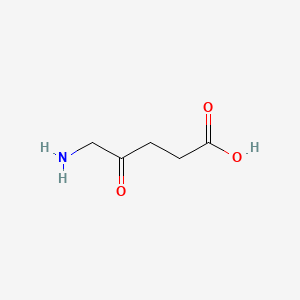
| Formula | C5H9NO3 |
|---|---|
| Molecular weight | 131.13 g/mol |
| IUPAC name | 5-amino-4-oxopentanoic acid |
| CAS | 106-60-5 |
| PubChem CID | 137 |
| InChIKey | ZGXJTSGNIOSYLO-UHFFFAOYSA-N |
| logP | -0.62 (XLogP -3.8) |
| Polar surface area | 80.39 Ų |
| H-bond acceptors / donors | 3 / 2 |
| Drug-likeness (QED) | 0.53 |
| Lipinski violations | 0 |
SMILES
NCC(=O)CCC(=O)OBiology & Pharmacokinetics
Pharmacokinetics predicted
| Bioavailability | 10.0% |
|---|---|
| Half-life | 1.758 h |
| Volume of distribution | 0.248 L/kg |
| Protein binding | 7.3% |
| BBB penetrant | No |
Transporters
BCRP (Inhibitor)BSEP (Inhibitor)MRP1 (Inhibitor)OATP1B1 (Inhibitor)OATP1B1 (Inhibitor)OATP1B3 (Inhibitor)P-gp (Inhibitor)PEPT1 (Inhibitor)BCRP (Substrate)MDR1 (Substrate)P-gp (Substrate)PEPT1 (Substrate)PEPT2 (Substrate)
Drug–drug interactions (94, DDInter)
| Interacting drug | Severity | Management |
|---|---|---|
| Acetazolamide | major | |
| Acitretin | major | |
| Adapalene (topical) | major | |
| Afatinib | major | |
| Alectinib | major | |
| Alitretinoin (topical) | major | |
| Amiodarone | major | |
| Avapritinib | major | |
| Bendroflumethiazide | major | |
| Bexarotene | major | |
| Bexarotene (topical) | major | |
| Bicalutamide | major | |
| Bumetanide | major | |
| Capmatinib | major | |
| Celecoxib | major | |
| Cetuximab | major | |
| Chlorothiazide | major | |
| Chlorpromazine | major | |
| Chlorpropamide | major | |
| Chlorthalidone | major | |
| Ciprofloxacin | major | |
| Cobimetinib | major | |
| Dabrafenib | major | |
| Dapsone | major | |
| Demeclocycline | major | |
| Doxycycline | major | |
| Eravacycline | major | |
| Erlotinib | major | |
| Etacrynic acid | major | |
| Fenoprofen | major | |
| Fluphenazine | major | |
| Flurbiprofen | major | |
| Furosemide | major | |
| Gatifloxacin | major | |
| Gefitinib | major | |
| Gemifloxacin | major | |
| Glimepiride | major | |
| Glipizide | major | |
| Glyburide | major | |
| Griseofulvin | major |
Showing 40 of 94.
Registered Products (1)
| Brand | Form / strength | Pack | Agent | Citizen (JOD) |
|---|---|---|---|---|
| Gliolan powder for oral solution | Solution 30 mg/1 ml | 30 mg | Al Hilal Drug Store | — |