Amiodarone
JFDA label: CORDARONE TAB
- Life-threatening arrhythmias (tablet):
- Potentially fatal toxicities (tablet):
- High-risk patients (tablet):
Mechanism of Action
Class III antiarrhythmic agent which inhibits adrenergic stimulation (alpha- and beta-blocking properties), affects sodium, potassium, and calcium channels, prolongs the action potential and refractory period in myocardial tissue; decreases AV conduction and sinus node function
Indications
Approved
- Ventricular arrhythmias
Off-label
- Atrial fibrillation in critically ill patients without preexcitation who require heart rate control
- Atrial fibrillation in patients with heart failure without preexcitation who require heart rate control
- Atrial fibrillation in patients with hypertrophic cardiomyopathy
- Cardiogenic shock
- Maintenance of sinus rhythm after cardioversion of atrial fibrillation
- Paroxysmal supraventricular tachycardia (SVT) (not initial drug of choice)
- Pharmacologic conversion of atrial fibrillation to and maintenance of normal sinus rhythm
- Prevention of postoperative atrial fibrillation and atrial flutter associated with cardiothoracic surgery
- Supraventricular tachycardia (infants/children/adolescents)
Contraindications
Source: Lexicomp
- Hypersensitivity to amiodarone, iodine, or any component of the formulation Absolute
- bradycardia causing syncope (except in patients with a functioning artificial pacemaker) Absolute
- cardiogenic shock Canadian labeling (oral formulation): Additional contraindications (not in US labeling): Evidence of hepatitis Absolute
- pulmonary interstitial abnormalities Absolute
- second- and third-degree heart block (except in patients with a functioning artificial pacemaker) Absolute
- severe sinus-node dysfunction causing marked sinus bradycardia Absolute
- thyroid dysfunction Absolute
Adverse Reactions
Cardiac disorders (12)
Very Common Asystole · atrioventricular block · Bradycardia · cardiac arrest · cardiac arrhythmia · cardiac failure · edema, ataxia, fatigue, involuntary body movements, malaise, dizziness, solar dermatitis, Stevens-Johnson syndrome, decreased libido, hyperthyroidism · exacerbation of cardiac arrhythmia · Hypotension, vomiting (10% to 33%; intravenous: Respiratory: Pulmonary toxicity (oral: 2% to 17%; intravenous: 1% to 10%: · sinus bradycardia
Common Bradycardia / heart block
Uncommon QT prolongation / torsades de pointes (low risk paradoxically)
Nervous system disorders (2)
Very Common Peripheral neuropathy
Uncommon Peripheral neuropathy (long-term)
Hepatobiliary disorders (1)
Common Elevated liver enzymes / hepatotoxicity
Endocrine disorders (1)
Common Thyroid dysfunction (hypo or hyper)
Gastrointestinal disorders (7)
Very Common abdominal pain · altered salivation · Anorexia · constipation · diarrhea, thrombocytopenia, hepatic disease, increased serum ALT · dysgeusia
Common Nausea / anorexia
Skin and subcutaneous tissue disorders (2)
Very Common Photosensitivity
Uncommon Blue-grey skin discolouration
Eye disorders (5)
Very Common Blurred vision, pulmonary fibrosis (oral: ≤9%; intravenous: Miscellaneous: Fever (intravenous: 3%; oral: Frequency not defined: · Corneal deposits · Corneal microdeposits (keratopathy) · dry eye syndrome · photophobia
Respiratory, thoracic and mediastinal disorders (3)
Very Common Hypersensitivity pneumonitis · pneumonitis (alveolar)
Uncommon Pulmonary toxicity (pneumonitis / fibrosis)
Dosing
Source: Lexicomp
Warnings & Precautions
Source: Lexicomp
Bradycardia/hypotension
May cause hypotension and bradycardia (infusion-rate related). Hypotension with rapid administration has been attributed to the emulsifier polysorbate 80. Commercially-prepared premixed solutions do not contain polysorbate 80 and may have a lower incidence of hypotension.
Dermatologic toxicity
May cause life-threatening or fatal cutaneous reactions, including Stevens-Johnson syndrome and toxic epidermal necrolysis (TEN). If symptoms or signs (eg, progressive skin rash often with blisters or mucosal lesions) occur, immediately discontinue.
Hepatotoxicity
[US Boxed Warning (tablet)]: Liver toxicity is common, but usually mild with evidence of only increased liver enzymes; severe liver toxicity can occur and has been fatal in a few cases. Hepatic enzyme levels are frequently elevated in patients exposed to amiodarone; most cases are asymptomatic. If increases >3x ULN (or ≥2x baseline in patients with preexisting elevations), consider dose reduction or discontinuation. Monitor hepatic enzymes regularly in patients on relatively high maintenance doses. Elevated bilirubin levels have been reported have been reported in patients administered IV amiodarone. Note: Although the US Boxed Warning pertains to the tablet prescribing information, these effects may also be seen with intravenous administration depending on duration of use.
Neurotoxicity
Peripheral neuropathy has been reported rarely with chronic administration; may resolve when amiodarone is discontinued, but resolution may be slow and incomplete.
Ocular effects
Regular ophthalmic examination (including slit lamp and fundoscopy) is recommended. May cause optic neuropathy and/or optic neuritis resulting in visual impairment (peripheral vision loss, changes in acuity) at any time during therapy; permanent blindness has occurred. If symptoms of optic neuropathy and/or optic neuritis occur, prompt ophthalmic evaluation is recommended. If diagnosis of optic neuropathy and/or optic neuritis is confirmed, reevaluate amiodarone therapy. Corneal microdeposits occur in a majority of adults and may cause visual disturbances in up to 10% of patients (blurred vision, halos); asymptomatic microdeposits may be reversible and are not generally considered a reason to discontinue treatment. Corneal refractive laser surgery is generally contraindicated in amiodarone users (from manufacturers of surgical devices).
Photosensitivity
Avoid excessive exposure to sunlight; may cause photosensitivity. During long-term treatment, a blue-gray discoloration of exposed skin may occur; risk increased in patients with fair complexion or excessive sun exposure; may be related to cumulative dose and duration of therapy.
Proarrhythmic effects
[US Boxed Warning (tablet)]: Amiodarone can exacerbate arrhythmias, by making them more difficult to tolerate or reverse; other types of arrhythmias have occurred, including significant heart block, sinus bradycardia, new ventricular fibrillation, incessant ventricular tachycardia, increased resistance to cardioversion, and polymorphic ventricular tachycardia associated with QTc prolongation (torsades de pointes [TdP]). Risk may be increased with concomitant use of other antiarrhythmic agents or drugs that prolong the QTc interval. Proarrhythmic effects may be prolonged. Note: Although the US Boxed Warning pertains to the tablet prescribing information, these effects may also be seen with intravenous administration depending on duration of use.
Pulmonary toxicity
[US Boxed Warning (tablet)]: Pulmonary toxicity (hypersensitivity pneumonitis or interstitial/alveolar pneumonitis and abnormal diffusion capacity without symptoms) may occur. Reports of acute-onset pulmonary injury (pulmonary infiltrates and/or mass on X-ray, pulmonary alveolar hemorrhage, pleural effusion, pulmonary fibrosis, bronchospasm, wheezing, fever, dyspnea, cough, hemoptysis, hypoxia) have occurred; some cases have progressed to respiratory failure and/or death. Fatalities due to pulmonary toxicity occur in ~10% of cases; most fatalities due to sudden cardiac death occurred when amiodarone was discontinued; rule out other causes of respiratory impairment before discontinuing amiodarone in patients with life-threatening arrhythmias; use extreme caution if dose is decreased or discontinued. If hypersensitivity pneumonitis occurs, discontinue amiodarone and institute steroid therapy; if interstitial/alveolar pneumonitis occurs, institute steroid therapy and reduce amiodarone dose or preferably, discontinue. Some cases of interstitial/alveolar pneumonitis may resolve following dosage reduction and steroid therapy; rechallenge at a lower dose has not resulted in return of interstitial/alveolar pneumonitis in some patients; however, in some patients the pulmonary lesions have not been reversible. Educate patients about monitoring for symptoms (eg, nonproductive cough, dyspnea, pleuritic pain, hemoptysis, wheezing, weight loss, fever, malaise). Evaluate new respiratory sym
Thyroid effects
May cause hyper- or hypothyroidism; hyperthyroidism may result in thyrotoxicosis (including fatalities) and/or the possibility of arrhythmia breakthrough or aggravation. If any new signs of arrhythmia appear, consider the possibility of hyperthyroidism. Hypothyroidism (sometimes severe) may be primary or subsequent to resolution of preceding amiodarone-induced hyperthyroidism; myxedema (may be fatal) has been reported. If hyper- or hypothyroidism occurs, reduce dose or discontinue amiodarone. Thyroid nodules and/or thyroid cancer have also been reported. Use caution in patients with thyroid disease; thyroid function should be monitored prior to treatment and periodically thereafter, particularly in the elderly and in patients with underlying thyroid dysfunction. Disease-related concerns:
Arrhythmias
Appropriate use: [US Boxed Warnings (tablet)]: Only indicated for patients with life-threatening arrhythmias because of risk of substantial toxicity. Alternative therapies should be tried first before using amiodarone. Patients should be hospitalized when amiodarone is initiated. Currently, the 2015 ACLS guidelines recommend the consideration of IV amiodarone as the preferred antiarrhythmic for the treatment of pulseless VT/VF unresponsive to CPR, defibrillation, and vasopressor therapy (AHA [Link 2015]). In patients with non-life-threatening arrhythmias (eg, atrial fibrillation), amiodarone should be used only if the use of other antiarrhythmics has proven ineffective or are contraindicated. Note: Although the US Boxed Warning pertains to the tablet prescribing information, these effects may also be seen with intravenous administration depending on duration of use.
Cardiac devices (eg, implanted defibrillators, pacemakers)
Chronic administration of antiarrhythmic drugs may affect defibrillation or pacing thresholds. Assess when initiating amiodarone and during therapy.
Electrolyte imbalance
Correct electrolyte disturbances, especially hypokalemia, hypomagnesemia, or hypocalcemia, prior to use and throughout therapy.
Myocardial infarction
In the setting of acute myocardial infarction, beta-blocker therapy should still be initiated even though concomitant amiodarone therapy provides beta-blockade.
Wolff-Parkinson-White (WPW) syndrome
Amiodarone should not be used in patients with WPW syndrome and preexcited atrial fibrillation/flutter since ventricular fibrillation may result (AHA/ACC/HRS [January 2014]). Concurrent drug therapy issues:
Drug-drug interactions
Potentially significant interactions may exist, requiring dose or frequency adjustment, additional monitoring, and/or selection of alternative therapy. Consult drug interactions database for more detailed information.
Drugs metabolized by CYP enzymes
Amiodarone is a potent inhibitor of CYP enzymes and transport proteins (including p-glycoprotein), which may lead to increased serum concentrations/toxicity of a number of medications.
Drugs with QT prolongation potential
Particular caution must be used when a drug with QTc-prolonging potential relies on metabolism via enzymes amiodarone inhibits, since the effect of elevated concentrations may be additive with the effect of amiodarone. Carefully assess risk:benefit of coadministration of other drugs which may prolong QTc interval.
Warfarin
Use caution when initiating amiodarone in patients on warfarin. Cases of increased INR with or without bleeding have occurred in patients treated with warfarin; monitor INR closely after initiating amiodarone in these patients. Special populations:
Surgical patients
Use caution and close perioperative monitoring in surgical patients; may enhance myocardial depressant and conduction effects of halogenated inhalational anesthetics; adult respiratory distress syndrome (ARDS) has been reported postoperatively (fatal in rare cases). Hypotension upon discontinuation of cardiopulmonary bypass during open-heart surgery have been reported (rare); relationship to amiodarone is unknown. Dosage form specific issues:
Commercially-prepared premixed infusion
Contains the excipient cyclodextrin (sulfobutyl ether beta-cyclodextrin), which may accumulate in patients with renal insufficiency, although the clinical significance of this finding is uncertain (Luke, 2010).
Long-term use
There has been limited experience in patients receiving IV amiodarone for >3 weeks.
Polysorbate 80
Some dosage forms may contain polysorbate 80 (also known as Tweens). Hypersensitivity reactions, usually a delayed reaction, have been reported following exposure to pharmaceutical products containing polysorbate 80 in certain individuals (Isaksson 2002; Lucente 2000; Shelley 1995). Thrombocytopenia, ascites, pulmonary deterioration, and renal and hepatic failure have been reported in premature neonates after receiving parenteral products containing polysorbate 80 (Alade 1986; CDC 1984). See manufacturer's labeling. Other warnings/precautions:
CAST trial
In the Cardiac Arrhythmia Suppression Trial (CAST), recent (>6 days but • Discontinuation of therapy: Patients may still be at risk for amiodarone-related adverse reactions or drug interactions after the drug has been discontinued. The pharmacokinetics are complex (due to prolonged duration of action and half-life) and difficult to predict.
Pregnancy & Lactation
Pregnancy
Adverse events have been observed in some animal reproduction studies. Amiodarone crosses the placenta (~10% to 50%) and may cause fetal harm when administered to a pregnant woman. Reported risks include neonatal bradycardia, QT prolongation, and periodic ventricular extrasystoles; neonatal hypothyroidism (with or without goiter); neonatal hyperthyroxinemia; neurodevelopmental abnormalities independent of thyroid function; jerk nystagmus with synchronous head titubation; fetal growth retardation; and/or premature birth. Oral or IV amiodarone should be used in pregnant women only to treat arrhythmias refractory to other treatments or when other treatments are contraindicated (Page [ACC/AHA/HRS 2015]; Regitz-Zagrosek [ESG/AEPC/DGesGM/ESC] 2011).
Lactation
Amiodarone and its active metabolite are excreted in breast milk. Breast-feeding may lead to significant infant exposure and potential toxicity. Due to the long half-life, amiodarone may be present in breast milk for several days following discontinuation of maternal therapy (Hall 2003). The manufacturer recommends that breast-feeding be discontinued if treatment is needed.
Monitoring
| Efficacy | Serum amiodarone 0.5–2.5 mg/L; thyroid function (TSH, T3, T4) every 6 months; LFTs; CXR annually; pulmonary function |
|---|---|
| Toxicity | Thyrotoxicosis or hypothyroidism (iodine-rich drug); pulmonary toxicity (interstitial pneumonitis); hepatotoxicity; photosensitivity; corneal microdeposits; peripheral neuropathy |
| Clinical pearl | Amiodarone has an extremely long half-life (40–55 days). Side effects may appear months after starting and persist months after stopping. Contains ~37% iodine by weight. |
| Counseling | Protect skin from sunlight. Report shortness of breath, visual changes, or jaundice immediately. Iodine-rich diet should be consistent. Regular ophthalmological and thyroid checks are essential. |
Chemistry & Properties
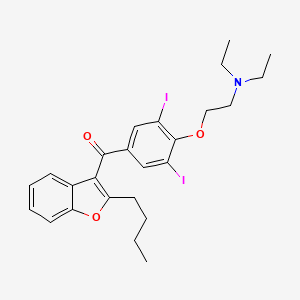
| Formula | C25H29I2NO3 |
|---|---|
| Molecular weight | 645.32 g/mol |
| IUPAC name | (2-butyl-1-benzofuran-3-yl)-[4-[2-(diethylamino)ethoxy]-3,5-diiodophenyl]methanone |
| CAS | 1951-25-3 |
| PubChem CID | 2157 |
| InChIKey | IYIKLHRQXLHMJQ-UHFFFAOYSA-N |
| logP | 6.94 (XLogP 7.6) |
| Polar surface area | 42.68 Ų |
| H-bond acceptors / donors | 4 / 0 |
| Drug-likeness (QED) | 0.17 |
| Lipinski violations | 2 |
SMILES
CCCCc1oc2ccccc2c1C(=O)c1cc(I)c(OCCN(CC)CC)c(I)c1Biology & Pharmacokinetics
Pharmacokinetics
| BBB penetrant | No (logBB -1.08) |
|---|
Enzyme interactions
| Enzyme | Role | Detail |
|---|---|---|
| CYP1A2 | Inhibitor | — |
| CYP2B6 | Inhibitor | — |
| CYP2C19 | Substrate | — |
| CYP2C8 | Inhibitor | Ki 8.763560920082655 µM |
| CYP2C9 | Inhibitor | — |
| CYP2D6 | Inhibitor | — |
| CYP2D6 | Substrate | — |
| CYP3A4 | Substrate | — |
Receptor binding (top 1)
| Target | Action | Affinity |
|---|---|---|
| M5 receptor (CHRM5) | Allosteric modulator | pKB 7.2 |
Transporters
BCRP (Inhibitor)BCRP (Inhibitor)BSEP (Inhibitor)BSEP (Inhibitor)MDR1 (Inhibitor)MRP1 (Inhibitor)MRP2 (Inhibitor)MRP3 (Inhibitor)MRP4 (Inhibitor)OAT (Inhibitor)OATP (Inhibitor)OATP1B1 (Inhibitor)OATP1B3 (Inhibitor)OCT(unspecified) (Inhibitor)OCT1 (Inhibitor)OCT3 (Inhibitor)OCTN2 (Inhibitor)P-gp (Inhibitor)BSEP (Substrate)OATP2B1 (Substrate)OCT1 (Substrate)P-gp (Substrate)
Drug–drug interactions (100+, DDInter)
| Interacting drug | Severity | Management |
|---|---|---|
| Abarelix | major | |
| Abiraterone | major | |
| Agalsidase beta | major | |
| Alimemazine | major | |
| Aminolevulinic acid | major | |
| Amphotericin B | major | |
| Amphotericin B (cholesteryl sulfate) | major | |
| Amphotericin B (lipid complex) | major | |
| Amphotericin B (liposomal) | major | |
| Anagrelide | major | |
| Apalutamide | major | |
| Arsenic trioxide | major | |
| Astemizole | major | |
| Betrixaban | major | |
| Bicalutamide | major | |
| Bosutinib | major | |
| Cabozantinib | major | |
| Ceritinib | major | |
| Chloroquine | major | |
| Cisapride | major | |
| Cisplatin | major | |
| Clarithromycin | major | |
| Clotrimazole | major | |
| Cobicistat | major | |
| Corticotropin | major | |
| Crizotinib | major | |
| Dasatinib | major | |
| Daunorubicin | major | |
| Daunorubicin (liposomal) | major | |
| Degarelix | major | |
| Dexamethasone | major | |
| Dicoumarol | major | |
| Digoxin Immune Fab (Ovine) | major | |
| Docetaxel | major | |
| Dolasetron | major | |
| Doxepin | major | |
| Doxepin (topical) | major | |
| Doxorubicin | major | |
| Doxorubicin (liposomal) | major | |
| Edoxaban | major |
Showing 40 of 100+.
Registered Products (8)
| Brand | Form / strength | Pack | Agent | Citizen (JOD) |
|---|---|---|---|---|
| SEDACORON TABS | Tablet 200 mg | 20 tab | Sabbagh Drug Store | 3.080 |
| CORDARONE TAB | Tablet 200 mg | 30 tab | Ulfa Pharma Co. | 4.390 |
| Amidrone IV Amp | Ampoule 150 mg/3 ml | 6 amp | Hikma Pharmaceuticals Co.Ltd/Jordan | — |
| Amiocord | Ampoule 150 mg/3 ml | 3 ml | Khalil ibraheem drug stores | — |
| CORDARONE AMP | Ampoule 150 mg/3 ml | 6 | Ulfa Pharma Co. | — |
| Cadronax | Ampoule 150 mg/3 ml | 6 amp | ٠ستÙدع أدÙÙØ© اÙÙÙÙÙÙÙ | — |
| SEDACORON AMPS | Ampoule 150 mg/3 ml | 5 amp | Sabbagh Drug Store | — |
| Sunnydarone | Ampoule 150 mg/3 ml | 5 amp | Sahar Drug Store | — |