Aprepitant
JFDA label: Emend
Mechanism of Action
Antagonist of Substance-P receptor — Neurokinin 1 receptor antagonist
| Target | Action | Gene / class |
|---|---|---|
| Substance-P receptor efficacy | ANTAGONIST | TACR1 |
Indications
Approved
- IV (Cinvanti)
- Oral(Emend oral)
- Postoperative nausea and vomiting
- Prevention of chemotherapy-induced nausea and vomiting
Contraindications
Source: Lexicomp
- Additional contraindications (not in the US labeling): Concurrent use with astemizole, cisapride, or terfenadine Absolute
- Hypersensitivity to aprepitant or any component of the formulation Absolute
- concurrent use with pimozide Absolute
Adverse Reactions
Cardiac disorders (2)
Very Common bradycardia, dizziness, alopecia, decreased serum albumin, diarrhea, dyspepsia, abdominal pain, hiccups, decreased appetite, decreased white blood cell count, anemia, increased serum alkaline phosphat · Hypotension
Nervous system disorders (1)
Very Common Fatigue
Blood and lymphatic system disorders (1)
Very Common Neutropenia (children & adolescents: 13%; adults: 1% to 10%:
Musculoskeletal and connective tissue disorders (2)
Very Common musculoskeletal pain (Renal: Increased blood urea nitrogen (Respiratory: Cough (Miscellaneous: Wound dehiscence (PONV: · Weakness
Dosing
Source: Lexicomp
Warnings & Precautions
Source: Lexicomp
Hypersensitivity
Hypersensitivity reactions, including anaphylactic reactions, have been reported with fosaprepitant or oral aprepitant. Symptoms have included flushing, erythema, dyspnea, hypotension, and syncope. Monitor for hypersensitivity reaction during and following infusion; if a reaction occurs, discontinue infusion and manage appropriately. Do not re-initiate aprepitant IV if hypersensitivity symptoms occur during the initial infusion. Disease-related concerns:
Hepatic impairment
Use with caution in patients with severe hepatic impairment (Child-Pugh class C); has not been studied. Concurrent drug therapy issues:
Drug-drug interactions
Potentially significant interactions may exist, requiring dose or frequency adjustment, additional monitoring, and/or selection of alternative therapy. Consult drug interactions database for more detailed information. A clinically significant decrease in INR or prothrombin time (PT) may occur with concurrent warfarin therapy; monitor INR/PT for 2 weeks (particularly at 7 to 10 days) following aprepitant administration in each chemotherapy cycle. Special populations:
Pediatrics
For prevention of chemotherapy-induced nausea and vomiting, use is not recommended in pediatric patients weighing Dosage form specific issues:
Aprepitant IV
The IV aprepitant formulation is an emulsion which also contains the excipients alcohol, egg lecithin, soybean oil, and sucrose.
Pregnancy & Lactation
Pregnancy
Adverse events were not observed in animal reproduction studies. The injection formulation contains ethanol; use should be avoided in females who are pregnant. Efficacy of hormonal contraceptive may be reduced during and for 28 days following the last aprepitant dose; alternative or additional effective methods of contraception should be used both during treatment with fosaprepitant or aprepitant and for at least 1 month following the last fosaprepitant/aprepitant dose.
Lactation
It is not known if aprepitant is present in breast milk. According to the manufacturer, the decision to breastfeed during therapy should consider the risk of infant exposure, the benefits of breastfeeding to the infant, and benefits of treatment to the mother. The injection formulation contains ethanol.
Monitoring
| Clinical pearl | In patients receiving concurrent warfarin, monitor INR/PT for 2 weeks (particularly at 7 to 10 days) following aprepitant administration; monitor for signs/symptoms of hypersensitivity reaction. |
|---|
Chemistry & Properties
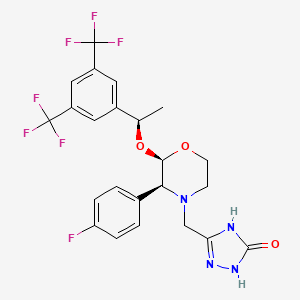
| Formula | C23H21F7N4O3 |
|---|---|
| Molecular weight | 534.43 g/mol |
| IUPAC name | 3-[[(2R,3S)-2-[(1R)-1-[3,5-bis(trifluoromethyl)phenyl]ethoxy]-3-(4-fluorophenyl)morpholin-4-yl]methyl]-1,4-dihydro-1,2,4-triazol-5-one |
| CAS | 170729-80-3 |
| PubChem CID | 135413536 |
| InChIKey | ATALOFNDEOCMKK-OITMNORJSA-N |
| logP | 4.95 (XLogP 4.2) |
| Polar surface area | 83.24 Ų |
| H-bond acceptors / donors | 5 / 2 |
| Drug-likeness (QED) | 0.44 |
| Lipinski violations | 1 |
SMILES
C[C@@H](O[C@H]1OCCN(Cc2n[nH]c(=O)[nH]2)[C@H]1c1ccc(F)cc1)c1cc(C(F)(F)F)cc(C(F)(F)F)c1Biology & Pharmacokinetics
Pharmacokinetics
| BBB penetrant | Yes |
|---|
Enzyme interactions
| Enzyme | Role | Detail |
|---|---|---|
| CYP1A2 | Substrate | — |
| CYP3A4 | Inhibitor | IC₅₀ 0.024629860647679767 µM |
| CYP3A4 | Substrate | — |
Receptor binding (top 1)
| Target | Action | Affinity |
|---|---|---|
| NK1 receptor (TACR1) | Antagonist | pKi 10.1 |
Transporters
BCRP (Inhibitor)BSEP (Inhibitor)BSEP (Inhibitor)MDR1 (Inhibitor)MRP1 (Inhibitor)MRP2 (Inhibitor)MRP3 (Inhibitor)MRP4 (Inhibitor)OATP1B1 (Inhibitor)OATP1B3 (Inhibitor)P-gp (Inhibitor)MDR1 (Substrate)P-gp (Substrate)
Drug–drug interactions (100+, DDInter)
| Interacting drug | Severity | Management |
|---|---|---|
| Acalabrutinib | major | |
| Alfentanil | major | |
| Astemizole | major | |
| Avanafil | major | |
| Avapritinib | major | |
| Benzhydrocodone | major | |
| Bosutinib | major | |
| Brexpiprazole | major | |
| Brigatinib | major | |
| Butorphanol | major | |
| Cilostazol | major | |
| Cisapride | major | |
| Cobimetinib | major | |
| Colchicine | major | |
| Deflazacort | major | |
| Eliglustat | major | |
| Encorafenib | major | |
| Entrectinib | major | |
| Eplerenone | major | |
| Everolimus | major | |
| Fentanyl | major | |
| Flibanserin | major | |
| Guanfacine | major | |
| Halofantrine | major | |
| Hydrocodone | major | |
| Ibrutinib | major | |
| Ivabradine | major | |
| Ivacaftor | major | |
| Ivosidenib | major | |
| Lemborexant | major | |
| Levacetylmethadol | major | |
| Lomitapide | major | |
| Lonafarnib | major | |
| Lumateperone | major | |
| Lurasidone | major | |
| Lurbinectedin | major | |
| Naloxegol | major | |
| Neratinib | major | |
| Olaparib | major | |
| Oliceridine | major |
Showing 40 of 100+.
Registered Products (4)
| Brand | Form / strength | Pack | Agent | Citizen (JOD) |
|---|---|---|---|---|
| Emend combo | Capsule 1 Cap (125 mg) + 2 Cap (80 mg) | 2 cap | Adatco Drug Store | — |
| Enevom 125mg Hard capsules | Capsule 125 mg | 1 cap | MS PHARMA/JORDAN | — |
| Enevom 80mg & 125mg Hard capsules(80mg(2caps)+125mg(1cap) | Capsule 80+125 mg/1BOX | 3 cap | ms pahrma - Jordan | — |
| Enevom 80mg Hard capsules | Capsule 80 mg | 1 cap | ms pahrma - Jordan | — |