Bromocriptine
JFDA label: Ronalin Tablets
Mechanism of Action
Semisynthetic ergot alkaloid derivative and a sympatholytic dopamine D2 receptor agonist which activates postsynaptic dopamine receptors in the tuberoinfundibular (inhibiting pituitary prolactin secretion) and nigrostriatal pathways (enhancing coordinated motor control). In the treatment of type 2 diabetes mellitus, the mechanism of action is unknown; however, bromocriptine is believed to affect circadian rhythms which are mediated, in part, by dopaminergic activity, and are believed to play a role in obesity and insulin resistance. It is postulated that bromocriptine (when administered during the morning and released into the systemic circulation in a rapid, 'pulse-like' dose) may reset hypothalamic circadian activities which have been altered by obesity, thereby resulting in the revers
Indications
Approved
- Acromegaly (excluding Cycloset)
- Diabetes mellitus, type 2 (Cycloset only)
- Hyperprolactinemia (excluding Cycloset)
- Parkinson disease (excluding Cycloset)
Off-label
- Neuroleptic malignant syndrome
Contraindications
Source: Lexicomp
- Hypersensitivity to bromocriptine, ergot alkaloids, or any component of the formulation Additional product-specific contraindications: Cycloset: Syncopal migraine Absolute
- breast-feeding Parlodel: Uncontrolled hypertension Absolute
- postpartum women with a history of coronary artery disease or other severe cardiovascular conditions (unless withdrawal of medication is medically contraindicated) Absolute
- pregnancy (risk to benefit evaluation must be performed in women who become pregnant during treatment for acromegaly, prolactinoma, or Parkinson disease - hypertension during treatment should generally result in efforts to withdraw) Absolute
Adverse Reactions
Cardiac disorders (4)
Common Hypotension (including postural/orthostatic) · Raynaud's phenomenon · syncope · vasospasm (digital)
Nervous system disorders (5)
Very Common Dizziness · fatigue · headache
Common Drowsiness · lightheadedness
Metabolism and nutrition disorders (1)
Common Hypoglycemia
Gastrointestinal disorders (9)
Very Common Constipation · nausea
Common Abdominal cramps · anorexia · diarrhea · dyspepsia · gastrointestinal hemorrhage · vomiting · xerostomia
Musculoskeletal and connective tissue disorders (1)
Very Common Weakness
Eye disorders (1)
Common Amblyopia
Infections and infestations (1)
Common Increased susceptibility to infection
Other (66)
Not Known Abdominal distress · acquired valvular heart disease · alopecia · anxiety · ataxia · blepharospasm · blurred vision · bradycardia · cardiac arrhythmia · cerebrovascular accident (postpartum) · cold extremities · cold intolerance · confusion · constrictive pericarditis · delusions · depression · dyskinesia · dysphagia · dyspnea · epileptiform seizures · ergot alkaloids toxicity · erythromelalgia · Frequency of adverse effects may vary by dose and/or indication · gastrointestinal ulcer · hallucination · heavy headedness · hypersensitivity reaction · hypertension (postpartum) · increased cerebrospinal fluid pressure · increased libido · insomnia · lassitude · lethargy · muscle cramps · myocardial infarction (postpartum) · narcolepsy · nervousness · nightmares · on-off phenomenon · pallor · paranoia · paresthesia · pericardial effusion · peripheral edema · pleural effusion · pleurisy · psychomotor agitation · psychosis · pulmonary fibrosis · retroperitoneal fibrosis · seizure (postpartum) · skin mottling · skin rash · sleep disorder · status epilepticus (postpartum) · tachycardia · tingling of the ears · tinnitus · transient blindness · urinary frequency · urinary incontinence · urinary retention · vasodepressor syncope · ventricular tachycardia · vertigo · visual disturbance
Respiratory, thoracic and mediastinal disorders (4)
Very Common Rhinitis
Common Flu-like symptoms · nasal congestion · sinusitis
Dosing
Source: Lexicomp
Warnings & Precautions
Source: Lexicomp
Cardiac valvular fibrosis
Ergot alkaloids and derivatives have been associated with fibrotic valve thickening (eg, aortic, mitral, tricuspid); usually associated with long-term, chronic use.
Cardiovascular effects
Hypotension, including orthostatic hypotension and syncope, may occur, particularly upon initiation of therapy and dose escalation. In addition, hypertension, seizures, MI, and stroke have been reported. Severe headache or visual changes may precede events. The onset of reactions may be immediate or delayed (often may occur in the second week of therapy). Discontinue therapy and evaluate promptly if hypertension, severe, progressive, or unremitting headache (with or without visual disturbance), or evidence of CNS toxicity develops. In a scientific statement from the American Heart Association, bromocriptine has been determined to be an agent that may cause direct myocardial toxicity (magnitude: major) (AHA [Page 2016]).
CNS depression
May cause CNS depression, which may impair physical or mental abilities, and episodes of sudden sleep onset particularly in patients with Parkinson disease; patients must be cautioned about performing tasks that require mental alertness (eg, operating machinery or driving). Consider dosage reduction or discontinuation of therapy if symptoms occur.
Hallucinations
Visual or auditory hallucinations may occur when administered alone or concomitantly with levodopa; dose reductions or discontinuation may be necessary. Symptoms may persist for several weeks following discontinuation.
Impulse control disorders
Dopamine agonists used for Parkinson disease or restless legs syndrome have been associated with compulsive behaviors and/or loss of impulse control, which has manifested as new or increased gambling urges, sexual urges, uncontrolled spending, or other intense urges. Dose reduction or discontinuation of therapy reverses these behaviors in some, but not all cases.
Melanoma
Risk for melanoma development is increased in Parkinson disease patients; drug causation or factors contributing to risk have not been established. Monitor all patients closely for melanoma and perform periodic skin examinations.
Pleural/retroperitoneal fibrosis
Cases of pleural and pericardial effusions, as well as pleural, pulmonary, and/or retroperitoneal fibrosis and constrictive pericarditis have been reported with prolonged and high-dose daily use. Discontinue therapy if fibrotic changes are suspected. Disease-related concerns:
Acromegaly
Appropriate use: In the treatment of acromegaly, discontinuation is recommended if tumor expansion occurs during therapy. In patients treated with pituitary irradiation, withhold therapy for 4 to 8 weeks on a yearly basis to assess both the clinical effects of radiation on the disease process as well as the effects of bromocriptine. Digital vasospasm (cold sensitive) may occur in some patients with acromegaly; may require dosage reduction.
Cardiovascular disease
Use with caution in patients with cardiovascular disease (myocardial infarction; residual atrial, nodal, or ventricular arrhythmia).
Dementia
Use with caution in patients with dementia; high doses may be associated with confusion and mental disturbances.
Galactose intolerance/malabsorption (Parlodel)
Avoid use in patients with rare hereditary problems of galactose intolerance, severe lactase deficiency or glucose-galactose malabsorption.
Hepatic impairment
Use with caution in patients with hepatic impairment; dosage adjustment may be necessary due to extensive hepatic metabolism.
Macroadenomas
Discontinuation of therapy in patients with macroadenomas has been associated with rapid regrowth of tumor and increased prolactin serum levels.
Peptic ulcer disease
Use with caution in patients with peptic ulcer disease; severe gastrointestinal bleeding has been reported (some fatal).
Prolactin-secreting adenomas
Cerebrospinal fluid rhinorrhea has been observed in some of these patients.
Psychosis
Use with caution in patients with psychosis; dopamine agonists may exacerbate the disorder or diminish the effectiveness of drugs used to treat the disorder. Use in patients with severe psychotic disorder is not recommended. Concurrent drug therapy issues:
Drug-drug interactions
Potentially significant interactions may exist, requiring dose or frequency adjustment, additional monitoring, and/or selection of alternative therapy. Consult drug interactions database for more detailed information. Dosage form specific issues:
Interchangeability (Cycloset)
Due to a difference in the formulation and resulting pharmacokinetics of Cycloset ("quick-release" tablet) compared to other formulations of bromocriptine, interchangeability with any other bromocriptine product is not recommended in the setting of type 2 diabetes mellitus management. Other warnings/precautions:
Appropriate use (Cycloset)
Not indicated for use in type 1 diabetes mellitus or diabetic ketoacidosis.
Discontinuation of therapy
Dopaminergic agents have been associated with a syndrome resembling neuroleptic malignant syndrome on abrupt withdrawal or significant dosage reduction after long-term use; gradual dosage reduction is recommended when discontinuing therapy.
Visual monitoring
Monitoring and careful evaluation of visual changes during the treatment of hyperprolactinemia is recommended to differentiate between tumor shrinkage and traction on the optic chiasm; rapidly progressing visual field loss requires neurosurgical consultation.
Pregnancy & Lactation
Pregnancy
Bromocriptine crosses the placenta (Molitch 2015). Data collected from women taking bromocriptine during pregnancy suggest the incidence of birth defects is not increased with use. However, the majority of women discontinued use within 8 weeks of pregnancy. Women with hyperprolactinemia may be infertile, have amenorrhea and galactorrhea. A mechanical contraceptive should be used during therapy until normal ovulatory menses is established. Contraception can then be discontinued if pregnancy is desired. Bromocriptine should be discontinued if pregnancy is confirmed unless needed for treatment of a rapidly expanding macroadenoma. When used for the treatment of acromegaly or Parkinson disease, consider discontinuing therapy during pregnancy. If treatment is withdrawn, monitor for signs and symptoms of an enlarging prolactin secreting tumor. Regardless of indication, if bromocriptine is needed in a pregnant woman, monitor closely for hypertensive disorders during pregnancy and immediately
Lactation
Use is contraindicated in nursing women when used for the treatment of type 2 diabetes and in postpartum women with a history of coronary artery disease or other severe cardiovascular conditions (unless withdrawal of medication is medically contraindicated). Bromocriptine is known to inhibit lactation. A previous indication for prevention of postpartum lactation was withdrawn voluntarily by the manufacturer following reports of serious adverse reactions, including stroke, MI, seizures, and sev
Monitoring
| Clinical pearl | Blood pressure and heart rate (orthostatic vital signs; baseline and periodically thereafter); hepatic, renal, hematopoietic, and cardiovascular function (periodically); visual fields (prolactinoma; periodic); pregnancy test during amenorrheic period; growth hormone (acromegaly; periodic); prolactin levels; GI bleeding (patients with history of peptic ulcer); melanoma skin examinations (regular assessment) Diabetes mellitus, type 2: Serum glucose and HbA1c (at least twice yearly in patients who have stable glycemic control and are meeting treatment goals; quarterly in patients not meeting treatment goals or with therapy change [ADA 2018a) |
|---|
Chemistry & Properties
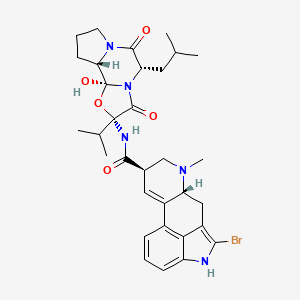
| Formula | C32H40BrN5O5 |
|---|---|
| Molecular weight | 654.61 g/mol |
| IUPAC name | (6aR,9R)-5-bromo-N-[(1S,2S,4R,7S)-2-hydroxy-7-(2-methylpropyl)-5,8-dioxo-4-propan-2-yl-3-oxa-6,9-diazatricyclo[7.3.0.02,6]dodecan-4-yl]-7-methyl-6,6a,8,9-tetrahydro-4H-indolo[4,3-fg]quinoline-9-carboxamide |
| CAS | 25614-03-3 |
| PubChem CID | 31101 |
| InChIKey | OZVBMTJYIDMWIL-AYFBDAFISA-N |
| logP | 3.19 (XLogP 3.8) |
| Polar surface area | 118.21 Ų |
| H-bond acceptors / donors | 6 / 3 |
| Drug-likeness (QED) | 0.46 |
| Lipinski violations | 1 |
SMILES
CC(C)C[C@H]1C(=O)N2CCC[C@H]2[C@]2(O)O[C@](NC(=O)[C@@H]3C=C4c5cccc6[nH]c(Br)c(c56)C[C@H]4N(C)C3)(C(C)C)C(=O)N12Biology & Pharmacokinetics
Pharmacokinetics
| BBB penetrant | No (logBB -1.1) |
|---|
Enzyme interactions
| Enzyme | Role | Detail |
|---|---|---|
| CYP1A2 | Substrate | — |
| CYP2C19 | Substrate | — |
| CYP3A4 | Inhibitor | IC₅₀ 2.44914679021083 µM |
| CYP3A4 | Substrate | — |
Receptor binding (top 30)
| Target | Action | Affinity |
|---|---|---|
| adrenergic Alpha1D (ADRA1D) | Binding | pKi 8.9 |
| adrenergic Alpha1B (ADRA1B) | Binding | pKi 8.9 |
| DOPAMINE D2 (DRD2) | Binding | pKi 8.6 |
| adrenergic Alpha1A (ADRA1A) | Binding | pKi 8.4 |
| DOPAMINE D2 Short (DRD2) | Binding | pKi 8.3 |
| DOPAMINE D3 (DRD3) | Binding | pKi 8.2 |
| 5-HT1D receptor (HTR1D) | Agonist | pKi 8.0 |
| 5-HT1D (HTR1D) | Binding | pKi 8.0 |
| adrenergic Alpha2A (ADRA2A) | Binding | pKi 8.0 |
| 5-HT1A (HTR1A) | Binding | pKi 7.9 |
| 5-HT1A receptor (HTR1A) | Agonist | pKi 7.9 |
| DOPAMINE D2 Long (DRD2) | Binding | pKi 7.8 |
| α2C-adrenoceptor (ADRA2C) | Antagonist | pKi 7.6 |
| adrenergic Alpha2C (ADRA2C) | Binding | pKi 7.5 |
| 5-HT6 receptor (HTR6) | Agonist | pKi 7.5 |
Transporters
BCRP (Inhibitor)BSEP (Inhibitor)MDR1 (Inhibitor)MRP1 (Inhibitor)OATP1B1 (Inhibitor)OATP1B1 (Inhibitor)OATP1B3 (Inhibitor)OATP1B3 (Inhibitor)OCTN2 (Inhibitor)P-gp (Inhibitor)MDR1 (Substrate)P-gp (Substrate)
Drug–drug interactions (71, DDInter)
| Interacting drug | Severity | Management |
|---|---|---|
| Isometheptene | major | |
| Lorcaserin | major | |
| Phenylpropanolamine | major | |
| Alimemazine | moderate | |
| Amyl Nitrite | moderate | |
| Azatadine | moderate | |
| Azelastine (nasal) | moderate | |
| Brigatinib | moderate | |
| Brimonidine (ophthalmic) | moderate | |
| Brimonidine (topical) | moderate | |
| Brompheniramine | moderate | |
| Carbinoxamine | moderate | |
| Chlorphenesin | moderate | |
| Chlorpheniramine | moderate | |
| Clarithromycin | moderate | |
| Clemastine | moderate | |
| Clofedanol | moderate | |
| Codeine | moderate | |
| Cyclizine | moderate | |
| Cyclosporine | moderate | |
| Cyproheptadine | moderate | |
| Deferasirox | moderate | |
| Dexbrompheniramine | moderate | |
| Dextromethorphan | moderate | |
| Difenoxin | moderate | |
| Diphenhydramine | moderate | |
| Diphenoxylate | moderate | |
| Doxepin | moderate | |
| Doxepin (topical) | moderate | |
| Doxylamine | moderate | |
| Dronabinol | moderate | |
| Erythromycin | moderate | |
| Ethanol | moderate | |
| Fedratinib | moderate | |
| Fluconazole | moderate | |
| Fostamatinib | moderate | |
| Hydrocodone | moderate | |
| Idelalisib | moderate | |
| Imatinib | moderate | |
| Ioflupane I-123 | moderate |
Showing 40 of 71.
Registered Products (2)
| Brand | Form / strength | Pack | Agent | Citizen (JOD) |
|---|---|---|---|---|
| Ronalin Tablets | Tablet 2.5 mg | 30 tab pack varies | Hikma Pharmaceuticals Co.Ltd/Jordan | 4.940 |
| Ronalin Tablets | Tablet 2.5 mg | 1000 tab pack varies | Hikma Pharmaceuticals Co.Ltd/Jordan | 139.970 |