Chloroquine
JFDA label: Heroquine Syrup
Mechanism of Action
Binds to and inhibits DNA and RNA polymerase; interferes with metabolism and hemoglobin utilization by parasites; inhibits prostaglandin effects; chloroquine concentrates within parasite acid vesicles and raises internal pH resulting in inhibition of parasite growth; may involve aggregates of ferriprotoporphyrin IX acting as chloroquine receptors causing membrane damage; may also interfere with nucleoprotein synthesis
Indications
Approved
- Extraintestinal amebiasis
- Malaria
Off-label
- Discoid lupus erythematosus
Antimicrobial Spectrum
Expected / intrinsic spectrum (EUCAST breakpoints & labels) — not local resistance. Source: openfda-label.
Protozoa
| Organism | Activity | MIC |
|---|---|---|
| Entamoeba histolytica | Active | — |
| Plasmodium falciparum | Active | — |
| Plasmodium malariae | Active | — |
| Plasmodium ovale | Active | — |
| Plasmodium parasites | Active | — |
| Plasmodium vivax | Active | — |
Contraindications
Source: Lexicomp
- Hypersensitivity to chloroquine, 4-aminoquinoline compounds, or any component of the formulation Absolute
- the presence of retinal or visual field changes of any etiology (when used for indications other than acute malaria) Absolute
Adverse Reactions
Cardiac disorders (9)
Not Known Atrioventricular block · bundle branch block · cardiac arrhythmia · cardiomyopathy · ECG changes (including prolonged QRS and QTc intervals, T-wave inversion, or depression) · hypotension · torsades de pointes · ventricular fibrillation · ventricular tachycardia
Nervous system disorders (16)
Not Known Agitation · anxiety · confusion · decreased deep tendon reflex · delirium · depression · extrapyramidal reaction (dystonia, dyskinesia, protrusion of the tongue, torticollis) · hallucination · headache · insomnia · motor dysfunction (sensorimotor disorder) · personality changes · polyneuropathy · psychosis · seizure · suicidal tendencies
Hepatobiliary disorders (2)
Not Known Hepatitis · increased liver enzymes
Blood and lymphatic system disorders (6)
Not Known Agranulocytosis (reversible) · aplastic anemia · hemolytic anemia (in G6PD-deficient patients) · neutropenia · pancytopenia · thrombocytopenia
Immune system disorders (4)
Not Known Anaphylactoid reaction · anaphylaxis · angioedema · DRESS syndrome
Metabolism and nutrition disorders (1)
Not Known Hypoglycemia
Gastrointestinal disorders (5)
Not Known Abdominal cramps · anorexia · diarrhea · nausea · vomiting
Skin and subcutaneous tissue disorders (13)
Not Known Alopecia · bleaching of hair · blue gray skin pigmentation · erythema multiforme · exacerbation of psoriasis · exfoliative dermatitis · lichen planus · pleomorphic rash · pruritus · skin photosensitivity · Stevens-Johnson syndrome · toxic epidermal necrolysis · urticaria
Musculoskeletal and connective tissue disorders (3)
Not Known Myopathy · neuromuscular disease · proximal myopathy
Eye disorders (9)
Not Known Accommodation disturbances · blurred vision · corneal opacity (reversible) · macular degeneration (may be irreversible) · maculopathy (may be irreversible) · nocturnal amblyopia · retinopathy (including irreversible changes in some patients' long-term or high-dose therapy) · transient scotomata · visual field defects
Ear and labyrinth disorders (3)
Not Known Deafness (nerve) · hearing loss (risk increased in patients with preexisting auditory damage) · tinnitus
Dosing
Source: Lexicomp
Warnings & Precautions
Source: Lexicomp
Cardiovascular effects
Cases of cardiomyopathy resulting in cardiac failure (sometimes fatal) have been reported during long term therapy at high doses. Monitor for signs and symptoms of cardiomyopathy; discontinue if cardiomyopathy develops. Consider chronic toxicity and discontinue chloroquine if conduction disorders (bundle branch block/AV block) are diagnosed. QT prolongation, torsade de pointes, and ventricular arrhythmias (some fatal) have been reported; risk is increased with high doses. Use with caution in patients with cardiac disease, history of ventricular arrhythmias, uncorrected hypokalemia and/or hypomagnesemia, or bradycardia, and during concomitant administration with QT interval prolonging agents due to potential for QT prolongation. In a scientific statement from the American Heart Association, chloroquine has been determined to be an agent that may either cause direct myocardial toxicity or exacerbate underlying myocardial dysfunction (magnitude: major) (AHA [Page 2016]).
Extrapyramidal effects
Acute extrapyramidal disorders may occur, usually resolving after discontinuation of therapy and/or symptomatic treatment.
Hematologic effects
Rare hematologic reactions including reversible agranulocytosis, aplastic anemia, neutropenia, pancytopenia, and thrombocytopenia have been reported; monitor CBC during prolonged therapy. Consider discontinuation if severe blood disorders occur that are unrelated to disease.
Hypoglycemia
Severe hypoglycemia, including loss of consciousness, has been reported in patients treated with or without antidiabetic agents. Counsel patients about risk of hypoglycemia and associated signs and symptoms.
Neuromuscular effects
Skeletal muscle myopathy or neuromyopathy, leading to progressive weakness and atrophy of proximal muscle groups have been reported; muscle strength (especially proximal muscles) should be assessed periodically during prolonged therapy; discontinue therapy if weakness occurs.
Retinal toxicity
Retinal toxicity, potentially causing irreversible retinopathy, is predominantly associated with high daily doses and a duration of >5 years of use of chloroquine or hydroxychloroquine in the treatment of rheumatic diseases. Other major risk factors include concurrent tamoxifen use, renal impairment, lower body weight, and potentially the presence of macular disease. Risk is most accurately assessed on the basis of duration of use relative to daily dose/body weight (Marmor [AAO 2016]; Melles 2014). Based on these risks, the American Academy of Ophthalmology (AAO) recommends not exceeding a daily chloroquine phosphate dosage of 2.3 mg/kg using actual body weight. Previous recommendations to use ideal body weight are no longer advised; very thin patients in particular were at increased risk for retinal toxicity using this practice. Current AAO guidelines do not specifically address dosing in obese patients. AAO also recommends baseline screening for retinal toxicity and annual screening beginning after 5 years of use (or sooner if major risk factors are present) (Marmor [AAO 2016]). Disease-related concerns:
Auditory damage
Use with caution in patients with preexisting auditory damage; discontinue immediately if hearing defects are noted.
G6PD deficiency
Although the manufacturer’s labeling recommends chloroquine be used with caution in patients with G6PD deficiency due to a potential for hemolytic anemia, there is limited data to support this risk. Many experts consider chloroquine, when given in usual therapeutic doses to WHO Class II and III G6PD deficient patients, to probably be safe (Cappellini 2008; Glader 2017; Luzzatto 2016; Youngster 2010). Safety in Class I G6PD deficiency (ie, severe form of the deficiency associated with chronic hemolytic anemia) is generally unknown (Glader 2017). In a trial conducted in West Africa involving 74 G6PD deficient patients (predominantly Class III deficiency), there were no cases of hemolysis reported following exposure to usual doses of chloroquine (Mandi 2005). In addition, the ACR Rheumatology guidelines do not mention the need to evaluate G6PD levels prior to initiation of therapy (Singh 2015).
Hepatic impairment
Use with caution in patients with hepatic impairment, alcoholism, or concurrent therapy with hepatotoxic agents.
Porphyria
Use with caution in patients with porphyria; may exacerbate disease symptoms.
Psoriasis
Use with caution in patients with psoriasis; may exacerbate disease symptoms.
Seizure disorder
Use with caution in patients with a history of seizure disorder; may cause seizures. Concurrent drug therapy issues:
Drug-drug interactions
Potentially significant interactions may exist, requiring dose or frequency adjustment, additional monitoring, and/or selection of alternative therapy. Consult drug interactions database for more detailed information. Other warnings/precautions:
Appropriate use
Chloroquine does not prevent relapses in patients with vivax or ovale malaria (not effective against exoerythrocytic forms); additional treatment with an antimalarial effective against these forms (eg, an 8-aminoquinoline) is required for the treatment of infections with P. vivax and P. ovale. Do not use for the treatment of complicated malaria (high-grade parasitemia and/or complications [eg, cerebral malaria, acute renal failure]).
Chloroquine resistance
Chloroquine is not effective against chloroquine- or hydroxychloroquine-resistant strains of Plasmodium species. Chloroquine resistance is widespread in P. falciparum and is reported in P. vivax. Prior to initiation of chloroquine for prophylaxis, it should be determined if chloroquine is appropriate for use in the region to be visited; do not use for malaria prophylaxis in areas where chloroquine resistance occurs. Patients should be treated with another antimalarial if patient is infected with a resistant strain of plasmodia.
Pregnancy & Lactation
Pregnancy
In animal reproduction studies, drug accumulated in fetal ocular tissues and remained for several months following drug elimination from the rest of the body. Chloroquine and its metabolites cross the placenta and can be detected in the cord blood and urine of the newborn infant (Akintonwa 1988; Essien 1982; Law 2008). In one study, chloroquine and its metabolites were measurable in the cord blood 89 days (mean) after the last maternal dose (Law 2008). Malaria infection in pregnant women may be more severe than in nonpregnant women and has a high risk of maternal and perinatal morbidity and mortality. Therefore, pregnant women and women who are likely to become pregnant are advised to avoid travel to malaria-risk areas. Chloroquine is recommended for the treatment of pregnant women for uncomplicated malaria in chloroquine-sensitive regions; when caused by chloroquine-sensitive P. vivax or P. ovale, pregnant women should be maintained on chloroquine prophylaxis for the duration of the
Lactation
Chloroquine and its metabolite can be detected in breast milk. Per product labeling, 11 lactating women with malaria were given a single oral dose of chloroquine 600 mg. The maximum daily dose to the breastfeeding infant was calculated to be 0.7% of the maternal dose. Additional information has been published and results are variable. In one study, the relative dose to the nursing infant was calculated to be 2.3% (chloroquine) and 1% (metabolite) of the weight-adjusted maternal dose with the sam
Monitoring
| Clinical pearl | Evaluate neuromuscular function periodically during prolonged therapy. Periodic CBC in patients receiving prolonged therapy Ophthalmologic exam at baseline (fundus examination within the first year plus visual fields and spectral-domain optical coherence tomography [SD OCT] if maculopathy is present) to screen for retinal toxicity, followed by annual screening beginning after 5 years of use (or sooner if major risk factors are present) (Marmor [AAO 2016]). |
|---|
Chemistry & Properties
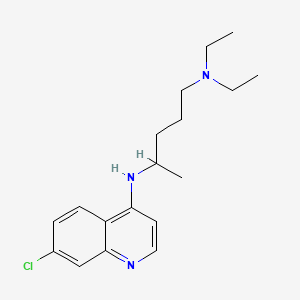
| Formula | C18H26ClN3 |
|---|---|
| Molecular weight | 319.88 g/mol |
| IUPAC name | 4-N-(7-chloroquinolin-4-yl)-1-N,1-N-diethylpentane-1,4-diamine |
| CAS | 54-05-7 |
| PubChem CID | 2719 |
| InChIKey | WHTVZRBIWZFKQO-UHFFFAOYSA-N |
| logP | 4.81 (XLogP 4.6) |
| Polar surface area | 28.16 Ų |
| H-bond acceptors / donors | 3 / 1 |
| Drug-likeness (QED) | 0.76 |
| Lipinski violations | 0 |
SMILES
CCN(CC)CCCC(C)Nc1ccnc2cc(Cl)ccc12Biology & Pharmacokinetics
Pharmacokinetics predicted
| Bioavailability | 10.0% |
|---|---|
| Half-life | 0.561 h |
| Volume of distribution | 11.91 L/kg |
| Protein binding | 49.6% |
| BBB penetrant | Yes |
Enzyme interactions
| Enzyme | Role | Detail |
|---|---|---|
| CYP2B6 | Inhibitor | — |
| CYP2C19 | Substrate | — |
| CYP3A4 | Substrate | — |
Receptor binding (top 7)
| Target | Action | Affinity |
|---|---|---|
| Cholinergic, muscarinic M5 (CHRM5) | Binding | pKi 9.4 |
| Norepinephrine transporter | Binding | pKi 6.0 |
| 5-HT1A (HTR1A) | Binding | pKi 5.2 |
| 5-HT2C (HTR2C) | Binding | pKi 5.2 |
| 5-HT2A (HTR2A) | Binding | pKi 5.2 |
| DAT | Binding | pKi 5.1 |
| SERT | Binding | pKi 5.1 |
Transporters
ASBT (Inhibitor)BCRP (Inhibitor)BCRP (Inhibitor)BSEP (Inhibitor)BSEP (Inhibitor)MATE1 (Inhibitor)MATE2 (Inhibitor)MDR1 (Inhibitor)MRP1 (Inhibitor)MRP2 (Inhibitor)MRP3 (Inhibitor)MRP4 (Inhibitor)OATP1A2 (Inhibitor)OATP1B1 (Inhibitor)OATP1B1 (Inhibitor)OATP1B3 (Inhibitor)OATP1B3 (Inhibitor)OATP2B1 (Inhibitor)OCT1 (Inhibitor)OCT2 (Inhibitor)OCTN2 (Inhibitor)P-gp (Inhibitor)MDR1 (Substrate)P-gp (Substrate)
Drug–drug interactions (100+, DDInter)
| Interacting drug | Severity | Management |
|---|---|---|
| Agalsidase beta | major | |
| Alfuzosin | major | |
| Alimemazine | major | |
| Amiodarone | major | |
| Amisulpride | major | |
| Amitriptyline | major | |
| Amoxapine | major | |
| Anagrelide | major | |
| Apomorphine | major | |
| Arsenic trioxide | major | |
| Asenapine | major | |
| Astemizole | major | |
| Atomoxetine | major | |
| Auranofin | major | |
| Aurothioglucose | major | |
| Azithromycin | major | |
| Bedaquiline | major | |
| Bepridil | major | |
| Bosutinib | major | |
| Buprenorphine | major | |
| Bupropion | major | |
| Cabozantinib | major | |
| Ceritinib | major | |
| Chlorpromazine | major | |
| Cilostazol | major | |
| Ciprofloxacin | major | |
| Cisapride | major | |
| Citalopram | major | |
| Clarithromycin | major | |
| Clofazimine | major | |
| Clomipramine | major | |
| Clozapine | major | |
| Crizotinib | major | |
| Dasatinib | major | |
| Daunorubicin | major | |
| Daunorubicin (liposomal) | major | |
| Deferiprone | major | |
| Desipramine | major | |
| Deutetrabenazine | major | |
| Dextropropoxyphene | major |
Showing 40 of 100+.
Registered Products (1)
| Brand | Form / strength | Pack | Agent | Citizen (JOD) |
|---|---|---|---|---|
| Heroquine Syrup | Syrup (as phosphate) BP 1.0 % | 60 ml | PHILADELPHIA PHAEMACEUTICALS.COMP/JORDAN | 0.800 |