Dacomitinib
JFDA label: Vizimpro
Mechanism of Action
Inhibitor of Epidermal growth factor receptor — Epidermal growth factor receptor erbB1 inhibitor; Inhibitor of Receptor tyrosine-protein kinase erbB-2 — Receptor protein-tyrosine kinase erbB-2 inhibitor; Inhibitor of Receptor tyrosine-protein kinase erbB-4 — Receptor protein-tyrosine kinase erbB-4 inhibitor
| Target | Action | Gene / class |
|---|---|---|
| Epidermal growth factor receptor efficacy | INHIBITOR | EGFR |
| Receptor tyrosine-protein kinase erbB-2 efficacy | INHIBITOR | ERBB2 |
| Receptor tyrosine-protein kinase erbB-4 efficacy | INHIBITOR | ERBB4 |
Indications
Approved
- Carcinoma, Non-Small-Cell Lung — non-small cell lung carcinoma
- Neoplasms — neoplasm
Contraindications
Source: openFDA
- None. None. ( 4 ) Absolute
Adverse Reactions
Gastrointestinal disorders (6)
Very Common And Diarrhea · Decreased Appetite · Ons In Patients Treated With Vizimpro Were Diarrhea · Stomatitis
Common Serious Adverse Reactions Were Diarrhea · Stomatitis 0 9
Skin and subcutaneous tissue disorders (7)
Very Common Alopecia · And Pruritus · Dry Skin · E Reactions Leading To Dose Interruptions Were Rash · Erse Reactions Leading To Dose Reductions Were Rash · Rash
Common Rash 2 6
Investigations (1)
Very Common Decreased Weight
General disorders and administration site conditions (2)
Very Common Paronychia
Common Respectively
Respiratory, thoracic and mediastinal disorders (4)
Very Common Cough
Common And Interstitial Lung Disease · Interstitial Lung Disease · Interstitial Lung Disease 1 8
Dosing
Source: openFDA
Warnings & Precautions
Source: openFDA
Warnings & Precautions
• Interstitial Lung Disease (ILD): Permanently discontinue VIZIMPRO if ILD is confirmed. ( 5.1 ) • Diarrhea: Withhold and reduce the dose of VIZIMPRO based on the severity. ( 2.3 , 5.2 ) • Dermatologic Adverse Reactions: Withhold and reduce the dose of VIZIMPRO based on the severity. ( 2.3 , 5.3 ) • Embryo-Fetal Toxicity: VIZIMPRO can cause fetal harm. Advise females of reproductive potential to use effective contraception. ( 5.4 , 8.1 , 8.3 )
Interstitial Lung Disease (ILD) Severe and fatal ILD/pneumonitis occur
Interstitial Lung Disease (ILD) Severe and fatal ILD/pneumonitis occurred in patients treated with VIZIMPRO and occurred in 0.5% of the 394 VIZIMPRO-treated patients; 0.3% of cases were fatal. Monitor patients for pulmonary symptoms indicative of ILD/pneumonitis. Withhold VIZIMPRO and promptly investigate for ILD in patients who present with worsening of respiratory symptoms which may be indicative of ILD (e.g., dyspnea, cough, and fever). Permanently discontinue VIZIMPRO if ILD is confirmed [see Adverse Reactions (6.1) ] .
Diarrhea Severe and fatal diarrhea occurred in patients treated with V
Diarrhea Severe and fatal diarrhea occurred in patients treated with VIZIMPRO. Diarrhea occurred in 86% of the 394 VIZIMPRO-treated patients; Grade 3 or 4 diarrhea was reported in 11% of patients and 0.3% of cases were fatal. Withhold VIZIMPRO for Grade 2 or greater diarrhea until recovery to less than or equal to Grade 1 severity, then resume VIZIMPRO at the same or a reduced dose depending on the severity of diarrhea [see Dosage and Administration (2.3) and Adverse Reactions (6.1) ]. Promptly initiate anti-diarrheal treatment (loperamide or diphenoxylate hydrochloride with atropine sulfate) for diarrhea.
Dermatologic Adverse Reactions Rash and exfoliative skin reactions occ
Dermatologic Adverse Reactions Rash and exfoliative skin reactions occurred in patients treated with VIZIMPRO. Rash occurred in 78% of the 394 VIZIMPRO-treated patients; Grade 3 or 4 rash was reported in 21% of patients. Exfoliative skin reactions of any severity were reported in 7% of patients. Grade 3 or 4 exfoliative skin reactions were reported in 1.8% of patients. Withhold VIZIMPRO for persistent Grade 2 or any Grade 3 or 4 dermatologic adverse reaction until recovery to less than or equal to Grade 1 severity, then resume VIZIMPRO at the same or a reduced dose depending on the severity of the dermatologic adverse reaction [see Dosage and Administration (2.3) and Adverse Reactions (6.1) ]. The incidence and severity of rash and exfoliative skin reactions may increase with sun exposure. At the time of initiation of VIZIMPRO, initiate use of moisturizers and appropriate measures to limit sun exposure. Upon development of Grade 1 rash, initiate treatment with topical antibiotics and topical steroids. Initiate oral antibiotics for Grade 2 or more severe dermatologic adverse reactions.
Embryo-Fetal Toxicity Based on findings from animal studies and its me
Embryo-Fetal Toxicity Based on findings from animal studies and its mechanism of action, VIZIMPRO can cause fetal harm when administered to a pregnant woman. In animal reproduction studies, oral administration of dacomitinib to pregnant rats during the period of organogenesis resulted in an increased incidence of post-implantation loss and reduced fetal body weight at doses resulting in exposures near the exposure at the 45 mg human dose. The absence of EGFR signaling has been shown to result in embryolethality as well as post-natal death in animals. Advise pregnant women of the potential risk to the fetus. Advise females of reproductive potential to use effective contraception during treatment with VIZIMPRO and for at least 17 days after the final dose [see Use in Specific Populations (8.1 and 8.3) ] .
Pregnancy & Lactation
Lactation
However, because of its potential toxicity in the breastfed infant and its half-life of 70 hours, the manufacturer recommends that breastfeeding be discontinued during dacomitinib therapy and for at least 17 days after the last dose.
Chemistry & Properties
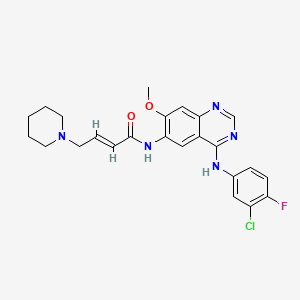
| Formula | C24H27ClFN5O3 |
|---|---|
| Molecular weight | 487.96 g/mol |
| IUPAC name | (E)-N-[4-(3-chloro-4-fluoroanilino)-7-methoxyquinazolin-6-yl]-4-piperidin-1-ylbut-2-enamide |
| CAS | 1110813-31-4 |
| PubChem CID | 11511120 |
| InChIKey | BSPLGGCPNTZPIH-IPZCTEOASA-N |
| logP | 5.16 (XLogP 4.4) |
| Polar surface area | 79.38 Ų |
| H-bond acceptors / donors | 6 / 2 |
| Drug-likeness (QED) | 0.47 |
| Lipinski violations | 1 |
SMILES
COc1cc2ncnc(Nc3ccc(F)c(Cl)c3)c2cc1NC(=O)/C=C/CN1CCCCC1.OBiology & Pharmacokinetics
Pharmacokinetics predicted
| Bioavailability | 70.0% |
|---|---|
| Half-life | 0.661 h |
| Volume of distribution | 22.396 L/kg |
| Protein binding | 92.4% |
| BBB penetrant | No |
Enzyme interactions
| Enzyme | Role | Detail |
|---|---|---|
| CYP1A2 | Inhibitor | — |
| CYP2B6 | Inhibitor | — |
| CYP2C19 | Inhibitor | — |
| CYP2C8 | Inhibitor | — |
| CYP2D6 | Inhibitor | — |
| CYP2D6 | Substrate | — |
Receptor binding (top 3)
| Target | Action | Affinity |
|---|---|---|
| epidermal growth factor receptor (EGFR) | Inhibitor | pIC50 8.2 |
| erb-b2 receptor tyrosine kinase 2 (ERBB2) | Inhibitor | pIC50 7.3 |
| erb-b2 receptor tyrosine kinase 4 (ERBB4) | Inhibitor | pIC50 7.1 |
Transporters
BCRP (Inhibitor)BCRP (Inhibitor)BSEP (Inhibitor)MRP1 (Inhibitor)OATP1B1 (Inhibitor)OATP1B3 (Inhibitor)P-gp (Inhibitor)MDR1 (Substrate)P-gp (Substrate)
Drug–drug interactions (91, DDInter)
| Interacting drug | Severity | Management |
|---|---|---|
| Atomoxetine | major | |
| Brexpiprazole | major | |
| Deutetrabenazine | major | |
| Dexlansoprazole | major | |
| Eliglustat | major | |
| Esomeprazole | major | |
| Iloperidone | major | |
| Lansoprazole | major | |
| Oliceridine | major | |
| Omeprazole | major | |
| Pantoprazole | major | |
| Pexidartinib | major | |
| Pimozide | major | |
| Pitolisant | major | |
| Rabeprazole | major | |
| Sacituzumab govitecan | major | |
| Tamoxifen | major | |
| Tetrabenazine | major | |
| Thioridazine | major | |
| Valbenazine | major | |
| Vortioxetine | major | |
| Amitriptyline | moderate | |
| Amoxapine | moderate | |
| Amphetamine | moderate | |
| Aripiprazole | moderate | |
| Asenapine | moderate | |
| Binimetinib | moderate | |
| Carvedilol | moderate | |
| Cevimeline | moderate | |
| Chlorpheniramine | moderate | |
| Chlorpromazine | moderate | |
| Cimetidine | moderate | |
| Clomipramine | moderate | |
| Clozapine | moderate | |
| Codeine | moderate | |
| Darifenacin | moderate | |
| Desipramine | moderate | |
| Dexfenfluramine | moderate | |
| Dextromethorphan | moderate | |
| Dextropropoxyphene | moderate |
Showing 40 of 91.
Registered Products (3)
| Brand | Form / strength | Pack | Agent | Citizen (JOD) |
|---|---|---|---|---|
| Vizimpro | Tablet 15 mg | 30 tab | Petra Drug Store | — |
| Vizimpro | Tablet 30 mg | 30 tab | Petra Drug Store | — |
| Vizimpro | Tablet 45 mg | 30 tab | Petra Drug Store | — |