Ketoconazole
JFDA label: Kenazole cream
- hepatotoxicity — ChEMBL drug_warning (Black Box Warning) | United States
- cardiotoxicity — ChEMBL drug_warning (Black Box Warning) | United States
- Withdrawn: hepatotoxicity — ChEMBL drug_warning (Withdrawn) | Guatemala; Madagascar | Liver toxicity is more frequent and severe than with other antifungal treatments; Elevated risk of early onset liver damage
- Because ketoconazole tablets have been associated with serious adverse reactions (see WARNINGS section), ketoconazole tablets are not indicated for treatment of onychomycosis, cutaneous dermatophyte i
Mechanism of Action
Inhibitor of Lanosterol 14-alpha demethylase — Cytochrome P450 51 inhibitor
| Target | Action | Gene / class |
|---|---|---|
| Lanosterol 14-alpha demethylase efficacy | INHIBITOR | ERG11 |
Indications
Approved
- Adrenal Gland Diseases — adrenal gland disease
- Blastomycosis — blastomycosis
- Cushing Syndrome — Cushing syndrome
- Dermatitis, Seborrheic — seborrheic dermatitis
- Tinea — tinea
- Tinea Pedis — tinea pedis
Off-label
- Acne Vulgaris
- Breast Neoplasms
- Burns
- Candidiasis, Vulvovaginal
- Dermatitis
- Hypogonadism
- Leukemia, Myelogenous, Chronic, BCR-ABL Positive
- Neoplasms
- Prostatic Neoplasms
- Prostatic Neoplasms, Castration-Resistant
- Psoriasis
- Respiratory Distress Syndrome
- Vaginosis, Bacterial
Antimicrobial Spectrum
Expected / intrinsic spectrum (EUCAST breakpoints & labels) — not local resistance. Source: openfda-label.
Fungi
| Organism | Activity | MIC |
|---|---|---|
| Blastomyces dermatitidis | Active | — |
| Coccidioides immitis | Active | — |
| Histoplasma capsulatum | Active | — |
Class profile
| antifungalClass | Azole |
|---|---|
| targetMolecule | Lanosterol 14-alpha-demethylase (CYP51) |
| isFungicidal | 0 |
| spectrumCandida | S |
| spectrumAspergillus | Variable |
| spectrumCryptococcus | S |
| spectrumDermatophytes | S |
| resistanceMechanisms | ERG11 mutations,Efflux pumps,Major CYP3A4 inhibitor limits systemic use |
| source | Pappas2016/Lass-Florl2011 |
Contraindications
Source: Curated · openFDA
- Acute or chronic liver disease Absolute
- Concurrent terfenadine, astemizole, cisapride, dofetilide, quinidine, or pimozide (QT risk) Absolute
- Drug Interactions Coadministration of a number of CYP3A4 substrates such as dofetilide, quinidine cisapride and pimozide is contraindicated with ketoconazole tablets. Coadministration with ketoconazole can cause elevated plasma concentrations of these drugs and may increase or prolong both therapeutic and adverse effects to such an extent that a potentially serious adverse reaction may occur. For example, increased plasma concentrations of some of these drugs can lead to QT prolongation and sometimes resulting in life-threatening ventricular tachyarrhythmias including occurrences of torsades de pointes, a potentially fatal arrhythmia. (See PRECAUTIONS: DRUG INTERACTIONS ). Coadministration of ketoconazole tablets with lurasidone is contraindicated since it may result in an increase in lurasidone exposure and the potential for serious adverse reactions (See PRECAUTIONS: DRUG INTERACTIONS ). Additionally, the following other drugs are contraindicated with ketoconazole tablets: methadone, disopyramide, dronedarone, ergot alkaloids such as dihydroergotamine, ergometrine, ergotamine, methylergometrine, irinotecan, lurasidone, oral midazolam, alprazolam, triazolam, felodipine, nisoldipine, ranolazine, tolvaptan, eplerenone, lovastatin, simvastatin and colchicine. (See PRECAUTIONS: DRUG INTERACTIONS ). Enhanced Sedation Coadministration of ketoconazole tablets with oral midazolam, oral triazolam or alprazolam has resulted in elevated plasma concentrations of these drugs. This may potentiate and prolong hypnotic and sedative side effects, especially with repeated dosing or chronic administration of these agents. Concomitant administration of ketoconazole tablets with oral triazolam, oral midazolam or alprazolam is contraindicated. (See PRECAUTIONS: DRUG INTERACTIONS.) Myopathy Absolute
Dosing
Source: openFDA
Warnings & Precautions
Source: openFDA
Boxed Warning
Because ketoconazole tablets have been associated with serious adverse reactions (see WARNINGS section), ketoconazole tablets are not indicated for treatment of onychomycosis, cutaneous dermatophyte infections, or Candida infections. Ketoconazole tablets should be used only when other effective antifungal therapy is not available or tolerated and the potential benefits are considered to outweigh the potential risks. Hepatotoxicity Serious hepatotoxicity, including cases with a fatal outcome or requiring liver transplantation has occurred with the use of oral ketoconazole. Somepatients had no obvious risk factors for liver disease. Patients receiving this drug should be informed by the physician of the risk and should be closely monitored. See WARNINGS section.4 QT Prolongation and Drug Interactions Leading to QT Prolongation Co-administration of the following drugs with ketoconazole is contraindicated: dofetilide, quinidine, pimozide, lurasidone, cisapride, methadone, disopyramide, dronedarone, ranolazine. Ketoconazole can cause elevated plasma concentrations of these drugs and may prolong QT intervals, sometimes resulting in life-threatening ventricular dysrhythmias such as torsades de pointes. See CONTRAINDICATIONS , WARNINGS , and PRECAUTIONS : DRUG INTERACTIONS sections.
Warnings & Precautions
Because of the serious adverse reactions that have been reported in association with ketoconazole, including fatal hepatotoxicity, ketoconazole tablets are not indicated for treatment of onychomycosis, cutaneous dermatophyte infections, or Candida infections. Ketoconazole tablets should be used only when other effective antifungal therapy is not available or tolerated and the potential benefits are considered to outweigh the potential risks. Hepatotoxicity Serious hepatotoxicity, including cases with a fatal outcome or requiring liver transplantation, has occurred with the use of oral ketoconazole. Some patients had no obvious risk factors for liver disease. Serious hepatotoxicity was reported both by patients receiving high doses for short treatment durations and by patients receiving low doses for long durations. The hepatic injury has usually, but not always, been reversible upon discontinuation of ketoconazole treatment. Cases of hepatitis have been reported in children. At baseline, obtain laboratory tests (such as SGGT, alkaline phosphatase, ALT, AST, total bilirubin (TBL), Prothrombin Time (PT), International Normalization Ratio (INR), and testing for viral hepatitides). Patients should be advised against alcohol consumption while on treatment. If possible, use of other potentially hepatotoxic drugs should be avoided in patients receiving ketoconazole tablets. Prompt recognition of liver injury is essential. During the course of treatment, serum ALT should be monitored weekly for the duration of treatment. If ALT values increase to a level above the upper limit of normal or 30 percent above baseline, or if the patient develops symptoms, ketoconazole treatment should be interrupted and a full set of liver tests should be obtained. Liver tests should be repeated to ensure normalization of values. Hepatotoxicity has been reported with restarting oral ketoconazole (rechallenge). If it is decided to restart oral ketoconazole, monitor the patient frequently to detect any recurring liver injury from the drug. QT Prolongation and Drug Interactions Leading to QT Prolongation Ketoconazole con prolong the QT interval. Co-administration of the following drugs with ketoconazole is contraindicated: dofetilide, quinidine, pimozide, lurasidone,cisapride, methadone, disopyramide, dronedarone, ranolazine. Ketoconazole can cause elevated plasma concentrations of these drugs which may prolong the QT interval, sometimes resulting in life-threatening ventricular dysrhyth
Pregnancy & Lactation
Pregnancy
Lactation
The manufacturers recommend that mothers taking ketoconazole or levoketoconazole avoid breastfeeding during treatment and for 1 day after the last dose.
Monitoring
| Efficacy | Fungal culture and species identification; minimum inhibitory concentration (MIC) where available; clinical response (temperature, imaging for invasive fungal disease) |
|---|---|
| Toxicity | LFTs (hepatotoxicity — azoles in particular); renal function; ECG for QT prolongation (azoles); drug levels if available (itraconazole, voriconazole) |
| Clinical pearl | Voriconazole levels are highly variable due to CYP2C19 polymorphism — TDM recommended (target trough 2–5 mg/L). Check for drug interactions with CYP3A4 substrates. |
| Counseling | Report visual disturbances (voriconazole), jaundice, or rash. Take azoles with food or as directed to optimise absorption. |
Chemistry & Properties
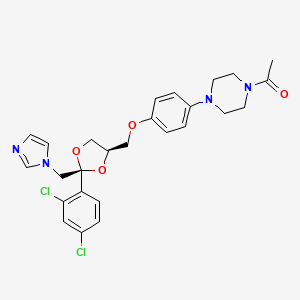
| Formula | C26H28Cl2N4O4 |
|---|---|
| Molecular weight | 531.44 g/mol |
| IUPAC name | 1-[4-[4-[[(2S,4R)-2-(2,4-dichlorophenyl)-2-(imidazol-1-ylmethyl)-1,3-dioxolan-4-yl]methoxy]phenyl]piperazin-1-yl]ethanone |
| CAS | 65277-42-1 |
| PubChem CID | 47576 |
| InChIKey | XMAYWYJOQHXEEK-UHFFFAOYSA-N |
| logP | 4.21 (XLogP 4.3) |
| Polar surface area | 69.06 Ų |
| H-bond acceptors / donors | 7 / 0 |
| Drug-likeness (QED) | 0.46 |
| Lipinski violations | 1 |
SMILES
CC(=O)N1CCN(c2ccc(OCC3COC(Cn4ccnc4)(c4ccc(Cl)cc4Cl)O3)cc2)CC1Biology & Pharmacokinetics
Pharmacokinetics
| BBB penetrant | Yes |
|---|
Enzyme interactions
| Enzyme | Role | Detail |
|---|---|---|
| CYP1A2 | Inhibitor | IC₅₀ 26.000000000000014 µM |
| CYP2B6 | Inhibitor | — |
| CYP2C19 | Inhibitor | IC₅₀ 15.39133149075496 µM |
| CYP2C8 | Inhibitor | IC₅₀ 1.954993606127653 µM |
| CYP2C9 | Inhibitor | IC₅₀ 13.846743783125536 µM |
| CYP2D6 | Inhibitor | IC₅₀ 0.27723176237960506 µM |
| CYP3A4 | Inhibitor | Ki 0.02356904911587423 µM |
| CYP3A4 | Substrate | — |
Receptor binding (top 1)
| Target | Action | Affinity |
|---|---|---|
| CYP17A1 (CYP17A1) | Inhibitor | pKi 7.4 |
Transporters
BCRP (Inhibitor)BCRP (Inhibitor)BSEP (Inhibitor)BSEP (Inhibitor)MATE1 (Inhibitor)MATE2 (Inhibitor)MDR1 (Inhibitor)MRP1 (Inhibitor)MRP2 (Inhibitor)MRP3 (Inhibitor)MRP4 (Inhibitor)NTCP (Inhibitor)OAT (Inhibitor)OAT1 (Inhibitor)OAT3 (Inhibitor)OATP (Inhibitor)OATP1A2 (Inhibitor)OATP1B1 (Inhibitor)OATP1B1 (Inhibitor)OATP1B3 (Inhibitor)OATP1B3 (Inhibitor)OATP2B1 (Inhibitor)OCT1 (Inhibitor)P-gp (Inhibitor)Transporter(unspecified) (Inhibitor)MDR1 (Substrate)OATP1B1 (Substrate)OATP1B3 (Substrate)OCT1 (Substrate)P-gp (Substrate)
Drug–drug interactions (100+, DDInter)
| Interacting drug | Severity | Management |
|---|---|---|
| Abemaciclib | major | |
| Acalabrutinib | major | |
| Alfentanil | major | |
| Alfuzosin | major | |
| Alprazolam | major | |
| Amiodarone | major | |
| Amisulpride | major | |
| Anagrelide | major | |
| Apixaban | major | |
| Arsenic trioxide | major | |
| Artemether | major | |
| Astemizole | major | |
| Atorvastatin | major | |
| Avanafil | major | |
| Avapritinib | major | |
| Axitinib | major | |
| Bedaquiline | major | |
| Benzhydrocodone | major | |
| Bepridil | major | |
| Berotralstat | major | |
| Betrixaban | major | |
| Bosutinib | major | |
| Brexpiprazole | major | |
| Brigatinib | major | |
| Budesonide | major | |
| Butorphanol | major | |
| Cabozantinib | major | |
| Capmatinib | major | |
| Cariprazine | major | |
| Ceritinib | major | |
| Cerivastatin | major | |
| Chloroquine | major | |
| Cilostazol | major | |
| Cisapride | major | |
| Citalopram | major | |
| Clozapine | major | |
| Cobimetinib | major | |
| Colchicine | major | |
| Conivaptan | major | |
| Copanlisib | major |
Showing 40 of 100+.
Registered Products (6)
| Brand | Form / strength | Pack | Agent | Citizen (JOD) |
|---|---|---|---|---|
| Philazole Cream | Cream 2 % | 15 g tube | PHILADELPHIA PHAEMACEUTICALS.COMP/JORDAN | 1.150 |
| Kenazole cream | Cream 2 % | 15 g tube | Pharma International Company/ Jordan | 1.350 |
| Fungipan cream | Cream 2 % | 15 g tube | MIDDLE EAST PHARMA&CHEMICAL IND/JORDAN | 1.550 |
| Nizoral cream | Cream 20 mg | 15 g tube | Telegraph Drug Store | 1.740 |
| Kenazole tab | Tablet 200 mg | 10 tab pack varies | Pharma International Company/ Jordan | 6.000 |
| Kenazole tab | Tablet 200 mg | 500 tab pack varies | Pharma International Company/ Jordan | 202.300 |