Medroxyprogesterone
JFDA label: DEPO PROVERA 150
- Cardiovascular disorders (tablet):
- Breast cancer (tablet):
- Dementia (tablet):
- Long-term use (injection):
- Loss of bone mineral density (injection):
- Patient education (subcutaneous injection):
- Risk vs benefits (tablet):
Mechanism of Action
Agonist of Progesterone receptor — Progesterone receptor agonist
| Target | Action | Gene / class |
|---|---|---|
| Progesterone receptor efficacy | AGONIST | PGR |
Indications
Approved
- Abnormal uterine bleeding (tablet)
- Amenorrhea, secondary (tablet)
- Contraception (104 mg/0.65 mL and 150 mg/mL injection)
- Endometrial carcinoma (400 mg/mL injection) (100 mg tablet [Canadian product])
- Endometrial hyperplasia prevention (tablet)
- Endometriosis (104 mg/0.65 mL injection)
Off-label
- Endometrial hyperplasia (treatment)
- Hot flashes (intramuscular administration)
- Paraphilia/hypersexuality (treatment)
Contraindications
Source: Lexicomp
- Additional contraindications (not in the US labeling): Injection (50 mg/mL, 104 mg per 0.65 mL, 150 mg/mL): History of or current benign or malignant liver tumors Absolute
- DVT or PE (current or history of) Absolute
- Injection (104 mg/0.65 mL): Hypersensitivity to medroxyprogesterone or any component of the formulation Absolute
- MI or coronary artery disease (current or history of) Absolute
- active or history of arterial thromboembolic disease (eg, stroke, MI) Absolute
- active thrombophlebitis Absolute
- any ocular lesion arising from ophthalmic vascular disease, such as partial or complete loss of vision or defect in visual fields Absolute
- breast cancer (known, suspected, or history of) Absolute
- cerebral vascular disease Absolute
- cerebral vascular disease Tablet: Anaphylactic reaction or angioedema to medroxyprogesterone Absolute
- current or history of migraine with focal aura Absolute
- diabetes mellitus with vascular involvement Tablet: Partial or complete loss of vision due to ophthalmic vascular disease Absolute
- diagnostic test for pregnancy Injection (400 mg/mL): Hypersensitivity to medroxyprogesterone or any component of the formulation Absolute
- estrogen- or progesterone-dependent tumor (known or suspected) (excludes 100 mg tablet [Canadian product] indicated for endometrial cancer) Absolute
- heavy smoking (>15 cigarettes per day) and older than 35 years of age Absolute
- hepatic impairment or disease Absolute
- hereditary or acquired predisposition for venous or arterial thrombosis (eg, Factor V leiden and Prothrombin G20210 A mutation, activated protein C (APC) resistance, antithrombin-III-deficiency, protein C deficiency, protein S deficiency, hyperhomocysteinanemia and antiphospholipid-antibodies (anticardiolipin antibodies, lupus anticoagulant) Absolute
- known or suspected progestin-dependent neoplasia Absolute
- pregnancy Injection (150 mg/mL): Hypersensitivity to medroxyprogesterone or any component of the formulation Absolute
- presence of severe or multiple risk factors for arterial or venous thrombosis including the following: severe hypertension (persistent bp ≥160/100 mm Hg) Absolute
- severe dyslipoproteinemia Absolute
- significant hepatic disease Absolute
- thromboembolic disorders (current or history of) Absolute
- thromboembolic disorders (current or history of) or cerebral vascular disease Absolute
- undiagnosed abnormal genital bleeding Absolute
- undiagnosed breast pathology Absolute
- undiagnosed vaginal bleeding Absolute
- urinary tract bleeding Absolute
Adverse Reactions
Cardiac disorders (1)
Common Edema
Nervous system disorders (6)
Very Common Headache · nervousness
Common anxiety, change in menstrual flow (menometrorrhagia; 1% to Gastrointestinal: Abdominal distension (1% to Genitourinary: Abnormal Pap smear (1% to Infection: Influenza (1% to Local: Pain at injection s · Dizziness · Euphoria · malaise
Renal and urinary disorders (2)
Common Breakthrough bleeding · spotting
Metabolism and nutrition disorders (6)
Very Common Amenorrhea · menstrual disease · weight gain
Common Cushing syndrome · hypercalcemia · lipodystrophy
Gastrointestinal disorders (1)
Very Common Abdominal pain
General disorders and administration site conditions (2)
Common Injection site nodule · tenderness at injection site
Dosing
Source: Lexicomp
Warnings & Precautions
Source: Lexicomp
Adrenal suppression
May cause suppression of hypothalamic-pituitary-adrenal (HPA) axis, resulting in decreased plasma cortisol concentrations, decreased cortisol secretion, and low plasma ACTH concentrations. Cushingoid symptoms may occur.
Anaphylaxis/hypersensitivity reactions
Anaphylaxis or anaphylactoid reactions have been reported with use of the injection; medication for the treatment of hypersensitivity reactions should be available for immediate use.
Bone mineral density loss
Prolonged use of medroxyprogesterone contraceptive injection may result in a loss of bone mineral density (BMD). It is not known if use during adolescence or early adulthood will decrease peak bone mass accretion or increase the risk for osteoporotic fractures later in life. Loss is related to the duration of use, may not be completely reversible on discontinuation of the drug, and incidence is not significantly different between the SubQ and IM dosage forms. The impact on peak bone mass in adolescents should be weighed against the potential for unintended pregnancies in treatment decision. Consider alternative contraceptive methods in patients at risk for osteoporosis (eg, metabolic bone disease, chronic alcohol and/or tobacco use, anorexia nervosa, strong family history of osteoporosis, chronic use of medications associated with osteoporosis such as anticonvulsants or corticosteroids). All patients should have adequate calcium and Vitamin D intake. Consider evaluating bone mineral density in patients receiving high doses of medroxyprogesterone for long term endometrial cancer.
Breast cancer
Based on data from the Women's Health Initiative (WHI) studies, an increased risk of invasive breast cancer was observed in postmenopausal women using conjugated estrogens (CE) in combination with medroxyprogesterone acetate (MPA). This risk may be associated with duration of use and declines once combined therapy is discontinued (Chlebowski 2009). The risk of invasive breast cancer was decreased in postmenopausal women with a hysterectomy using CE only, regardless of weight. However, the risk was not significantly decreased in women at high risk for breast cancer (family history of breast cancer, personal history of benign breast disease) (Anderson 2012). Women who used depo-medroxyprogesterone within the previous 5 years and for a duration of 12 months or longer were found to have an increased risk of breast cancer. An increase in abnormal mammogram findings has also been reported with estrogen alone or in combination with progestin therapy. Most products are contraindicated in patients with known or suspected breast cancer. Use of medroxyprogesterone for the treatment of endometrial carcinoma is not recommended in women with known or suspected breast cancer and women with a strong family history of breast cancer should be carefully monitored.
Dementia
Estrogens with or without progestin should not be used to prevent dementia. In the Women's Health Initiative Memory Study (WHIMS), an increased incidence of probable dementia was observed in women ≥65 years of age taking CE in combination with MPA. The risk to younger postmenopausal persons is not known.
Ectopic pregnancy
When used for contraception, the possibility of ectopic pregnancy should be considered in patients with severe abdominal pain.
Endometrial cancer
MPA is used to reduce the risk of endometrial hyperplasia in nonhysterectomized postmenopausal women receiving conjugated estrogens. The use of unopposed estrogen in women with a uterus is associated with an increased risk of endometrial cancer. The addition of a progestin to estrogen therapy may decrease the risk of endometrial hyperplasia, a precursor to endometrial cancer. Adequate diagnostic measures, including endometrial sampling if indicated, should be performed to rule out malignancy in postmenopausal women with undiagnosed abnormal vaginal bleeding. There is no evidence that the use of natural estrogens results in a different endometrial risk profile than synthetic estrogens at equivalent estrogen doses. The risk of endometrial cancer is dose and duration dependent; risk appears to be greatest with use ≥5 years and may persist following discontinuation of therapy.
Hypertriglyceridemia
In women using estrogen plus progesterone therapy, triglycerides may be increased in women with preexisting hypertriglyceridemia; discontinue if pancreatitis occurs.
Ovarian cancer
Postmenopausal estrogen therapy and combined estrogen/progesterone therapy may increase the risk of ovarian cancer; however, the absolute risk to an individual woman is small. Although results from various studies are not consistent, risk does not appear to be significantly associated with the duration, route, or dose of therapy. In one study, the risk decreased after 2 years following discontinuation of therapy (Mørch, 2009). Although the risk of ovarian cancer is rare, women who are at an increased risk (eg, family history) should be counseled about the association (NAMS2012).
Retinal vascular thrombosis
Discontinue pending examination in cases of sudden partial or complete vision loss, sudden onset of proptosis, diplopia, or migraine; discontinue permanently if papilledema or retinal vascular lesions are observed on examination.
Vaginal bleeding
Unscheduled bleeding/spotting may occur. Presentation of irregular, unresolving vaginal bleeding following previously regular cycles warrants further evaluation including endometrial sampling, if indicated, to rule out malignancy.
Weight gain
Contraceptive therapy with medroxyprogesterone commonly results in an average weight gain of ~3.7 kg after 2 years of treatment. Disease-related concerns:
Asthma
Use estrogen plus progestin therapy with caution in patients with asthma; may exacerbate disease.
Cardiovascular disease
Estrogens with progestin should not be used to prevent cardiovascular disease. Using data from the Women’s Health Initiative (WHI) studies, an increased risk of deep vein thrombosis (DVT), pulmonary emboli (PE), and stroke has been reported with CE 0.625 mg with MPA 2.5 mg in postmenopausal women 50 to 79 years. Additional risk factors include diabetes mellitus, hypercholesterolemia, hypertension, SLE, obesity, tobacco use, and/or history of venous thromboembolism (VTE). Risk factors should be managed appropriately; discontinue use if adverse cardiovascular events occur or are suspected. Use is contraindicated in women with active DVT, PE, arterial thromboembolic disease or a history of these conditions. When used for contraception, use caution in patients with risk factors for cardiovascular disease (Curtis 2016b). If thrombosis develops with contraceptive treatment, discontinue treatment (unless no other acceptable contraceptive alternative).
Depression
Use with caution in patients with a history of depression.
Diabetes
Estrogen plus progestin therapy may have adverse effects on glucose tolerance; use caution in women with diabetes mellitus.
Diseases exacerbated by fluid retention
Use with caution in patients with diseases which may be exacerbated by fluid retention, including cardiac or renal dysfunction.
Epilepsy
Use estrogen plus progestin therapy with caution in patients with epilepsy; may exacerbate disease.
Hepatic dysfunction
Estrogens plus progestins are poorly metabolized in patients with hepatic dysfunction. Use caution with a history of cholestatic jaundice associated with prior estrogen use or pregnancy. Discontinue if jaundice develops or if acute or chronic hepatic disturbances occur. Most products are contraindicated with hepatic impairment or disease. Use of medroxyprogesterone for the treatment of endometrial carcinoma is not recommended in women with significant hepatic dysfunction and should be discontinued if liver dysfunction occurs.
Hepatic hemangiomas
Use estrogen plus progestin therapy with caution in patients with hepatic hemangiomas; may exacerbate disease.
Hypoparathyroidism
Use estrogen plus progestin therapy with caution in patients with hypoparathyroidism; estrogen-induced hypocalcemia may occur.
Migraine
Use caution in patients with migraine; may exacerbate disease.
Porphyria
Use estrogen plus progestin therapy with caution in patients with porphyria; may exacerbate disease.
Systemic lupus erythematosus
Use estrogen plus progestin therapy with caution in patients with systemic lupus erythematosus (SLE); may exacerbate disease. Concurrent drug therapy issues:
Drug-drug interactions
Potentially significant interactions may exist, requiring dose or frequency adjustment, additional monitoring, and/or selection of alternative therapy. Consult drug interactions database for more detailed information. Special populations:
Menopause
Use may mask the onset of menopause in women treated for endometrial cancer.
Pediatric
Not for use prior to menarche.
Surgical patients
Whenever possible, progestins in combination with estrogens should be discontinued at least 4 to 6 weeks prior to surgery associated with an increased risk of thromboembolism or during periods of prolonged immobilization. Dosage form specific issues:
Polysorbate 80
Some dosage forms may contain polysorbate 80 (also known as Tweens). Hypersensitivity reactions, usually a delayed reaction, have been reported following exposure to pharmaceutical products containing polysorbate 80 in certain individuals (Isaksson 2002; Lucente 2000; Shelley, 1995). Thrombocytopenia, ascites, pulmonary deterioration, and renal and hepatic failure have been reported in premature neonates after receiving parenteral products containing polysorbate 80 (Alade 1986; CDC 1984). See manufacturer's labeling. Other warnings/precautions:
HIV infection protection
Inform patients that injectable contraceptives do not protect against HIV infection or other sexually transmitted diseases. Women at high risk for HIV infection should be informed that there may be an increased risk of acquiring HIV with use of a progestin-only injection contraceptive. However, available data are inconsistent, and benefits of use may outweigh potential risk; treatment should not be withheld when appropriate. Women should be instructed about HIV prevention measures (Tepper 2017).
Laboratory changes
The use of estrogens and/or progestins may change the results of some laboratory tests (eg, coagulation factors, lipids, glucose tolerance, binding proteins). The dose, route, and the specific estrogen/progestin influences these changes. In addition, personal risk factors (eg, cardiovascular disease, smoking, diabetes, age) also contribute to adverse events; use of specific products may be contraindicated in women with certain risk factors.
Long-term use
Long-term use (ie, >2 years) should be limited to situations where other birth control methods are inadequate. When used for endometrial carcinoma, the effects of long term use on adrenal, hepatic, ovarian, pituitary, and uterine function is not known.
Risks vs benefits
Estrogens with progestin should be used for the shortest duration possible at the lowest effective dose consistent with treatment goals and risks for the individual woman. Patients should be reevaluated as clinically appropriate to determine if treatment is still necessary. Available data related to treatment risks are from Women’s Health Initiative (WHI) studies, which evaluated oral CE 0.625 mg with or without MPA 2.5 mg relative to placebo in postmenopausal women. Other combinations and dosage forms of estrogens and progestins were not studied. Outcomes reported from clinical trials using CE with or without MPA should be assumed to be similar for other doses and other dosage forms of estrogens and progestins until comparable data becomes available. Women who are early in menopause, who are in good cardiovascular health, and who are at low risk for adverse cardiovascular events can be considered candidates for estrogen with or without progestin therapy for the relief of menopausal symptoms (ACOG 565 2013).
Pregnancy & Lactation
Pregnancy
Most products are contraindicated in women who are pregnant, suspected to be pregnant or as a diagnostic test for pregnancy. In general, there is not an increased risk of birth defects following inadvertent use of the injectable medroxyprogesterone acetate (MPA) contraceptives early in pregnancy. Hypospadias has been reported in male babies and clitoral enlargement and labial fusion have been reported in female babies exposed to MPA during the first trimester of pregnancy. High doses impair fertility. Ectopic pregnancies have been reported with use of the MPA contraceptive injection. Median time to conception/return to ovulation following discontinuation of MPA contraceptive injection is 10 months following the last injection and is unrelated to the duration of use.
Lactation
Medroxyprogesterone acetate (MPA) is present in breast milk. Composition, quality, and quantity of breast milk are not affected; adverse developmental and behavioral effects have not been noted following exposure of infant to MPA while breastfeeding. The manufacturer does not recommend the use of MPA tablets in breastfeeding mothers; however, guidelines note that the injectable MPA contraceptives can be initiated immediately postpartum in women who are breastfeeding (Curtis 2016a; Curtis 2016b).
Monitoring
| Clinical pearl | Monitor patient closely for loss of vision; sudden onset of proptosis, diplopia, or migraine; signs and symptoms of thromboembolic disorders; signs or symptoms of depression; glucose in patients with diabetes; or blood pressure. Adequate diagnostic measures, including endometrial sampling, if indicated, should be performed to rule out malignancy in all cases of undiagnosed abnormal vaginal bleeding. Monitor blood pressure at regular intervals with estrogen plus progestin therapy. Contraception: Assessment of pregnancy status (prior to therapy); weight (optional; BMI at baseline may be helpful to monitor changes during therapy); assess potential health status changes at routine visits (Curtis 2016a). BMD with long-term use (per manufacturer). Endometrial cancer: Consider BMD with long term use; breast cancer (in women with a strong family history of breast cancer). Endometrial hyperplasia, treatment (off-label use): Endometrial sampling every 3 to 6 months, although most appropriate frequency has not been determined (ACOG 631 2015; Trimble 2012) Treatment of paraphilia/hypersexuality (Guay 2009; Reilly, 2000): Hepatic function test (baseline and during treatment if suspected hepatotoxicity); CBC (baseline); serum testosterone (baseline then monthly for 4 months then every 6 months); serum LH and prolactin (baseline and every 6 months); FSH (baseline); glucose; bone scan (baseline then annually) if serum testosterone significantly suppressed; gallbladder function; blood |
|---|
Chemistry & Properties
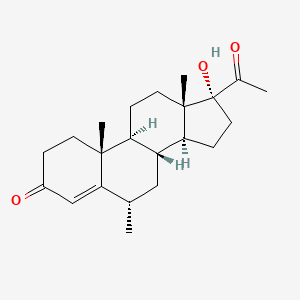
| Formula | C24H34O4 |
|---|---|
| Molecular weight | 386.53 g/mol |
| IUPAC name | (6S,8R,9S,10R,13S,14S,17R)-17-acetyl-17-hydroxy-6,10,13-trimethyl-2,6,7,8,9,11,12,14,15,16-decahydro-1H-cyclopenta[a]phenanthren-3-one |
| CAS | 520-85-4 |
| PubChem CID | 10631 |
| InChIKey | PSGAAPLEWMOORI-PEINSRQWSA-N |
| logP | 4.66 (XLogP 3.5) |
| Polar surface area | 60.44 Ų |
| H-bond acceptors / donors | 4 / 0 |
| Drug-likeness (QED) | 0.65 |
| Lipinski violations | 0 |
SMILES
CC(=O)O[C@]1(C(C)=O)CC[C@H]2[C@@H]3C[C@H](C)C4=CC(=O)CC[C@]4(C)[C@H]3CC[C@@]21CBiology & Pharmacokinetics
Pharmacokinetics
| BBB penetrant | No |
|---|
Enzyme interactions
| Enzyme | Role | Detail |
|---|---|---|
| CYP2B6 | Inhibitor | — |
| CYP2C19 | Inhibitor | — |
| CYP2C8 | Inhibitor | — |
| CYP2C9 | Inhibitor | — |
| CYP3A4 | Inhibitor | — |
| CYP3A4 | Substrate | — |
Receptor binding (top 1)
| Target | Action | Affinity |
|---|---|---|
| Progesterone receptor (PGR) | Agonist | pKi 9.5 |
Transporters
BCRP (Inhibitor)BCRP (Inhibitor)BSEP (Inhibitor)BSEP (Inhibitor)MRP1 (Inhibitor)MRP2 (Inhibitor)MRP3 (Inhibitor)MRP4 (Inhibitor)OATP1B1 (Inhibitor)OATP1B1 (Inhibitor)OATP1B3 (Inhibitor)P-gp (Inhibitor)P-gp (Substrate)
Drug–drug interactions (100+, DDInter)
| Interacting drug | Severity | Management |
|---|---|---|
| Acitretin | major | |
| Amprenavir | major | |
| Bexarotene | major | |
| Boceprevir | major | |
| Bosentan | major | |
| Brigatinib | major | |
| Dabrafenib | major | |
| Encorafenib | major | |
| Fosamprenavir | major | |
| Griseofulvin | major | |
| Lumacaftor | major | |
| Mycophenolate mofetil | major | |
| Mycophenolic acid | major | |
| Pexidartinib | major | |
| Sugammadex | major | |
| Telaprevir | major | |
| Tranexamic acid | major | |
| Abametapir (topical) | moderate | |
| Acarbose | moderate | |
| Acetohexamide | moderate | |
| Adalimumab | moderate | |
| Albiglutide | moderate | |
| Alefacept | moderate | |
| Alogliptin | moderate | |
| Aminoglutethimide | moderate | |
| Amobarbital | moderate | |
| Anakinra | moderate | |
| Apalutamide | moderate | |
| Aprepitant | moderate | |
| Armodafinil | moderate | |
| Artemether | moderate | |
| Asparaginase Erwinia chrysanthemi | moderate | |
| Asparaginase Escherichia coli | moderate | |
| Atazanavir | moderate | |
| Bazedoxifene | moderate | |
| Berotralstat | moderate | |
| Butabarbital | moderate | |
| Butalbital | moderate | |
| Calaspargase pegol | moderate | |
| Canagliflozin | moderate |
Showing 40 of 100+.
Registered Products (7)
| Brand | Form / strength | Pack | Agent | Citizen (JOD) |
|---|---|---|---|---|
| PROVERA TABS | Tablet 5 mg | 24 tab | Khoury Drug Store | 2.420 |
| DEPO PROVERA 150 | Vial 150 mg/ml | 1 ml | Khoury Drug Store | 3.760 |
| Premelle Cycle 5 Tab | Tablet 0.625 mg, 10 mg | 28 tab | Arab Company for Medical & Agricultural Products | 8.410 |
| Premelle 2.5 Tab | Tablet 2.5 mg, 0.625 mg | 28 tab | Arab Company for Medical & Agricultural Products | 8.470 |
| Premelle 5 Tab | Tablet 5 mg, 0.625 mg | 28 tab | Arab Company for Medical & Agricultural Products | 8.470 |
| Premelle Cycle 10Tab | Tablet 0.625 mg, 2.5 mg | 28 tab | Arab Company for Medical & Agricultural Products | 8.470 |
| Sayana Press 104mg/0.65 ml | Tablet 104 mg/0.65 ml | 200 Pre Filled | Khoury Drug Store | — |