Metoprolol
JFDA label: Betaloc Zok 100mg Tablet
- Ischemic heart disease:
Mechanism of Action
Selective inhibitor of beta1-adrenergic receptors; competitively blocks beta1-receptors, with little or no effect on beta2-receptors at oral doses
Indications
Approved
- Acute coronary syndromes (eg, myocardial infarction, non-ST-elevation ACS [NSTE-ACS])
- Angina (oral formulations)
- Chronic kidney disease (CKD) and hypertension
- Coronary artery disease (CAD) and hypertension
- Heart failure
- Heart failure (extended-release oral formulation)
- Hypertension
- Hypertension (oral formulations)
- Myocardial infarction (immediate-release oral formulation; injection)
Off-label
- Atrial ectopy
- Atrial fibrillation (rate control)
- Atrial fibrillation/flutter (prevention)
- Essential tremor
- Hypertrophic obstructive cardiomyopathy (symptomatic treatment)
- Prevention of reinfarction and sudden death after myocardial infarction
- Thyrotoxicosis
- Ventricular arrhythmias
Contraindications
Source: Lexicomp · Curated
- Additional contraindications (not in US labeling): Cor pulmonale Absolute
- Cardiogenic shock Absolute
- Hypersensitivity to metoprolol, any component of the formulation, or other beta-blockers Absolute
- Severe bradycardia or sick sinus syndrome without pacemaker Absolute
- asthma and other obstructive respiratory disease (injection only) Absolute
- concomitant use with anesthesia agents that cause myocardial depression Absolute
- decompensated heart failure Absolute
- overt heart failure Absolute
- second- or third-degree heart block. Note: Additional contraindications are formulation and/or indication specific. Immediate-release tablets/injectable formulation: Hypertension and angina (oral only): Sinus bradycardia Absolute
- severe peripheral arterial circulatory disorders Myocardial infarction (oral and injection): Severe sinus bradycardia (heart rate Extended-release tablet: Severe bradycardia, cardiogenic shock Absolute
- sick sinus syndrome Absolute
- sick sinus syndrome (except in patients with a functioning artificial pacemaker) Absolute
- untreated pheochromocytoma Absolute
Adverse Reactions
Cardiac disorders (11)
Common Bradycardia
Not Known arterial insufficiency · bradycardia · cardiac failure · cerebrovascular accident · claudication · cold extremities · first degree atrioventricular block · Hypotension · palpitations · peripheral edema
Vascular disorders (2)
Common Cold extremities
Uncommon Hypotension
Nervous system disorders (13)
Common Dizziness · Headache
Not Known confusion · depression · disturbed sleep · Dizziness · fatigue · hallucination · headache · insomnia · nightmares · temporary amnesia · vertigo
Metabolism and nutrition disorders (2)
Not Known Decreased libido · unstable diabetes
Gastrointestinal disorders (9)
Common Nausea
Not Known constipation · Diarrhea · flatulence · heartburn · nausea · stomach pain · vomiting · xerostomia
Musculoskeletal and connective tissue disorders (1)
Not Known Musculoskeletal pain
Psychiatric disorders (1)
Uncommon Depression
Eye disorders (2)
Not Known Blurred vision · visual disturbance
Ear and labyrinth disorders (1)
Not Known Tinnitus
Reproductive system and breast disorders (1)
Common Erectile dysfunction
General disorders and administration site conditions (2)
Very Common Fatigue
Not Known Accidental injury
Respiratory, thoracic and mediastinal disorders (5)
Uncommon Bronchospasm (asthmatic patients)
Not Known bronchospasm · Dyspnea · rhinitis · wheezing
Other (4)
Not Known exacerbation of psoriasis · Pruritus · rash · skin photosensitivity
Dosing
Source: Lexicomp
Warnings & Precautions
Source: Lexicomp
Anaphylactic reactions
Use caution with history of severe anaphylaxis to allergens; patients taking beta-blockers may become more sensitive to repeated allergen challenges. Treatment of anaphylaxis (eg, epinephrine) in patients taking beta-blockers may be ineffective or promote undesirable effects.
Atrioventricular (AV) block
Metoprolol commonly produces mild first-degree heart block. Metoprolol may also produce severe first-, second-, or third-degree heart block. Patients with acute myocardial infarction (especially right ventricular myocardial infarction) have a high risk of developing heart block of varying degrees. If severe heart block occurs, metoprolol should be discontinued and measures to increase heart rate should be employed.
Bradycardia
Bradycardia, including sinus pause, heart block, and cardiac arrest, may occur. Patients with first-degree AV block, sinus node dysfunction, or conduction disorders may be at increased risk. Monitor heart rate and rhythm; if severe bradycardia occurs, reduce dose or discontinue therapy.
CNS depression
May cause CNS depression, which may impair physical or mental abilities; patients must be cautioned about performing tasks that require mental alertness (eg, operating machinery, driving).
Hypotension
Symptomatic hypotension may occur with use. Disease-related concerns:
Bronchospastic disease
In general, patients with bronchospastic disease should not receive beta-blockers; however, metoprolol, with B1 selectivity, has been used cautiously with close monitoring.
Conduction abnormality
Consider preexisting conditions such as sick sinus syndrome before initiating.
Diabetes
Use with caution in patients with diabetes mellitus; may potentiate hypoglycemia and/or mask signs and symptoms.
Heart failure
Use with caution in patients with compensated heart failure; monitor for a worsening of heart failure (only the ER formulation is indicated for use in heart failure). May need to increase diuretics and wait until clinically stable to advance dose to target.
Hepatic impairment
Use with caution in patients with hepatic impairment.
Myasthenia gravis
Use beta-blockers with caution in patients with myasthenia gravis.
Peripheral vascular disease (PVD) and Raynaud disease
May precipitate or aggravate symptoms of arterial insufficiency in patients with PVD and Raynaud disease. Use with caution and monitor for progression of arterial obstruction.
Pheochromocytoma (untreated)
Adequate alpha-blockade is required prior to use of any beta-blocker.
Prinzmetal variant angina
Beta-blockers without alpha1-adrenergic receptor blocking activity should be avoided in patients with Prinzmetal variant angina because unopposed alpha1-adrenergic receptors mediate coronary vasoconstriction and can worsen anginal symptoms (Mayer 1998).
Psoriasis
Beta-blocker use has been associated with induction or exacerbation of psoriasis, but cause and effect have not been firmly established.
Psychiatric disease
Use beta-blockers with caution in patients with a history of psychiatric illness; may cause or exacerbate CNS depression.
Thyroid disease
May mask signs of hyperthyroidism (eg, tachycardia). If hyperthyroidism is suspected, carefully manage and monitor; abrupt withdrawal may exacerbate symptoms of hyperthyroidism or precipitate thyroid storm. Alterations in thyroid function tests may be observed. Concurrent drug therapy issues:
Drug-drug interactions
Potentially significant interactions may exist, requiring dose or frequency adjustment, additional monitoring, and/or selection of alternative therapy. Consult drug interactions database for more detailed information. Dosage form specific issues:
Switching dosage forms
The conversion ratio for immediate release (metoprolol tartrate) and extended release (metoprolol succinate) is 1:1, therefore the same total daily dose of metoprolol should be used when switching formulations. However, metoprolol tartrate is typically administered in 2 to 3 divided daily doses and metoprolol succinate is administered once daily. Special populations:
Elderly
Bradycardia may be observed more frequently in elderly patients (>65 years of age); dosage reductions may be necessary. Other warnings/precautions:
Abrupt withdrawal
Beta-blocker therapy should not be withdrawn abruptly (particularly in patients with CAD), but gradually tapered over 1 to 2 weeks to avoid acute tachycardia, hypertension, and/or ischemia. Severe exacerbation of angina, ventricular arrhythmias, and myocardial infarction (MI) have been reported following abrupt withdrawal of beta-blocker therapy. Temporary but prompt resumption of beta-blocker therapy may be indicated with worsening of angina or acute coronary insufficiency.
Major surgery
Chronic beta-blocker therapy should not be routinely withdrawn prior to major surgery.
Pregnancy & Lactation
Pregnancy
Adverse events have been observed in animal reproduction studies. Metoprolol and the metabolite alpha-hydroxymetoprolol cross the placenta and can be detected in cord blood (Lindeberg 1987; Ryu 2016). Adverse events, such as fetal/neonatal bradycardia, hypoglycemia, and reduced birth weight, have been observed following in utero exposure to beta-blockers as a class. Adequate facilities for monitoring infants at birth is generally recommended. The pharmacokinetics of metoprolol may be changed during pregnancy; the degree of changes may be dependent upon maternal CYP2D6 genotype (Ryu 2016). Untreated chronic maternal hypertension and preeclampsia are also associated with adverse events in the fetus, infant, and mother (ACOG 2015; Magee 2014). Recommendations for the treatment of hypertension in pregnancy vary by guideline, but use of metoprolol may be considered (ESC [Regitz-Zagrosek 2011]; Magee 2014). Heart failure, peripartum cardiomyopathy, and valvular heart disease may cause se
Lactation
Metoprolol is present in breast milk. The relative infant dose (RID) of metoprolol is 1.7% to 10% when calculated using the highest breast milk concentration located and compared to an infant therapeutic dose of 1 to 6 mg/kg/day. In general, breastfeeding is considered acceptable when the RID is The RID of metoprolol was calculated using a milk concentration of 690 ng/mL, providing an estimated daily infant dose via breast milk of 0.1 mg/kg/day. This milk concentration was obtained following
Monitoring
| Efficacy | Resting heart rate (target 55–70 bpm in heart failure or angina); blood pressure; symptom control |
|---|---|
| Toxicity | Bradycardia; hypotension; bronchoconstriction in asthmatics; masking of hypoglycaemia |
| Clinical pearl | Do not stop abruptly in patients with ischaemic heart disease — rebound tachycardia and angina can occur. Always taper. |
| Counseling | Report pulse < 50 bpm, dizziness, or shortness of breath. Do not stop suddenly. |
Chemistry & Properties
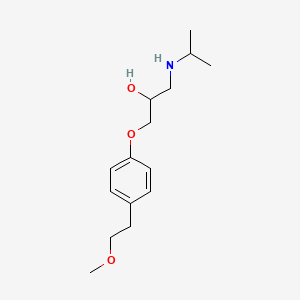
| Formula | C15H25NO3 |
|---|---|
| Molecular weight | 267.37 g/mol |
| IUPAC name | 1-[4-(2-methoxyethyl)phenoxy]-3-(propan-2-ylamino)propan-2-ol |
| CAS | 51384-51-1 |
| PubChem CID | 4171 |
| InChIKey | IUBSYMUCCVWXPE-UHFFFAOYSA-N |
| logP | 1.61 (XLogP 1.9) |
| Polar surface area | 50.72 Ų |
| H-bond acceptors / donors | 4 / 2 |
| Drug-likeness (QED) | 0.71 |
| Lipinski violations | 0 |
SMILES
COCCc1ccc(OCC(O)CNC(C)C)cc1Biology & Pharmacokinetics
Pharmacokinetics
| BBB penetrant | Yes (logBB 1.15) |
|---|
Enzyme interactions
| Enzyme | Role | Detail |
|---|---|---|
| CYP1A2 | Substrate | — |
| CYP2C19 | Substrate | — |
| CYP2D6 | Inhibitor | IC₅₀ 24.000000000000018 µM |
| CYP2D6 | Substrate | — |
| CYP3A4 | Substrate | — |
Transporters
BCRP (Inhibitor)BCRP (Inhibitor)BSEP (Inhibitor)BSEP (Inhibitor)MDR1 (Inhibitor)MRP1 (Inhibitor)MRP2 (Inhibitor)MRP3 (Inhibitor)MRP4 (Inhibitor)NTCP (Inhibitor)OATP1B1 (Inhibitor)OATP1B1 (Inhibitor)OATP1B3 (Inhibitor)OATP1B3 (Inhibitor)OATP2B1 (Inhibitor)OCT1 (Inhibitor)OCT2 (Inhibitor)OCT3 (Inhibitor)OCTN2 (Inhibitor)P-gp (Inhibitor)BCRP (Substrate)MCT1 (Substrate)MDR1 (Substrate)OATP (Substrate)P-gp (Substrate)Transporter(unspecified) (Substrate)
Drug–drug interactions (100+, DDInter)
| Interacting drug | Severity | Management |
|---|---|---|
| Aminophylline | major | |
| Ceritinib | major | |
| Dolasetron | major | |
| Dyphylline | major | |
| Fingolimod | major | |
| Methacholine | major | |
| Oxtriphylline | major | |
| Siponimod | major | |
| Theophylline | major | |
| Abiraterone | moderate | |
| Acetohexamide | moderate | |
| Aldesleukin | moderate | |
| Alectinib | moderate | |
| Alimemazine | moderate | |
| Amifostine | moderate | |
| Atropine | moderate | |
| Betamethasone | moderate | |
| Brigatinib | moderate | |
| Brimonidine (ophthalmic) | moderate | |
| Brimonidine (topical) | moderate | |
| Budesonide | moderate | |
| Bupropion | moderate | |
| Calcium Phosphate | moderate | |
| Calcium acetate | moderate | |
| Calcium carbonate | moderate | |
| Calcium citrate | moderate | |
| Calcium glubionate anhydrous | moderate | |
| Calcium gluconate | moderate | |
| Calcium lactate | moderate | |
| Canagliflozin | moderate | |
| Celecoxib | moderate | |
| Chlorphenesin | moderate | |
| Chlorpropamide | moderate | |
| Cimetidine | moderate | |
| Cinacalcet | moderate | |
| Clidinium | moderate | |
| Cobicistat | moderate | |
| Codeine | moderate | |
| Corticotropin | moderate | |
| Crizotinib | moderate |
Showing 40 of 100+.
Registered Products (8)
| Brand | Form / strength | Pack | Agent | Citizen (JOD) |
|---|---|---|---|---|
| Metomac 100 | Tablet 100 mg | 30 tab | Sun Set Drug Store | 3.910 |
| BETALOC ZOK TAB | Tablet 47.5 mg | 30 tab | Shawi & Rushedat Drug Store | 4.040 |
| Artrol | Tablet 50 mg | 40 tab | Dar Al Dawa Development and Investment Co Ltd/Jordan | 4.310 |
| Betaloc Zok | Tablet 95 mg | 30 tab | Shawi & Rushedat Drug Store | 5.590 |
| Artrol | Tablet 100 mg | 40 tab | Dar Al Dawa Development and Investment Co Ltd/Jordan | 5.960 |
| METOSWISS | Ampoule 1 mg/ml | 5 amp | Argon drug store | — |
| Mitloc 5mg/5ml Solution for IV Injection | Injection 5 mg/5 ml | 5 vial | MS PHARMA/JORDAN | — |
| Toprol | Ampoule 5 mg/5 ml | 5 amp | Hikma Pharmaceuticals Co.Ltd/Jordan | — |