Minocycline
🧬 Cross-allergy: Tetracyclines
JFDA label: Vulga XR 55 mg Tab
Mechanism of Action
Inhibits bacterial protein synthesis by binding with the 30S and possibly the 50S ribosomal subunit(s) of susceptible bacteria; cell wall synthesis is not affected.
Indications
Approved
- Acne
- Actinomycosis
- Acute intestinal amebiasis
- Anthrax
- Asymptomatic carriers of Neisseria meningitidis
- Campylobacter
- Cholera
- Clostridium
- Gram-negative infections
- Listeriosis
- Meningitis
- Ophthalmic infections
- Oral (extended-release)
- Oral (immediate release) and IV
- Relapsing fever
- Respiratory tract infections
- Rickettsial infections
- Sexually transmitted infections
- Skin and skin structure infections
- Urinary tract infections
- Vincent infection
- Yaws
- Zoonotic infections
Off-label
- Cellulitis (purulent) due to community-acquired MRSA
- Leprosy
- Nocardiosis
- Prosthetic Joint Infection
- Rheumatoid arthritis
Antimicrobial Spectrum
Expected / intrinsic spectrum (EUCAST breakpoints & labels) — not local resistance. Source: EUCAST v16 · openfda-label.
Bacteria
| Organism | Activity | MIC |
|---|---|---|
| Bacillus anthracis | Active | — |
| Borrelia recurrentis | Active | — |
| Campylobacter fetus | Active | — |
| Chlamydia trachomatis | Active | — |
| Enterobacter aerogenes | Active | — |
| Enterococcus faecalis | Active | — |
| Escherichia coli | Active | — |
| Fusobacterium fusiforme | Active | — |
| Fusobacterium nucleatum | Active | — |
| Haemophilus ducreyi | Active | — |
| Haemophilus influenzae | Susceptible | 11.0 mg/L |
| Klebsiella granulomatis | Active | — |
| Listeria monocytogenes | Active | — |
| Moraxella catarrhalis | Susceptible | 11.0 mg/L |
| Mycobacterium marinum | Active | — |
| Mycoplasma pneumoniae | Active | — |
| Neisseria gonorrhoeae | Active | — |
| Neisseria meningitidis | Susceptible | 11.0 mg/L |
| Staphylococcus aureus | Active | — |
| Staphylococcus spp. | Susceptible | 0.51 mg/L |
| Streptococcus A/B/C/G | Susceptible | 0.51 mg/L |
| Streptococcus pneumoniae | Susceptible | 0.51 mg/L |
| Treponema pallidum | Active | — |
| Vibrio cholerae | Active | — |
| Yersinia pestis | Active | — |
Class profile
| gramStatus | Both |
|---|---|
| spectrumBreadth | Broad |
| atypicalCoverage | Yes |
| isBactericidal | 0 |
| moaCategory | Protein synthesis inhibitor (30S ribosomal) |
| pdIndex | Time-dependent |
| postAntibioticEffect | Short |
| mrsaCoverage | 0 |
| resistanceMechanisms | Efflux pumps,Ribosomal protection proteins |
Contraindications
Source: Lexicomp
- Additional contraindications (not in the US labeling): Severe liver disease Absolute
- Hypersensitivity to minocycline, other tetracyclines, or any component of the formulation Absolute
- complete renal failure Absolute
- myasthenia gravis Absolute
- use in children Absolute
Adverse Reactions
Nervous system disorders (4)
Common Dizziness · drowsiness · fatigue · malaise
Skin and subcutaneous tissue disorders (2)
Common Pruritus · urticaria
Musculoskeletal and connective tissue disorders (1)
Common Arthralgia
Ear and labyrinth disorders (1)
Common Tinnitus
Dosing
Source: Lexicomp
Warnings & Precautions
Source: Lexicomp
Autoimmune syndromes
Lupus-like, hepatitis, and vasculitis autoimmune syndromes (including serum sickness [eg fever, arthralgia, and malaise]) have been reported; discontinue if symptoms occur and assess liver function tests, ANA, and CBC.
Benign intracranial hypertension (eg, pseudotumor cerebri [PTC])
Benign intracranial hypertension (headache, blurred vision, diplopia, vision loss, and/or papilledema) has been associated with use. Women of childbearing age who are overweight or have a history of intracranial hypertension are at greater risk. Concomitant use of isotretinoin (known to cause PTC) and minocycline should be avoided. Intracranial hypertension typically resolves after discontinuation of treatment; however, permanent visual loss is possible. If visual symptoms develop during treatment, prompt ophthalmologic evaluation is warranted. Intracranial pressure can remain elevated for weeks after drug discontinuation; monitor patients until they stabilize.
CNS effects
Lightheadedness, dizziness, and vertigo may occur; patients must be cautioned about performing tasks which require mental alertness (eg, operating machinery or driving). Symptoms usually disappear with continued therapy and when the drug is discontinued.
Hepatotoxicity
Serious liver injury, including irreversible drug induced hepatitis and fulminant hepatic failure (sometimes fatal) have been reported with use for acne treatment.
Hyperpigmentation
Hyperpigmentation may occur in nails, bone, skin (including scar and injury sites), eyes, sclerae, thyroid, oral cavity, visceral tissue, and heart valves; skin and oral hyperpigmentation are independent of dose or administration duration.
Hypersensitivity
Anaphylaxis has been reported; discontinue drug immediately and institute supportive measures.
Increased BUN
May be associated with increases in BUN secondary to antianabolic effects; use caution in patients with renal impairment as this may lead to azotemia, hyperphosphatemia, acidosis, and possibly to drug accumulation and potential hepatotoxicity.
Photosensitivity
May cause photosensitivity; discontinue if skin erythema occurs. Use skin protection and avoid prolonged exposure to sunlight; avoid use of use tanning equipment or UVA/B treatment.
Skin rash
Rash, erythema multiforme, Stevens Johnson syndrome or eosinophilia, fever, and organ failure (Drug Rash with Eosinophilia and Systemic Symptoms [DRESS] syndrome), may occur; onset of symptoms may be delayed up to several weeks; fatal in up to 10% of cases; discontinue treatment immediately if DRESS syndrome is suspected.
Superinfection
Prolonged use may result in fungal or bacterial superinfection, including C. difficile-associated diarrhea (CDAD) and pseudomembranous colitis; CDAD has been observed >2 months postantibiotic treatment. Disease-related concerns:
Hepatic impairment
Hepatotoxicity has been reported; use with caution in patients with hepatic impairment or in conjunction with other hepatotoxic drugs.
Renal impairment
Use with caution in patients with renal impairment (CrCl Concurrent drug therapy issues:
Drug-drug interactions
Potentially significant interactions may exist, requiring dose or frequency adjustment, additional monitoring, and/or selection of alternative therapy. Consult drug interactions database for more detailed information. Special populations:
Pediatric
May cause tissue hyperpigmentation, tooth enamel hypoplasia, or permanent tooth discoloration; more common with long-term use, but observed with repeated, short courses; use of tetracyclines should be avoided during tooth development (infancy and children ≤8 years of age) unless other drugs are not likely to be effective or are contraindicated.
Pregnancy
Do not use during pregnancy. In addition to affecting tooth development, tetracycline use has been associated with retardation of skeletal development and reduced bone growth. Dosage form specific issues:
Magnesium content
Parenteral (IV) formulation contains magnesium; monitor serum magnesium in patients with renal impairment and signs of magnesium intoxication (eg, flushing, sweating, hypotension, depressed reflexes, flaccid paralysis, hypothermia, circulatory collapse, cardiac and CNS depression leading to respiratory paralysis). Also use with caution and closely monitor patients with heart block or myocardial damage. Other warnings/precautions:
Appropriate use
Acne: The American Academy of Dermatology acne guidelines recommends minocycline be used as adjunctive treatment for moderate and severe acne and forms of inflammatory acne that are resistant to topical treatments. Concomitant topical therapy with benzoyl peroxide or a retinoid is recommended should be administered with systemic antibiotic therapy (eg, minocycline) and continued for maintenance after the antibiotic course is completed (AAD [Zaenglein 2016]).
Pregnancy & Lactation
Pregnancy
Minocycline crosses the placenta. Tetracycline-class antibiotics may cause fetal harm following maternal use in pregnancy. Rare spontaneous reports of congenital anomalies, including limb reduction, have been reported following maternal minocycline use. Due to limited information, a causal association cannot be established. Tetracyclines accumulate in developing teeth and long tubular bones (Mylonas 2011). Permanent discoloration of teeth (yellow, gray, brown) can occur following in utero exposure and is more likely to occur following long-term or repeated exposure. As a class, tetracyclines are generally considered second-line antibiotics in pregnant women and their use should be avoided (Mylonas 2011). Minocycline is not recommended for the treatment of Rocky Mountain Spotted Fever (Biggs 2016), Q fever (Anderson 2013), or anthrax infection (Meaney-Delman 2014) in pregnant women. When systemic antibiotics are needed for dermatologic conditions in pregnant women, other agents are pr
Lactation
Minocycline is present in breast milk (Brogden 1975). According to the manufacturer, the decision to continue or discontinue breastfeeding during therapy should take into account the risk of exposure to the infant and the benefits of treatment to the mother. Oral absorption is not affected by dairy products; therefore, oral absorption of minocycline by the breastfed infant would not be expected to be diminished by the calcium in the maternal milk. There have been case reports of black discolor
LactMed: monitor the infant.
Monitoring
| Efficacy | Culture and susceptibility testing; clinical resolution (temperature, WBC, CRP, procalcitonin) |
|---|---|
| Toxicity | Renal function (dose adjustment in renal impairment); hepatic function for hepatically cleared agents; signs of C. difficile infection (diarrhoea) |
| Clinical pearl | Culture results guide de-escalation to narrower-spectrum therapy. Review antibiotic appropriateness at 48–72 h (antimicrobial stewardship). |
| Counseling | Complete the full course. Report persistent diarrhoea, rash, or lack of improvement after 48–72 h. |
Chemistry & Properties
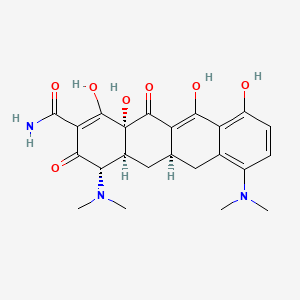
| Formula | C23H27N3O7 |
|---|---|
| Molecular weight | 457.48 g/mol |
| IUPAC name | (4S,4aS,5aR,12aR)-4,7-bis(dimethylamino)-1,10,11,12a-tetrahydroxy-3,12-dioxo-4a,5,5a,6-tetrahydro-4H-tetracene-2-carboxamide |
| CAS | 10118-90-8 |
| PubChem CID | 54675783 |
| InChIKey | DYKFCLLONBREIL-KVUCHLLUSA-N |
| logP | 0.19 (XLogP -0.6) |
| Polar surface area | 164.63 Ų |
| H-bond acceptors / donors | 9 / 5 |
| Drug-likeness (QED) | 0.40 |
| Lipinski violations | 0 |
SMILES
CN(C)c1ccc(O)c2c1C[C@H]1C[C@H]3[C@H](N(C)C)C(O)=C(C(N)=O)C(=O)[C@@]3(O)C(O)=C1C2=OBiology & Pharmacokinetics
Pharmacokinetics
| BBB penetrant | Yes (logBB -0.52) |
|---|
Transporters
BCRP (Inhibitor)BSEP (Inhibitor)BSEP (Inhibitor)MRP1 (Inhibitor)MRP2 (Inhibitor)MRP3 (Inhibitor)MRP4 (Inhibitor)OAT1 (Inhibitor)OAT2 (Inhibitor)OAT3 (Inhibitor)OAT4 (Inhibitor)OATP1B1 (Inhibitor)OATP1B1 (Inhibitor)OATP1B3 (Inhibitor)OATP1B3 (Inhibitor)P-gp (Inhibitor)P-gp (Substrate)
Drug–drug interactions (100+, DDInter)
| Interacting drug | Severity | Management |
|---|---|---|
| Acitretin | major | |
| Aminolevulinic acid | major | |
| Isotretinoin | major | |
| Leflunomide | major | |
| Lomitapide | major | |
| Methoxyflurane | major | |
| Mipomersen | major | |
| Pexidartinib | major | |
| Teriflunomide | major | |
| Tretinoin | major | |
| Typhoid vaccine (live) | major | |
| Vibrio cholerae CVD 103-HgR strain live antigen (live) | major | |
| Vitamin A | major | |
| Activated charcoal | moderate | |
| Aluminum hydroxide | moderate | |
| Aminolevulinic acid (topical) | moderate | |
| Aminophylline | moderate | |
| Amoxicillin | moderate | |
| Ampicillin | moderate | |
| Anisindione | moderate | |
| Asparaginase Erwinia chrysanthemi | moderate | |
| Asparaginase Escherichia coli | moderate | |
| Atracurium | moderate | |
| Attapulgite | moderate | |
| Bacampicillin | moderate | |
| Balsalazide | moderate | |
| Bedaquiline | moderate | |
| Benzylpenicillin | moderate | |
| Benzylpenicillin (potassium) | moderate | |
| Benzylpenicillin (sodium) | moderate | |
| Bifidobacterium longum infantis | moderate | |
| Bismuth subcitrate potassium | moderate | |
| Bismuth subgallate | moderate | |
| Bismuth subsalicylate | moderate | |
| Brentuximab vedotin | moderate | |
| Calaspargase pegol | moderate | |
| Calcium Phosphate | moderate | |
| Calcium acetate | moderate | |
| Calcium carbonate | moderate | |
| Calcium chloride | moderate |
Showing 40 of 100+.
Registered Products (5)
| Brand | Form / strength | Pack | Agent | Citizen (JOD) |
|---|---|---|---|---|
| Vulga XR | Tablet as hydrochloride Dihydrate 55 mg | 30 tab | Hikma Pharmaceuticals Co.Ltd/Jordan | 11.090 |
| Vulga XR | Tablet as hydrochloride Dihydrate 80 mg | 30 tab | Hikma Pharmaceuticals Co.Ltd/Jordan | 11.090 |
| Vulga XR | Tablet 65 mg | 30 tab | Hikma Pharmaceuticals Co.Ltd/Jordan | 11.090 |
| Vulga XR 105 Tab | Tablet as hydrochloride Dihydrate 105 mg | 30 tab | Hikma Pharmaceuticals Co.Ltd/Jordan | 11.090 |
| Vulga | Vial 100 mg | 1 vial | HIKMA PHARMACEUTICALS FREE ZONE/JORDAN | — |