Oxybutynin
JFDA label: DITROPAN 5mg Tab
Mechanism of Action
Antagonist of Muscarinic acetylcholine receptor M3 — Muscarinic acetylcholine receptor M3 antagonist; Antagonist of Muscarinic acetylcholine receptor M2 — Muscarinic acetylcholine receptor M2 antagonist
| Target | Action | Gene / class |
|---|---|---|
| Muscarinic acetylcholine receptor M2 efficacy | ANTAGONIST | CHRM2 |
| Muscarinic acetylcholine receptor M3 efficacy | ANTAGONIST | CHRM3 |
Indications
Approved
- Overactive bladder
Contraindications
Source: Lexicomp
- Additional contraindications (not in US labeling): Severe GI conditions Absolute
- Hypersensitivity to oxybutynin or any component of the formulation Absolute
- myasthenia gravis Absolute
- patients with or at risk for uncontrolled narrow-angle glaucoma, urinary retention, gastric retention or conditions with severely decreased GI motility. OTC labeling: When used for self-medication, do not use if you have pain or burning when urinating, blood in urine, unexplained lower back or side pain, cloudy or foul-smelling urine Absolute
Adverse Reactions
Cardiac disorders (1)
Common Decreased blood pressure, nervousness, insomnia, confusion, pruritus
Nervous system disorders (4)
Very Common Dizziness · drowsiness
Common fatigue · headache
Renal and urinary disorders (2)
Common Dysuria · Urinary tract infection
Metabolism and nutrition disorders (1)
Common Fluid retention, dyspepsia, coated tongue, urinary tract infection, urinary retention, cystitis, eye irritation, asthma (1% to
Gastrointestinal disorders (5)
Very Common constipation · nausea · Xerostomia
Common diarrhea · viral gastroenteritis
Skin and subcutaneous tissue disorders (2)
Common Macular eruption · Pruritus
Eye disorders (1)
Common Visual disturbance
General disorders and administration site conditions (6)
Common application site dermatitis · Application site erythema · application site pruritus · application site rash · Application site reaction · application site vesicles
Respiratory, thoracic and mediastinal disorders (2)
Common nasopharyngitis · Upper respiratory tract infection
Other (1)
Very Common Local: Application site pruritus
Dosing
Source: Lexicomp
Warnings & Precautions
Source: Lexicomp
Angioedema/hypersensitivity reactions
May cause hypersensitivity, including anaphylaxis and angioedema. Cases of angioedema involving the face, lips, tongue, and/or larynx have been reported with oral oxybutynin; some cases have occurred after a single dose. Discontinue immediately if tongue, hypopharynx, or larynx is involved; promptly initiate appropriate management.
CNS effects
Anticholinergics may cause agitation, confusion, drowsiness, dizziness, hallucinations, headache, somnolence, and/or blurred vision, which may impair physical or mental abilities; patients must be cautioned about performing tasks which require mental alertness (eg, operating machinery or driving). Dose reduction or discontinuation should be considered if CNS effects occur.
Heat prostration
May increase the risk of heat prostration. Disease-related concerns:
Bladder flow obstruction
Use with caution in patients with bladder flow obstruction; may increase the risk of urinary retention.
Cardiovascular disease
Use with caution in patients with CAD, heart failure, hypertension, and/or cardiac arrhythmias; may exacerbate condition.
Dementia
Use with caution in patients with dementia treated with cholinesterase inhibitors; may aggravate symptoms of disease.
GI disorders
Use with caution in patients with decreased GI motility or GI obstructive disorders; may increase the risk of gastric retention. Use with caution in patients with ulcerative colitis, intestinal atony, pyloric stenosis, gastroesophageal reflux, or with medications that may cause or exacerbate esophagitis (eg, bisphosphonates). In patients with ulcerative colitis, use may decrease gastric motility to the point of increasing the risk of paralytic ileus or toxic megacolon.
Glaucoma
Use with caution in patients with treated angle-closure glaucoma; may exacerbate condition; use is contraindicated with uncontrolled narrow-angle glaucoma.
Hepatic impairment
Use with caution in patients with hepatic impairment (limited experience).
Hiatal hernia
Use with caution in patients with hiatal hernia.
Hyperthyroidism
Use with caution in patients with hyperthyroidism; may exacerbate condition.
Myasthenia gravis
Avoid use in patients with myasthenia gravis; may exacerbate condition. Discontinue therapy if signs/symptoms occur.
Neuropathy
Use with caution in patients with autonomic neuropathy; may aggravate symptoms of decreased GI motility.
Parkinson disease
Use with caution in patients with Parkinson disease; may aggravate symptoms of disease.
Prostatic hyperplasia/urinary stricture
Use with caution in patients with prostatic hyperplasia and/or urinary stricture; may cause urinary retention.
Renal impairment
Use with caution in patients with renal impairment (limited experience). Concurrent drug therapy issues:
Drug-drug interactions
Potentially significant interactions may exist, requiring dose or frequency adjustment, additional monitoring, and/or selection of alternative therapy. Consult drug interactions database for more detailed information. Dosage form specific issues:
Extended release formulation
The extended release formulation consists of drug within a nondeformable matrix; following drug release/absorption, the matrix/shell is expelled in the stool. The use of nondeformable products in patients with known stricture/narrowing of the GI tract has been associated with symptoms of obstruction (rare).
Topical gel
To minimize transferring medication to others, cover treatment area with clothing after gel has dried. Discontinue use if skin irritation occurs. Contains ethanol; do not expose to open flame or smoking until gel has dried.
Transdermal patch
May contain conducting metal (eg, aluminum); remove patch prior to MRI. Other warnings/precautions:
OTC labeling
Other causes of frequent urination (UTI, diabetes, early pregnancy, other serious conditions) may need to be considered prior to use. Patients should contact a health care provider if symptoms do not improve within 2 weeks of initial use or for new or worsening symptoms.
Pregnancy & Lactation
Pregnancy
Adverse events were not observed in animal reproduction studies.
Lactation
It is not known if oxybutynin is present in breast milk. According to the manufacturer, the decision to breastfeed during therapy should consider the risk of infant exposure, the benefits of breastfeeding to the infant, and benefits of treatment to the mother. Suppression of lactation has been reported.
Monitoring
| Clinical pearl | Incontinence episodes, postvoid residual (PVR), anticholinergic reactions. |
|---|
Chemistry & Properties
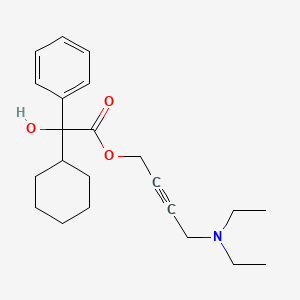
| Formula | C22H31NO3 |
|---|---|
| Molecular weight | 357.49 g/mol |
| IUPAC name | 4-(diethylamino)but-2-ynyl 2-cyclohexyl-2-hydroxy-2-phenylacetate |
| CAS | 5633-20-5 |
| PubChem CID | 4634 |
| InChIKey | XIQVNETUBQGFHX-UHFFFAOYSA-N |
| logP | 3.34 (XLogP 4.2) |
| Polar surface area | 49.77 Ų |
| H-bond acceptors / donors | 4 / 1 |
| Drug-likeness (QED) | 0.60 |
| Lipinski violations | 0 |
SMILES
CCN(CC)CC#CCOC(=O)C(O)(c1ccccc1)C1CCCCC1Biology & Pharmacokinetics
Pharmacokinetics
| BBB penetrant | No |
|---|
Enzyme interactions
| Enzyme | Role | Detail |
|---|---|---|
| CYP1A2 | Inhibitor | — |
| CYP1A2 | Substrate | — |
| CYP2C19 | Inhibitor | IC₅₀ 2.8982753492378888 µM |
| CYP2C8 | Inhibitor | — |
| CYP2C9 | Inhibitor | — |
| CYP2D6 | Inhibitor | — |
| CYP3A4 | Inhibitor | — |
| CYP3A4 | Substrate | — |
Receptor binding (top 4)
| Target | Action | Affinity |
|---|---|---|
| M3 receptor (CHRM3) | Antagonist | pKi 8.8 |
| M1 receptor (CHRM1) | Antagonist | pKi 8.6 |
| M2 receptor (CHRM2) | Antagonist | pKi 7.9 |
| M5 receptor (CHRM5) | Antagonist | pKi 7.9 |
Transporters
BCRP (Inhibitor)BSEP (Inhibitor)BSEP (Inhibitor)MRP1 (Inhibitor)MRP2 (Inhibitor)MRP4 (Inhibitor)OATP1B1 (Inhibitor)OATP1B3 (Inhibitor)OCT1 (Inhibitor)OCT2 (Inhibitor)OCT3 (Inhibitor)P-gp (Inhibitor)OCT1 (Substrate)P-gp (Substrate)
Drug–drug interactions (78, DDInter)
| Interacting drug | Severity | Management |
|---|---|---|
| Potassium chloride | major | |
| Potassium citrate | major | |
| Aclidinium | moderate | |
| Acrivastine | moderate | |
| Alimemazine | moderate | |
| Apalutamide | moderate | |
| Aprepitant | moderate | |
| Atropine | moderate | |
| Azatadine | moderate | |
| Bexarotene | moderate | |
| Brigatinib | moderate | |
| Brompheniramine | moderate | |
| Carbinoxamine | moderate | |
| Chlorcyclizine | moderate | |
| Chlorpheniramine | moderate | |
| Clemastine | moderate | |
| Clidinium | moderate | |
| Codeine | moderate | |
| Cyclizine | moderate | |
| Cyproheptadine | moderate | |
| Dabrafenib | moderate | |
| Dasatinib | moderate | |
| Deferasirox | moderate | |
| Dexbrompheniramine | moderate | |
| Dicyclomine | moderate | |
| Diphenhydramine | moderate | |
| Doxepin | moderate | |
| Doxepin (topical) | moderate | |
| Doxylamine | moderate | |
| Edrophonium | moderate | |
| Eluxadoline | moderate | |
| Enzalutamide | moderate | |
| Ethanol | moderate | |
| Fedratinib | moderate | |
| Fostamatinib | moderate | |
| Glycopyrronium | moderate | |
| Glycopyrronium (topical) | moderate | |
| Hydrocodone | moderate | |
| Hyoscyamine | moderate | |
| Idelalisib | moderate |
Showing 40 of 78.
Registered Products (5)
| Brand | Form / strength | Pack | Agent | Citizen (JOD) |
|---|---|---|---|---|
| Dreptageed | Suspension 5 mg/5 ml | 100 ml | Al-Gadeed Pharmaceutical Industries/JORDAN | 1.250 |
| Nobutin ER 5 | Tablet Oxybutynin Hcl 5 mg | 30 tab | Reda Jardaneh Drug Store | 1.520 |
| Nobutin ER 10 | Tablet Oxybutynin Hcl 10 mg | 30 tab | Reda Jardaneh Drug Store | 2.490 |
| DITROPAN | Tablet 5 mg | 60 tab | Ulfa Pharma Co. | 2.900 |
| Nobutin ER 15 | Tablet Oxybutynin Hcl 15 mg | 30 tab | Reda Jardaneh Drug Store | 3.470 |