Paricalcitol
JFDA label: Zemplar
Mechanism of Action
Agonist of Vitamin D3 receptor — Vitamin D receptor agonist
| Target | Action | Gene / class |
|---|---|---|
| Vitamin D3 receptor efficacy | AGONIST | VDR |
Indications
Approved
- IV
- Oral
Contraindications
Source: Lexicomp
- Hypersensitivity to paricalcitol or any component of the formulation Absolute
- hypercalcemia Documentation of allergenic cross-reactivity for vitamin D analogues is limited. However, because of similarities in chemical structure and/or pharmacologic actions, the possibility of cross-sensitivity cannot be ruled out with certainty Absolute
- vitamin D toxicity Absolute
Adverse Reactions
Cardiac disorders (8)
Common atrial flutter, chills, insomnia, vertigo, headache, anxiety, depression, fatigue, malaise, abnormal gait, dermal ulcer, ecchymoses, acne vulgaris, dehydration, hypoglycemia, hirsutism, gastrointestin · chest pain · edema · Hypertension · hypotension · palpitations · peripheral edema · syncope
Gastrointestinal disorders (2)
Very Common diarrhea · Nausea
Infections and infestations (3)
Very Common Infection
Common Influenza · sepsis
General disorders and administration site conditions (1)
Common Pain at injection site, arthritis, weakness, back pain, leg cramps, muscle spasm, joint stiffness, asthma, pneumonia, oropharyngeal pain, bronchitis, cough, sinusitis, dyspnea, laboratory test abnorma
Respiratory, thoracic and mediastinal disorders (1)
Very Common Rhinitis
Dosing
Source: Lexicomp
Warnings & Precautions
Source: Lexicomp
Excessive vitamin D
Excessive vitamin D administration may lead to over suppression of PTH, progressive or acute hypercalcemia, hypercalciuria, hyperphosphatemia and adynamic bone disease.
Hypercalcemia
Progressive and/or acute hypercalcemia may increase risk of cardiac arrhythmias and seizures; chronic hypercalcemia may lead to generalized vascular and other soft-tissue calcification. Phosphate and vitamin D (and its derivatives) should be withheld during therapy to avoid hypercalcemia. Risk of hypercalcemia may be increased by concomitant use of calcium-containing supplements and/or medications that increase serum calcium (eg, thiazide diuretics). Concurrent drug therapy issues:
Drug-drug interactions
Potentially significant interactions may exist, requiring dose or frequency adjustment, additional monitoring, and/or selection of alternative therapy. Consult drug interactions database for more detailed information
Pregnancy & Lactation
Pregnancy
Adverse events have been observed in some animal reproduction studies.
Lactation
It is not known if paricalcitol is excreted in breast milk. Due to the potential for serious adverse reactions in the nursing infant, breast-feeding is not recommended by the manufacturer.
Monitoring
| Clinical pearl | Signs and symptoms of vitamin D intoxication and hypercalcemia . Serum calcium and phosphorus: IV: Twice weekly during initial phase, then at least monthly once dose established Oral: Baseline, at least every 2 weeks for initial 3 months or following dose adjustment, then monthly for 3 months, then every 3 months Serum or plasma intact PTH (iPTH): IV: Every 2 to 4 weeks, then every 3 months once dose established Oral: : Baseline, at least every 2 weeks for 3 months or following dose adjustment, then monthly for 3 months, then every 3 months |
|---|
Chemistry & Properties
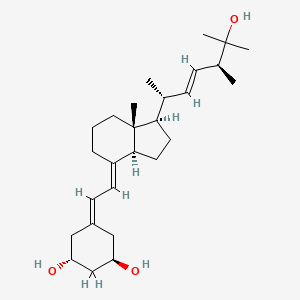
| Formula | C27H44O3 |
|---|---|
| Molecular weight | 416.65 g/mol |
| IUPAC name | trans-(1R,3R)-5-[(2E)-2-[(1R,3aS,7aR)-1-[(E,2R,5S)-6-hydroxy-5,6-dimethylhept-3-en-2-yl]-7a-methyl-2,3,3a,5,6,7-hexahydro-1H-inden-4-ylidene]ethylidene]cyclohexane-1,3-diol |
| CAS | 131918-61-1 |
| PubChem CID | 5281104 |
| InChIKey | BPKAHTKRCLCHEA-UBFJEZKGSA-N |
| logP | 5.56 (XLogP 5.0) |
| Polar surface area | 60.69 Ų |
| H-bond acceptors / donors | 3 / 3 |
| Drug-likeness (QED) | 0.51 |
| Lipinski violations | 1 |
SMILES
C[C@H](/C=C/[C@H](C)C(C)(C)O)[C@H]1CC[C@H]2/C(=C/C=C3C[C@@H](O)C[C@H](O)C3)CCC[C@]12CBiology & Pharmacokinetics
Pharmacokinetics predicted
| Bioavailability | 70.0% |
|---|---|
| Half-life | 1.431 h |
| Volume of distribution | 0.505 L/kg |
| Protein binding | 98.7% |
| BBB penetrant | No |
Enzyme interactions
| Enzyme | Role | Detail |
|---|---|---|
| CYP2B6 | Inhibitor | — |
| CYP2C8 | Inhibitor | — |
Transporters
BCRP (Inhibitor)BSEP (Inhibitor)MRP1 (Inhibitor)OATP1B1 (Inhibitor)OATP1B3 (Inhibitor)P-gp (Inhibitor)P-gp (Substrate)
Drug–drug interactions (100+, DDInter)
| Interacting drug | Severity | Management |
|---|---|---|
| Aluminum hydroxide | major | |
| Burosumab | major | |
| Calcifediol | major | |
| Calcitriol | major | |
| Cholecalciferol | major | |
| Dihydrotachysterol | major | |
| Doxercalciferol | major | |
| Erdafitinib | major | |
| Ergocalciferol | major | |
| Sucralfate | major | |
| Abametapir (topical) | moderate | |
| Amobarbital | moderate | |
| Amprenavir | moderate | |
| Apalutamide | moderate | |
| Atazanavir | moderate | |
| Bendroflumethiazide | moderate | |
| Benzthiazide | moderate | |
| Berotralstat | moderate | |
| Butabarbital | moderate | |
| Butalbital | moderate | |
| Calcipotriol (topical) | moderate | |
| Calcitriol (topical) | moderate | |
| Carbamazepine | moderate | |
| Ceritinib | moderate | |
| Chlorothiazide | moderate | |
| Chlorthalidone | moderate | |
| Cholestyramine | moderate | |
| Clarithromycin | moderate | |
| Cobicistat | moderate | |
| Colesevelam | moderate | |
| Colestipol | moderate | |
| Dabrafenib | moderate | |
| Delavirdine | moderate | |
| Digitoxin | moderate | |
| Digoxin | moderate | |
| Duvelisib | moderate | |
| Echinacea | moderate | |
| Enzalutamide | moderate | |
| Erythromycin | moderate | |
| Fedratinib | moderate |
Showing 40 of 100+.
Registered Products (1)
| Brand | Form / strength | Pack | Agent | Citizen (JOD) |
|---|---|---|---|---|
| Zemplar | Ampoule 5 mcg/ml | 5 amp | Abu Sheikha Drug Store | — |