Regorafenib
JFDA label: Stivarga
- Hepatotoxicity:
Mechanism of Action
Inhibitor of Tyrosine-protein kinase ABL1 — Tyrosine-protein kinase ABL inhibitor; Inhibitor of RAF proto-oncogene serine/threonine-protein kinase — Serine/threonine-protein kinase RAF inhibitor; Inhibitor of Mast/stem cell growth factor receptor Kit — Stem cell growth factor receptor inhibitor; Inhibitor of Fibroblast growth factor receptor 1 — Fibroblast growth factor receptor 1 inhibitor; Inhibitor of Mitogen-activated protein kinase 11 — MAP kinase p38 beta inhibitor; Inhibitor of Fibroblast growth factor receptor 2 — Fibroblast growth factor receptor 2 inhibitor; Inhibitor of Tyrosine-protein kinase FRK — Tyrosine-protein kinase FRK inhibitor; Inhibitor of Discoidin domain-containing receptor 2 — Discoidin domain-containing receptor 2 inhibitor; Inhibitor of Serine/threonine-protein kinase B-raf — Serine/threonine-protein kinase B-raf inhibitor; Inhibitor of Angiopoietin-1 receptor — Tyrosine-protein kinase TIE-2 inhibitor; Inhibitor of Platelet-derived growth factor receptor — Platelet-derived growth factor receptor inhibitor; Inhibitor of Vascular endothelial growth factor receptor — Vascular endothelial growth factor receptor inhibitor; Inhibitor of Proto-oncogene tyrosine-protein kinase receptor Ret — Tyrosine-protein kinase receptor RET inhibitor; Inhibitor of Ephrin type-A receptor 2 — Ephrin type-A receptor 2 inhibitor; Inhibitor of High affinity nerve growth factor receptor — Nerve growth factor receptor Trk-A inhibitor
| Target | Action | Gene / class |
|---|---|---|
| Angiopoietin-1 receptor efficacy | INHIBITOR | TEK |
| Discoidin domain-containing receptor 2 efficacy | INHIBITOR | DDR2 |
| Ephrin type-A receptor 2 efficacy | INHIBITOR | EPHA2 |
| Fibroblast growth factor receptor 1 efficacy | INHIBITOR | FGFR1 |
| Fibroblast growth factor receptor 2 efficacy | INHIBITOR | FGFR2 |
| High affinity nerve growth factor receptor efficacy | INHIBITOR | NTRK1 |
| Mast/stem cell growth factor receptor Kit efficacy | INHIBITOR | KIT |
| Mitogen-activated protein kinase 11 efficacy | INHIBITOR | MAPK11 |
| Platelet-derived growth factor receptor efficacy | INHIBITOR | |
| Proto-oncogene tyrosine-protein kinase receptor Ret efficacy | INHIBITOR | RET |
| RAF proto-oncogene serine/threonine-protein kinase efficacy | INHIBITOR | RAF1 |
| Serine/threonine-protein kinase B-raf efficacy | INHIBITOR | BRAF |
Indications
Approved
- Colorectal cancer, metastatic
- Gastrointestinal stromal tumors
- Hepatocellular carcinoma
Contraindications
Source: Lexicomp
- Hypersensitivity to regorafenib, any component of the formulation, or sorafenib Absolute
- There are no contraindications listed in the manufacturer's US labeling Absolute
Adverse Reactions
Cardiac disorders (3)
Very Common Hypertension
Common Ischemic heart disease · myocardial infarction
Nervous system disorders (4)
Very Common Fatigue · headache · pain · voice disorder
Hepatobiliary disorders (1)
Common Hepatic failure
Renal and urinary disorders (2)
Very Common Proteinuria
Common Urinary tract infection
Blood and lymphatic system disorders (3)
Very Common Anemia · lymphocytopenia · thrombocytopenia, hyperbilirubinemia, increased serum ALT
Metabolism and nutrition disorders (7)
Very Common hypocalcemia · hypokalemia · hyponatremia · Hypophosphatemia · hypothyroidism · increased amylase · weight loss
Gastrointestinal disorders (9)
Very Common decreased appetite · diarrhea · Gastrointestinal pain · increased serum lipase · mucositis · nausea · vomiting
Common Mucocutaneous candidiasis · pancreatitis
Skin and subcutaneous tissue disorders (4)
Very Common alopecia · Palmar-plantar erythrodysesthesia · skin rash
Common Exfoliative dermatitis
Musculoskeletal and connective tissue disorders (4)
Very Common stiffness · Weakness
Common Muscle spasm · tremor
Infections and infestations (2)
Very Common Infection
Common Candidiasis
General disorders and administration site conditions (1)
Very Common Fever
Respiratory, thoracic and mediastinal disorders (2)
Common Nasopharyngitis · pneumonia
Dosing
Source: Lexicomp
Warnings & Precautions
Source: Lexicomp
Cardiovascular events
Myocardial ischemia and infarction were observed at a higher incidence than placebo in a clinical trial. Interrupt therapy in patients who develop new or acute onset ischemia or infarction; resume only if the benefit of therapy outweighs the cardiovascular risk.
Dermatologic toxicity
Skin reactions occurred commonly, including hand-foot skin reaction (HFSR), also known as palmar-plantar erythrodysesthesia syndrome (PPES), and severe rash requiring dose reduction. Grade 3 or 4 HFSR was observed more frequently in regorafenib-treated patients (compared to placebo), and although rare, erythema multiforme and Stevens Johnson syndrome were also observed more frequently in regorafenib-treated patients. Toxic epidermal necrolysis has also been reported (rare). Onset of HFSR typically occurs in the first cycle of treatment. Therapy interruptions, dosage reductions, and/or discontinuation may be necessary depending on the severity and persistence. Supportive treatment may be of benefit for symptomatic relief. Pooled data from several clinical trials showed a higher incidence of HFSR in Asian patients compared to Caucasians. In addition to recommended dosage modifications, the following treatments may be used for management of HFSR (McLellan 2015): A manicure/pedicure to remove hyperkeratotic areas/calluses which may predispose to HFSR and mechanical support/correction for abnormal weight bearing prior to treatment are recommended. During treatment, patients should use alcohol-free moisturizers liberally, reduce exposure to hot water (may exacerbate hand-foot symptoms), avoid constrictive footwear and excessive skin friction, and avoid vigorous exercise/activities that may stress hands or feet. Patients should wear thick cotton gloves/socks and wear shoes with padd
Gastrointestinal perforation
Gastrointestinal perforation or fistula has occurred in a small number of patients treated with regorafenib; some cases were fatal. Monitor for signs/symptoms of perforation (fever, abdominal pain with constipation, and/or nausea/vomiting); permanently discontinue if perforation or fistula develop.
Hemorrhage
The incidence of hemorrhage was increased with regorafenib. Hemorrhage of the respiratory, gastrointestinal, or genitourinary tracts was observed in trials; some cases were fatal. Permanently discontinue in patients who experience severe or life-threatening bleeding. In patients receiving concomitant warfarin, monitor INR frequently.
Hepatotoxicity
Severe and sometimes fatal hepatotoxicity has been observed in clinical trials. Monitor hepatic function at baseline and during treatment. Interrupt therapy for hepatotoxicity; dose reductions or discontinuation are necessary depending on the severity and persistence. Hepatic dysfunction, characterized by a hepatocellular injury pattern, typically occurred with the first 2 months of treatment in clinical trials. Closely monitor in patients with mild or moderate impairment for adverse events; use is not recommended in severe impairment. A higher incidence of hepatotoxicity has been observed in Asian patients (particularly Japanese), compared to Caucasians (Li 2015).
Hypersensitivity
Hypersensitivity reactions have been observed with regorafenib.
Hypertension
Elevated blood pressure was observed in clinical trials (onset typically in the first cycle of therapy); ensure blood pressure is adequately controlled prior to initiation. Monitor blood pressure weekly for the first 6 weeks and monthly thereafter or as clinically indicated; if hypertension develops, interrupt therapy or permanently discontinue for severe or uncontrolled hypertension. Hypertensive crisis has occurred in some patients. Patients 65 years and older had an increased incidence of grade 3 or higher hypertension (compared to younger patients).
Infection
An increased rate of infection (including fatal events) was observed in regorafenib-treated patients in clinical trials. The most commonly reported infections were urinary tract infections, nasopharyngitis, mucocutaneous and systemic fungal infections, and pneumonia. Respiratory infections were the most commonly reported fatal infections. Interrupt therapy for grade 3 or 4 infections (or worsening infection of any grade).
Reversible posterior leukoencephalopathy syndrome (RPLS)
RPLS occurred very rarely in regorafenib-treated patients; evaluate promptly if symptoms (eg, seizures, severe headache, visual disturbances, confusion or altered mental function) occur. Discontinue if diagnosis is confirmed.
Wound healing impairment
Regorafenib inhibits vascular endothelial growth factor, which may lead to impaired wound healing. Discontinue regorafenib at least 2 weeks prior to scheduled surgery; resume regorafenib postsurgery based on clinical judgment of wound healing; discontinue if wound dehiscence occurs. Concurrent drug therapy issues:
Drug-drug/drug-food interactions
Potentially significant interactions may exist, requiring dose or frequency adjustment, additional monitoring, and/or selection of alternative therapy. Consult drug interactions database for more detailed information. Special populations:
Asian patients
A higher incidence of hepatotoxicity and hand-foot skin reactions were observed in Asian patients, particularly in Japanese patients, compared to non-Asian patients (Li 2015).
Colorectal cancer
Consider a reduced initial dose in patients with metastatic colorectal cancer. In a dose escalation study comparing an initial dose of 80 mg/day (escalated gradually to 160 mg/day on days 1 to 21 every 28 days) to the standard dose (160 mg/day on days 1 to 21 every 28 days), more patients receiving the lower initial dose were able to initiate a third treatment cycle. The lower initial dose demonstrated a favorable toxicity profile as well as improved median overall survival compared to the standard dose (Bekaii-Saab 2018).
Pregnancy & Lactation
Pregnancy
In animal reproduction studies, teratogenic effects were observed with doses less than the equivalent human dose. Based on animal reproduction studies and on the mechanism of action, regorafenib may cause fetal harm if administered during pregnancy. Patients (male and female) should use effective contraception during therapy and for at least 2 months following treatment.
Lactation
It is not known if regorafenib is present in breast milk. Due to the potential for serious adverse reactions in the breastfed infant, breastfeeding is not recommended by the manufacturer during treatment and for 2 weeks after the last dose.
Monitoring
| Clinical pearl | Obtain liver function tests at baseline, every 2 weeks during the first 2 months of treatment, then monthly or more frequently if clinically necessary (weekly until improvement if liver function tests are elevated). CBC with differential and platelets and serum electrolytes (baseline and periodic). Monitor INR more frequently if receiving warfarin. Monitor blood pressure weekly for the first 6 weeks of therapy and with every subsequent cycle, or more frequently if indicated. Monitor for hand-foot skin reaction (HFSR)/palmar-plantar erythrodysesthesia syndrome (PPES); it is recommended to monitor for signs of HFSR during the first weeks of treatment, then every 1 to 2 weeks for 2 cycles, then every 4 to 6 weeks thereafter (McLellan 2015). Monitor for signs/symptoms of cardiac ischemia or infarction, bleeding, GI perforation or fistula, infection, and reversible posterior leukoencephalopathy syndrome (severe headaches, seizure, confusion, or change in vision). Monitor for impaired wound healing. Monitor adherence. |
|---|
Chemistry & Properties
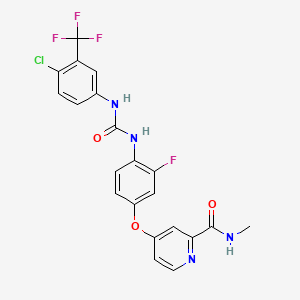
| Formula | C21H15ClF4N4O3 |
|---|---|
| Molecular weight | 482.82 g/mol |
| IUPAC name | 4-[4-[[4-chloro-3-(trifluoromethyl)phenyl]carbamoylamino]-3-fluorophenoxy]-N-methylpyridine-2-carboxamide |
| CAS | 755037-03-7 |
| PubChem CID | 11167602 |
| InChIKey | FNHKPVJBJVTLMP-UHFFFAOYSA-N |
| logP | 5.69 (XLogP 4.2) |
| Polar surface area | 92.35 Ų |
| H-bond acceptors / donors | 4 / 3 |
| Drug-likeness (QED) | 0.41 |
| Lipinski violations | 1 |
SMILES
CNC(=O)c1cc(Oc2ccc(NC(=O)Nc3ccc(Cl)c(C(F)(F)F)c3)c(F)c2)ccn1Biology & Pharmacokinetics
Pharmacokinetics
| BBB penetrant | No |
|---|
Enzyme interactions
| Enzyme | Role | Detail |
|---|---|---|
| CYP1A2 | Inhibitor | — |
| CYP1A2 | Substrate | — |
| CYP2B6 | Inhibitor | — |
| CYP2C19 | Inhibitor | — |
| CYP2C8 | Inhibitor | — |
| CYP2C9 | Inhibitor | — |
| CYP3A4 | Substrate | — |
Receptor binding (top 2)
| Target | Action | Affinity |
|---|---|---|
| kinase insert domain receptor (KDR) | Inhibitor | pIC50 7.9 |
| B-Raf proto-oncogene, serine/threonine kinase (BRAF) | Inhibitor | pIC50 7.6 |
Transporters
BCRP (Inhibitor)BCRP (Inhibitor)BSEP (Inhibitor)BSEP (Inhibitor)MDR1 (Inhibitor)MRP1 (Inhibitor)OATP1B1 (Inhibitor)OATP1B3 (Inhibitor)OATP2B1 (Inhibitor)P-gp (Inhibitor)BCRP (Substrate)MDR1 (Substrate)MRP2 (Substrate)OATP1B3 (Substrate)P-gp (Substrate)Transporter(unspecified) (Substrate)
Drug–drug interactions (100+, DDInter)
| Interacting drug | Severity | Management |
|---|---|---|
| Abciximab | major | |
| Acalabrutinib | major | |
| Acetylsalicylic acid | major | |
| Alteplase | major | |
| Anagrelide | major | |
| Anisindione | major | |
| Anistreplase | major | |
| Antithrombin III human | major | |
| Apixaban | major | |
| Ardeparin | major | |
| Argatroban | major | |
| Avapritinib | major | |
| Berotralstat | major | |
| Betrixaban | major | |
| Binimetinib | major | |
| Bivalirudin | major | |
| Bromfenac | major | |
| Cabozantinib | major | |
| Cangrelor | major | |
| Caplacizumab | major | |
| Cilostazol | major | |
| Clopidogrel | major | |
| Dalteparin | major | |
| Danaparoid | major | |
| Dasatinib | major | |
| Deferasirox | major | |
| Defibrotide | major | |
| Desirudin | major | |
| Diclofenac | major | |
| Dicoumarol | major | |
| Diflunisal | major | |
| Dipyridamole | major | |
| Drotrecogin alfa | major | |
| Edoxaban | major | |
| Encorafenib | major | |
| Enoxaparin | major | |
| Epoprostenol | major | |
| Eptifibatide | major | |
| Etodolac | major | |
| Fedratinib | major |
Showing 40 of 100+.
Registered Products (2)
| Brand | Form / strength | Pack | Agent | Citizen (JOD) |
|---|---|---|---|---|
| Stivarga | Tablet 40 mg | 28 tab pack varies | Khoury Drug Store | — |
| Stivarga | Tablet 40 mg | 28 tab pack varies | Khoury Drug Store | — |